
IRS office audit: what happens at the in-person exam
Short answer
An IRS office audit is an in-person interview at a local IRS office where an examiner reviews the specific items listed in your appointment letter. You can attend alone, bring a witness, or send an enrolled agent, CPA or attorney with Form 2848 in your place. Bring organized copies of the records the letter requests, and nothing beyond them.
- 01How you are notified
- By mail only; the IRS does not start audits by phone
- 02Where it happens
- An IRS office near your residence
- 03Representation form
- Form 2848, Power of Attorney and Declaration of Representative
- 04Recording the meeting
- Written request at least 10 calendar days before the interview
- 05Possible results
- No change, agreed or unagreed
- 06Years usually examined
- Returns filed within the last 3 years
What is an IRS office audit?
An IRS office audit is an examination held face to face at an IRS office, as opposed to a mail audit or a field audit at your home or business. The IRS lists three audit formats on its IRS audits page: by mail, at an IRS office, and in the field. The office examination sits in the middle: more personal than a letter, less intrusive than a visit to your premises.
Treasury regulations say the IRS picks office or field format based on how complex the return is and which format examines it most efficiently. For individuals and sole proprietors, the office used is generally the IRS office closest to where you live (26 CFR 301.7605-1).
Being selected does not mean the IRS has found an error. Publication 3498, The Examination Process, says an examination may end with no change at all or even a refund. The appointment letter names the tax year and the exact items under review, which is often a handful of deductions, business expenses or income sources rather than the whole return. For an overview of every audit type, see the IRS audit guide.
How the IRS schedules an in-person audit
The IRS sends an appointment letter by mail, and it never opens an audit with a phone call. If someone calls claiming to schedule your audit and you have no letter, treat it as a likely scam. Our guide to IRS audit letters shows how to confirm a letter is real.
Can I reschedule an office audit?
Yes. Call the examiner named on the letter as soon as you know the date will not work. The IRS audit page says to ask the assigned auditor for more time and, if needed, to contact that auditor's manager. Publication 3498 adds that when the time or place is inconvenient, the examiner will try to arrange something more suitable.
Ask early and confirm the new date in writing. Repeated postponements without a reason can push the case toward a report based only on what the IRS already has, and an examiner may ask you to extend the assessment deadline if time is running short.
What to bring to an IRS audit at the office
Bring exactly the records the appointment letter requests, organized by the items it lists, plus copies you can hand over. The IRS gives a written request for the specific documents it wants to see, so the letter is your checklist. Bringing unrelated papers can widen the conversation without helping you.
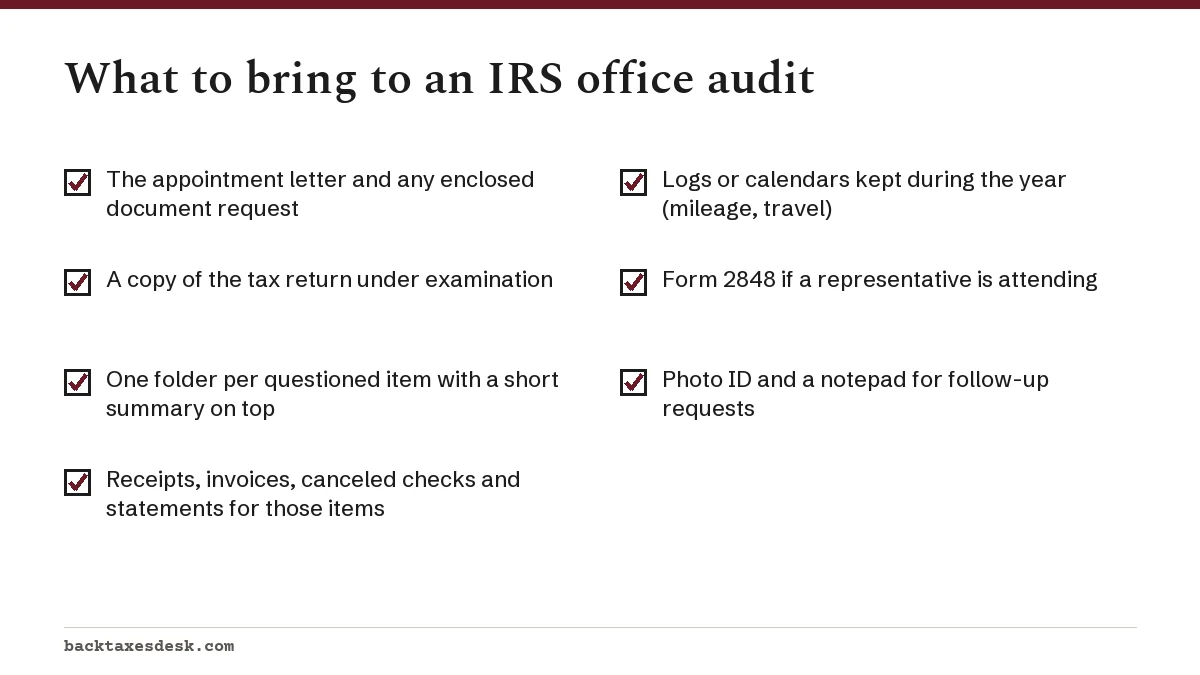
A practical way to organize: one folder per questioned item, each with a one-page summary on top. For example, if the letter questions $8,400 of vehicle expenses, the summary shows the mileage log total, the business-use percentage and the math, followed by the log itself and repair receipts. The examiner can then test your summary instead of rebuilding it.
| Item questioned | Records that usually support it |
|---|---|
| Charitable contributions | Bank records, written acknowledgments from charities, appraisals for property |
| Business or rental expenses | Receipts, invoices, canceled checks, bank and card statements |
| Vehicle use | Mileage log kept during the year, repair and fuel receipts |
| Unreported or disputed income | Forms W-2 and 1099, bank deposit records, explanations of transfers or loans |
| Dependents and credits | School, medical or lease records showing where the child lived |
Can someone go to the office audit for me?
Yes. Publication 3498 says a representative can handle an in-person examination with or without you present. The representative is usually an attorney, CPA, enrolled agent, enrolled actuary, or the preparer who signed the return if they meet the rules for unenrolled preparers. You authorize them on Form 2848, and spouses on a joint return file separate Forms 2848 even when they use the same person.
Your other options: go alone, go with a representative, or bring someone as a witness or for support. If you go alone and decide mid-interview that you want professional help, the IRS will suspend and reschedule the interview, unless you are there under an administrative summons. Form 8821 only lets someone receive your information; it does not let them speak for you.
Enrolled agents, CPAs and attorneys all have unlimited rights to represent you before the IRS. Our comparison of enrolled agents and CPAs covers which fits an audit, and a Low Income Taxpayer Clinic may represent you for free or a small fee if your income qualifies.
What happens during the office examination meeting
The examiner starts by confirming you received Publication 1, Your Rights as a Taxpayer, and by explaining the process, according to the IRS audit manual (IRM 4.10.3). Then the examiner goes item by item through the letter, asks how you figured each amount and reviews your records.
- Answer the question asked, briefly, and say so if you do not know.
- If a record is missing, offer to send it by a set date rather than guessing.
- Ask what the examiner still needs before you leave, and get it in writing if possible.
- You may audio record the interview with your own equipment if you make a written request at least 10 calendar days before the meeting (IRM 4.10.3.4.7.1).
Office audits of simple issues can finish in one meeting, but many need a follow-up document request. The IRS says audit length depends on the issues, how quickly records arrive and whether you agree with the findings. See how long an IRS audit takes for typical stages.
After the meeting: the three possible results
Every office examination ends as no change, agreed or unagreed. A no-change letter means the IRS accepted your return as filed; keep it with your tax records for that year.
If you agree with proposed changes, you sign the agreement form and pay. Publication 3498 says that if the total due is under $100,000 and you pay within 21 calendar days of the bill, no further interest or penalties are added; at $100,000 or more the window is 10 business days. Example: an agreed $4,800 increase paid in full within 21 days of the bill stops growing at that point, while an unpaid balance keeps accruing interest at the quarterly rate, 7% a year for October to December 2026.
If you disagree, you can ask for a meeting with the examiner's manager, then receive a 30-day letter explaining your right to go to the IRS Independent Office of Appeals. If you cannot pay the agreed amount at once, pay what you can and set up an IRS payment plan for the rest.
Common questions
Is an office audit worse than a mail audit?
Not necessarily. An office audit usually means the items need a conversation or more documents than a letter can handle, but it can still end with no change. It is generally narrower than a field audit because it covers only the items in the appointment letter.
Do I have to go to an IRS office audit in person?
No. An authorized representative with a signed Form 2848 can attend without you. The IRS can require your personal attendance only in limited cases, such as an administrative summons.
How long does an IRS office audit meeting last?
The IRS does not publish a set length. A meeting on one or two items can be short, while a return with several business issues can take a full session plus follow-up requests.
What should I not say during an IRS office audit?
Avoid guessing, volunteering unrelated information or offering estimates you cannot support. If you are unsure of an answer, say you will check and follow up in writing by an agreed date.
Can I bring my tax preparer to an office audit?
Yes, as a witness or support at minimum. To speak for you, the preparer must be an attorney, CPA or enrolled agent, or an unenrolled preparer who signed that return and meets the IRS rules, and must be named on Form 2848.
Sources
- IRS audits irs.gov
- Publication 3498, The Examination Process irs.gov
- About Form 2848, Power of Attorney and Declaration of Representative irs.gov
- IRM 4.10.3, Examination Techniques irs.gov
- 26 CFR 301.7605-1, Time and place of examination law.cornell.edu
- Quarterly interest rates irs.gov
We check figures against these official pages. Rules change; confirm anything that affects a deadline or payment with the agency before you act.
Tell us what happened
Describe your situation and our editors will use it to improve this guide. If you leave your email, we may reply with a pointer to the right page or official contact. We never share your details.
Related guides
 IRS Audit Guide: Types, Letters, Timelines and Appeals
An IRS audit is a review of a filed tax return to check that income, deductions and credits were reported correctly, and the IRS…
IRS Field Audit: What Happens When the Auditor Comes to You
An IRS field audit is an in-person examination held where your books and records are kept, usually your place of business, someti…
IRS Audit Letter: What a Real One Looks Like and Says
A real IRS audit letter comes by US mail, shows a letter number such as Letter 566 or Letter 2205 in a corner, names the tax year…
Enrolled Agent vs CPA: Who Should Handle Your IRS Problem
In the enrolled agent vs CPA choice, both credentials carry unlimited rights to represent you before the IRS in audits, collectio…
IRS Appeals Process: How to Dispute an IRS Decision
The IRS appeals process lets you ask the IRS Independent Office of Appeals, which is separate from the office that audited or bil…