
Topic
Unfiled tax returns: how to catch up with the IRS
To catch up on unfiled tax returns, file the last six years the IRS normally enforces, using IRS wage and income transcripts to fill record gaps, and set up a payment plan for any balance. Waiting costs money: the failure-to-file penalty is 5% a month up to 25%, refunds expire after three years, and a year with no return can be assessed at any time.
7 guides in this topic Updated September 18, 2026
- Can You Go to Jail for Not Filing Taxes? The Real RiskYes, you can go to jail for not filing taxes, but only if the failure is willful: you knew you had to file and chose not to. Willful failure to file…
- Filing Old Tax Returns: Deadlines, Refunds and Right FormsFiling old tax returns is allowed for any year, but refunds are only paid if you file within three years of the original due date. In the 2027 season…
- How to File Unfiled Tax Returns: Step-by-Step GuideTo file unfiled tax returns, confirm which years are missing, download your IRS wage and income transcripts, prepare each year on that year's own For…
- IRS Substitute for Return (SFR): What It Is and What to DoA substitute for return is the IRS's own calculation of your tax for a year you did not file, built from W-2, 1099 and other reports. It may not give…
- Unfiled Tax Returns Statute of Limitations: How Far BackThere is no statute of limitations on unfiled tax returns for assessing tax: under IRC 6501(c)(3) the IRS can assess a year with no return at any tim…
- Unfiled Tax Returns for a Deceased Person: What to DoUnfiled tax returns for a deceased person are filed by the personal representative: the executor, the court-appointed administrator, or whoever is in…
- What Happens If You Don't File Taxes? IRS ConsequencesWhat happens if you don't file taxes depends on whether you owe. If you owe, the IRS adds 5% of the unpaid tax each month up to 25%, with a $525 mini…
Why unfiled tax returns cost more over time
Unfiled tax returns are years in which you had to file a federal return and did not. The cost of waiting comes from three places: penalties that build month by month, refunds that expire, and an IRS that can eventually file a return for you using only the income it knows about.
If you owe tax for a missing year, the failure-to-file penalty is 5% of the unpaid tax for each month or part of a month the return is late, capped at 25%. A separate failure-to-pay penalty of 0.5% a month keeps running after that cap is reached, and interest compounds daily on top of both. The individual underpayment rate is 7% for July through December 2026, according to the IRS quarterly interest rate page.
If the IRS owes you money instead, there is no penalty, but the clock is still running. A refund for a missing year is generally forfeited if you do not file within three years of the original due date. The IRS also holds refunds on current returns when its records show a past-due return, so one missing year can freeze money from a year you did file. The hold lasts until the missing return or an acceptable reason for not filing arrives.
How the IRS handles unfiled tax returns
The IRS matches W-2s, 1099s and other information returns against filed returns. When a year is missing, it starts with a CP59, follows with reminders such as CP515, CP516 and CP518, then may prepare a substitute for return, send a CP3219N 90-day letter and move to collection. Our page on what happens if you don't file taxes walks through that sequence in order.
Read the video transcript
Catching up on unfiled returns
The IRS normally enforces the last six years of unfiled returns, under its own policy statement.
Use IRS wage and income transcripts to rebuild records you no longer have.
The failure-to-file penalty is 5% of unpaid tax per month, capped at 25%.
For returns more than 60 days late, the minimum penalty is $525 or the full tax, whichever is less.
Refunds have a deadline too. You have three years from the original due date to claim one.
File each year on that year's own Form 1040. Only the current and two prior years can be e-filed.
How many years of unfiled returns do I need to file?
For most people, the practical answer is the most recent six years. IRS Policy Statement 5-133, summarized in IRM 4.12.1, says the enforcement period for delinquent returns is normally not more than six years. Going further back needs management approval, and managers weigh factors such as your history of noncompliance, income from illegal sources and how much tax is involved compared with the effort.
That policy is not the same as a legal deadline. When no return exists, the law lets the IRS assess the tax at any time, so older years never age out on their own. Our unfiled tax returns statute of limitations page explains the three separate clocks and when each one starts.
| Tax year | Original due date | Among the last six years? |
|---|---|---|
| 2026 | April 15, 2027 | Yes, once the due date passes |
| 2025 | April 15, 2026 | Yes |
| 2024 | April 15, 2025 | Yes |
| 2023 | April 15, 2024 | Yes |
| 2022 | April 18, 2023 | Yes |
| 2021 | April 18, 2022 | Yes |
| 2020 and earlier | Various | Only if the IRS asks for them |
Getting the records you are missing
Missing paperwork is the most common reason people stall. You do not need every original W-2 to start. The IRS keeps a wage and income transcript for the current and nine prior tax years, showing data from Forms W-2, 1099, 1098 and 5498 that employers, banks and brokers reported.
The fastest way to get it is your IRS online account through Get Transcript. Without online access, mail Form 4506-T and check the box on line 8 to request a wage and income transcript. The online transcript is limited to about 85 income documents; if a year has more, it will not generate online and Form 4506-T is the route.
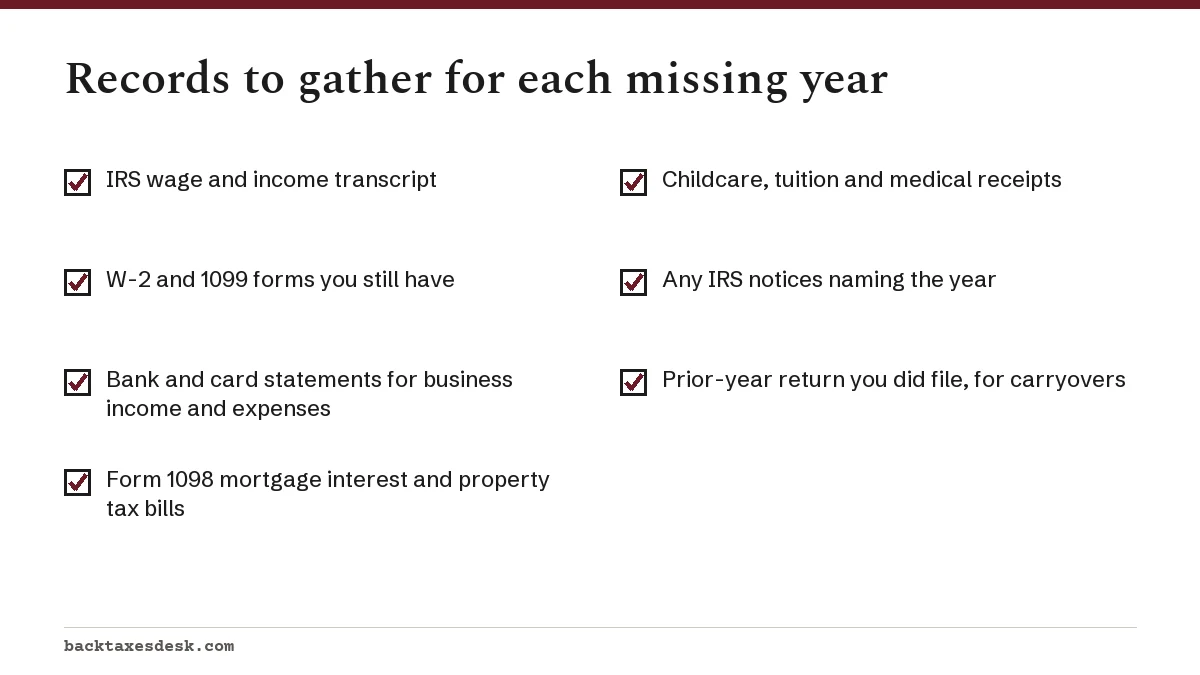
Transcripts only show what third parties reported. Self-employment income paid in cash, business expenses, dependents and deductions will not appear, so rebuild those from bank statements, invoices, receipts and old calendars. The IRS gives no credit for expenses it does not know about, which is exactly why a return you prepare is usually better than one it prepares for you.
How to resolve unfiled taxes: filing, paying and setting up a plan
Past-due returns go to the same place and use the same method as on-time returns, with one exception: if you received a notice, mail the return to the address on that notice. The IRS says an accurate past-due return takes about six weeks to process. Use each year's own Form 1040 and instructions, available from the IRS prior-year forms library.
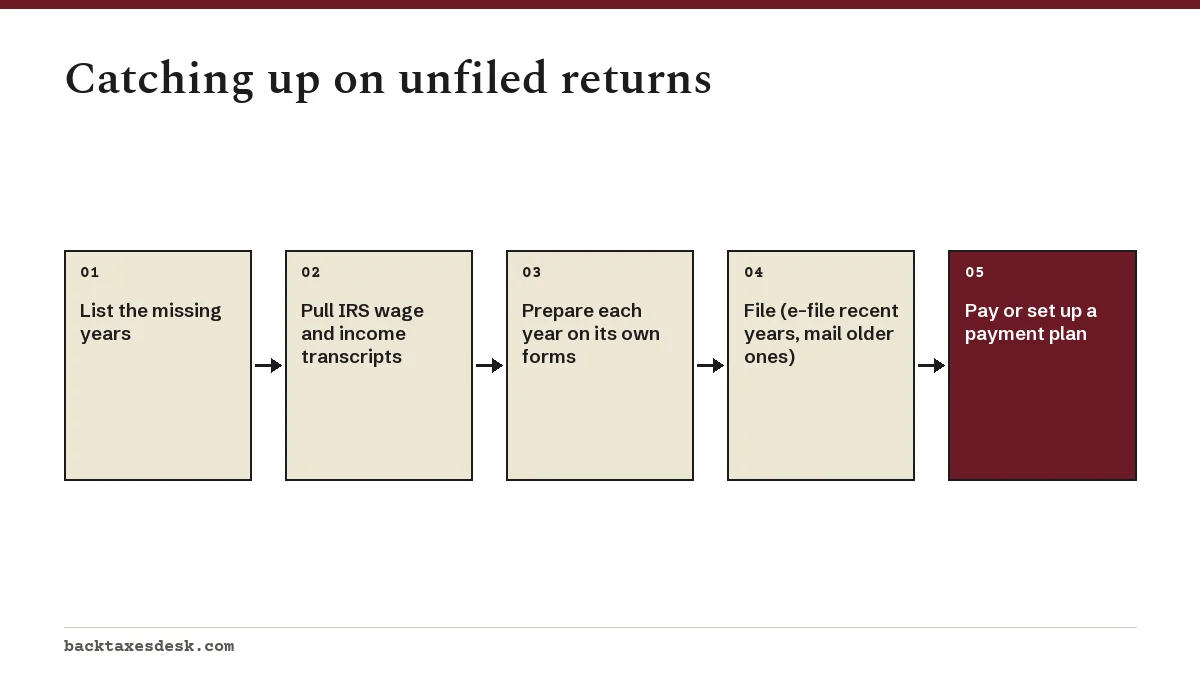
IRS e-file accepts the current tax year and the two prior tax years. In January 2026 that meant tax years 2025, 2024 and 2023; by the same rule, the 2027 season should cover 2026, 2025 and 2024, while 2023 and older must be printed and mailed. Our step-by-step guide on how to file unfiled tax returns covers the order to file them in.
If you cannot pay the balance
File anyway. The failure-to-file penalty is ten times the monthly rate of the failure-to-pay penalty, so filing without paying still stops the more expensive charge. You must have all required returns filed before the IRS will approve an installment agreement.
- Extra time: past-due filers can ask for 60 to 120 more days to pay in full through the Online Payment Agreement or by phone, with no user fee.
- Short-term plan: up to 180 days if the total of tax, penalties and interest is under $100,000, with no setup fee.
- Long-term plan: monthly payments online if you owe $50,000 or less; the setup fee is $29 with online direct debit.
- Hardship: Currently Not Collectible status or an Offer in Compromise, covered in our IRS payment plan guide and related pages.
What to do about unfiled taxes in special situations
You are owed refunds for some years
Prioritize any year still inside the three-year refund window. For tax year 2023, that window closes on April 15, 2027. Our page on filing old tax returns lists the refund deadline for each recent year.
You are handling returns for someone who died
The executor or administrator files any returns the person missed as well as the final one. See unfiled tax returns for a deceased person for the forms that give you authority to act.
You are worried about criminal charges
Willful failure to file is a federal misdemeanor under IRC 7203, carrying up to one year in prison. The usual consequences for late filers are civil: penalties, interest and collection. Our page on jail for not filing taxes explains what makes a case criminal and when to hire an attorney before you file.
Help with unfiled tax returns
Simple wage-earner years are often manageable on your own with transcripts and prior-year forms. Consider a professional if you have several years of self-employment income, a pending 90-day letter, assets that could be levied, or any reason to think a year involves fraud rather than neglect.
Enrolled agents, CPAs and attorneys can all represent you before the IRS. If your income is at or below 250% of the federal poverty guidelines, a Low Income Taxpayer Clinic may help for free or at low cost. Be cautious of firms that promise to settle your debt for pennies before they have seen your returns.
Pages in this section
- How to file unfiled tax returns: five steps from finding missing years to handling the balance.
- What happens if you don't file taxes: penalties, lost refunds and the notice sequence.
- Statute of limitations on unfiled returns: why the clock never starts without a return.
- IRS substitute for return: what an SFR is and how to replace it.
- Filing old tax returns: refund deadlines, forms and e-file limits by year.
- Unfiled returns for a deceased person: the executor's checklist.
- Can you go to jail for not filing taxes: civil versus criminal risk.
Common questions
What happens if you have unfiled tax returns?
If you owe, penalties and interest grow each month and the IRS may file a substitute return and start collection. If you are owed a refund, you lose it after three years. Either way, the IRS may hold refunds from years you did file.
How many years of unfiled returns do I need to file?
The IRS normally enforces the last six years under Policy Statement 5-133, but it can ask for more. If you have a notice, file the years it lists.
Can I still get a refund for an old tax year?
Only if you file within three years of that year's original due date. A 2023 refund, for example, must be claimed by April 15, 2027.
Will filing old returns trigger an audit?
Filing late is not listed by the IRS as a reason returns are selected; returns are chosen by random selection, computer screening or links to related examinations. An accurate return with records to back it up is your best protection either way.
Can I file unfiled tax returns if I cannot pay?
Yes, and you should. Filing stops the 5% monthly failure-to-file penalty, and being current on filing is required before the IRS will approve an installment agreement.