
IRS substitute for return (SFR): what it is and how to replace it
Short answer
A substitute for return is the IRS's own calculation of your tax for a year you did not file, built from W-2, 1099 and other reports. It may not give you deductions, credits or expenses you are entitled to, so the tax is often too high. You can replace it by filing your own return, but a CP3219N 90-day Tax Court deadline still applies.
- 01Legal authority
- IRC 6020(b)
- 02Proposal notices
- CP2566 or CP2566R, then CP3219N (notice of deficiency)
- 03Tax Court deadline on CP3219N
- 90 days (150 if addressed outside the US), not extended by filing
- 04Tax Court petition fee
- $60 (waiver available)
- 05Effect on collection clock
- SFR assessment starts the 10-year CSED
What a substitute for return is
A substitute for return, or SFR, is a return the IRS prepares for you under Internal Revenue Code section 6020(b) when you do not file after being asked. The IRS uses only the information it has, which is mostly what employers, banks, brokers and other payers reported on Forms W-2 and 1099.
The IRS substitute for return is not a courtesy filing. It is the first step toward assessing tax so the IRS can collect it. Because it is built without your input, the IRS itself warns that it may not give you credit for deductions and exemptions you could claim.
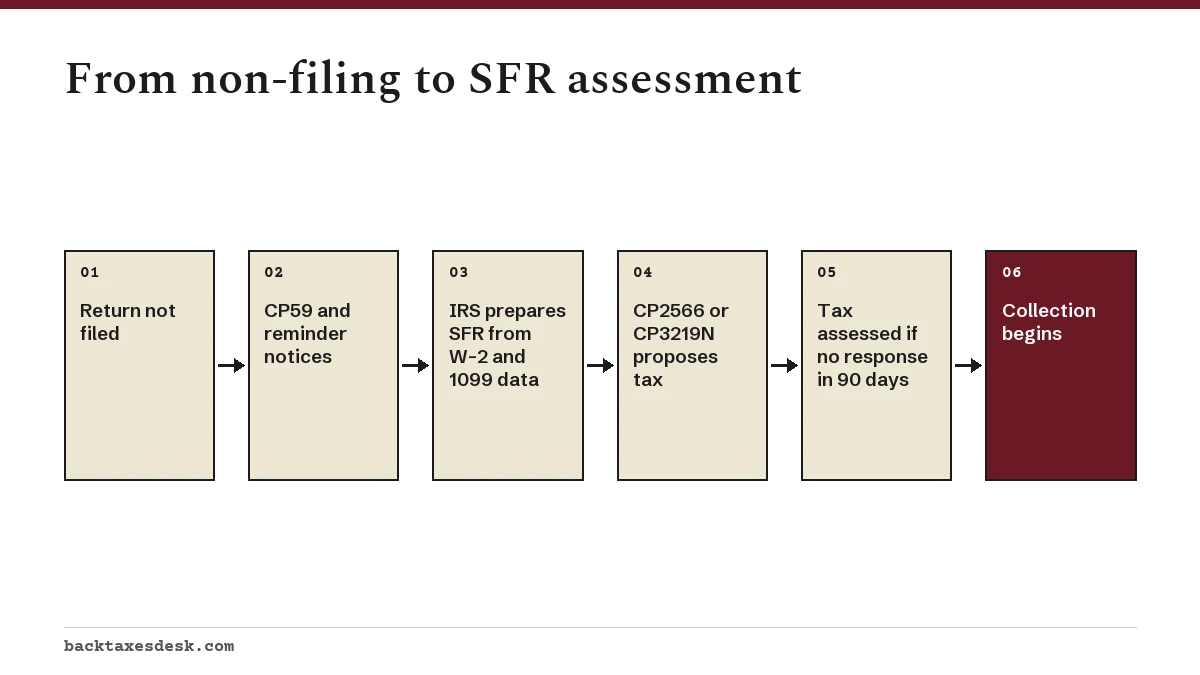
Why the IRS filed a return for me
An SFR almost always follows a string of letters you did not answer. The usual sequence starts with a CP59 saying there is no record of your return, then reminders such as CP515, CP516 and the final CP518. If a refund on another year was being held, you may also have seen a CP63.
When those go unanswered and third-party records show enough income to require a return, the IRS calculates tax, penalties and interest and sends one of these substitute return notices:
| Notice | What it says | What to do |
|---|---|---|
| CP2566 | The IRS calculated your tax from reported income because no return was received | File your return, or accept and pay, by the date shown |
| CP2566R | The IRS calculated your tax after you did not respond to an earlier CP63 refund-hold notice | File your return, or accept and pay, by the date shown |
| CP3219N | Notice of deficiency (90-day letter) proposing the SFR tax | File your return and, if needed, petition Tax Court within 90 days |
Why SFR tax is usually higher
The IRS does not know your family, your costs or your payments that were never reported to it. An SFR is therefore likely to miss items that lower your tax.
- Business expenses: a 1099-NEC is treated as income, with none of the costs of earning it on Schedule C.
- Cost basis: stock sales on a 1099-B may be taxed on the full proceeds if the basis was not reported.
- Dependents and credits: children, education credits and the earned income credit do not appear.
- Deductions: mortgage interest and other itemized amounts may not be claimed on your behalf.
- Filing status: the IRS does not know whether you could have filed as head of household or jointly.
Penalties then stack on that inflated figure. Failure-to-file and failure-to-pay penalties are percentages of unpaid tax, so an overstated tax means overstated penalties and interest, too.
Can I replace an IRS substitute return?
Yes. The IRS says filing your own return later usually replaces the SFR figures, and it encourages you to file so you get every deduction and credit you qualify for. Prepare the return on that year's Form 1040 using your full records, not just the income shown on the notice.
- Pull your wage and income transcript for the year so your return reports every item the IRS already has.
- Prepare the return with that year's forms, adding expenses, basis, dependents and deductions with records to support them.
- If the return is from the past two years, the CP2566 and CP3219N instructions say you may e-file it.
- For older years, mail the return with the response form in the envelope that came with the notice, or to the address on the notice, so it is matched to your account.
- Keep copies and proof of mailing, and watch for an adjustment notice showing the corrected balance.
Our guide on how to file unfiled tax returns covers records and forms in more detail, and filing old tax returns lists refund deadlines by year.
SFR deficiency notices and the Tax Court deadline
The CP3219N is a statutory notice of deficiency. It gives you 90 days from the notice date, or 150 days if it is addressed to you outside the United States, to petition the US Tax Court. The IRS notice itself states that filing a return does not extend this deadline, and the court cannot extend it either.
If you miss the 90 days and do not file, the IRS assesses the SFR tax and sends a bill. You can still file your own return after assessment to ask the IRS to reduce it, but you lose the right to go to Tax Court before paying. Our Tax Court petition page covers the filing steps through the court's DAWSON system.
After the balance is corrected
Once your return is processed, the IRS adjusts the assessment and sends a notice with the new balance. Penalties and interest tied to the removed tax drop with it. If you still owe, the usual options apply: pay in full, ask for up to 180 days, or request an installment agreement.
Keep one timing issue in mind. The SFR assessment date started the 10-year collection period for that tax, and it keeps running after your return replaces the figures. Separately, the IRS manual notes that an SFR does not start the assessment clock, so your own return is what finally starts the three-year period for the IRS to review that year.
Refunds are the exception to the good news. If your own return shows an overpayment but you file more than three years after the due date, the refund is gone, though the return still wipes out the SFR balance. See our unfiled tax returns overview for planning the rest of your missing years.
Common questions
Does an IRS substitute return include my deductions?
Often not. The IRS says an SFR may not give you credit for deductions and exemptions, because it only knows what third parties reported.
How do I respond to an SFR notice of deficiency?
File your own return by the date on the CP3219N if you disagree, and petition Tax Court within 90 days if you want to preserve that right, since filing a return does not extend the deadline. If you agree, sign and return the response form and pay or set up a plan.
Can I e-file a return to replace an SFR?
Yes, if the return is from the past two years, according to the IRS instructions for CP2566 and CP3219N. Older years must be mailed with the response form to the address on the notice.
Does an SFR count as filing my tax return?
No. It lets the IRS assess tax, but it does not satisfy your obligation to file, does not start the assessment statute and does not claim a refund for you.
Will the SFR be removed from my account?
The SFR assessment stays on your record, but the IRS adjusts the tax to match your processed return. The notice you receive after processing shows the corrected balance.
Sources
- Filing past due tax returns irs.gov
- Notices for past due tax returns irs.gov
- Understanding your CP3219N notice irs.gov
- Understanding your CP2566 notice irs.gov
- IRM 4.12.1 Nonfiled Returns irs.gov
- US Tax Court: starting a case ustaxcourt.gov
We check figures against these official pages. Rules change; confirm anything that affects a deadline or payment with the agency before you act.
Tell us what happened
Describe your situation and our editors will use it to improve this guide. If you leave your email, we may reply with a pointer to the right page or official contact. We never share your details.
Related guides
 How to File Unfiled Tax Returns: Step-by-Step Guide
To file unfiled tax returns, confirm which years are missing, download your IRS wage and income transcripts, prepare each year on…
Filing Old Tax Returns: Deadlines, Refunds and Right Forms
Filing old tax returns is allowed for any year, but refunds are only paid if you file within three years of the original due date…
 How to File a Tax Court Petition: Deadline, Fee and Steps
A Tax Court petition asks the US Tax Court to review an IRS determination before you pay. For a notice of deficiency it must be f…