
Topic
IRS payment plan: how it works, what it costs and who qualifies
An IRS payment plan lets you pay a tax bill over time: up to 180 days with no setup fee if you owe less than $100,000, or monthly under a long-term installment agreement, which individuals owing $50,000 or less can set up online for $29 with direct debit or $69 otherwise. All required returns must be filed first, and interest and some penalties keep running until the balance is paid.
11 guides in this topic Updated October 20, 2026
- Form 9465: How to Fill Out the Installment Agreement RequestForm 9465 is the paper request for a monthly IRS installment agreement when you cannot pay what your return or notice shows. You list what you owe, w…
- How to Set Up an IRS Payment Plan Online, by Phone or MailTo set up an IRS payment plan, first make sure every required return is filed, then apply through the Online Payment Agreement tool in your IRS Onlin…
- IRS Installment Agreement Default: Fixing a Missed PaymentAn IRS payment plan default happens when you miss a monthly payment, fail to file a return, or leave new tax unpaid. The IRS then sends Notice CP523,…
- IRS Installment Agreement Types: Which One Fits Your DebtAn IRS installment agreement is a long-term monthly payment plan whose type depends mostly on how much you owe. Tax of $10,000 or less can qualify fo…
- IRS Payment Plan Calculator: Estimate Your Monthly PaymentThis IRS payment plan calculator estimates your monthly payment from your balance, the number of months and the charges that keep running on a plan:…
- IRS Payment Plan Fees: Setup Costs and Low-Income WaiversIRS installment agreement fees range from $0 to $178. A short-term plan of 180 days or less is free. A long-term plan costs $29 online with direct de…
- IRS Payment Plan Not Working Online? Fixes and AlternativesWhen an IRS payment plan is not working online, the cause is usually one of five things: a missing tax return, a balance above the online limit, a bu…
- IRS Rejected Your Payment Plan? Why and What to Do NextWhen the IRS rejects a payment plan, you can appeal through the Collection Appeals Program by calling the number on the rejection letter within 30 da…
- IRS Short-Term Payment Plan: 180 Days With No Setup FeeAn IRS short-term payment plan gives you up to 180 days to pay your full balance, with no setup fee, if you owe less than $100,000 in combined tax, p…
- Partial Payment Installment Agreement (PPIA) ExplainedA partial payment installment agreement (PPIA) is an IRS payment plan for people who cannot pay their full tax debt before the 10-year collection per…
- Where to Mail Form 9465: IRS Mailing Addresses by StateMail Form 9465 on its own, after filing or in response to a notice, to the IRS address for your state in the Form 9465 instructions; there are seven,…
How an IRS payment plan works
An IRS payment plan is a formal arrangement in which the IRS agrees to accept your tax debt in pieces. You propose a payoff period or a monthly amount, the IRS approves it, and as long as you keep paying and keep filing, it does not move to seize wages or bank accounts for that debt.
The plan does not reduce what you owe. Tax, penalties and interest all stay on the account, and interest keeps adding up daily until the last dollar is paid. What you buy with a plan is time, protection from levies and, for people who filed on time, a lower monthly late-payment penalty.
There are two broad IRS payment plan options. A short-term payment plan gives you up to 180 days to pay in full. A long-term payment plan, which the IRS also calls an installment agreement, sets a monthly payment that runs for years if needed. Which one fits depends on how much you owe and how fast you can realistically clear it.
Short-term versus long-term IRS payment plan options
The deciding question is whether you can clear the whole balance, including the interest that builds along the way, within about six months. If yes, the short-term plan is free to set up. If not, a monthly installment agreement is the tool, and applying online keeps the fee lowest.
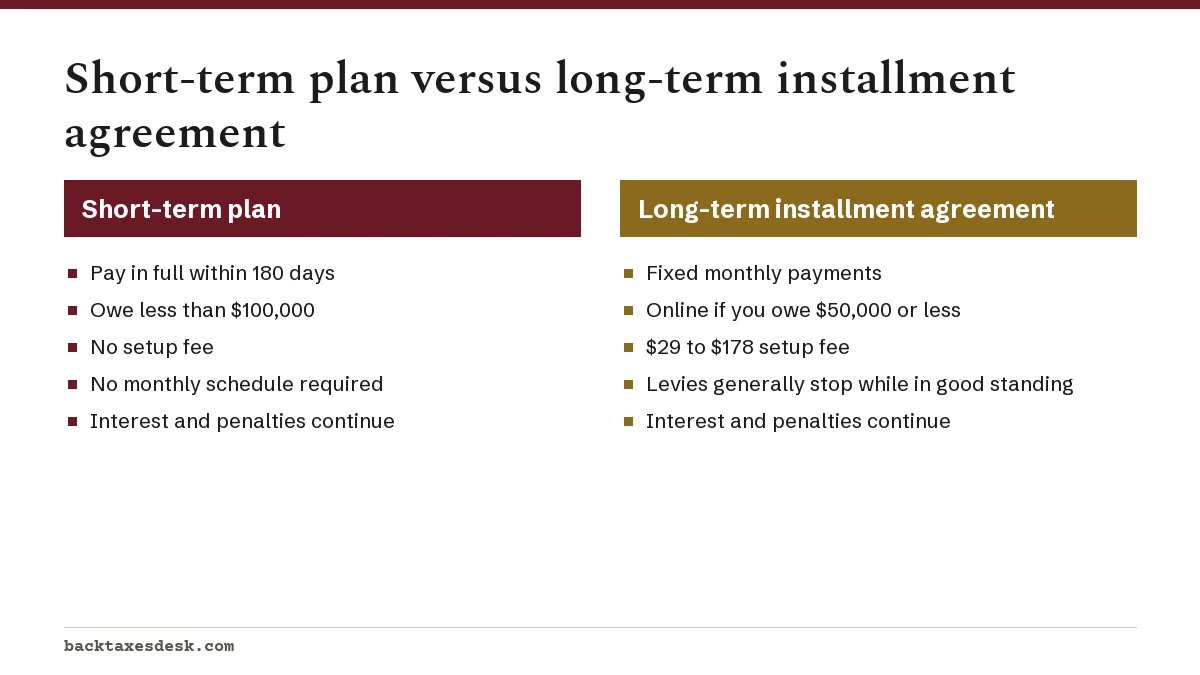
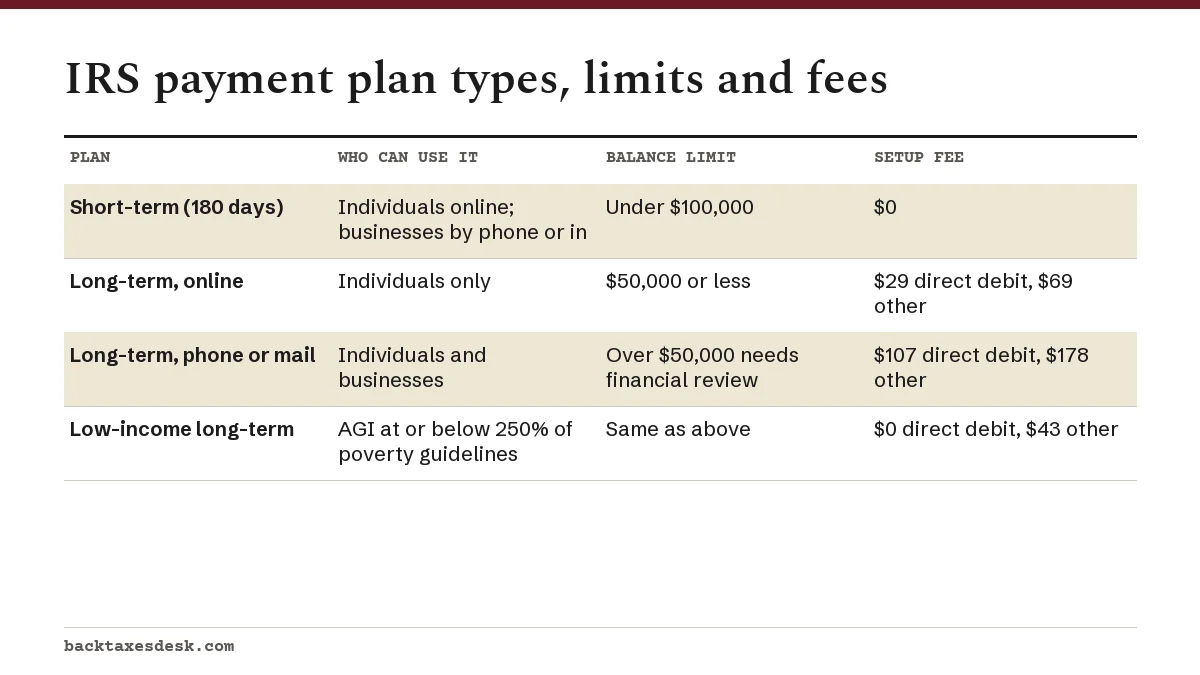
Both plan types are open to individuals online. Businesses cannot use the online application and must apply by phone or in person. Our page on the IRS short-term payment plan covers the 180-day option in detail, and IRS installment agreement types explains the guaranteed, streamlined and non-streamlined versions of the long-term plan.
Who qualifies for an IRS payment plan
Most people who owe the IRS qualify for some kind of plan. The limits below decide which kind, and whether you can apply online or need to talk to the IRS and share financial details.
- Filing is current. You must have filed every required return before the IRS will set up an installment agreement. A missing year will stop the request.
- Short-term plan: combined tax, penalties and interest under $100,000.
- Long-term plan online: combined tax, penalties and interest of $50,000 or less for individuals.
- Over $50,000: a plan is still possible, but you apply by phone, mail or in person, and the IRS generally asks for a financial statement such as Form 433-F.
- Businesses with payroll (trust fund) taxes: generally qualify for a simple plan only when they owe $25,000 or less.
If you have unfiled years, catch those up first; the steps are in our guide to filing unfiled tax returns. If you cannot afford any monthly payment at all, a payment plan is the wrong tool; hardship status or an offer in compromise may fit better.
How much an IRS payment plan costs
The setup fee depends on two choices: how you apply and how you pay each month. Applying online and paying by automatic direct debit is the cheapest way to get a long-term plan. The same plan set up by phone with monthly checks costs six times as much.
| Plan and payment method | Apply online | Apply by phone, mail or in person | Low-income applicants |
|---|---|---|---|
| Short-term, up to 180 days | $0 | $0 | $0 |
| Long-term, automatic direct debit | $29 | $107 | Fee waived |
| Long-term, other monthly payments | $69 | $178 | $43, may be reimbursed |
| Revising an existing plan | $6 | $89 | $6 online (may be reimbursed), $43 otherwise |
Low-income means adjusted gross income at or below 250% of the federal poverty guidelines. Changes to a direct debit plan's bank details carry no fee. A full breakdown, including how the low-income reimbursement works, is on our IRS payment plan fees page.
Do penalties and interest stop on an IRS payment plan?
No. Interest and the failure-to-pay penalty both continue until the balance is paid in full. What changes is the penalty rate: if you filed your return on time and have an approved payment plan, the failure-to-pay penalty drops from 0.5% to 0.25% of the unpaid tax per month.
Interest is the larger cost. The IRS sets the individual underpayment rate each quarter at the federal short-term rate plus 3 points and compounds it daily. The rate is 7% for October to December 2026. The rate for January to March 2027 is not yet announced; the IRS usually publishes it in late November.
Worked example: $15,000 of tax on a long-term plan
Say you filed on time and owe $15,000 of tax. In the first month of an approved plan, the penalty is about $37.50 (0.25% of $15,000) and interest at 7% is roughly $87. That is about $125 of added cost in month one, shrinking as the balance falls. Without the plan, the penalty alone would be $75 a month. Our IRS payment plan calculator runs the full schedule.
What an installment agreement protects you from
The strongest protection is against levies. While an installment agreement request is pending, and while an approved plan is in good standing, the IRS is generally prohibited from levying for that debt, and it generally holds off for 30 days after a request is rejected or a plan is terminated. That stops wage garnishment and bank levies from starting while you pay.
- Passport certification: debts in a timely-paid installment agreement, or with a pending plan request, are not certified to the State Department as seriously delinquent.
- Tax liens: a plan does not guarantee no lien. A Notice of Federal Tax Lien generally is not filed with guaranteed or streamlined agreements, but can be in some cases.
- Refunds: future refunds are taken and applied to the debt until it is paid, even while you are on a plan.
- The 10-year clock: the collection period is paused while a plan request is pending, and for 30 days after a rejection.
The IRS payment plan application: online, phone or mail
Applying for an IRS payment plan online is the fastest route for individuals. The Online Payment Agreement tool runs through your IRS Online Account, tells you on screen whether the plan is approved, and lets you revise it later. The tool is available daily from 5 a.m. to midnight Eastern time.
The paper route is Form 9465, Installment Agreement Request, mailed to the IRS or attached to your return. The IRS usually answers within 30 days, though requests tied to returns filed after March 31 can take longer. You can also apply by calling the number on your notice or visiting a Taxpayer Assistance Center.
Step-by-step instructions for each route are in how to set up an IRS payment plan. If the online tool refuses you, see IRS payment plan not working for the common causes.
Pages in this section
Each page below covers one part of IRS payment plans in depth. Start with the one that matches where you are: choosing a plan, applying, or fixing a plan that has gone wrong.
- Choosing a plan: installment agreement types, the short-term 180-day plan, and the partial payment installment agreement for people who cannot pay the full balance before the collection deadline.
- Applying: setting up a plan online, by phone or by mail, using the Online Payment Agreement tool, Form 9465 line by line, and where to mail Form 9465.
- Costs: setup and revision fees, and a calculator for monthly payments, interest and penalties.
- When a plan goes wrong: the online tool not working, a rejected request, and a missed payment or default leading to a CP523 notice.
If you already have a plan and missed a payment, go straight to IRS installment agreement default. The CP523 notice gives you about 30 days to act.
Common questions
How long can an IRS payment plan last?
A short-term plan lasts up to 180 days. A streamlined long-term plan must pay the assessed balance within 72 months or by the collection statute expiration date, whichever comes first. Larger balances can have other terms after a financial review.
Will the IRS keep my tax refund if I am on a payment plan?
Yes. Future refunds are applied to the tax debt until it is paid in full. The IRS still expects your scheduled monthly payment that month, so do not skip a payment because a refund was taken.
Can I pay off an IRS payment plan early?
Yes. You can pay more than the monthly amount or clear the balance at any time, and every extra dollar reduces the interest and penalty building on what is left. Pay through Direct Pay or your online account and apply the payment to the same tax year.
Is there a minimum monthly payment for an IRS installment agreement?
For a streamlined plan, the monthly payment has to be large enough to clear the assessed balance within 72 months. On $36,000, that works out to at least $500 a month. If you cannot meet the minimum, the online tool directs you to Form 9465 or another way to apply.
Can I get an IRS payment plan if I owe for several years?
Yes. One installment agreement can cover several tax years, as long as all required returns are filed and the combined total fits the plan limits.
Can I set up an IRS payment plan for taxes due in 2027?
Yes. File your 2026 return by April 15, 2027, then apply through the Online Payment Agreement tool; if you have not received a balance notice yet, the IRS says to use the balance shown on your return. You can also attach Form 9465 to the return. The fees on this page are the ones the IRS lists now, and the interest rate for January to March 2027 is not yet announced.