
How to file unfiled tax returns, step by step
Short answer
To file unfiled tax returns, confirm which years are missing, download your IRS wage and income transcripts, prepare each year on that year's own Form 1040, then e-file the three most recent years and mail older ones. If you received a notice, mail the return to the address on it. File even if you cannot pay, then request a payment plan.
- 01Form to use
- Form 1040 (or 1040-SR) for the specific tax year
- 02E-file limit
- Current tax year and the two prior tax years
- 03Where to mail
- Normal filing address, or the address on your IRS notice
- 04Processing time
- About 6 weeks for an accurate past-due return
- 05Extra time to pay
- 60 to 120 days, no user fee, for past-due filers
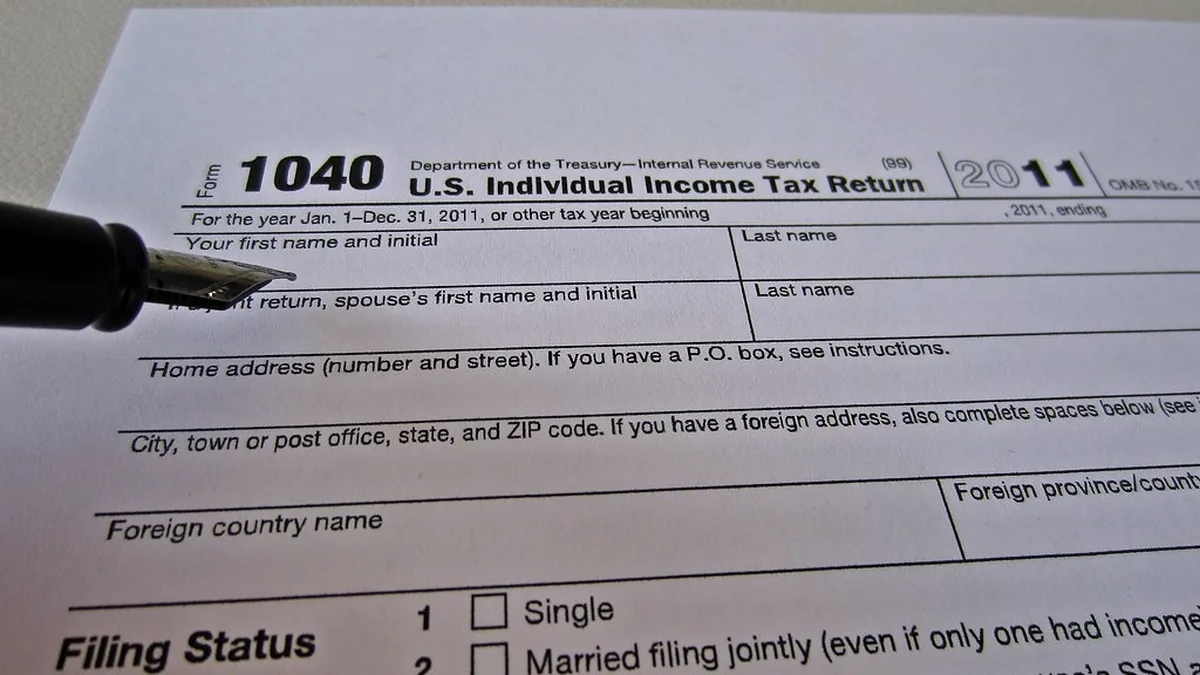
How to file unfiled tax returns: the short version
Filing a late return is the same job as filing an on-time one, done with older forms and older records. The IRS instructions for past-due returns say to file the same way and to the same location you would normally use, unless a notice gives a different address.
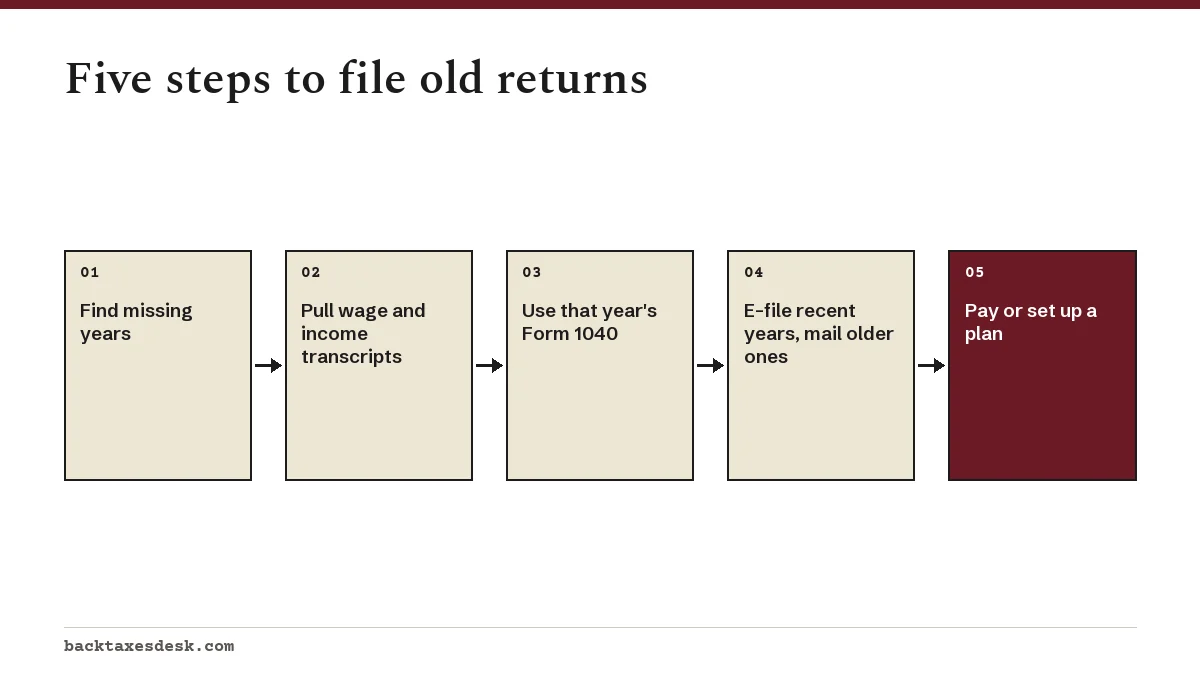
The five steps below work whether you are one year behind or six. Each step lists the exact form or tool to use and what to do if something goes wrong. If you want the background on why these years matter and how far back to go, start with our unfiled tax returns overview.
Step 1: find which years are missing
Do not rely on memory. Log in to your IRS online account and open the account transcript for each year you are unsure about. It shows whether a return was processed for that year, or whether the IRS assessed tax on a substitute return it prepared.
Online, account transcripts are available for the current and nine prior tax years. By mail or phone, you can only get the current and three prior years, so the online account is worth setting up if you are several years behind.
Check whether you had to file at all
Some people with very low income were never required to file. Compare each year's gross income with that year's filing threshold in the Form 1040 instructions. If you had federal tax withheld or qualify for refundable credits, filing is still worth it even when it was not required, as long as the refund window is open.
Step 2: get wage and income records
Order a wage and income transcript for every missing year. It lists what employers, banks, brokers and others reported to the IRS on Forms W-2, 1099, 1098 and 5498. This is also the income the IRS will use if it ever files a return for you, so matching it closely avoids later mismatch letters.
- Log in at Get Transcript and choose Wage and Income Transcript for each year.
- If the transcript will not generate online because a year has more than about 85 income documents, or you cannot use the online account, mail Form 4506-T and check the box on line 8 for a wage and income transcript.
- Ask former employers or payers for duplicate forms if a transcript is missing a job you know you had.
- Gather your own records for income no one reported: cash sales, tips, side work paid by apps under reporting thresholds.
Transcripts do not show state tax withheld on every form, estimated payments you made on a different account, or your deductions. Pull bank statements, mortgage statements, childcare receipts and business expense records from the same years.
Step 3: use the right unfiled tax return form for each year
There is no special late-filing form. Each missing year is filed on the Form 1040 or 1040-SR, schedules and instructions for that year, because brackets, standard deductions and credit rules change annually. Download them from the IRS prior-year forms page, which lets you search by form number and year.
| Situation | Forms for that year |
|---|---|
| W-2 wages only | Form 1040 for that year |
| Freelance or gig income | Form 1040, Schedule C, Schedule SE |
| Unemployment, interest or dividends | Form 1040 with Schedule B if required |
| Owe tax and want to claim penalty relief | Form 1040, then Form 843 or a written request after the bill arrives |
| Claiming a dependent-related credit | Form 1040 plus the credit schedule for that year |
Using software for older years
Most commercial programs sell prior-year editions for a few years back. Once a year is outside the e-file window, you print the software's return, sign it and mail it. Carry forward items such as capital loss carryovers or depreciation from the earliest year to the next, which is one reason to prepare the oldest year first.
Step 4: file back taxes online or by mail
IRS e-file accepts the current tax year and the two prior tax years. In January 2026, for example, the system took tax years 2025, 2024 and 2023. Applying the same rule, in 2027 you can expect to e-file 2026, 2025 and 2024, and mail 2023 and earlier.
| Tax year | How to file in 2027 |
|---|---|
| 2026 | E-file or mail |
| 2025 | E-file or mail |
| 2024 | E-file or mail |
| 2023 | Mail (paper only) |
| 2022 and earlier | Mail (paper only) |
Where do I mail a past-due return?
- If you received an IRS notice about the year: mail the return to the address on that notice, with the response form if one was included.
- If you have no notice: use the mailing address listed in that year's Form 1040 instructions for your state, which the IRS updates on its Where to File page.
- Mail each year in its own envelope, and use a trackable service so you can prove the mailing date.
Sign and date every return with the date you actually sign it. The IRS says an accurate past-due return takes about six weeks to process, so allow that long before calling to check on it.
Step 5: handle the balance
Send what you can with each return, but do not hold a return back because you cannot pay. Once a return is in, the 5% monthly failure-to-file charge stops growing; only the 0.5% monthly failure-to-pay penalty and interest continue.
- Wait for the bill (usually a CP14) so you know the exact total with penalties and interest.
- If you can pay within 60 to 120 days, request that extra time through the Online Payment Agreement or by phone; past-due filers pay no user fee for it.
- If not, apply for a long-term installment agreement. Online, individuals owing $50,000 or less qualify, and the setup fee is $29 with direct debit.
- Ask for penalty relief. The earliest missing year may qualify for First Time Abate if the three years before it were filed on time with no penalties; later years usually rely on reasonable cause.
Our IRS payment plan guide compares every plan type. For relief when you cannot pay anything, see Currently Not Collectible status.
How to catch up on unfiled taxes when several years are missing
Should I file all years at once?
Prepare them together but think about the order. Years still inside the three-year refund window come first because a refund from one year can be applied to a balance in another. Next come any years named in a notice with a deadline, then the remaining years oldest to newest so carryovers flow correctly.
A worked example
Suppose in March 2027 you have not filed for 2022, 2023 and 2024. The 2022 refund window closed in April 2026, so any overpayment for that year is gone, but a balance due is still collectible. The 2023 window closes April 15, 2027, so that return goes out immediately, by mail. The 2024 return can be e-filed, and 2022 goes by mail last.
If the IRS already filed for you
When a year has a substitute for return, you still file your own Form 1040 for it. Mail it to the address on the SFR notice so it is matched to the assessment rather than processed as a duplicate.
How to resolve unfiled tax returns you think you did not owe
If a CP59 or similar letter asks for a return you were not required to file, you do not send a Form 1040. Complete the Form 15103 that comes with the CP59, or reply in writing, explaining why no return was due, such as income below the filing threshold or income reported on someone else's return.
If you ignore the letters, the IRS may move to the stages described in what happens if you don't file taxes, including a substitute return and collection.
Step by step
Find the missing years
Check account transcripts in your IRS online account and list every year with no filed return.
Get wage and income records
Download wage and income transcripts or mail Form 4506-T, and gather your own records for unreported income and deductions.
Use each year's forms
Prepare every year on that year's Form 1040 and schedules from the IRS prior-year forms page.
File the returns
E-file years inside the current-plus-two-prior window; mail older years, or send to the address on your notice.
Handle the balance
Pay what you can, request 60 to 120 extra days or a payment plan, and ask for penalty relief.
Common questions
Can you e-file old tax returns?
Only the current tax year and the two prior tax years. In 2027 that should mean tax years 2024 through 2026; anything older must be mailed on paper.
Where do I mail a past-due tax return?
If you have a notice about that year, use the address on the notice. Otherwise, use the address in that year's Form 1040 instructions or on the IRS Where to File page for your state.
What form do I use for an old tax year?
The Form 1040 or 1040-SR for that specific year, with that year's schedules and instructions. Using a current-year form will produce the wrong tax.
How long does it take the IRS to process a late return?
The IRS says about six weeks for an accurately completed past-due return. Errors or missing schedules add time.
Do I need to include payment with a late return?
No. Pay what you can, but file on time regardless, because the penalty for not filing is ten times the monthly rate of the penalty for not paying.
Can I file unfiled returns without my W-2s?
Yes. Use the IRS wage and income transcript for that year, which shows the W-2 and 1099 figures employers and payers reported.
Sources
- Filing past due tax returns irs.gov
- Transcript types and ways to order them irs.gov
- Benefits of 1040 Modernized e-File irs.gov
- Understanding your CP3219N notice irs.gov
- Payment plans (installment agreements) irs.gov
- Understanding your CP59 notice irs.gov
We check figures against these official pages. Rules change; confirm anything that affects a deadline or payment with the agency before you act.
Tell us what happened
Describe your situation and our editors will use it to improve this guide. If you leave your email, we may reply with a pointer to the right page or official contact. We never share your details.
Related guides
 IRS Payment Plan: How It Works, Costs and Who Qualifies
An IRS payment plan lets you pay a tax bill over time: up to 180 days with no setup fee if you owe less than $100,000, or monthly…
What Happens If You Don't File Taxes? IRS Consequences
What happens if you don't file taxes depends on whether you owe. If you owe, the IRS adds 5% of the unpaid tax each month up to 2…
Filing Old Tax Returns: Deadlines, Refunds and Right Forms
Filing old tax returns is allowed for any year, but refunds are only paid if you file within three years of the original due date…