
Topic
IRS penalties and interest: what you are charged and how to get relief
The two IRS penalties most people face are the failure-to-file penalty (5% of unpaid tax per month, up to 25%) and the failure-to-pay penalty (0.5% per month, up to 25%), plus interest at 7% a year for late 2026. An IRS penalty can often be removed through First Time Abate, the new automatic exemption or reasonable cause.
12 guides in this topic Updated September 18, 2026
- Estimated Tax Penalty: Why You Got It and How to Fix ItThe estimated tax penalty is an IRS charge for not paying enough tax through withholding or quarterly payments during the year. You generally avoid i…
- Failure to File Penalty: 5% a Month and the $525 MinimumThe IRS failure to file penalty is 5% of the tax left unpaid on the due date for each month or part of a month your return is late, up to 25%. If the…
- Failure to Pay Penalty: How IRS Late Payment Penalties WorkThe IRS failure to pay penalty is 0.5% of your unpaid tax for each month or part of a month after the due date, up to 25%. It falls to 0.25% a month…
- First Time Penalty Abatement: Who Qualifies and What ChangesFirst time penalty abatement (First Time Abate, or FTA) is an IRS waiver that removes failure-to-file, failure-to-pay and failure-to-deposit penaltie…
- Form 843 for Penalty Abatement: How to Fill It Out RightForm 843, Claim for Refund and Request for Abatement, is the IRS form for asking in writing that a penalty or certain interest be removed, or refunde…
- How to Request First Time Penalty Abatement From the IRSTo request first time penalty abatement, call the toll-free number in the top right corner of your IRS penalty notice, or mail a written request or F…
- IRS Automatic Penalty Relief (AEP): What Changes in 2027IRS automatic penalty relief, called the Automatic Exemption from Penalty (AEP), means the IRS does not assess late filing, late payment or failure t…
- IRS Interest Rate 2027: Quarterly Rates and Release DatesThe IRS interest rate for 2027 has not been announced yet: the January to March 2027 rate usually comes out in late November. The rate for October to…
- IRS Interest Rate on Underpayment: How the Daily Rate Is SetThe IRS interest rate on underpayments for individuals is the federal short-term rate plus 3 percentage points, reset each quarter and compounded dai…
- IRS Penalty Calculator: Late Filing, Payment and InterestThis IRS penalty calculator estimates what filing or paying late adds to your tax bill: 5% a month for filing late (up to 25%, with a $525 minimum af…
- IRS Penalty Rates 2027: Late Filing and Payment FiguresIRS penalty rates for 2027 keep the same percentages: 5% a month for filing late and 0.5% a month for paying late, each capped at 25%. The main new f…
- Reasonable Cause Penalty Abatement: What the IRS AcceptsReasonable cause penalty abatement is IRS relief that removes a penalty when you took ordinary care but events beyond your control, such as a serious…
What is an IRS penalty and which ones will I see?
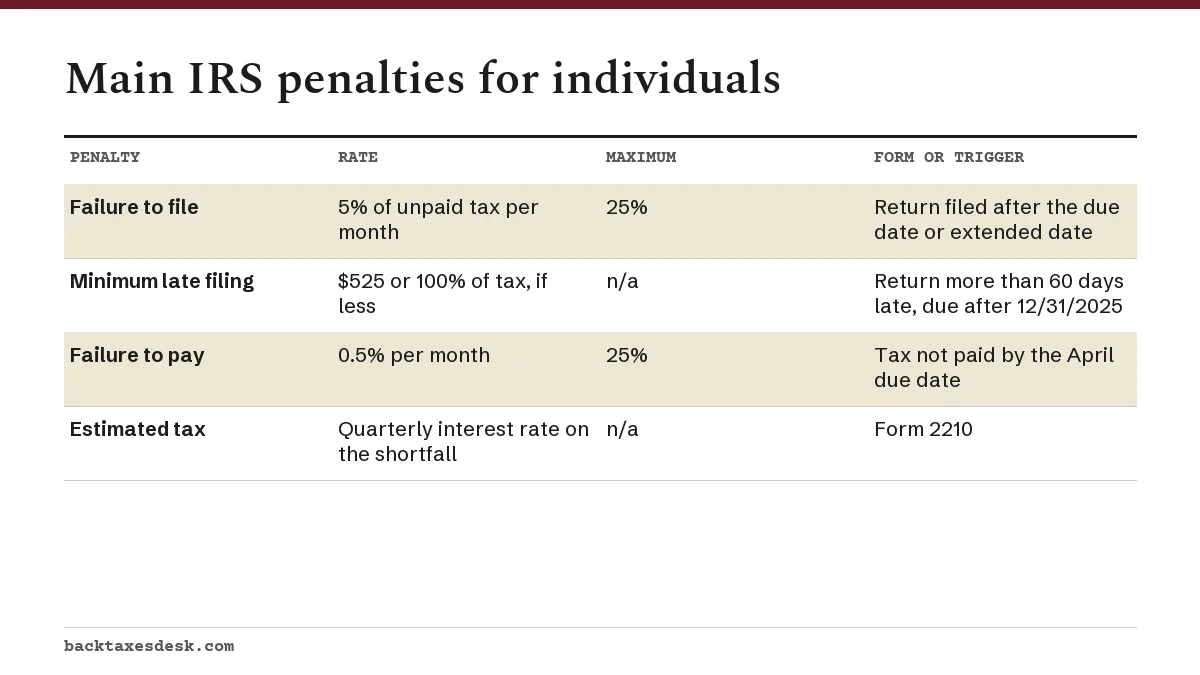
An IRS penalty is a charge added to your account when you file a required return late, pay tax late or underpay during the year. For individuals, three penalties cause most balance-due notices: failure to file, failure to pay and the estimated tax penalty. Each one is figured on the unpaid tax, not on your income.
Penalties are separate from interest. Interest is the cost of using the government's money after the due date, while a penalty is a charge for missing a rule. Your notice lists them on separate lines, and the IRS applies your payments to tax first, then to penalties, then to interest (IRS, Tax Topic 653).
Failure to file
Filing late costs 5% of the tax still unpaid for each month or part of a month the return is late, capped at 25%. If the return is more than 60 days late, a minimum applies: $525 or 100% of the tax owed, whichever is smaller, for returns due after December 31, 2025. The failure to file penalty page walks through the monthly math and the minimum.
Failure to pay
Paying late costs 0.5% of the unpaid tax per month or part of a month, also capped at 25%. The rate falls to 0.25% if you filed on time and have an approved payment plan, and rises to 1% if you still have not paid 10 days after a notice of intent to levy. See the failure to pay penalty page for how each rate is triggered.
Estimated tax underpayment
Self-employed people, investors and anyone with too little withholding can owe the estimated tax penalty. You generally avoid it if the balance due on your return is under $1,000, or if you paid at least 90% of this year's tax or 100% of last year's (110% if last year's adjusted gross income was over $150,000). It is figured on Form 2210.
Read the video transcript
IRS penalties and interest: what you are charged and how to get relief
The two IRS penalties most people face are the failure-to-file penalty (5% of unpaid tax per month, up to 25%) and the failure-to-pay penalty (0.5% per month, up to 25%), plus interest at 7% a year for late 2026.
Failure-to-file penalty: 5% of unpaid tax per month or part of a month, max 25%.
Failure-to-pay penalty: 0.5% per month, max 25% (0.25% on a plan, 1% after a levy notice).
Minimum late-filing penalty: $525 or 100% of the tax, if less, for returns due after 2025 and filed more than 60 days late.
Interest runs on unpaid tax from the original due date until the balance is paid in full.
On July 8, 2026 (IR-2026-83), the IRS announced the Automatic Exemption from Penalty (AEP).
If you cannot pay the balance, a filed-on-time taxpayer with an approved plan pays the lower 0.25% monthly late-payment rate.
What is the most common IRS penalty? For individuals, the failure-to-pay penalty is the one most people see, because it applies to any balance not paid by the April due date even when the return was filed on time.
How much is the IRS penalty per month?
If you neither file nor pay, the combined IRS penalty is 5% of the unpaid tax per month for the first five months. That is because the failure-to-file charge is reduced by the failure-to-pay charge for any month both apply, so the split is 4.5% plus 0.5%. After five months the late-filing part stops at its cap and only the 0.5% late-payment charge continues.
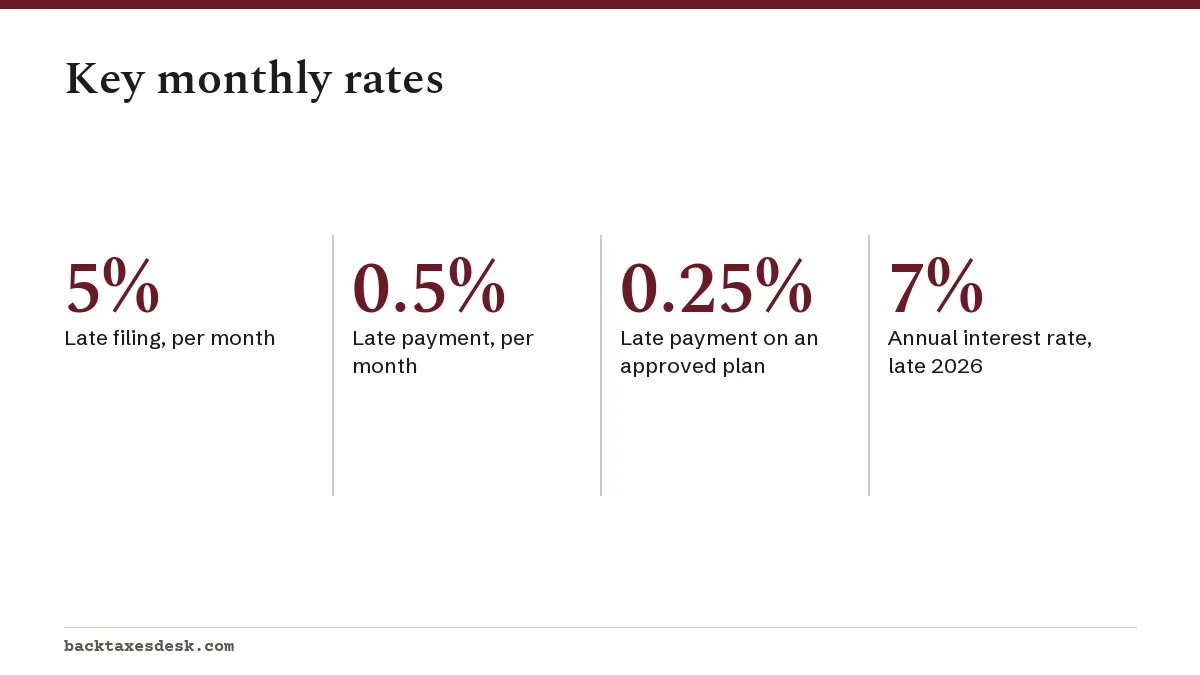
Worked through, that means 22.5% for late filing (4.5% times five months) and up to 25% for late payment, a combined ceiling of 47.5% of the original unpaid tax before interest. The late-payment part takes 50 months at 0.5% to reach its cap. Note that the IRS charges a full month even if you pay on the first day of it.
How IRS penalties and interest add up over time
Interest runs on unpaid tax from the original due date until the balance is paid in full. The individual underpayment rate is the federal short-term rate plus 3 percentage points, reset each quarter and compounded daily. It is 7% a year for both July to September and October to December 2026 (IRS, Quarterly interest rates).
The IRS also charges interest on penalties. The rate for January to March 2027 is not yet announced; the IRS usually publishes the next quarter's rate in late November. Current and past quarters are tracked on our IRS underpayment interest rate page.
Example: a $4,000 balance left unpaid for a full year at 7% compounded daily grows by about $290 in interest alone. Add 6% in late-payment penalties ($240) and the total is roughly $4,530, before any late-filing charge. To run your own numbers, use the IRS penalty and interest calculator.
Can IRS penalties be removed? The official relief routes
Yes. The IRS offers penalty relief in three main ways: an administrative waiver based on a clean record (First Time Abate, now being replaced by an automatic version), reasonable cause, and correction of IRS errors. Relief is not a negotiation, and no outside company can get a result you could not request yourself for free.
| Route | Who it fits | How it starts | Penalties it covers |
|---|---|---|---|
| Automatic Exemption from Penalty (AEP) | Clean three-year filing and payment history | Automatic during processing; no request | Failure to file, failure to pay, failure to deposit |
| First Time Abate (FTA) | Clean three-year history; returns not handled by AEP | Phone call, letter or Form 843 | Failure to file, failure to pay, failure to deposit |
| Reasonable cause | Serious illness, disaster, records destroyed or other events outside your control, with good-faith effort | Phone, letter or Form 843 with an explanation | Most penalties, reviewed case by case |
| IRS error or written advice | The IRS gave wrong written advice or made a processing mistake | Contact the IRS office on the notice | Penalties caused by the error |
First time penalty abatement is the simplest request if you have a clean record: the IRS checks your history itself and you do not need to attach documents. If your record is not clean, reasonable cause penalty abatement is the fallback, and it depends on showing what happened and when.
What changes for IRS penalty waivers in 2027?
On July 8, 2026 (IR-2026-83), the IRS announced the Automatic Exemption from Penalty (AEP). If you pass the compliance history test, late-filing, late-payment and failure-to-deposit penalties are not assessed at all while the return is processed, and the IRS mails a notice confirming the relief. No phone call or form is needed.
AEP began in summer 2026 for eligible original returns starting with tax year 2025 and 2026 quarterly returns. It replaces First Time Abate for eligible returns with original due dates on or after January 1, 2027, which includes tax year 2026 Form 1040 returns due April 15, 2027. Details and the transition rules are on our IRS automatic penalty relief page.
- AEP does not cover information returns or returns filed only for one-off events, such as Form 706 and Form 709.
- During the transition, some eligible people may still get a penalty notice; they can still ask for First Time Abate.
- People who fail the history test can still request reasonable cause relief.
- Tax and interest are still owed in full, along with any penalty AEP does not cover.
What should I do first if I received a penalty notice?
- Check that the notice is real: look for the notice number (CP or LTR) in the top or bottom right corner, and compare the balance with your IRS online account.
- Separate the lines: tax, each penalty and interest. Note which penalty is largest.
- Check the math against the rates above, counting months from the due date shown on the notice, and confirm any payments you made are listed.
- Ask for relief on the penalty lines: call the number on the notice or write to the IRS. You do not need to name First Time Abate for the IRS to consider it.
- Pay the tax, or set up a plan, while you wait. Interest keeps running on unpaid tax even if a penalty request is pending.
If you cannot pay the balance, a filed-on-time taxpayer with an approved plan pays the lower 0.25% monthly late-payment rate. Our payment plan section explains the options and fees.
Pages in this section
- Failure to file penalty: the 5% monthly charge and the $525 minimum.
- Failure to pay penalty: the 0.5%, 0.25% and 1% rates.
- Estimated tax penalty: Form 2210 and the safe harbors.
- First time penalty abatement: who qualifies and how the history test works.
- How to request first time penalty abatement: phone, letter and Form 843.
- Reasonable cause penalty abatement: what counts and what to send.
- Form 843 for penalty abatement: line-by-line help.
- IRS penalty and interest calculator: estimate your total.
- IRS underpayment interest rate and the 2027 interest rate page.
- IRS automatic penalty relief and the 2027 penalty rates page.
Common questions
What is the most common IRS penalty?
For individuals, the failure-to-pay penalty is the one most people see, because it applies to any balance not paid by the April due date even when the return was filed on time. It runs at 0.5% of the unpaid tax per month, up to 25%.
Does the IRS waive penalties if you ask?
Often, yes, when you qualify. The IRS grants First Time Abate to people with a clean three-year record and reasonable cause relief when events outside your control caused the problem. From 2027, many clean-record filers get the Automatic Exemption from Penalty without asking.
Does interest stop if a penalty is removed?
The interest charged on that penalty is reduced or removed automatically. Interest on the unpaid tax itself continues until the tax is paid in full.
Can the IRS remove interest too?
Interest on tax is generally required by law and is not removed for reasonable cause. It is only reduced when the related penalty is reduced or in limited cases of IRS error or delay.
Is there a penalty for filing late if I owe nothing?
No. The late-filing penalty is a percentage of unpaid tax, so if your withholding and credits cover your tax, the penalty is zero. You still need to file within three years of the due date to claim any refund.
Do tax relief companies get penalties removed faster?
They use the same IRS routes you can use yourself: a phone call, a letter or Form 843. Relief under the new automatic program happens without any request at all.