
IRS interest rate on underpayments: how it is set and charged
Short answer
The IRS interest rate on underpayments for individuals is the federal short-term rate plus 3 percentage points, reset each quarter and compounded daily. It is 7% for October to December 2026. Interest runs from the original due date until the balance is paid, applies to penalties too, and is rarely removed on its own.
- 01Formula for individuals
- Federal short-term rate + 3 percentage points
- 02Rate for Oct. to Dec. 2026
- 7% (Internal Revenue Bulletin 2026-36)
- 03Compounding
- Daily
- 04Starts on unpaid tax
- The return due date, even if you had a filing extension
- 05Removed for reasonable cause
- No; only for unreasonable IRS error or delay, or when the underlying tax or penalty is reduced
What is the IRS interest rate on underpayment of tax?
Underpayment interest is the charge the IRS adds to any tax, penalty or interest you have not paid by its due date. For individuals the rate equals the federal short-term rate plus 3 percentage points, and it stands at 7% for the October to December 2026 quarter (IRS, Quarterly interest rates). Unlike a penalty, interest is not a punishment and has no cap; it simply compensates the government for the time the money was unpaid.
Businesses face slightly different figures. A corporation that owes more than $100,000 pays the large corporate underpayment rate, which is the short-term rate plus 5 points (9% for late 2026). This page focuses on the individual rate, which applies to most people with back taxes.
How the rate is set: the short-term rate plus 3 points
Each quarterly rate comes from a formula in Internal Revenue Code section 6621. The Treasury determines the federal short-term rate for the first month of each calendar quarter, and that figure applies to the next quarter. The result is rounded to the nearest full percent, with half-percent values rounded up.
In practice this means the January to March rate is based on the short-term rate measured in October, the April to June rate on the January figure, and so on. The IRS then publishes the new rates in the Internal Revenue Bulletin before the quarter starts. Because of the rounding, small moves in market rates often leave the IRS rate unchanged.
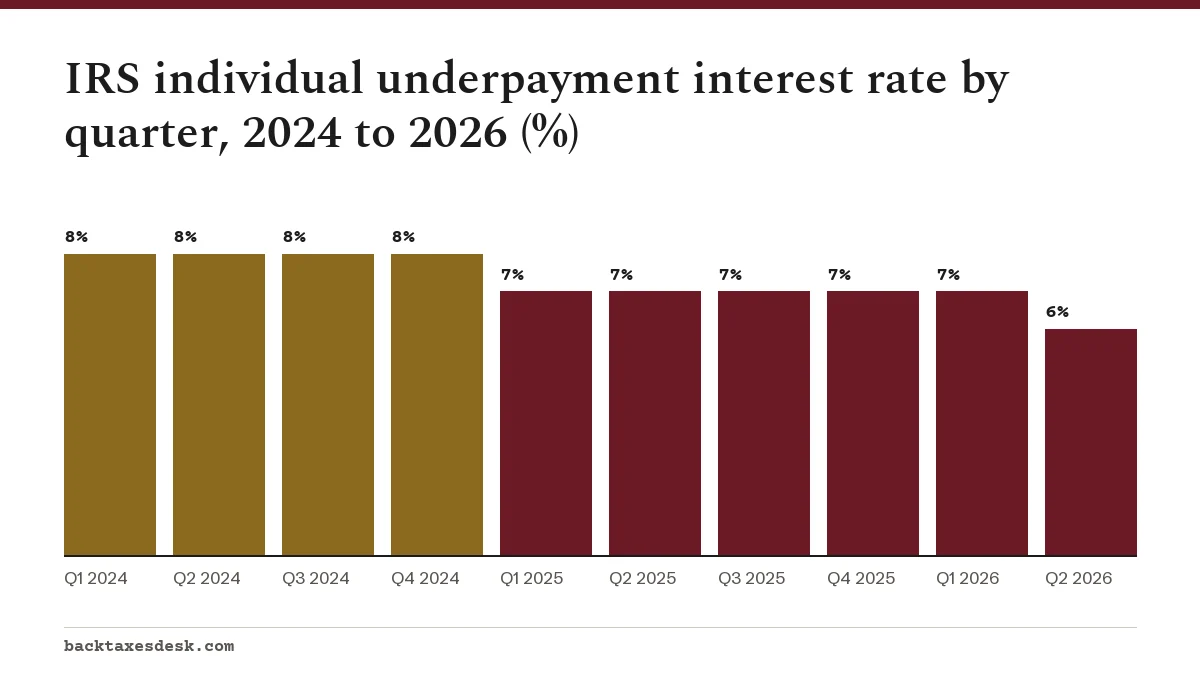
Over the last 12 quarters the individual rate has moved only between 6% and 8%: 8% throughout 2024, 7% throughout 2025, and 7%, 6%, 7% and 7% across the four quarters of 2026. Upcoming quarters and release timing are tracked on our IRS interest rate 2027 page.
Is IRS interest compounded daily?
Yes. The IRS compounds both underpayment and overpayment interest daily, so each day's interest is added to the balance and earns interest itself the next day. At 7%, daily compounding turns a simple 7% into an effective annual cost of about 7.25%.
| Days unpaid | Interest added | Balance owed |
|---|---|---|
| 30 | $57.69 | $10,057.69 |
| 91 | $176.04 | $10,176.04 |
| 182 | $355.17 | $10,355.17 |
| 365 | $725.01 | $10,725.01 |
| 730 | $1,502.58 | $11,502.58 |
The figures use the formula balance x ((1 + 0.07/365) to the power of days, minus 1) and assume the rate stays at 7%. Real bills also change when the quarterly rate changes and when penalties are added, which is why an IRS notice rarely matches a hand calculation to the cent. For a full estimate that includes penalties, use the IRS penalty calculator.
When does IRS interest on unpaid taxes start?
Interest on unpaid tax starts on the original due date of the return, whether or not you had an extension to file. For a tax year 2026 return, that is April 15, 2027. An extension moves the filing deadline to October 15, 2027, but not the interest start date.
Interest on penalties: the IRS penalty interest rate
The IRS charges the same rate on penalties, but the start date depends on the penalty type (IRS, Interest):
| Penalty | Interest starts |
|---|---|
| Failure to file | Return due date, or extended due date if you had an extension |
| Accuracy-related | Return due date, or extended due date |
| Failure to pay | Date the IRS sends a notice or assesses the penalty |
| Underpayment of estimated tax | Date the IRS sends a notice or assesses the penalty |
| Dishonored check | Date the IRS sends a notice or assesses the penalty |
If you get a bill and pay the full amount shown by its pay-by date, the IRS does not charge more interest on that amount.
Does interest stop on a payment plan?
No. Interest keeps running on the unpaid balance for as long as any of it remains, including while you are on a short-term plan, an installment agreement or in Currently Not Collectible status. A payment plan can lower the failure-to-pay penalty rate from 0.5% to 0.25% a month for people who filed on time, but it does nothing to the interest rate.
The practical lesson: every extra dollar paid early cuts future interest. If you can borrow at less than 7% a year, paying the IRS off sooner can cost less than a long installment agreement. See how to pay back taxes for the payment channels.
Can IRS interest be removed or reduced?
Interest can be reduced only in narrow cases. The IRS says it does not remove or reduce interest for reasonable cause, even when it removes a penalty for that reason. There are three ways interest comes down:
- The tax goes down. If an amended return, audit reconsideration or corrected notice lowers the tax, the interest on the removed amount goes with it automatically.
- A penalty is removed. When a penalty is abated through First Time Abate, reasonable cause or automatic penalty relief, the interest charged on that penalty is reduced or removed too.
- IRS error or delay. If interest grew because an IRS officer or employee made an unreasonable error or delay, you can ask for abatement on Form 843 or in a signed letter with documents showing the delay.
For how interest and every penalty type fit together on a bill, see the IRS penalties guide.
Common questions
How much interest does the IRS charge on unpaid taxes?
For individuals, 7% a year for October to December 2026, compounded daily. The rate is the federal short-term rate plus 3 percentage points and is reset every quarter.
Does the IRS charge interest on penalties?
Yes, at the same underpayment rate. Interest on late filing and accuracy-related penalties starts at the return due date; on late payment and estimated tax penalties it starts when the IRS sends a notice or assesses the penalty.
Does a filing extension stop IRS interest?
No. Interest on unpaid tax starts on the original due date, April 15 for most individual returns, even if you have an extension to October 15.
Is IRS interest simple or compound?
Compound. The IRS compounds interest daily, which makes a 7% rate cost about 7.25% over a full year.
Will the IRS remove interest if I had a good reason for paying late?
No. Reasonable cause can remove a penalty but not the interest on the tax. Interest is reduced only when the tax or a penalty is reduced, or when an unreasonable IRS error or delay caused it.
Sources
- Quarterly interest rates irs.gov
- Interest irs.gov
- Topic no. 653, IRS notices and bills, penalties and interest charges irs.gov
- 26 U.S. Code 6621, Determination of rate of interest law.cornell.edu
- Penalty relief due to First Time Abate or other administrative waiver irs.gov
We check figures against these official pages. Rules change; confirm anything that affects a deadline or payment with the agency before you act.
Tell us what happened
Describe your situation and our editors will use it to improve this guide. If you leave your email, we may reply with a pointer to the right page or official contact. We never share your details.