
First time penalty abatement: the clean-history test and the 2027 switch
Short answer
First time penalty abatement (First Time Abate, or FTA) is an IRS waiver that removes failure-to-file, failure-to-pay and failure-to-deposit penalties if you filed the same type of return on time for the prior three years and had no penalties in that period. For eligible returns due on or after January 1, 2027, automatic relief replaces it.
- 01Penalties covered
- Failure to file, failure to pay, failure to deposit
- 02Look-back period
- Prior three tax years (or 12 consecutive quarters)
- 03Prior estimated tax penalty
- Does not disqualify you
- 04Documents needed
- None; the IRS checks your record
- 05Replaced by
- Automatic Exemption from Penalty for eligible returns due on or after January 1, 2027
What is first time penalty abatement?
First time penalty abatement is an administrative waiver: the IRS removes certain penalties based on your good compliance record rather than on the reason you were late. You do not have to explain what went wrong. If your history passes the test, the penalty for the period in question is removed along with the interest charged on it.
The IRS calls it First Time Abate. It covers three penalties: failure to file, failure to pay and failure to deposit (the last one applies to employers and other businesses making payroll tax deposits). It does not appear on the IRS list of covered penalties for the estimated tax penalty, so relief for that charge works through its own rules on Form 2210.
Who qualifies for first time abate? The clean-history test
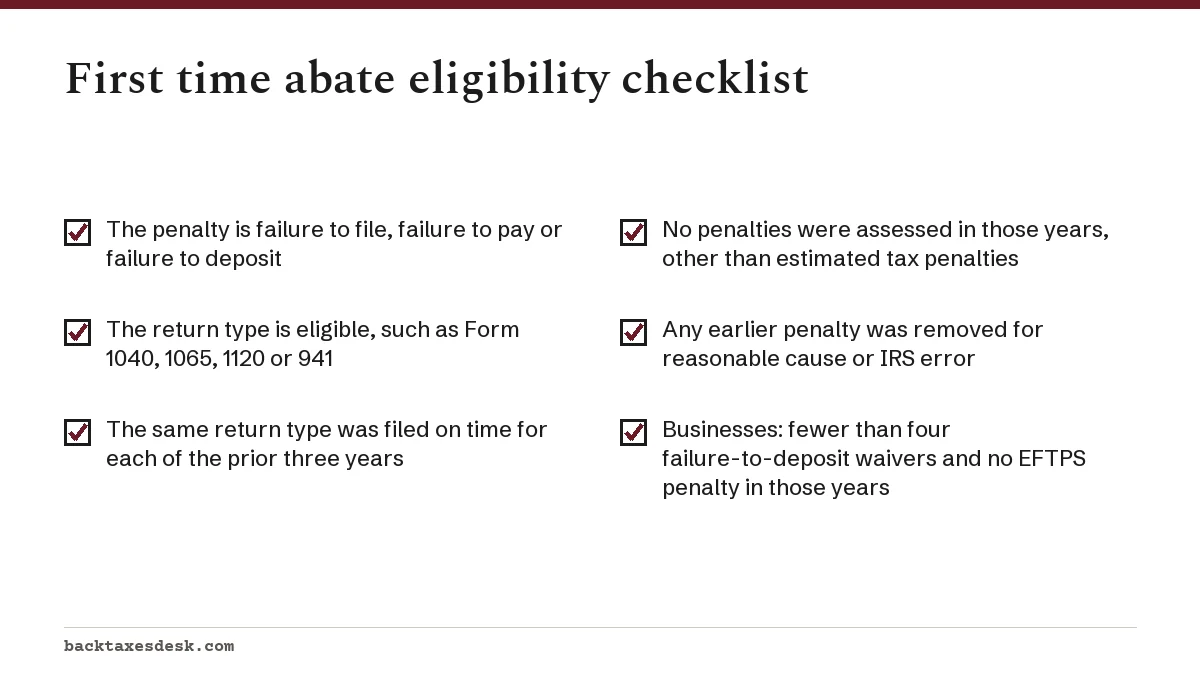
You qualify for first time abate if you have what the IRS calls a timely compliance history. There are two parts, and both look only at the three tax years before the year you want relief for (or the 12 quarters before, for quarterly returns such as Form 941).
Part one: returns filed on time
You must have filed the same type of return on time for each of the prior three years. For a Form 1040 penalty on tax year 2024, the IRS looks at your tax years 2021, 2022 and 2023 Form 1040 filings. A return filed under a valid extension counts as on time.
Part two: no penalties in those years
No penalty may have been assessed in those three years, with two exceptions. An estimated tax penalty does not count against you. And a penalty that was assessed but later removed for reasonable cause or IRS error is ignored. A penalty removed for any other reason, or one you simply paid, still counts.
Extra tests for businesses
Business filers must also show that the IRS did not waive failure-to-deposit penalties four or more times in the prior three years, and that no penalty was charged for not using the Electronic Federal Tax Payment System (EFTPS) when required.
First time penalty abatement requirements in real situations
The table applies the IRS test to common Form 1040 situations for a penalty on a tax year 2024 return. It is a reading of the published rules, not an IRS ruling on any account.
| Your 2021 to 2023 record | Likely result | Why |
|---|---|---|
| All filed on time, no penalties | Qualifies | Both parts of the test are met |
| Estimated tax penalty on 2022 only | Qualifies | Estimated tax penalties are excluded from the test |
| Late payment penalty on 2022, paid and never removed | Does not qualify | A penalty was assessed in the look-back period |
| Late filing penalty on 2021, removed for reasonable cause | Qualifies | Penalties removed for reasonable cause are ignored |
| 2023 return filed two months late | Does not qualify | Not every prior return was filed on time |
If you fail the test, you are not stuck. Reasonable cause penalty abatement looks at why you missed the deadline instead of at your history.
Which penalties and returns does it cover?
The IRS lists these returns as eligible for administrative penalty relief: Forms 1040, 1065, 1120, 940, 941, 943, 944, 945 and CT-1. So first time penalty abatement on a 1040 covers the failure-to-file and failure-to-pay penalties on an individual return, the two penalties most people see on a CP14 or later bill.
- Not covered: returns filed only for a single event or infrequently, such as Form 706 and Form 709.
- Not covered: the daily delinquency penalty and information returns that depend on other filings.
- Not covered: the estimated tax penalty, which has its own waiver rules.
- Interest: interest on the removed penalty goes too; interest on the tax does not.
For the size of the penalties at stake, see the failure to file penalty page: on a large balance, removing a 22.5% late filing charge can be worth thousands of dollars.
Is first time abate being replaced?
Yes, in stages. On July 8, 2026 the IRS announced the Automatic Exemption from Penalty (AEP), which uses the same history test but applies relief during processing, so the penalty is never assessed and you never have to ask. AEP replaces first time abate for eligible returns with original due dates on or after January 1, 2027.
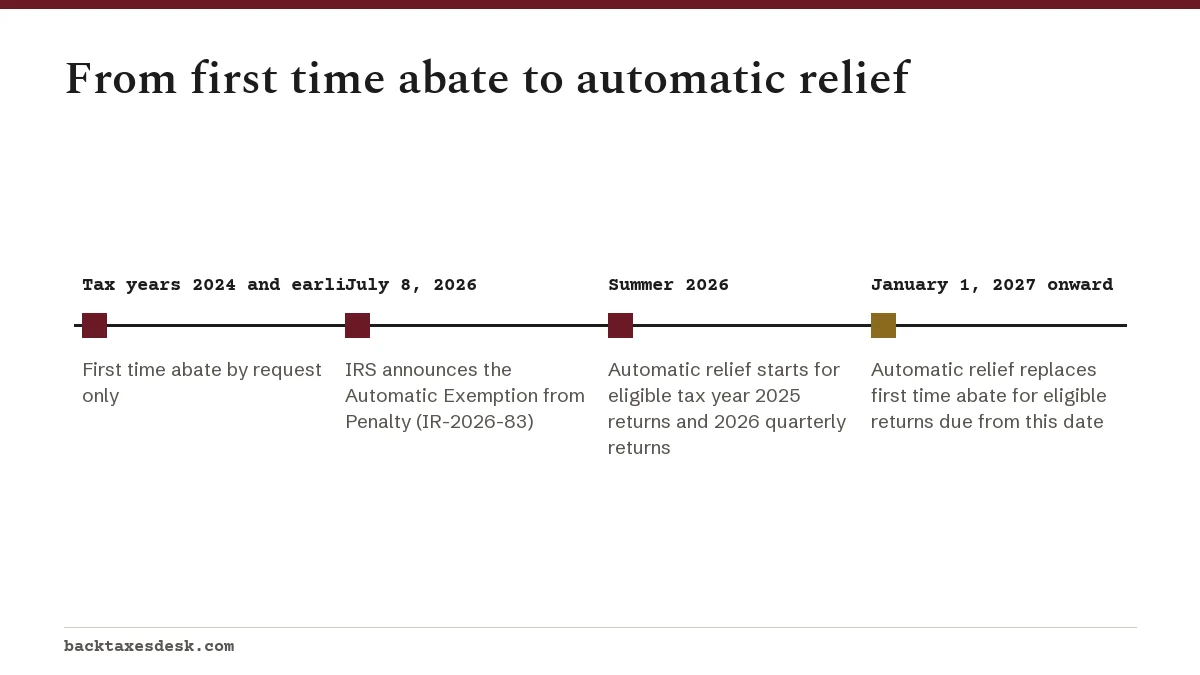
First time abate still matters in three cases: penalties on tax years 2024 and earlier, tax year 2025 returns not yet considered for AEP, and anyone who receives a penalty notice during the transition even though they meet the test. Our page on IRS automatic penalty relief covers the new program in detail.
How do I ask for it, and what if I do not qualify?
You can ask by calling the number on your penalty notice, by writing to the IRS, or by filing Form 843, Claim for Refund and Request for Abatement. You do not need to use the words first time abate or attach anything. Step-by-step instructions, including a letter outline, are in how to request first time penalty abatement.
If the IRS finds your history does not qualify, it tells you, and you can still request relief for reasonable cause. The full set of penalty rates and relief options is in the IRS penalties guide.
Common questions
Can you use first time abate more than once?
The test looks back three years each time, and a penalty removed by first time abate is not one of the exceptions the IRS ignores. So after using it, you generally need three new clean years before it can apply again.
Does first time abate remove interest?
It removes the interest charged on the penalty that was abated. Interest on the unpaid tax itself remains due.
Do I have to pay the tax before asking for first time abate?
The IRS relief page does not list full payment as a condition of the history test. Paying the tax still makes sense because interest keeps running on any unpaid balance.
Does an estimated tax penalty in a prior year disqualify me?
No. The IRS test counts all prior penalties except the estimated tax penalty.
Is first time abate available for tax year 2026 returns?
Tax year 2026 Form 1040 returns are due April 15, 2027, after the January 1, 2027 switch date, so eligible filers should get the automatic exemption instead. If you still receive a penalty notice, you can ask for first time abate.
Sources
- Penalty relief due to First Time Abate or other administrative waiver irs.gov
- Administrative penalty relief irs.gov
- IR-2026-83, IRS simplifies penalty relief irs.gov
- About Form 843 irs.gov
We check figures against these official pages. Rules change; confirm anything that affects a deadline or payment with the agency before you act.
Tell us what happened
Describe your situation and our editors will use it to improve this guide. If you leave your email, we may reply with a pointer to the right page or official contact. We never share your details.