
Form 843 for penalty abatement: a line-by-line guide
Short answer
Form 843, Claim for Refund and Request for Abatement, is the IRS form for asking in writing that a penalty or certain interest be removed, or refunded if already paid. For a late filing or late payment penalty on a Form 1040, you check Income tax, Form 1040, the penalty's code section and a reason box, then explain on line 8.
- 01Full name
- Form 843, Claim for Refund and Request for Abatement
- 02Current revision
- December 2024
- 03One form covers
- One tax period and one type of tax
- 04Where to mail if you got a notice
- The return address on that notice
- 05Refund time limit for a paid penalty
- 3 years from filing or 2 years from payment, whichever is later
- 06Appeal window after denial
- Generally 30 days from the rejection letter
What is Form 843 used for?
Form 843 is used to ask the IRS to abate (cancel) or refund certain taxes, interest, penalties, fees and additions to tax. For people who owe back taxes, its main use is an IRS penalty abatement request: removing a failure-to-file or failure-to-pay penalty, or refunding one you already paid. The current version is the December 2024 revision (IRS, About Form 843).
The form is also one way to request interest abatement when interest built up because of an unreasonable IRS error or delay under Internal Revenue Code section 6404(e)(1). That relief applies only to taxes that need a notice of deficiency, such as income tax; interest tied to employment or excise taxes cannot be abated this way.
When not to use Form 843
- To change the income tax on a return or claim an income tax refund. Use Form 1040-X instead.
- To ask the IRS to reduce the income, estate or gift tax itself.
- For the estimated tax penalty. The IRS directs waiver requests for that penalty to Form 2210 or a signed statement; see our estimated tax penalty page.
- When a phone call would be faster. Many penalty removals, including First Time Abate, can be granted by calling the number on the notice.
Can I use Form 843 for first time abate?
Yes. The IRS accepts First Time Abate requests by phone, by written statement or on Form 843, and you do not have to name First Time Abate or attach documents. The form has no box labeled with that name. Check the penalty box at the top for reasonable cause or other reason allowed under the law, check line 7, box c, and state on line 8 that you are asking for administrative penalty relief based on your filing and payment history.
Before mailing, confirm you likely qualify using our steps to request first time penalty abatement. For tax year 2026 returns due April 15, 2027, the IRS plans to apply automatic relief during processing for eligible filers, so check your notice first: if it already confirms relief, no Form 843 is needed.
Read the video transcript
Form 843 for penalty abatement: a line-by-line guide
Form 843, Claim for Refund and Request for Abatement, is the IRS form for asking in writing that a penalty or certain interest be removed, or refunded if already paid.
Full name: Form 843, Claim for Refund and Request for Abatement.
Current revision: December 2024.
One form covers: One tax period and one type of tax.
Yes. The IRS accepts First Time Abate requests by phone, by written statement or on Form 843, and you do not have to name First Time Abate or attach documents.
Page 1 starts with a list of reasons grouped under Tax, Penalty, Interest and Other.
The table uses a common case: a failure-to-pay penalty of $412 on a tax year 2025 Form 1040 that has not been paid yet.
Is there a faster way than mailing Form 843? Often, yes. The IRS accepts many penalty relief requests, including First Time Abate, by phone at the number on the notice.
Form 843 instructions: the top section and reason boxes
Page 1 starts with a list of reasons grouped under Tax, Penalty, Interest and Other. Check the one that matches your request. For most people with back taxes, it is one of these:
| Group | Box text (shortened) | Use it when |
|---|---|---|
| Penalty | Penalty due to reasonable cause or other reason allowed under the law | Late filing or late payment penalty removal, including First Time Abate |
| Penalty | Penalty due to erroneous written advice by the IRS, section 6404(f) | You followed written IRS advice that turned out to be wrong |
| Interest | Interest due to IRS error or delay, section 6404(e)(1) | Interest grew because the IRS was unreasonably slow or made an error |
| Other | Could not read and timely respond to a standard print notice | You needed an accessible format such as large print or braille |
Below the boxes, enter your name, SSN, your spouse's name and SSN if the penalty relates to a joint return, your current address and a daytime phone number. If the address on the return differs from your current address, list both.
How to fill out Form 843 line by line for a penalty
The table uses a common case: a failure-to-pay penalty of $412 on a tax year 2025 Form 1040 that has not been paid yet.
| Line | What it asks | Example entry |
|---|---|---|
| 1 | Tax period (beginning and ending dates) | 01/01/2025 to 12/31/2025 |
| 2 | Amount to be refunded or abated | $412 |
| 3 | Dates of payments you want refunded | Blank if you have not paid the penalty |
| 4 | Type of tax | Box e, Income |
| 5 | Type of return | Box i, 1040 |
| 6 | Internal Revenue Code section of the penalty | 6651(a)(2), as shown on the notice |
| 7 | Reason for the request | Box c, reasonable cause or other reason allowed under the law |
| 8 | Explanation and how you figured line 2 | Your dated facts, evidence list and the notice amount |
Line 6: finding the code section
Your penalty notice names the code section. The late filing penalty is section 6651(a)(1). The late payment penalty on tax shown on your return is section 6651(a)(2), and on tax assessed later after a notice is section 6651(a)(3). Copy exactly what the notice shows rather than guessing.
Line 7: choosing between boxes a to d
Box a is for interest caused by IRS errors or delays. Box b is for a penalty caused by erroneous written IRS advice. Box c covers reasonable cause and other reasons allowed under the law, which is where most penalty requests belong. Box d means none of the listed reasons apply.
Line 8: the explanation
Line 8 is where requests are won or lost. State what happened and when, why it stopped you from filing or paying, and what you did once you could. Attach extra pages if needed and list each document. Our page on reasonable cause penalty abatement shows what the IRS accepts and what it rejects.
Signing Form 843 and the one-period rule
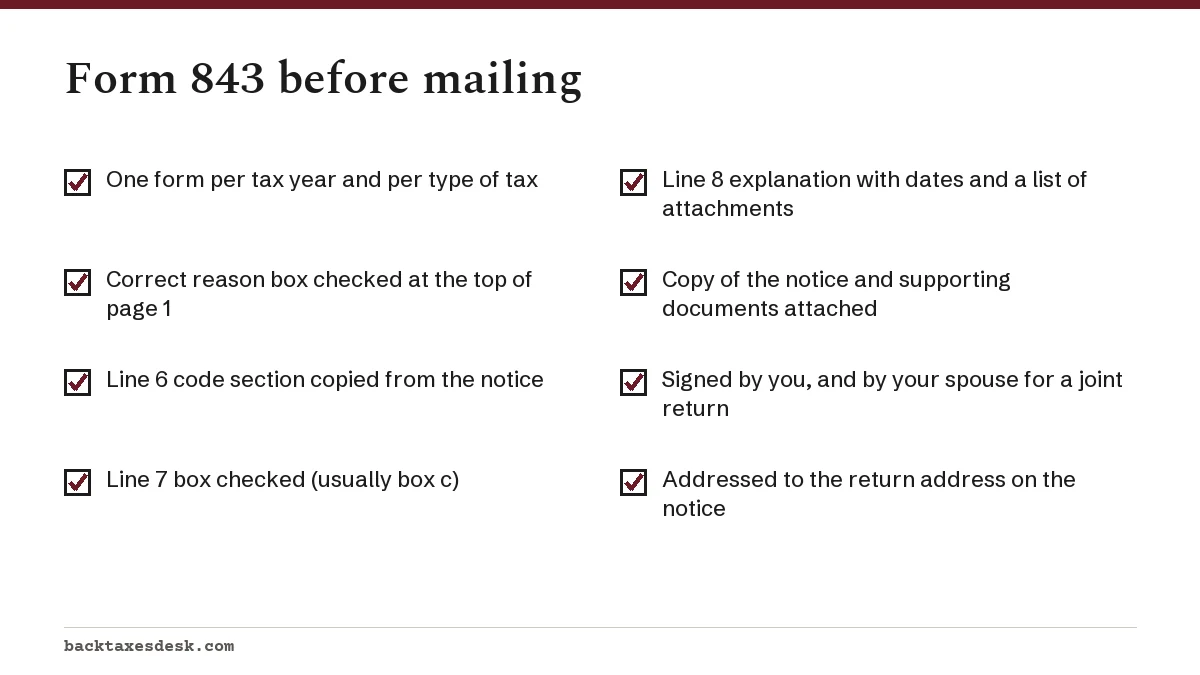
Sign and date the form under penalties of perjury. If the penalty relates to a joint return, both spouses must sign. If the IRS issued you an Identity Protection PIN, enter it next to your signature.
Use a separate Form 843 for each tax period and each type of tax. Penalties on your 2023 and 2024 Form 1040 need two forms. Both penalties for the same year, late filing and late payment, can go on one form if they relate to the same period and tax, with the combined amount on line 2 and both code sections explained on line 8.
Where do I mail Form 843?
Mail Form 843 to the return address on the IRS notice about the penalty. If you have no notice, send it to the service center where you would file a current-year return for that type of tax (IRS, Instructions for Form 843).
- Use certified mail with return receipt so you can prove the date you sent it.
- Write your SSN, the tax year and the notice number on each attached page.
- Include a copy of the notice, not the original.
- Keep a complete copy of the packet, including attachments.
How long does Form 843 take, and what happens after you file?
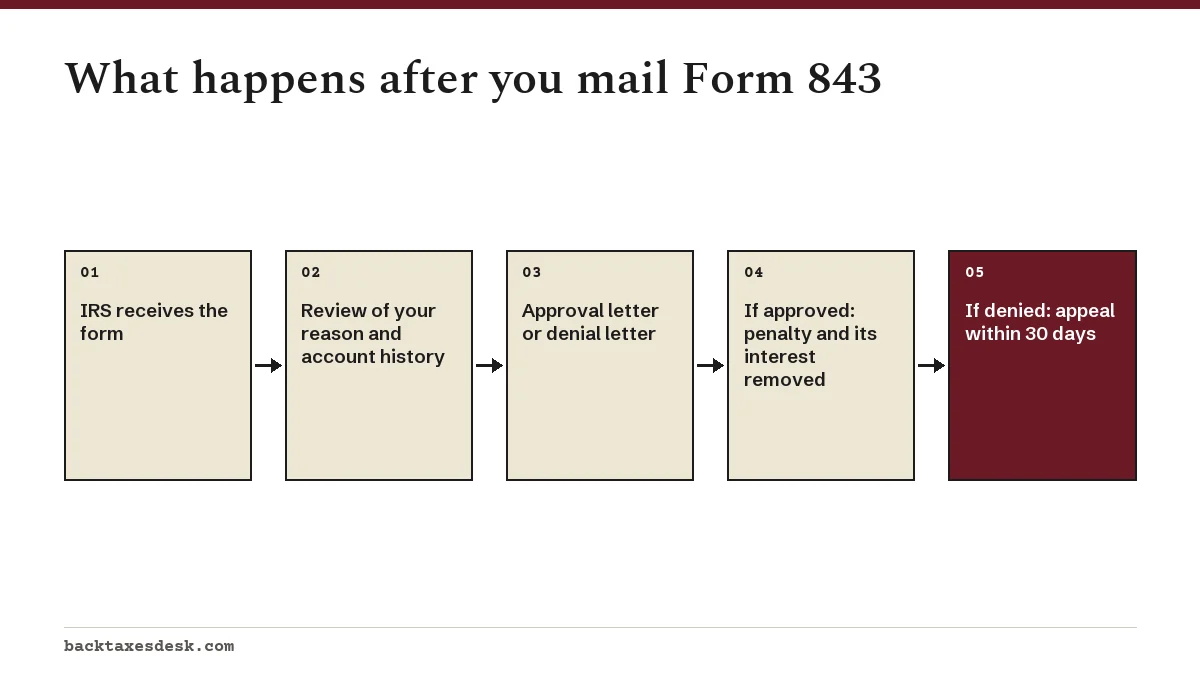
The IRS does not list a standard processing time for Form 843 on its form page. Expect a written answer by mail, either a letter approving the abatement or a letter denying it with your appeal rights.
If it is approved
The penalty comes off your account, and the interest the IRS charged on that penalty is reduced or removed automatically. If you had already paid, the refund or credit goes to your account; any other balance you owe may absorb it first.
If it is denied
You generally have 30 days from the date of the rejection letter to request an appeal of a denied failure-to-file or failure-to-pay penalty request. Address the specific reason given for the denial and add new evidence where you can.
Deadline for asking for a refund of a penalty you already paid
If you paid the penalty and want the money back, Form 843 is a refund claim, so the refund time limit applies. You generally must file within 3 years from the date you filed the original return or 2 years from the date you paid, whichever is later.
Example: you filed your 2022 return on May 1, 2023, and paid a late payment penalty on March 10, 2025. The 3-year window runs to May 1, 2026 and the 2-year window to March 10, 2027. The later date controls, so a Form 843 mailed in September 2026 is still on time. Enter the payment date on line 3.
To estimate the dollar amount to put on line 2 before your notice arrives, try the IRS penalty calculator, and see the IRS penalties guide for every penalty type.
Step by step
Check whether a call will do
Call the number on the penalty notice first; the IRS can often remove a penalty by phone, and eligible 2027 returns may get automatic relief.
Gather the notice and evidence
Collect the penalty notice, the code section it names, and documents with dates that explain the delay.
Check the reason box at the top
Choose the penalty box for reasonable cause or other reason allowed under the law, or the interest box for IRS error or delay.
Complete lines 1 to 7
Enter the tax period, amount, any payment dates, Income tax, Form 1040, the code section and line 7 box c.
Write the line 8 explanation
Give dated facts, explain why you could not comply, show what you did afterward and list attachments.
Sign and mail
Both spouses sign for a joint return. Mail to the address on the notice by certified mail and keep a copy.
Common questions
Is there a faster way than mailing Form 843?
Often, yes. The IRS accepts many penalty relief requests, including First Time Abate, by phone at the number on the notice. Form 843 is the written route when a call does not resolve it or you want a paper record.
Do I need a separate Form 843 for each year?
Yes. The instructions say to prepare a separate Form 843 for each tax period and each type of tax. Penalties for three different years need three forms.
What IRC section do I put on Form 843 for a late payment penalty?
Use the section printed on your notice. For a late payment penalty on tax shown on the return that is usually section 6651(a)(2); for a late filing penalty it is section 6651(a)(1).
Can I use Form 843 to remove interest?
Only in limited cases. Form 843 can request interest abatement for unreasonable IRS errors or delays under section 6404(e)(1). The IRS does not remove interest for reasonable cause, though interest on a removed penalty goes away with it.
Should both spouses sign Form 843?
Yes, if the penalty relates to a joint return, both spouses must sign the form. Each spouse enters an Identity Protection PIN if the IRS issued one.
What if the IRS does not answer my Form 843?
Check your IRS online account or call the number on the original notice to confirm it was received. Keep your certified mail receipt as proof of the date you sent it.
Sources
- About Form 843, Claim for Refund and Request for Abatement irs.gov
- Instructions for Form 843 irs.gov
- Form 843 (Rev. December 2024) irs.gov
- Penalty relief due to First Time Abate or other administrative waiver irs.gov
- Penalty relief for reasonable cause irs.gov
- Penalty appeal irs.gov
We check figures against these official pages. Rules change; confirm anything that affects a deadline or payment with the agency before you act.
Tell us what happened
Describe your situation and our editors will use it to improve this guide. If you leave your email, we may reply with a pointer to the right page or official contact. We never share your details.