
IRS automatic penalty relief: how the Automatic Exemption from Penalty works
Short answer
IRS automatic penalty relief, called the Automatic Exemption from Penalty (AEP), means the IRS does not assess late filing, late payment or failure to deposit penalties if you filed and paid on time for the prior three years. No request is needed. It began in summer 2026 and replaces First Time Abate for eligible returns due on or after January 1, 2027.
- 01Announced
- July 8, 2026 (IR-2026-83)
- 02Starts
- Summer 2026, for tax year 2025 returns and 2026 quarterly returns
- 03Replaces First Time Abate
- For eligible returns with original due dates on or after January 1, 2027
- 04Penalties covered
- Failure to file, failure to pay, failure to deposit
- 05Action required
- None; the IRS mails a notice confirming the relief
What is the IRS Automatic Exemption from Penalty?
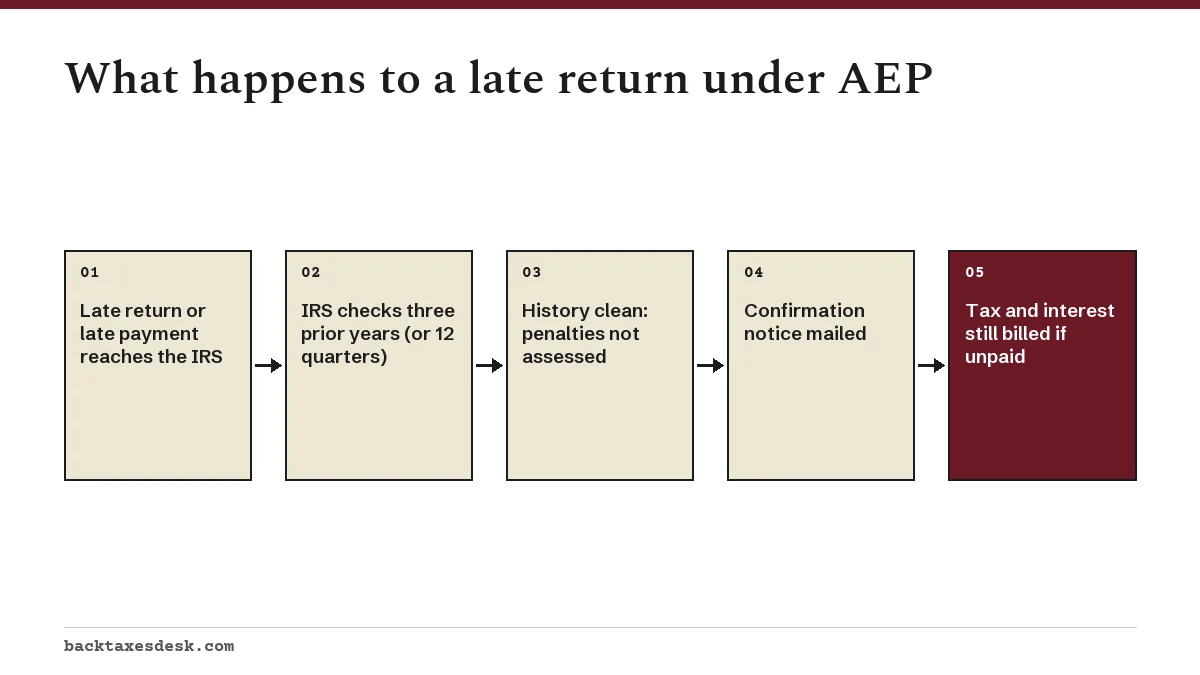
The Automatic Exemption from Penalty (AEP) is IRS automatic penalty relief applied while a return is being processed. If your record shows timely filing and payment for the three prior years, the IRS simply does not assess the failure to file, failure to pay or failure to deposit penalty for the current late return. The IRS announced it on July 8, 2026 in news release IR-2026-83.
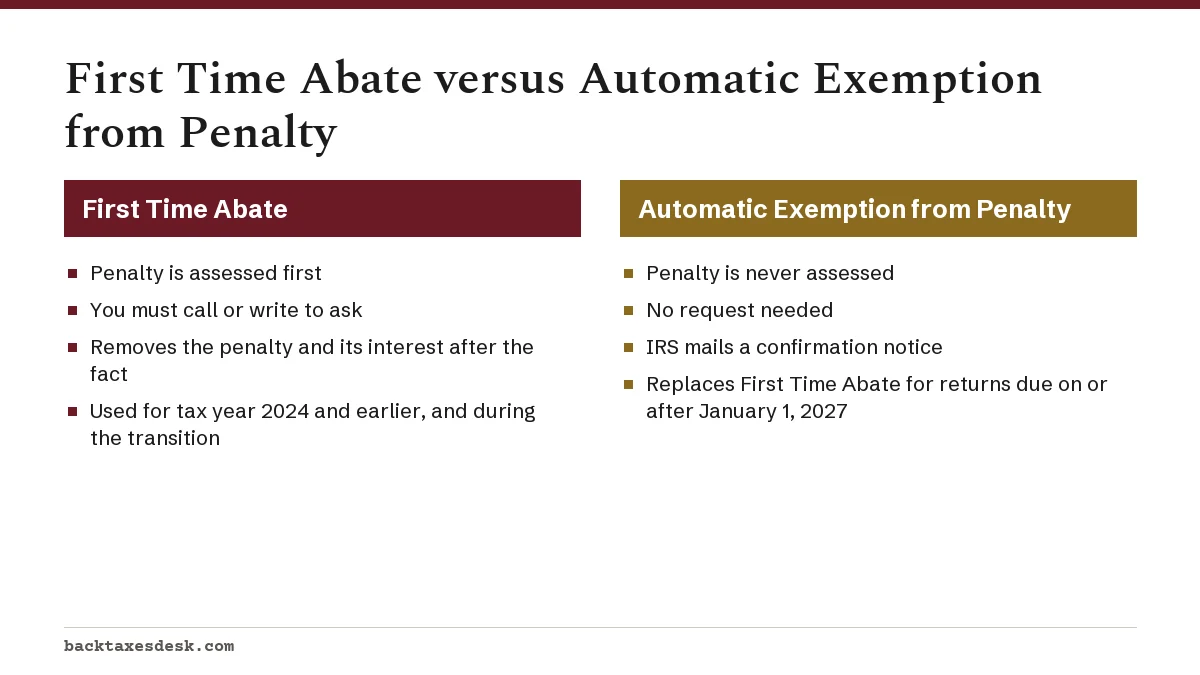
The difference from older relief is timing. Under First Time Abate, a penalty was charged first and removed only after you asked. Under AEP, the penalty never appears on your account, and the IRS mails a notice explaining that the penalties were not assessed because of your compliance history.
Who qualifies for IRS AEP?
You qualify if you filed or paid late this year but filed the same type of return on time and paid the tax due for each of the three prior years. Quarterly filers, such as employers filing Form 941, need 12 consecutive compliant quarters instead. The IRS checks this history itself; there is nothing to submit.
Here is how the test plays out for a Form 1040 filer whose tax year 2026 return, due April 15, 2027, arrives late with a balance owed.
| History for tax years 2023, 2024 and 2025 | Likely outcome |
|---|---|
| All three returns filed on time and all tax paid by the due date | Qualifies; penalties not assessed |
| Tax year 2024 return filed two months late | Does not qualify; the history is broken |
| Tax year 2023 balance paid late on a payment plan | Does not qualify; the payment history is broken |
| Tax year 2025 return filed on time under a valid extension | Extensions count as timely filing; the payment history must also be clean |
| No return required for one of those years (income below the filing threshold) | Check with the IRS; the published test speaks of returns filed, and the IRS has not detailed this case |
If you are not sure how your history looks, the account transcripts in your IRS online account list each year's filing date, payments and any penalty codes. That record is what the IRS compares against the test.
Which returns are covered and which are excluded?
AEP covers the regular income and employment tax returns that most individuals and businesses file every year or every quarter. It does not cover returns tied to a single event or information returns.
| Covered | Not covered |
|---|---|
| Form 1040 (individual income tax) | Form 706 (estate tax) |
| Form 1065 (partnerships) and Form 1120 (corporations) | Form 709 (gift tax) |
| Forms 940, 941, 943, 944 and 945 (employment taxes) | Information returns |
| Form CT-1 (railroad retirement taxes) | Returns filed only once or for infrequent events |
Coverage is also limited by penalty. Only the failure to file, failure to pay and failure to deposit penalties are waived. The IRS lists the daily delinquency penalty as excluded, and other charges, such as the estimated tax penalty figured on Form 2210, are not among the covered penalties.
Do I need to request automatic penalty relief?
No. The IRS applies AEP on its own while processing an eligible return, and you receive a notice confirming the relief. You do not call, write a letter or file Form 843.
What you should do is read the notice closely. A confirmation that penalties were not assessed is not a statement that you owe nothing. If the same notice or a later one shows a balance of tax and interest, pay it or set up a payment plan, because unpaid tax can still lead to collection notices.
- Keep the confirmation notice with that year's return.
- Check the balance due line for any remaining tax and interest.
- Pay in full or request a plan before the date shown on the notice.
- File next year's return on time: a late return now breaks your three-year history and you lose AEP for the following years until the record rebuilds.
Can I still use first time abate? The transition explained
Yes, during the transition. First Time Abate stays available for older years and for anyone who is billed a penalty even though they meet the history test. It is replaced by AEP only for eligible returns with original due dates on or after January 1, 2027.
| Return | Relief route |
|---|---|
| Tax year 2024 and earlier Form 1040 | First Time Abate, by request |
| Tax year 2025 Form 1040 (due April 15, 2026) | AEP applied from summer 2026; if a penalty notice arrives anyway, request First Time Abate |
| 2026 quarterly returns (for example, Form 941) | AEP |
| Tax year 2026 Form 1040 (due April 15, 2027) and later | AEP replaces First Time Abate |
If you receive a penalty notice for a return you believe qualifies, the IRS says you may contact it to request First Time Abate, using the number in the top right corner of the notice or a written statement. The steps are on our page on how to request first time penalty abatement, and the eligibility rules are in the first time penalty abatement guide.
What if you do not qualify for automatic relief?
If your history is not clean, the IRS assesses the penalties as usual and you can still ask for relief for reasonable cause. Reasonable cause covers events outside your control, such as a serious illness, a disaster or being unable to get records, and it is reviewed on the facts you provide.
- Reasonable cause: explain what happened, when, and how you fixed it once you could. See reasonable cause penalty abatement.
- Cut the penalty that remains: file right away to stop the 5% monthly late filing charge, and pay what you can to slow the 0.5% monthly late payment charge.
- Plan for the rates: current penalty percentages and the dollar minimum for late returns are listed in IRS penalty rates for 2027.
One more point for the future: every year you file and pay on time rebuilds the record. Three clean years in a row put you back within the AEP test for the next late return.
Common questions
Is IRS automatic penalty relief real?
Yes. The IRS announced the Automatic Exemption from Penalty on July 8, 2026 in news release IR-2026-83 and describes it on its administrative penalty relief page on irs.gov. Be wary of any company that charges a fee to apply it, since no application exists.
Does AEP remove interest?
AEP does not remove interest on the tax itself, which keeps running until you pay. Because the penalties are never assessed, no interest builds on them.
Which returns qualify for AEP?
Forms 1040, 1065, 1120, 940, 941, 943, 944, 945 and CT-1 are covered. Information returns and returns filed only for rare events, such as Forms 706 and 709, generally are not.
Will I get a letter if the IRS applies automatic penalty relief?
Yes. The IRS sends a notice saying that although the return was filed or paid late, the penalties were not assessed because of your history of timely compliance.
Does automatic penalty relief apply to state taxes?
No. AEP is a federal IRS program. State tax agencies set their own penalty and waiver rules, so check your state revenue department separately.
Can a business get automatic penalty relief on payroll taxes?
Yes, if it has 12 consecutive quarters of timely compliance. Employment tax returns such as Forms 941, 940, 943, 944 and 945 are covered, including the failure to deposit penalty.
Sources
- IRS: IRS simplifies penalty relief, introduces automatic process for eligible taxpayers (IR-2026-83) irs.gov
- IRS: Administrative penalty relief irs.gov
- IRS: Penalty relief due to First Time Abate or other administrative waiver irs.gov
- IRS: Quarterly interest rates irs.gov
We check figures against these official pages. Rules change; confirm anything that affects a deadline or payment with the agency before you act.
Tell us what happened
Describe your situation and our editors will use it to improve this guide. If you leave your email, we may reply with a pointer to the right page or official contact. We never share your details.