
If AI gets your tax return wrong, who is responsible?
Short answer
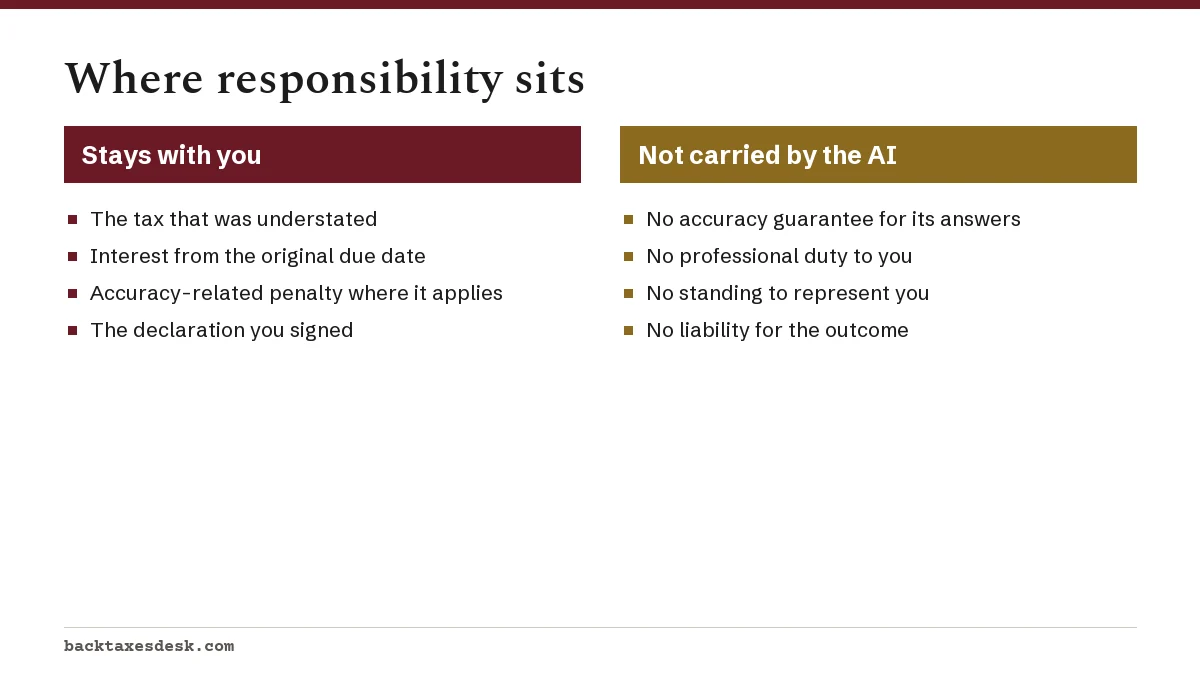
You are responsible. Signing a return is a declaration that it is true and complete to the best of your knowledge, and nothing about using AI changes that. The tax is owed, interest runs from the original due date, and an accuracy-related penalty of 20% of the underpayment can apply. "The AI told me" is not reasonable cause on its own.
- 01Who is liable
- The taxpayer who signs the return
- 02Accuracy-related penalty
- 20% of the underpayment
- 03Interest
- Runs from the original due date, not from discovery
- 04Is "AI said so" reasonable cause
- Not on its own
Who is responsible when AI makes a tax mistake?
The person who signs the return. When you file, you declare under penalties of perjury that the return is true, correct and complete to the best of your knowledge. That declaration does not carve out the parts a machine filled in.
The Taxpayer Advocate Service has said the same thing plainly: taxpayers remain responsible for the accuracy of their returns and should not rely solely on AI chatbots. No chatbot carries liability for a tax answer, and no consumer AI feature in tax software promises the AI's conclusions are correct.
What does it cost when the return is wrong?
Three separate things, and people often plan for only the first.
| What | How it works |
|---|---|
| The tax itself | Owed in full, whoever made the error |
| Interest | Runs from the original due date until paid |
| Accuracy-related penalty | 20% of the underpayment where it applies |
| Fraud penalty | Reserved for intent, not for a bad AI answer |
Interest is the part that surprises people, because it runs from the original due date rather than from the day the mistake was found. A problem discovered two years later carries two years of interest. How the charges build is covered in penalties and interest.
Is "the AI told me" reasonable cause?
Not by itself. Reasonable cause turns on whether you exercised ordinary business care and prudence, and accepting an answer from a tool that publishes no accuracy guarantee is hard to present as care.
Reliance on professional advice can support a reasonable cause argument, and that has a shape the IRS recognises: a qualified adviser, given the full facts, who reached a considered conclusion you relied on in good faith. A chatbot session meets none of those tests. It has no qualification, you may not have given it the full facts, and it has no professional duty to you.
Where a penalty applies and your record is otherwise clean, first-time penalty abatement may be available regardless of how the error arose.
Does a paid preparer change the answer?
It changes who else can be penalised, not whether you owe the tax.
A paid preparer who signs your return has their own obligations and their own preparer penalties, and a firm using AI carries the same duty of review it always had. That may give you a claim against the preparer. It does not remove the tax from your account, because the return is still yours.
Software accuracy guarantees work the same way. Where a vendor promises to cover penalties and interest caused by its own calculation error, that covers arithmetic the program got wrong, not a judgement you accepted from an assistant.
What to do if you think AI put an error on your return
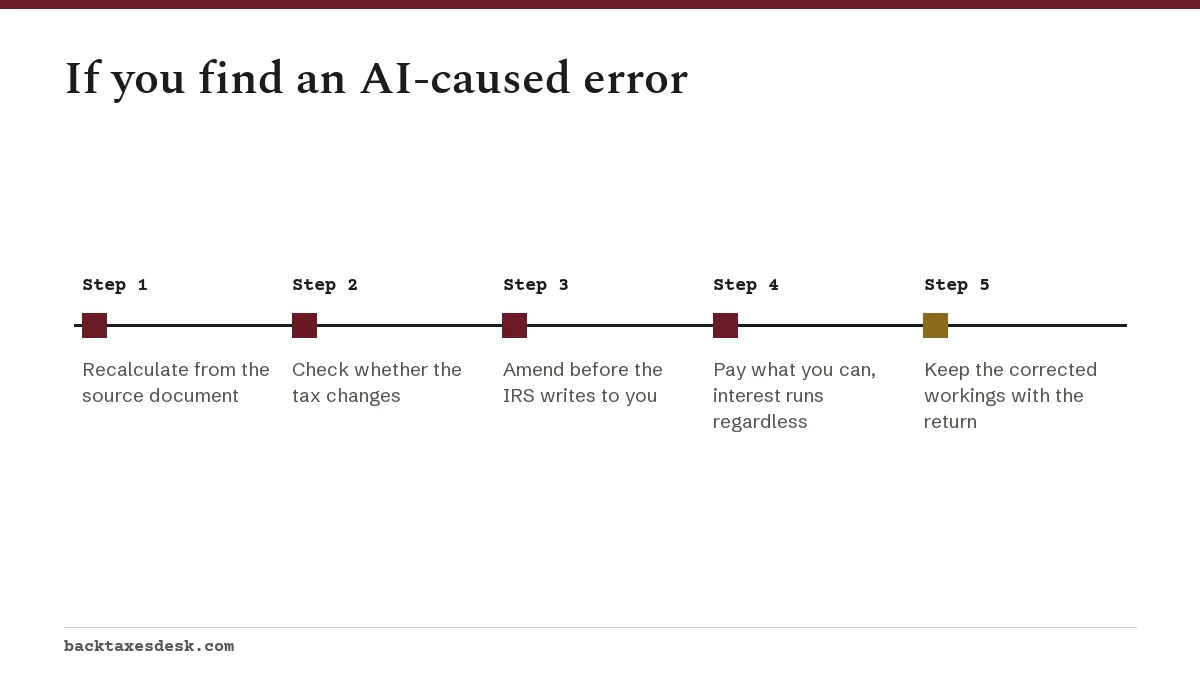
- Work out what the correct figure should have been, from the source document rather than from the tool.
- Check whether it changes the tax. Some errors do not.
- If it does, amend. Filing an amended return before the IRS contacts you is materially better than waiting.
- Pay what you can when you amend, because interest runs on the unpaid balance either way.
- Keep the corrected workings with the return, in case a question arrives later.
If the IRS has already written to you, respond to what the letter asks rather than to the whole return. If you cannot pay the corrected amount, payment plans come before anything sold as tax relief.
Using AI without taking on the risk
- Use it to find where to look, never as the source of a number that goes on the return.
- Ask which form, line or publication an answer comes from, then open that document yourself.
- Be most careful where rules changed recently, which for tax year 2026 means the Schedule 1-A deductions, the charitable deduction floor and the limitation replacing Pease.
- Treat every state answer as unverified until you have checked it against that state's own guidance.
- Keep a note of what you verified and where, because that record is worth something later and a chat transcript is not.
Common questions
Who is responsible if AI makes a mistake on my tax return?
You are. Signing the return is a declaration under penalties of perjury that it is true and complete to the best of your knowledge, and using AI does not change that.
Can I be penalised for an error an AI made?
Yes. The tax is owed, interest runs from the original due date, and an accuracy-related penalty of 20% of the underpayment can apply where the conditions are met.
Is relying on ChatGPT reasonable cause for penalty relief?
Not on its own. Reasonable cause looks at whether you exercised ordinary care, and reliance on advice normally means a qualified adviser given the full facts. A chatbot is neither qualified nor accountable to you.
Does my tax software's accuracy guarantee cover AI errors?
Those guarantees usually cover calculation errors by the software, not judgement calls you accepted from an assistant. Read the specific terms, because they differ by vendor.
Should I amend if AI caused an error?
If the error changes your tax, yes, and sooner is better. Amending before the IRS contacts you puts you in a materially better position than waiting for a notice.
Sources
- Accuracy-related penalty (IRS) irs.gov
- Penalty relief for reasonable cause (IRS) irs.gov
- Should you use AI to file your taxes? (CBS News) cbsnews.com
- Risks of using AI for tax preparation (Davidov CPA) davidovcpa.com
We check figures against these official pages. Rules change; confirm anything that affects a deadline or payment with the agency before you act.
Tell us what happened
Describe your situation and our editors will use it to improve this guide. If you leave your email, we may reply with a pointer to the right page or official contact. We never share your details.