
IRS letter scam: how to tell a real IRS letter from a fake
Short answer
To spot an IRS letter scam, look for the notice number (CP or LTR) in the right corner, look that number up on IRS.gov, and check whether the notice or balance appears in your IRS Online Account. Real IRS letters arrive by U.S. mail, explain your right to disagree, and send payments only to the United States Treasury.
- 01How the IRS usually makes first contact
- U.S. Postal Service mail
- 02Where the notice number appears
- Right corner of the letter (CP or LTR)
- 03Who IRS payments are made out to
- United States Treasury
- 04Report fake IRS emails and texts
- [email protected]
- 052026 Dirty Dozen scam number one
- IRS impersonation by email and text
How can you tell if an IRS letter is real?
An IRS letter is real if its notice number matches a notice described on IRS.gov, the details match what your IRS Online Account shows, and every payment instruction points to the IRS or the United States Treasury. If any of those checks fails, treat the letter as a possible IRS letter scam until the IRS confirms otherwise.
An IRS letter scam is a piece of mail, or a mailed-style document, designed to look like it came from the IRS so you will pay money or hand over personal and bank details. Unlike email scams, fake letters exploit the fact that the IRS really does use mail.
- Find the notice number, a code starting with CP or LTR, in the right corner of the page.
- Search that number on the IRS page "Understanding your IRS notice or letter". The description should match what your letter says.
- Sign in to your IRS Online Account by typing IRS.gov into your browser, not by using a link or QR code on the letter. Check your balance and the notices listed there.
- If the letter is not found or still looks wrong, call the IRS using a number you find on IRS.gov yourself, never the number printed on the suspicious letter.
Does the IRS send letters by regular mail?
Yes. The IRS normally contacts people for the first time by letter delivered by the U.S. Postal Service. It uses email, text or phone only in limited cases, such as when you have opted in or after it has already written to you.
That is why a letter arriving in a cardboard envelope from a private delivery service deserves a closer look. The IRS warned about exactly this in IR-2023-123 on July 3, 2023: a fake letter with an IRS masthead, about an "unclaimed refund", sent in a delivery-service envelope.
Some real letters come from outside the IRS. If your debt was assigned to one of the three private collection agencies the IRS uses, you first get IRS Notice CP40 and then a letter from the agency, both carrying the same taxpayer authentication number.
What are the signs of a fake IRS letter?
The clearest signs of a fake IRS letter are a request to send photos of your ID or bank details by email or phone, contact information that is not an IRS address, and pressure to act immediately. Sloppy formatting and wrong dates are common too.
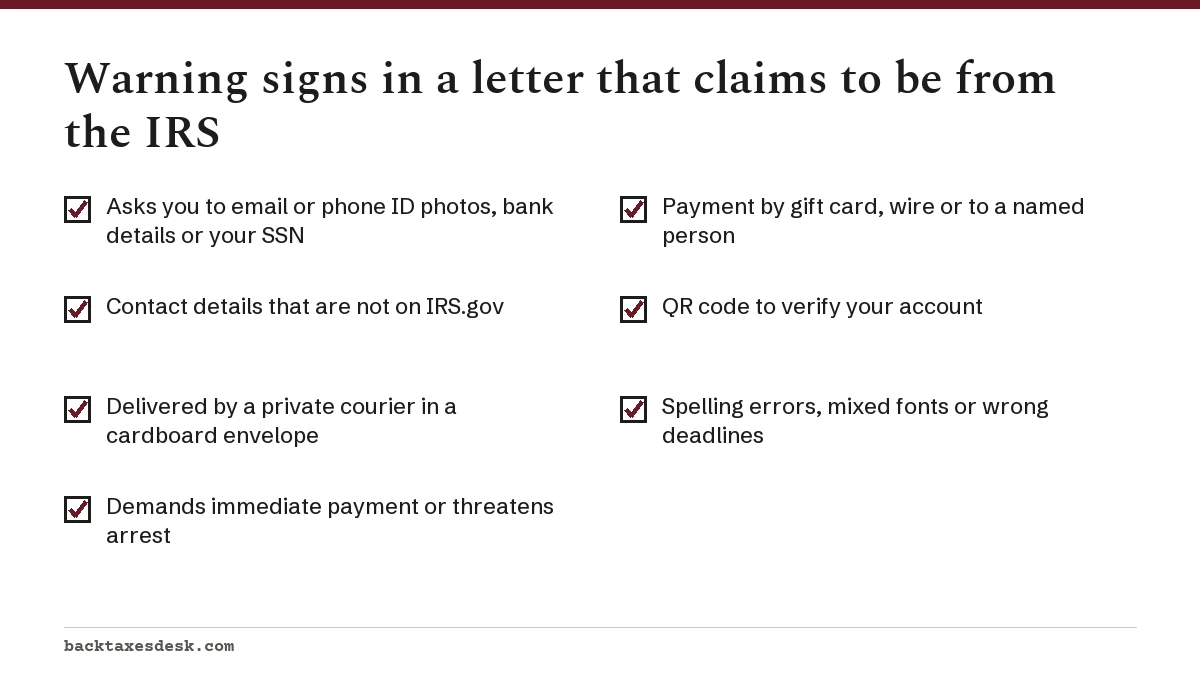
The 2023 delivery-service letter shows how these combine. It asked recipients to send detailed photos of their driver's license, a cell phone number, bank routing and account details and their Social Security number, all to contacts that did not belong to the IRS. The IRS pointed to odd punctuation, mixed fonts, a wrong extension deadline and the phrase "unclaimed property" in place of tax refund language as giveaways.
Real IRS letter or fake: what is different?
A real IRS letter gives you options and time, while a fake one removes both. Real balance-due notices list the amount, the tax year, a due date, and ways to pay or dispute; scam letters demand a single fast action through a channel the IRS does not use.
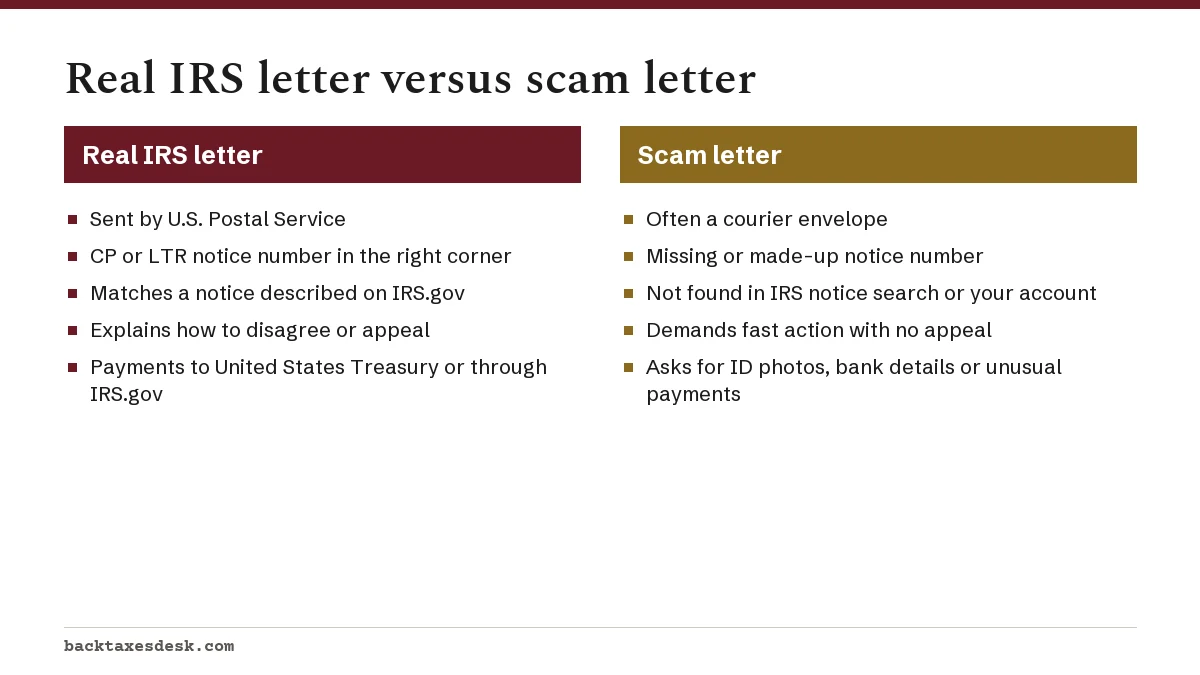
Real letters can still be alarming. A CP14 balance bill, a CP2000 income mismatch or a Final Notice of Intent to Levy all look serious because they are. If a letter checks out, our guide to why you got an IRS letter explains the common notices, and how to respond to an IRS notice covers deadlines and replies.
What should you do with a fake IRS letter?
Do not reply, call, pay or scan anything on a fake IRS letter. Keep the letter and envelope, confirm with the IRS that the notice is not real, and report it.
- Mail scams: the IRS says to verify the letter through its notice search and report fake mail to the U.S. Postal Service, the Federal Trade Commission or your state attorney general.
- Anyone claiming to be the IRS: report to the Treasury Inspector General for Tax Administration (TIGTA) through tigta.gov.
- Emails or texts that follow up on the letter: forward them to [email protected]. Forward scam texts to 7726 (SPAM) as well.
- Social media messages: the IRS says a social media direct message is never from it. Send the full profile URL to [email protected].
If you already sent information or money
Act the same day. Call your bank to block the account or payment, change passwords for any account you entered, and if you gave out your Social Security number, file Form 14039, Identity Theft Affidavit, through the IRS identity theft pages. Watch your IRS Online Account and credit reports for activity you do not recognize.
What IRS letter scams are common in 2026?
IRS impersonation by email and text is first on the IRS's 2026 Dirty Dozen list, and AI-enabled phone impersonation with spoofed caller ID is second. The IRS also reported finding more than 600 social media accounts impersonating it in fiscal year 2025.
These schemes often work together: a letter prompts a call, or a call claims a letter is on its way. The IRS phone scam page covers the phone side, and our summary of the Dirty Dozen tax scams lists all twelve. For trustworthy help with a real notice, start with help with IRS problems.
Step by step
Find the notice number
Look in the right corner of the letter for a code starting with CP or LTR.
Look it up on IRS.gov
Search the number on the IRS page for understanding notices and compare the description with your letter.
Check your IRS Online Account
Type IRS.gov into your browser, sign in, and check your balance and listed notices.
Call the IRS using a number from IRS.gov
If the letter is not found or looks suspicious, call the IRS using contact details from IRS.gov, not from the letter.
Report a fake
Report fake mail to the Postal Service, FTC or state attorney general, and impersonation to TIGTA.
Common questions
Can I check if an IRS letter is legitimate online?
Yes. Search the notice number on IRS.gov and sign in to your IRS Online Account, which shows your balance and certain notices. Reach both by typing IRS.gov yourself.
Is a letter from a collection agency about my IRS debt a scam?
Not necessarily. The IRS uses three private collection agencies, CBE Group, Coast Professional and ConServe, and sends Notice CP40 first. The agency letter must show the same taxpayer authentication number as your CP40.
Why did I get an IRS letter when I don't owe anything?
It may be a real notice about a return change, an identity check or a missing return, or it may be a scam. Look up the notice number and check your account before responding.
Would the IRS ask me to email a photo of my driver's license?
Not in a letter asking you to email or phone the details to an unverified contact. The IRS flagged exactly that request as part of a fake letter in IR-2023-123.
Who do I make an IRS payment out to?
Payments to the IRS are made out to the United States Treasury or made through IRS.gov payment options. A check payable to a person or company is a warning sign.
What if I threw away an IRS letter by mistake?
Sign in to your IRS Online Account to see certain notices and your balance, or contact the IRS through IRS.gov. Do not rely on a replacement copy offered by an unknown caller.
Sources
- Understanding your IRS notice or letter irs.gov
- Recognize tax scams and fraud irs.gov
- Report fake IRS, Treasury or tax-related emails and messages irs.gov
- IR-2023-123: unusual delivery service mailing scam irs.gov
- Dirty Dozen tax scams for 2026 (IR-2026-30) irs.gov
- Online account for individuals irs.gov
We check figures against these official pages. Rules change; confirm anything that affects a deadline or payment with the agency before you act.
Tell us what happened
Describe your situation and our editors will use it to improve this guide. If you leave your email, we may reply with a pointer to the right page or official contact. We never share your details.
Related guides
 Help With IRS Problems: Who Can Represent You and How
Help with IRS problems comes from three places: tools you can use yourself on IRS.gov, free help from the Taxpayer Advocate Servi…
IRS Phone Scam: Back Taxes Calls and How to Respond Safely
An IRS phone scam is a call from someone posing as the IRS who demands immediate payment of back taxes, often by gift card, wire…
Why Did I Get a Letter From the IRS? 7 Common Reasons
You got a letter from the IRS because it needs something about your account: most often you owe a balance, it changed or has a qu…
IRS Scam Alert 2026: Dirty Dozen Scams Aimed at Tax Debt
The main IRS scam alert of 2026 is the Dirty Dozen list, released March 5, 2026 in news release IR-2026-30, which names 12 scheme…
Private Debt Collection IRS: Is That Collector Legit?
Under the private debt collection IRS program, three contracted agencies, CBE Group, Coast Professional and ConServe, collect som…