
IRS scam alert 2026: the Dirty Dozen items that matter if you owe
Short answer
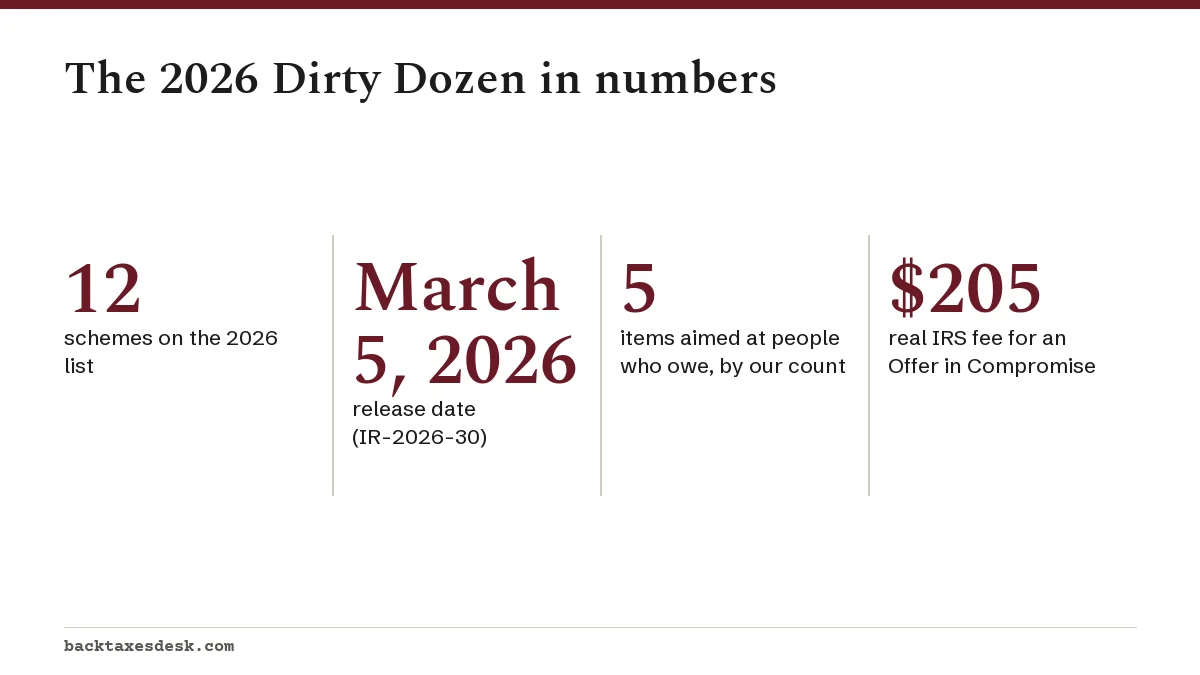
The main IRS scam alert of 2026 is the Dirty Dozen list, released March 5, 2026 in news release IR-2026-30, which names 12 schemes the IRS is warning taxpayers about. For people who owe back taxes, the most relevant are IRS impersonation by phone, email and text, identity theft through IRS Online Account access, ghost preparers, and aggressive Offer in Compromise marketing known as OIC mills.
- 012026 Dirty Dozen release
- March 5, 2026 (IR-2026-30)
- 02Number of schemes listed
- 12
- 032027 list
- Not yet announced; issued during filing season
- 04Report fake IRS emails and texts
- [email protected]
- 05Complain about a preparer
- Form 14157, Complaint: Tax Return Preparer
What is the IRS Dirty Dozen?
The Dirty Dozen is an annual list of 12 tax scams and schemes that the IRS publishes to warn taxpayers and tax professionals. It is the agency's main yearly IRS scam alert, and the 2026 edition was released on March 5, 2026 in news release IR-2026-30.
The list mixes two kinds of threat. Some items are outside criminals stealing money or identities, such as fake IRS calls. Others are schemes that talk taxpayers into filing false claims, which leave the taxpayer, not the promoter, owing the tax back. The IRS notes that the taxpayer is legally responsible for what is filed on their return.
What is on the IRS Dirty Dozen 2026 list?
The IRS Dirty Dozen 2026 list names these 12 items. The third column is our own reading of how each one connects to back taxes.
| # | Scheme | Why it matters if you owe |
|---|---|---|
| 1 | IRS impersonation by email and text | Fake balance-due messages lead to fake payment sites |
| 2 | AI-enabled IRS impersonation by phone | Callers claim back taxes are owed and demand instant payment |
| 3 | Fake charities | Indirect; steals donations and personal data |
| 4 | Misleading tax advice on social media | False claims can later produce a bill with penalties |
| 5 | Identity theft involving IRS Online Account access | The account where you check your balance becomes a target |
| 6 | Abusive undistributed long-term capital gains claims (Form 2439) | Improper refunds must be paid back |
| 7 | Bogus "Self-Employment Tax Credit" promotion | Improper refunds must be paid back |
| 8 | Ghost preparers | Common risk when catching up on unfiled returns |
| 9 | Non-cash charitable contribution schemes | Inflated deductions can be disallowed on audit |
| 10 | Overstated withholding schemes | Fabricated withholding creates a balance due when caught |
| 11 | Spear-phishing and malware aimed at tax professionals | Your representative's files can be exposed |
| 12 | Aggressive Offer in Compromise marketing (OIC mills) | Targets people who already owe |
Items 4, 6, 7, 9 and 10 share a pattern: a refund today, an IRS adjustment later. When the IRS reverses a false claim, the result is a balance due with interest, which is how some people end up reading pages like this one.
Which Dirty Dozen tax scams target people with tax debt?
Five of the 2026 Dirty Dozen tax scams are aimed squarely at people who owe or who are anxious about owing. Fear of an unpaid balance is the lever in each one.
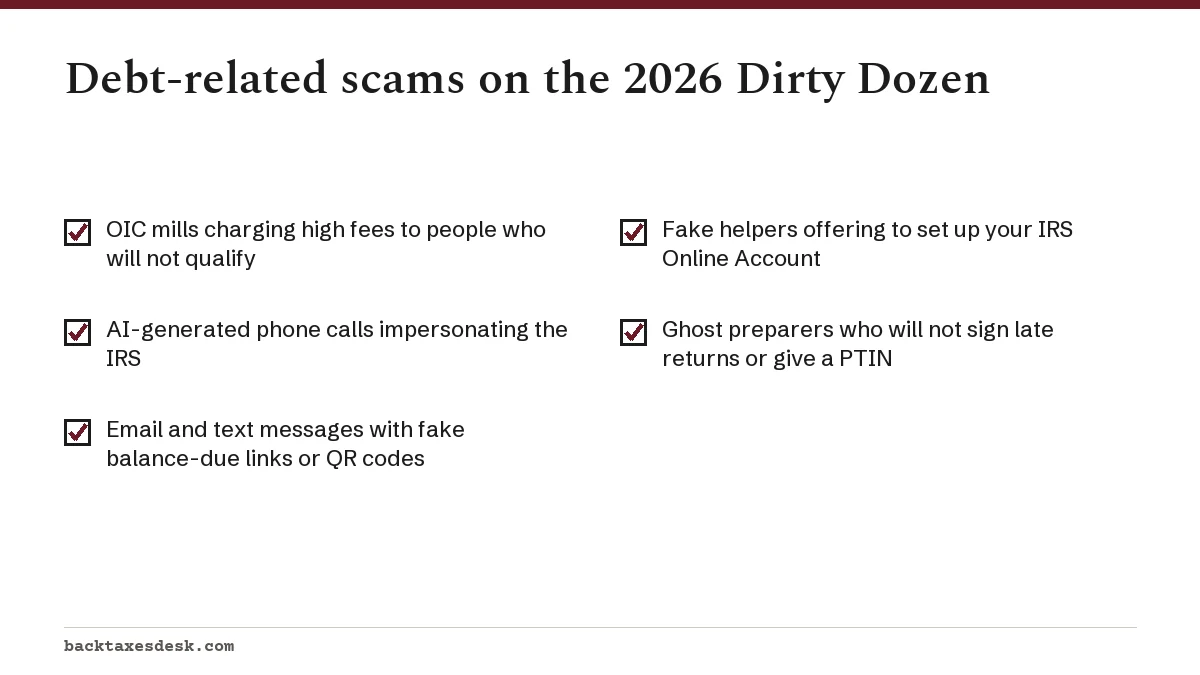
OIC mills
The IRS describes OIC mills as operations that overpromise results and charge high fees to taxpayers who do not qualify for an Offer in Compromise. The IRS's advice is to check eligibility with its own free tools first. The Offer in Compromise Pre-Qualifier on IRS.gov does this, and the real application fee is $205, waived for people who meet the low-income certification. Our guide on tax relief scams walks through the sales script.
Phone, email and text impersonation
For 2026 the IRS singled out calls using spoofed caller ID and computer-generated voices. It says it generally contacts taxpayers by mail first and does not leave urgent, threatening prerecorded messages, demand immediate payment or threaten arrest. The email and text version uses alarming language and QR codes that lead to fake IRS websites. See IRS letter scam for how to verify paper notices.
IRS Online Account identity theft
Criminals try to take over IRS Online Accounts using stolen personal data, or pose as helpers offering to set one up. The IRS says to create your account yourself, directly on IRS.gov, and to turn down unsolicited offers of help. The account is also the safest way to confirm whether a balance is real.
Ghost preparers
A ghost preparer is someone who prepares a return for pay but refuses to sign it or include a Preparer Tax Identification Number (PTIN). The risk is highest when you are rushing to file several late returns at once. Never sign a blank or incomplete return, and use a credentialed professional; enrolled agent vs CPA explains how to check one.
IRS scam alert 2027: when is the next list released?
The 2027 Dirty Dozen list is not yet announced. The IRS releases the list each year during filing season; the 2026 list came out on March 5, 2026, so the 2027 edition would be expected sometime during the 2027 filing season, which the IRS has also not yet dated.
We will not guess the 2027 items. What can be said is which risks carry into tax scams in 2027 because of changes already announced by the IRS:
- Penalty relief confusion. The IRS's Automatic Exemption from Penalty, announced July 8, 2026 (IR-2026-83), removes certain penalties automatically for eligible taxpayers. Anyone charging to "apply" for relief that the IRS now grants without a request deserves a hard look.
- Payment method changes. Under Executive Order 14247 the IRS began phasing out paper refund checks on September 30, 2025, and says any electronic-only payment requirement is not expected before 2027. Messages claiming you must pay a tax bill a new way by a certain date should be checked on IRS.gov.
- AI-generated voices and messages. The 2026 list already flagged them, and they are cheap to produce at scale.
How do I report a tax scam?
Report a tax scam to the channel that matches it: impersonation messages to [email protected], phone impersonation to the Treasury Inspector General for Tax Administration (TIGTA), bad preparers on Form 14157, and general tax fraud tips through IRS.gov/SubmitATip.
| Scam type | Where to report |
|---|---|
| Fake IRS email, text or social media message | [email protected] |
| Fake IRS phone call | TIGTA; the FTC at ReportFraud.ftc.gov if you lost money |
| Ghost preparer or preparer misconduct | Form 14157, Complaint: Tax Return Preparer plus Form 14157-A, Tax Return Preparer Fraud or Misconduct Affidavit, where it applies |
| Tax relief company that took fees and did nothing | FTC at ReportFraud.ftc.gov and your state attorney general |
| Tax fraud or abusive scheme | IRS.gov/SubmitATip |
| Tax-related identity theft | IRS.gov/idtheft |
Reporting does not settle any real balance you may have. Confirm what you owe in your IRS Online Account, then use an official option; the full set of routes, free and paid, is on help with IRS problems. For the phone version of these scams in detail, see IRS phone scam.
Common questions
What are the 2026 Dirty Dozen tax scams?
They are 12 schemes the IRS named on March 5, 2026 (IR-2026-30), including IRS impersonation by email, text and AI phone calls, fake charities, social media tax advice, Online Account identity theft, ghost preparers and aggressive Offer in Compromise marketing.
Is the IRS Dirty Dozen released every year?
Yes. The IRS publishes a Dirty Dozen list each year during filing season. The 2027 list has not been released yet.
What is an OIC mill?
An OIC mill is a company that aggressively markets the IRS Offer in Compromise, overpromises results and charges high fees to people who do not qualify. The IRS added the practice to its 2026 Dirty Dozen.
Can I get in trouble for a false claim a promoter talked me into?
Yes. The IRS says the taxpayer is legally responsible for what is filed on their return, so a false credit or withholding claim can be reversed and billed back to you with interest.
Does the IRS text people about back taxes?
The IRS says it does not send text messages without your permission. Report an unexpected text claiming to be from the IRS to [email protected] and forward it to 7726.
Sources
- Dirty Dozen tax scams for 2026 (IR-2026-30) irs.gov
- Recognize tax scams and fraud irs.gov
- Report phishing and online scams irs.gov
- Make a complaint about a tax return preparer irs.gov
- IRS simplifies penalty relief (IR-2026-83) irs.gov
- Offer in Compromise irs.gov
We check figures against these official pages. Rules change; confirm anything that affects a deadline or payment with the agency before you act.
Tell us what happened
Describe your situation and our editors will use it to improve this guide. If you leave your email, we may reply with a pointer to the right page or official contact. We never share your details.
Related guides
 Help With IRS Problems: Who Can Represent You and How
Help with IRS problems comes from three places: tools you can use yourself on IRS.gov, free help from the Taxpayer Advocate Servi…
Tax Relief Scams: How to Spot a Bad Tax Debt Company Early
Tax relief scams are companies that charge large upfront fees to settle IRS debt, often promising an Offer in Compromise to peopl…
IRS Letter Scam: How to Tell If an IRS Letter Is Real
To spot an IRS letter scam, look for the notice number (CP or LTR) in the right corner, look that number up on IRS.gov, and check…
Enrolled Agent vs CPA: Who Should Handle Your IRS Problem
In the enrolled agent vs CPA choice, both credentials carry unlimited rights to represent you before the IRS in audits, collectio…
IRS Phone Scam: Back Taxes Calls and How to Respond Safely
An IRS phone scam is a call from someone posing as the IRS who demands immediate payment of back taxes, often by gift card, wire…