
Enrolled agent vs CPA: which one to hire for an IRS problem
Short answer
In the enrolled agent vs CPA choice, both credentials carry unlimited rights to represent you before the IRS in audits, collections and appeals, so either can handle a back-tax case. The difference is the license: enrolled agents are licensed by the IRS and tested only on federal tax, while CPAs are licensed by state boards and trained in accounting more broadly.
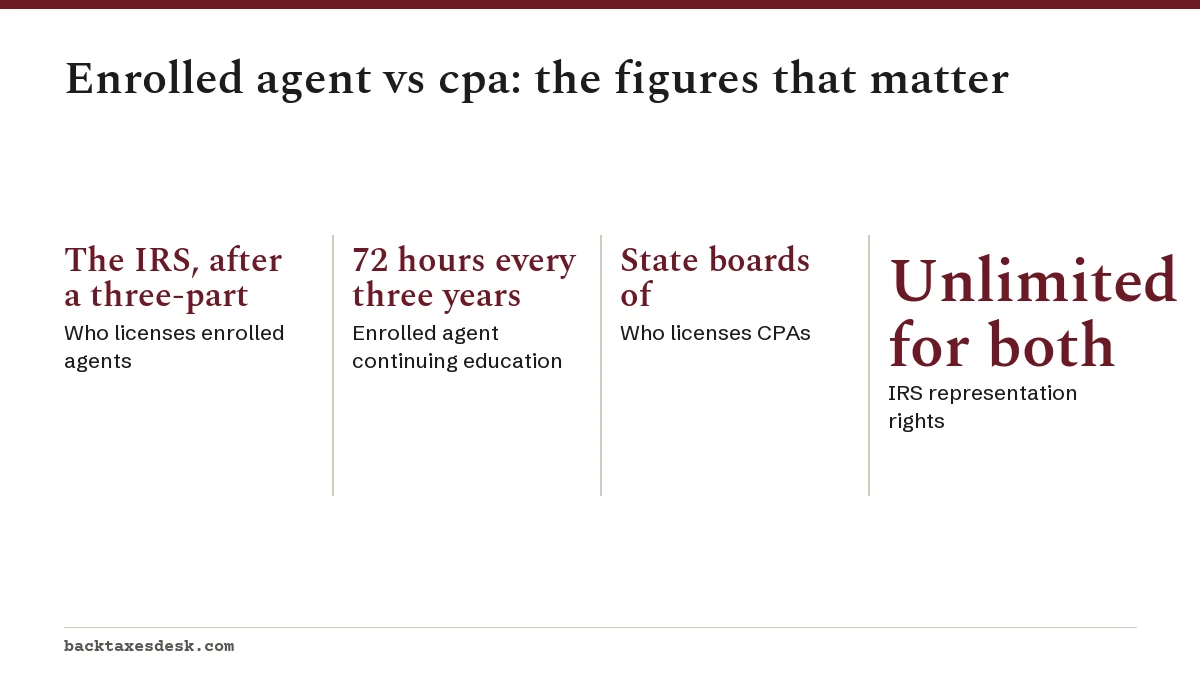
- 01Who licenses enrolled agents
- The IRS, after a three-part exam
- 02Enrolled agent continuing education
- 72 hours every three years
- 03Who licenses CPAs
- State boards of accountancy
- 04IRS representation rights
- Unlimited for both
- 05Form that authorizes either one
- Form 2848
Enrolled agent vs CPA: what is the difference for IRS problems?
For an IRS problem, the enrolled agent vs CPA difference is about training and focus, not legal authority. The IRS gives both the same unlimited right to represent any taxpayer on any tax matter, so an enrolled agent can negotiate a payment plan or sit through an audit exactly as a CPA can.
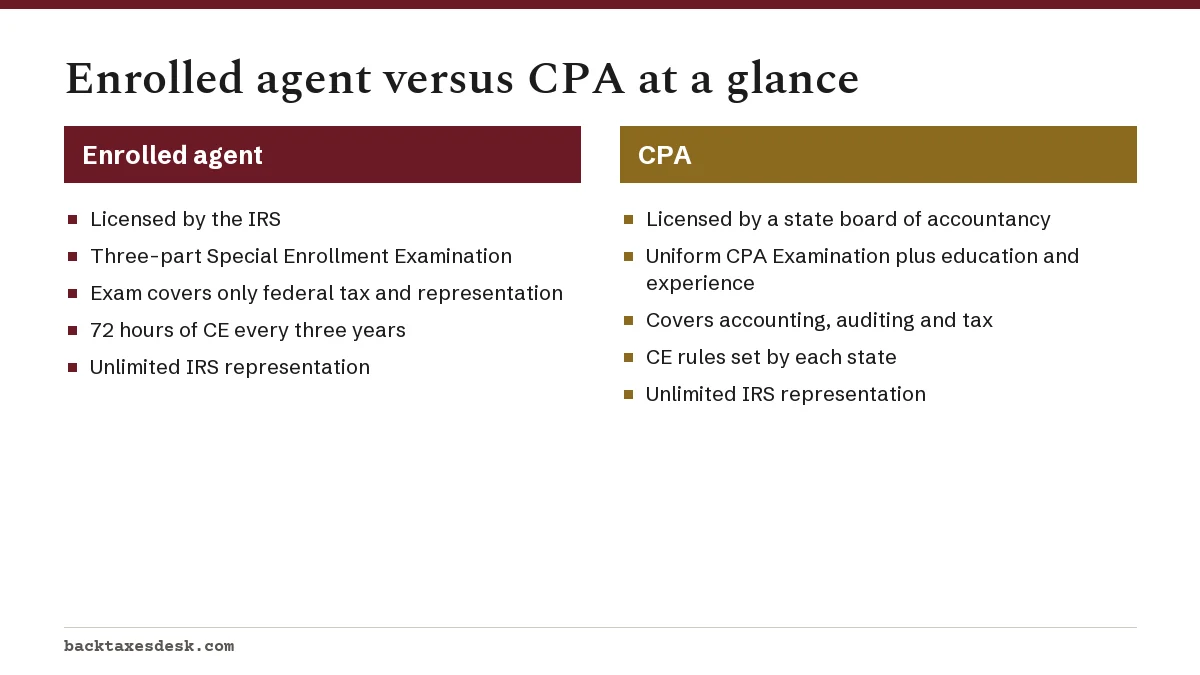
Where they part ways is everything outside federal tax. A CPA can audit a company's financial statements, sign attest reports and advise on bookkeeping systems, which an enrolled agent cannot. An enrolled agent, on the other hand, earned the credential by passing an exam that is entirely about federal tax, including a full part on representation, which is the skill a back-tax case uses most.
What is an enrolled agent?
An enrolled agent (EA) is a tax practitioner licensed directly by the IRS to prepare returns and represent taxpayers before the agency. Unlike CPAs and attorneys, who get their licenses from a state, enrolled agents earn theirs from the federal tax agency itself.
Enrolled agent requirements
- Pass the three-part IRS Special Enrollment Examination (SEE), which covers individual returns, business returns, and representation, ethics and practice before the IRS.
- Obtain and keep a Preparer Tax Identification Number (PTIN).
- Apply for enrollment on Form 23 and pass a suitability check that includes a review of the applicant's own tax compliance.
- Complete 72 hours of continuing education every three years to keep the license active.
- Follow the rules of practice in Treasury Department Circular 230, Regulations Governing Practice before the IRS.
Because the enrolled agent's license comes from the IRS rather than a state, the IRS describes it as unrestricted: an enrolled agent may represent any taxpayer, on any type of tax matter, before any IRS office in the country.
What is a CPA?
A certified public accountant (CPA) is an accountant licensed by a state board of accountancy after passing the Uniform CPA Examination and meeting that state's education, experience and character requirements. The IRS recognizes the state license and gives CPAs unlimited representation rights on that basis.
Continuing education rules for CPAs are set by each state. Many CPAs work in audit, corporate finance or advisory roles and never handle IRS collection cases, so the letters after the name tell you less about tax controversy experience than they seem to.
Representation rights compared: can an enrolled agent represent me in collections?
Yes. An enrolled agent can represent you in collections, including installment agreements, Offers in Compromise, lien and levy disputes and Collection Due Process hearings with the IRS Independent Office of Appeals. The same is true for a CPA.
| Task | Enrolled agent | CPA |
|---|---|---|
| Talk to the IRS for you under Form 2848 | Yes | Yes |
| Negotiate a payment plan or Offer in Compromise | Yes | Yes |
| Represent you in an audit and in IRS Appeals | Yes | Yes |
| Represent you in U.S. Tax Court | Only after passing the Tax Court's non-attorney exam | Only after passing the Tax Court's non-attorney exam |
| Confidentiality privilege for tax advice | Noncriminal federal tax matters only (IRC 7525) | Noncriminal federal tax matters only (IRC 7525) |
| Defend you in a criminal tax case | No | No |
Two limits apply to both. Tax Court is a separate admission: attorneys join by application, while non-attorneys must pass a written exam and a character review under Tax Court Rule 200. And the federally authorized tax practitioner privilege in Internal Revenue Code section 7525 protects confidential tax advice only in noncriminal matters, which is one reason a criminal exposure calls for a lawyer. Our tax attorney vs CPA page covers that line in detail.
Is an enrolled agent better than a CPA for IRS problems?
Neither is better by title alone. For a pure IRS collection or audit case, an enrolled agent who handles those cases every week is often the more specialized choice, while a CPA is the better fit when the tax problem is tangled up with messy books, business financial statements or years of missing records.
| Your situation | Often a good fit | Reason |
|---|---|---|
| Individual with a balance and a CP504 or levy notice | Enrolled agent | Collection procedure is the core of the EA exam |
| Five years of unfiled returns with W-2 income | Either | Both prepare returns and can request transcripts |
| Business owing payroll tax with no clean bookkeeping | CPA | Needs reconstructed books and financial statements |
| Offer in Compromise with Form 433-A (OIC) | Either, with offer experience | The financial statement drives the result |
| Audit of a business return with inventory or depreciation issues | CPA or EA with business audit experience | Accounting methods may be at issue |
Ask any candidate how many cases like yours they closed in the last year, what the outcomes were and who will actually do the work. If your income is low, a Low Income Taxpayer Clinic may give you the same kind of representation for free, and if IRS processes are stuck, the Taxpayer Advocate Service costs nothing.
How do I verify an enrolled agent or CPA?
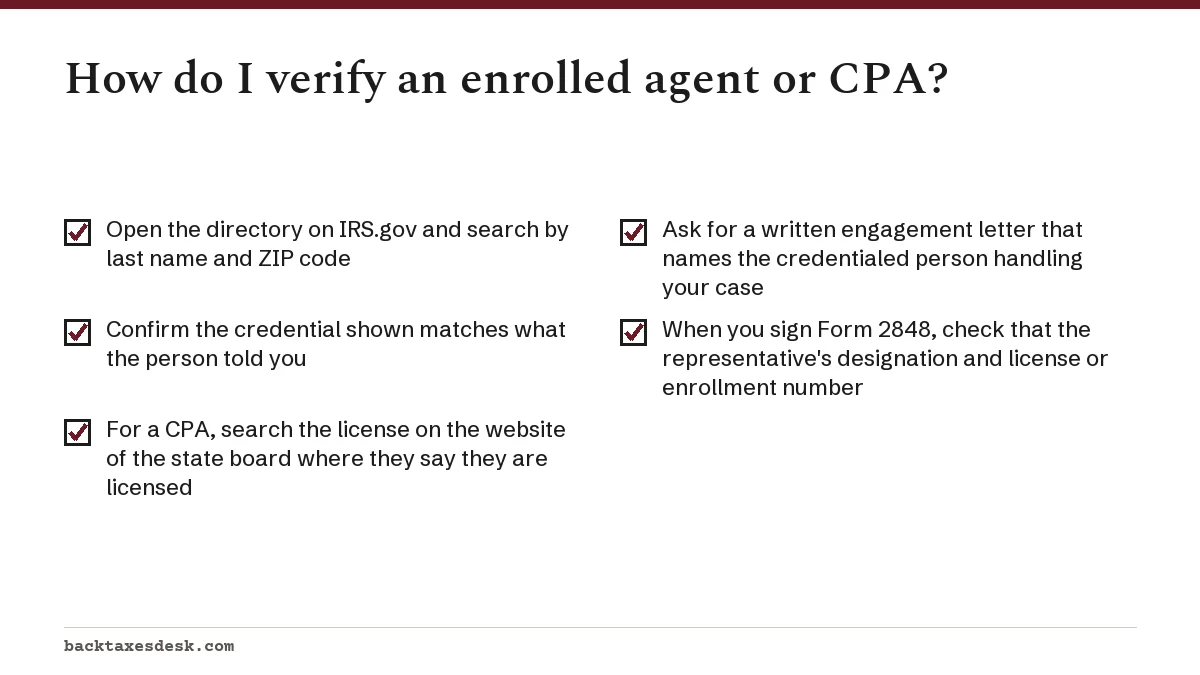
Use the IRS Directory of Federal Tax Return Preparers with Credentials and Select Qualifications for an enrolled agent lookup, and use the state board of accountancy's license search for a CPA. Do both checks before you sign Form 2848 or pay anything.
- Open the directory on IRS.gov and search by last name and ZIP code. It lists enrolled agents, CPAs, attorneys, enrolled retirement plan agents and enrolled actuaries who hold a valid Preparer Tax Identification Number (PTIN), plus Annual Filing Season Program participants.
- Confirm the credential shown matches what the person told you.
- For a CPA, search the license on the website of the state board where they say they are licensed, and look for any disciplinary history.
- Ask for a written engagement letter that names the credentialed person handling your case.
- When you sign Form 2848, check that the representative's designation and license or enrollment number are filled in.
What does each one need from you on day one?
Either professional starts the same way: a signed Form 2848, copies of every IRS notice, and your income and expense records. With the power of attorney on file, they can pull your IRS account transcripts and see the full balance, assessment dates and collection status.
If the case is heading toward an Offer in Compromise or hardship status, expect a request for bank statements, pay stubs and a list of assets so they can complete Form 433-F or Form 433-A. For the full range of free and paid options, start at help with IRS problems.
Common questions
Is an enrolled agent a real IRS credential?
Yes. Enrolled agents are licensed by the IRS after passing the three-part Special Enrollment Examination, and they must complete 72 hours of continuing education every three years.
Do enrolled agents work for the IRS?
No. Enrolled agents are licensed by the IRS but work for their clients, usually in private practice. Their job is to represent you, not the government.
Can an enrolled agent do state taxes?
An enrolled agent's license is federal, and state rules decide who may represent taxpayers before a state tax agency. Ask the state revenue department or the agent which state matters they can handle.
Are enrolled agents cheaper than CPAs?
There is no official price for either. Fees depend on the person and the case, so compare written quotes for the same scope of work.
How do I look up an enrolled agent's license?
Search the IRS Directory of Federal Tax Return Preparers with Credentials and Select Qualifications on IRS.gov by name and ZIP code. It lists enrolled agents who hold a current PTIN.
Can an enrolled agent take my case to Tax Court?
Only if the enrolled agent has separately passed the U.S. Tax Court's non-attorney admission exam and character review. Otherwise you need an attorney admitted to the court or you can represent yourself.
Sources
- Understanding tax return preparer credentials and qualifications irs.gov
- About Form 2848, Power of Attorney and Declaration of Representative irs.gov
- Choosing a tax professional irs.gov
- 26 U.S. Code section 7525, Confidentiality privileges relating to taxpayer communications law.cornell.edu
- U.S. Tax Court, admission to practice ustaxcourt.gov
We check figures against these official pages. Rules change; confirm anything that affects a deadline or payment with the agency before you act.
Tell us what happened
Describe your situation and our editors will use it to improve this guide. If you leave your email, we may reply with a pointer to the right page or official contact. We never share your details.
Related guides
 Help With IRS Problems: Who Can Represent You and How
Help with IRS problems comes from three places: tools you can use yourself on IRS.gov, free help from the Taxpayer Advocate Servi…
AI Got Your Tax Return Wrong: Who Pays the Penalty
You are responsible. Signing a return is a declaration that it is true and complete to the best of your knowledge, and nothing ab…
Tax Attorney vs CPA: When You Need a Lawyer for IRS Debt
In the tax attorney vs CPA decision, both have unlimited rights to represent you before the IRS, so most back-tax, payment plan a…
Low Income Taxpayer Clinic: Free IRS Representation Guide
A Low Income Taxpayer Clinic (LITC) is an independent, IRS-funded organization that represents low-income people in audits, appea…
Taxpayer Advocate Service: Free Help When the IRS Is Stuck
The Taxpayer Advocate Service (TAS) is a free, independent organization within the IRS that steps in when a federal tax problem i…
Form 433-F: IRS Collection Information Statement Guide
Form 433-F is the IRS Collection Information Statement, a short financial snapshot the IRS uses to decide how much you can pay ea…