
Form 433-F: how to fill out the IRS Collection Information Statement
Short answer
Form 433-F is the IRS Collection Information Statement, a short financial snapshot the IRS uses to decide how much you can pay each month on a tax debt. You list accounts, property, income and monthly living expenses, sign under penalty of perjury, and send it with proof. It is typically requested for installment agreements over $50,000 and hardship (Currently Not Collectible) reviews.
- 01Current revision
- Form 433-F (Rev. 7-2024)
- 02Required with Form 9465 when
- The balance is more than $50,000
- 03Food, clothing and other items standard
- $867 a month for one person, effective June 29, 2026
- 04Out-of-pocket health care standard
- $90 a month per person under 65, $163 for 65 and older
- 05Not used for
- Offers in compromise, which need Form 433-A (OIC)
What Form 433-F is and when the IRS asks for it
Form 433-F, Collection Information Statement, is the form the IRS uses to collect current financial details from wage earners and self-employed individuals who owe tax. The form's own instructions say its purpose is to work out how you can satisfy an outstanding liability. Your answers decide whether you get a payment plan, what the monthly payment is, or whether collection is paused.
You usually need Form 433-F in one of these situations:
- A long-term payment plan over $50,000. The Form 9465 instructions say to complete and attach Form 433-F when the balance on line 9 is more than $50,000. See our Form 9465 instructions.
- A plan between $25,000 and $50,000 with a low payment. If your proposed payment is below the required amount and you will not use direct debit, you check the box on Form 9465 and attach Form 433-F.
- A hardship request. To place an account in Currently Not Collectible status, the IRS may ask for Form 433-F, 433-A or 433-B with proof of income, expenses and assets.
- A collection employee asks for it. A phone assistor or revenue officer may request it to set up an IRS installment agreement or a partial payment installment agreement.
Form 433-F vs 433-A: which collection information statement do you need?
The IRS has several collection information statements, and they are not interchangeable. Use the one named in your letter or requested by the IRS employee handling your case.
| Form | Who uses it | Typical use |
|---|---|---|
| Form 433-F | Individual wage earners and self-employed people | Payment plans and hardship reviews |
| Form 433-A | Wage earners and self-employed individuals | A longer, more detailed statement the IRS may request instead |
| Form 433-A (OIC) | Individuals making an offer in compromise | Required with Form 656; calculates the minimum offer |
| Form 433-B | Businesses | Business collection cases and hardship reviews |
| Form 433-B (OIC) | Businesses making an offer | Required with a business Form 656 |
If you are thinking about settling rather than paying over time, Form 433-F will not do. An offer needs Form 433-A (OIC), and the free offer in compromise pre-qualifier runs the same math before you commit.
Form 433-F instructions: section-by-section walkthrough
The July 2024 revision has a header, sections A through H, and a signature line. Use extra sheets whenever a section runs out of room, and enter N/A for questions that do not apply rather than leaving them blank.
Header: identity and household
Enter names, address, county of residence, Social Security or ITIN numbers, and phone numbers for you and your spouse. Then give the number of people in the household you can claim on this year's return, split into under 65 and 65 and over. That split matters, because the health care allowance is higher for older household members. If you have self-employment income, add the business name, EIN, type of business and number of employees.
Section A: accounts and lines of credit
List every checking, savings, money market and online or mobile account, such as PayPal, even if the balance is zero. Then list investments: CDs, IRAs, 401(k) plans, brokerage accounts, stocks, bonds, and holdings like gold or silver. Do not list bank loans here. The same page asks for digital assets, including the wallet or exchange, the email used to open it, and the current US dollar value.
Section B: real estate
List your home, vacation property, timeshares and land. For each, give current market value, loan balance, monthly payment, and purchase and refinance history. Equity is market value minus what you owe. Your mortgage payment goes here, not on the rent line in Section H.
Sections C and D: other assets and credit cards
Section C covers vehicles by make, model and year, boats, RVs, whole life insurance with cash value, and valuables such as collections or antiques. If a car is leased, write lease in the year purchased column. Section D lists every credit card and credit line, with limit, balance and minimum payment, even at a zero balance.
Sections E, F and G: business, wages and other income
Section E applies only if you or your spouse have self-employment income, including online sales. List money owed to you in E1 and any merchant card or digital payment accounts in E2. Section F asks for each employer, pay frequency, gross pay and taxes withheld per period; you may attach a current pay stub instead. Section G lists monthly non-wage income such as Social Security, pensions, unemployment, child support, alimony, rental and net self-employment income.
For rental or business income, report the monthly amount after cash expenses and attach a current profit and loss statement or Schedule C. Leave depreciation out, since it is not a cash cost, and enter 0 if the result is a loss.
Section H: monthly necessary living expenses
Section H has two columns: your actual monthly cost and the IRS allowed amount. Convert bills that are not monthly using the multipliers from the form's instructions.
| If you pay the bill | Monthly amount equals |
|---|---|
| Weekly | Weekly amount x 4.3 |
| Every two weeks | Biweekly amount x 2.17 |
| Twice a month | Semimonthly amount x 2 |
| Quarterly | Quarterly amount / 3 |
433-F allowable expenses: what the IRS will count
The IRS does not simply accept your budget. It compares each category with its Collection Financial Standards, updated effective June 29, 2026. For food, clothing and other items, and for out-of-pocket health care, you get the national standard without having to prove what you spend. You can claim more only by documenting the higher cost.
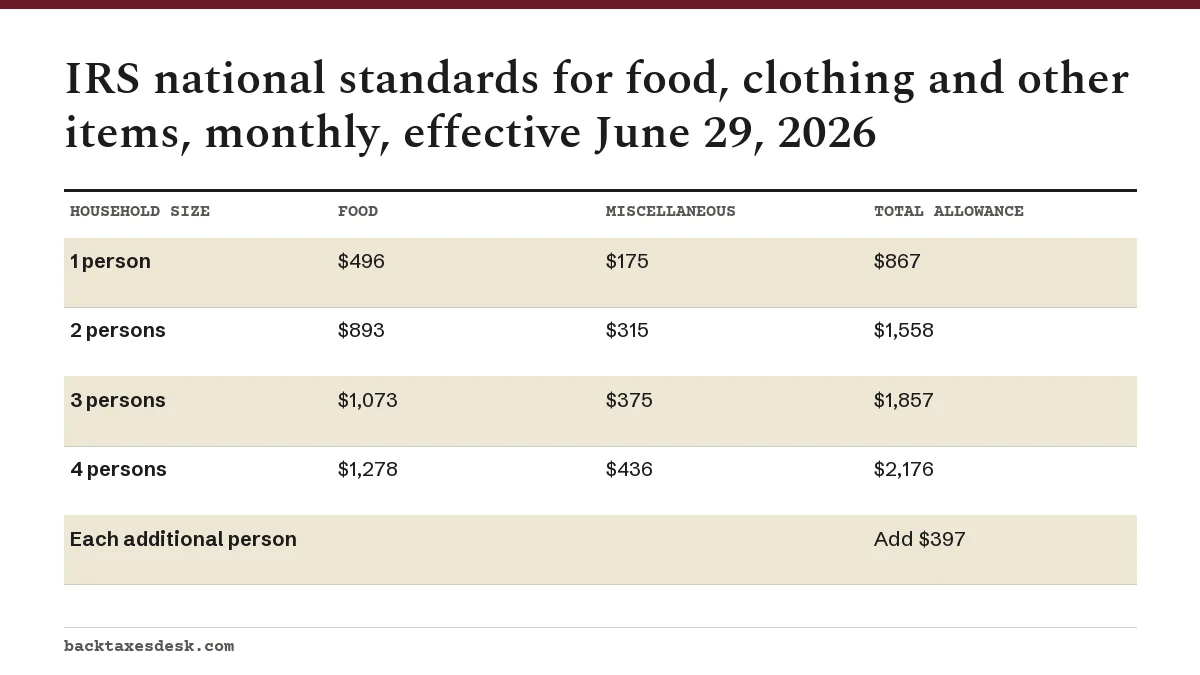
- Miscellaneous is capped at the standard for your household size. It is meant to cover things like credit card payments, bank fees and school supplies, so card payments do not get their own line.
- Out-of-pocket health care is $90 a month per person under 65 and $163 per person 65 and older. Health insurance premiums are listed separately.
- Housing and utilities and transportation use local standards by county and family size. You are allowed the lower of your actual cost or the local standard.
- Other expenses can include child or dependent care, current estimated tax payments, term life insurance, required retirement contributions, union dues, court-ordered payments, and minimum payments on federally guaranteed student loans.
- Six-year rule: if you can pay the full balance, including penalties and interest, within six years, the IRS may allow expenses above the standards.
A worked example
Consider a married couple, both under 65, with $6,200 in gross monthly wages and $900 in taxes withheld. They claim the two-person national standard of $1,558 and $180 of out-of-pocket health care. Rent and utilities are $1,900, below their county's local standard, so the actual amount counts. Add a $450 car payment and $350 of vehicle operating costs, both within local standards, plus $420 of health insurance.
Allowed expenses total $5,758 including withheld taxes, leaving about $442 a month. That figure is roughly what the IRS would expect as a monthly payment. If the total balance could not be paid before the collection deadline at that rate, a partial payment plan may fit. These numbers are illustrative only; your county's housing and car standards will differ.
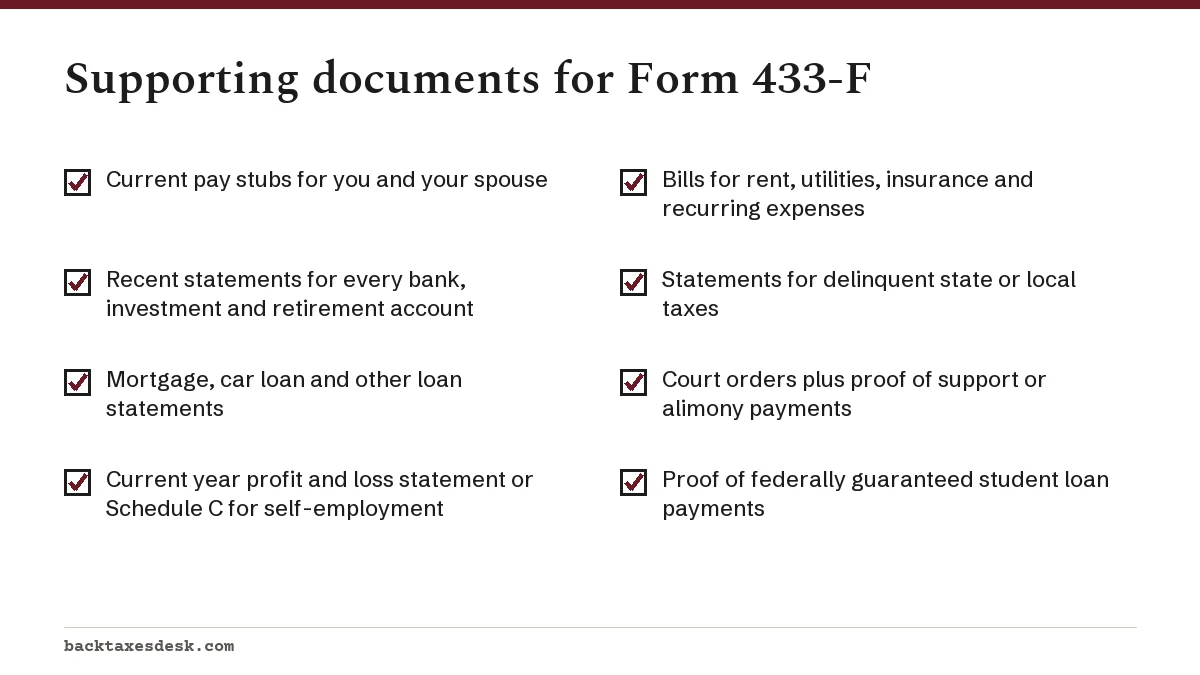
Documents to attach to Form 433-F
The instructions say the IRS may ask for proof of income and of any expense above the standards after it reviews the form. Sending clear copies up front avoids a second round of letters. Keep a full copy of what you send.
Sign, send and what happens next
Both spouses sign if the debt is joint, declaring under penalty of perjury that the statement is true, correct and complete. Send the form to the address or fax number on your notice, or to the IRS employee who asked for it. If you are also requesting a payment plan by mail, submit Form 9465 with it; the instructions note that a larger down payment can speed up approval and cut penalties and interest.
The IRS then compares your figures with its standards and the third-party income data it already has, and may call or write for more proof. Expect one of three outcomes: an installment agreement, a partial payment plan, or a hardship delay. None of them erases the debt, as explained on our page asking does the IRS forgive tax debt. For how these outcomes fit together, see our tax debt relief options.
Step by step
Confirm the form
Check that your notice or IRS contact asked for Form 433-F and not Form 433-A or 433-A (OIC).
Gather statements
Collect recent pay stubs, bank and investment statements, loan statements and bills.
Complete sections A to G
List every account, property, vehicle, credit card, employer and non-wage income source, using N/A where a question does not apply.
Complete Section H
Enter actual monthly expenses, convert non-monthly bills, and compare each line with the IRS Collection Financial Standards.
Sign and attach proof
Both spouses sign for joint debts; attach proof of income and of any expense above the standards.
Send and keep a copy
Mail or fax it as your notice directs, with Form 9465 if you are requesting a plan, and keep a full copy.
Common questions
What is Form 433-F used for?
It gives the IRS a current picture of your income, expenses and assets so it can decide how much you can pay each month. It is commonly used for payment plans over $50,000 and for Currently Not Collectible hardship requests.
Can I file Form 433-F online?
Form 433-F is a paper form you download from IRS.gov and send by mail or fax to the address or number on your notice or given by the IRS employee on your case. Payment plans of $50,000 or less can usually be set up online without it.
Does the IRS allow credit card payments on Form 433-F?
Not as a separate expense. Credit card payments are expected to come out of the miscellaneous allowance, which is capped at the national standard for your household size, $175 a month for one person as of June 29, 2026.
How far back do bank statements need to go for Form 433-F?
The form does not set a fixed period. Send recent statements for each account listed and answer any IRS request for more months within the deadline in its letter.
What if my real expenses are higher than the IRS standards?
List your actual amount in the first column of Section H and attach proof. The IRS may allow it, especially for health and welfare costs or costs needed to earn income, or under the six-year rule if you can pay in full within six years.
Do I list my spouse's income on Form 433-F?
Yes, the form asks for household income and for your spouse's employer and wages. A spouse who does not owe the debt still affects how shared living costs are divided.
Sources
- Form 433-F, Collection Information Statement (Rev. 7-2024) irs.gov
- Instructions for Form 9465 irs.gov
- Collection Financial Standards irs.gov
- National Standards: Food, Clothing and Other Items irs.gov
- National Standards: Out-of-Pocket Health Care irs.gov
- Temporarily delay the collection process irs.gov
We check figures against these official pages. Rules change; confirm anything that affects a deadline or payment with the agency before you act.
Tell us what happened
Describe your situation and our editors will use it to improve this guide. If you leave your email, we may reply with a pointer to the right page or official contact. We never share your details.
Related guides
 Does the IRS Forgive Tax Debt? What Is Actually Possible
Does the IRS forgive tax debt? Not in the way ads suggest. There is no general forgiveness program. A balance can shrink or end o…