
Is an IRS offer in compromise worth it?
Short answer
An IRS offer in compromise is worth it mainly when your assets and future income clearly cannot cover the debt before the collection deadline runs out. If you could pay in full through a payment plan, the IRS will generally reject the offer, and you lose the $205 fee, any payments sent, and refunds offset while it is pending.
- 01Application fee
- $205, not refunded (waived for low-income certification)
- 02Offers proposed in FY 2025
- 38,797
- 03Offers accepted in FY 2025
- 5,464
- 04Compliance period after acceptance
- 5 years of on-time filing and payment
- 05Deadline to appeal a rejection
- 30 days, using Form 13711
Is an IRS offer in compromise worth it? The short test
Deciding whether an IRS offer in compromise is worth it comes down to one question the IRS asks itself: is the amount you offer the most it can expect to collect from you within a reasonable time? If the answer is yes, an offer can settle a large balance for much less. If you could pay the full debt through an installment agreement or by using equity in your assets, the IRS will generally say no.
So the offer is not a discount program. It is a bet that your finances, measured by the IRS's own formula, show a gap between what you owe and what you can ever pay. Before spending money on an application, run the free offer in compromise pre-qualifier, which uses the same formula and costs nothing.
When an offer usually makes sense
- Your household income, after the IRS allowable living expenses, leaves little or nothing each month.
- You have little equity in a home, car, retirement account or savings once the IRS applies its 80% quick-sale value.
- Your balance is large compared with what a payment plan could clear before the collection statute expiration date (CSED).
- Your situation is unlikely to improve, for example because of retirement, disability or a long-term illness.
- All required returns are filed and this year's estimated payments are current, which the IRS requires before it will look at an offer.
When an offer is a poor fit
- You earn enough, after allowable expenses, to pay the debt over a normal payment plan.
- You have home equity or retirement savings that cover the balance, even after the 20% reduction.
- You are in an open bankruptcy case, or you have an open audit or innocent spouse claim that is not resolved yet.
- You dispute the amount itself. That calls for a Doubt as to Liability offer on Form 656-L, an appeal or audit reconsideration, not an ability-to-pay offer.
How successful is an offer in compromise?
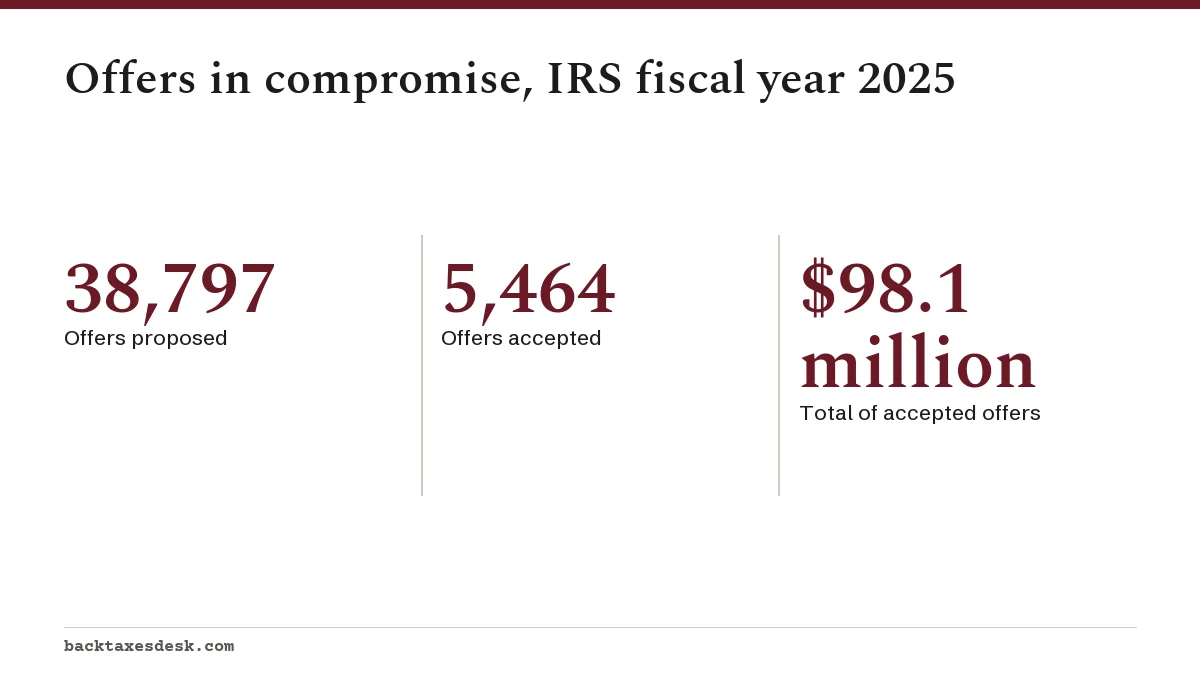
Most offers do not get accepted. The IRS Data Book for fiscal year 2025 reports that taxpayers proposed 38,797 offers and the IRS accepted 5,464 of them, worth a combined $98.1 million. Because accepted offers are not all from that year's filings, the ratio of about 14% is only a rough gauge.
Many offers fail before any real review. The IRS returns offers, with no appeal rights, when a required return is missing, when a periodic payment is skipped during review, or when you do not answer a request for more information on time. Those are avoidable losses, and they are the main reason to get your filing current first.
Pros and cons of an offer in compromise
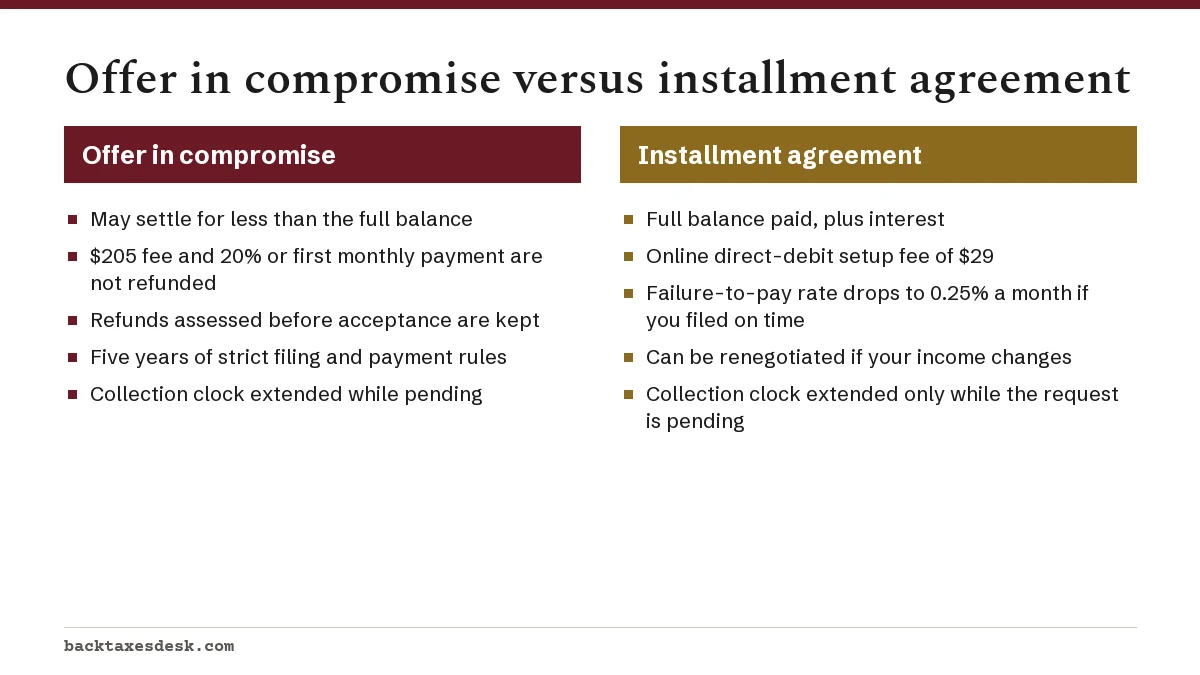
The pros and cons of an offer in compromise are easiest to see next to the option most people compare it with, a long-term payment plan. A payment plan is cheaper to start and hard to lose, but you pay everything plus interest. An offer can cut the balance, but it has upfront costs you never get back and strict rules afterward.
| Cost | Amount or effect | Low-income certification |
|---|---|---|
| Application fee | $205 | Waived |
| Lump-sum offer | 20% of the offer amount sent with the application | Waived |
| Periodic offer | First payment with the application, then monthly payments during review | Waived until acceptance |
| Tax refunds | Refunds for returns assessed before acceptance are kept and applied to the debt | Still kept |
| Penalties and interest | Keep growing while the IRS reviews the offer | Still grow |
Low-income certification is based on family size and adjusted gross income. On the April 2026 revision of Form 656, a single filer in the 48 contiguous states qualifies at $39,900 or less and a family of four at $82,500 or less, per the Form 656 chart in the Form 656-B booklet.
The costs you do not get back
Do I lose my refund if I file an offer?
Often, yes. The IRS keeps any refund, with interest, for a return assessed before the date it accepts your offer, and that refund does not count as a payment toward the offer. The Form 656-B booklet gives the example of a return filed April 15 and assessed in late May, with the offer accepted in July: the overpayment goes against the old debt.
You also agree not to file an amended return for the years in the offer while it is pending or after acceptance. If you expect a large refund or a refund from an amended return, weigh that money against the savings the offer might bring.
What happens if my offer is rejected?
You have 30 days from the rejection letter to appeal with Form 13711, Request for Appeal of Offer in Compromise. The offer stays pending during those 30 days and during the appeal. A returned offer is different: the IRS did not process it, and there is no appeal.
If the rejection stands, the full balance is still owed, and the money you sent has already been applied to it. The time the offer was pending, plus 30 days after a rejection and any appeal time, is added to the collection clock, so the IRS gets longer to collect. A payment plan you had before the offer is reinstated only if you did not run up new tax debt.
Obligations after acceptance
An accepted offer is a contract. For five years starting on the acceptance date, you must file every return and pay every tax on time. Miss that and the IRS can default the offer and bring back the original debt, minus what you paid, plus the interest and penalties that kept running.
- Pay the rest of the offer on schedule: lump-sum offers within five months of acceptance, periodic offers within 24 months of the offer.
- File all returns and pay all taxes on time through the fifth year after acceptance.
- Do not ask for an installment agreement or another offer during those five years; you will need to pay any new balance in full.
- Pay promptly any tax assessed later for years that ended before acceptance but were not in the offer.
Does an offer in compromise hurt your credit?
The offer is an agreement with the IRS, not a new loan or credit account. The piece that matters for lenders is the federal tax lien. The IRS may file a Notice of Federal Tax Lien while the offer is under review or while you pay a periodic offer, and it is a public notice to creditors that affects your ability to borrow.
After acceptance, liens for the periods in the offer are generally released within 45 days after your final payment is received and verified. Read more about how a lien works on our federal tax lien page.
Alternatives to compare first
Before you decide, price out each official option on the tax debt relief options page. The right one depends on your monthly surplus and on how many years are left on the collection clock.
- Installment agreement: pays the full balance over time; the online direct-debit setup fee is $29. See IRS installment agreements.
- Partial payment installment agreement: monthly payments you can afford, with any balance left when the CSED arrives no longer collectible. See partial payment plans.
- Currently Not Collectible: a pause for hardship when you cannot pay anything; interest keeps growing and the IRS reviews you again later. See Currently Not Collectible status.
- Penalty relief: if penalties make up a large share of the balance, removing them may shrink the debt enough to pay it.
If you still think an offer fits, the step-by-step filing guide is on our offer in compromise page. Be wary of firms that promise a settlement before seeing your numbers; the IRS names misleading offer marketing in its 2026 Dirty Dozen list.
Common questions
Is an offer in compromise a good idea if I can afford a payment plan?
Usually not. The IRS generally rejects offers from people who can pay in full through an installment agreement or asset equity, and you would lose the $205 fee and any payments sent with the offer.
How much does the IRS usually accept in an offer in compromise?
There is no set percentage. The minimum acceptable offer is your net equity in assets plus your monthly surplus after allowable expenses times 12 (lump sum) or 24 (periodic). Accepted offers in fiscal year 2025 totaled $98.1 million across 5,464 offers.
Can I get my $205 back if my offer is rejected?
No. The fee and any payments you sent are applied to your tax debt. The fee is returned only if the IRS does not accept the offer for processing.
Can the IRS levy my bank account while my offer is pending?
The IRS can levy up to the moment an IRS official signs the offer as pending. After that, most collection activity stops, although a continuous wage levy already in place may be kept.
What happens if I miss a tax payment after my offer is accepted?
Failing to file or pay on time during the five years after acceptance lets the IRS default the offer. The original debt, minus payments made, plus accrued interest and penalties, becomes due again.
Sources
- Offer in Compromise irs.gov
- Form 656-B, Offer in Compromise Booklet irs.gov
- Payment plans, installment agreements irs.gov
- IRS Data Book: Collections, activities, penalties and appeals irs.gov
- Time IRS can collect tax irs.gov
We check figures against these official pages. Rules change; confirm anything that affects a deadline or payment with the agency before you act.
Tell us what happened
Describe your situation and our editors will use it to improve this guide. If you leave your email, we may reply with a pointer to the right page or official contact. We never share your details.