
IRS liens: what a federal tax lien means for you
Short answer
IRS liens are the government's legal claim against everything you own, created automatically when a tax is assessed, the IRS sends a notice and demand for payment, and you do not pay in full. The lien covers current and future property, including a house, a car and business receivables. It stays until the debt is paid, the collection period ends, or the IRS grants discharge, subordination or withdrawal.
- 01When a lien arises
- After assessment, a notice and demand, and nonpayment
- 02What it covers
- All current and future property and rights to property
- 03Hearing notice after filing
- Sent within 5 business days; 30 days to request a CDP hearing
- 04Release after payment
- Within 30 days
- 05Discharge application lead time
- At least 45 days before closing (Form 14135)
What IRS liens are and when they arise
A federal tax lien is a legal claim the United States holds against a taxpayer's property to secure an unpaid tax debt. IRS liens arise by operation of law, with no court order: the IRS assesses the tax, sends a bill that serves as a notice and demand for payment, and you neglect or refuse to pay it in full.
In practice this means the lien exists from the moment the first bill, usually Notice CP14, goes unpaid. Nobody outside the IRS knows about it at that stage. The lien becomes visible only when the IRS files a Notice of Federal Tax Lien in the public records.
A lien is not a seizure. The IRS does not take anything by having a lien; that requires a levy, which follows separate notice rules explained on our IRS levy page. The broader sequence is laid out in the IRS collection process overview.
What a Notice of Federal Tax Lien is
A Notice of Federal Tax Lien (NFTL) is the public filing that tells other creditors the government has a claim on your property. The IRS files it with the county recorder of deeds or the Secretary of State office, depending on the type of property and the state, so that its claim has a recorded priority date.
The notice shows your assessed balance as of the filing date. It does not show interest and penalties added afterward, and it does not include the IRS's charges for filing and releasing the lien, so the figure on the notice is not your payoff amount (Publication 594).
Your hearing right after a lien is filed
Within five business days of the first NFTL filing for a debt, the IRS sends Letter 3172, Notice of Federal Tax Lien Filing and Your Right to a Hearing. You then have 30 days to request a Collection Due Process hearing on Form 12153. Appeals can decide the notice should stay filed, be withdrawn or be released, and you can take that decision to the Tax Court within 30 days.
What does a federal tax lien attach to?
A federal tax lien attaches to all of your property and rights to property, including assets you acquire while the lien is in effect. For a business, the IRS says it also attaches to all business property and rights to business property, including accounts receivable.
| Type of property | Examples |
|---|---|
| Real estate | Your home, rental property, land, including property bought after the lien arose |
| Personal property | Vehicles, boats, equipment, valuables |
| Financial assets | Bank balances, brokerage accounts, retirement account interests |
| Rights to payment | Wages owed to you, business receivables, amounts due under contracts |
| Business assets | Inventory, fixtures, receivables of a business you own |
Because the lien follows new property, paying off a mortgage or inheriting assets does not escape it. Any equity you build becomes part of what the government has a claim against until the lien is removed.
Can you sell or refinance a house with an IRS lien on it?
Yes, you can sell a house with an IRS lien on it, but the title company will not close until the lien is paid from the proceeds or the IRS removes it from that property. The two tools for this are a certificate of discharge (for a sale) and a certificate of subordination (usually for a refinance).
Selling: the discharge route
Worked example: a home sells for $300,000, the first mortgage payoff is $200,000, closing costs are $20,000, and the recorded IRS lien is for $45,000. The net proceeds of $80,000 exceed the lien, so the IRS will normally be paid in full at closing. If instead the net proceeds were only $30,000, the owner could apply for a certificate of discharge, under which the IRS accepts its share of the proceeds and removes the lien from that one property while the rest of the debt remains.
Discharge applications go on Form 14135, Application for Certificate of Discharge of Property from Federal Tax Lien, using the instructions in Publication 783. The IRS asks you to submit it at least 45 days before the closing date so it has time to review and issue the certificate.
Refinancing: the subordination route
A lender will not usually refinance a home while the federal tax lien has priority. Subordination lets the new mortgage move ahead of the government's claim. You apply on Form 14134 with the guidance in Publication 784, at least 45 days before the loan closes. Under IRC 6325(d)(1) you pay the IRS an amount equal to the interest being subordinated; under IRC 6325(d)(2) no payment is needed if you show the subordination will increase what the government collects, for example a lower-rate refinance that frees up a larger monthly payment on the tax debt.
How IRS liens affect credit and business
The IRS says a filed Notice of Federal Tax Lien may limit your ability to get credit, because lenders and others can find it in public records. Publication 594 adds that employers, landlords and others may view the filing unfavorably.
For a business, the lien reaches receivables, which can complicate factoring or a line of credit. Any lender taking a security interest will want to see the lien released, discharged, subordinated or withdrawn before it funds.
How to get an IRS lien removed: four options
There are four ways to remove or neutralize a federal tax lien, and they differ in whether the debt is gone and whether the public record changes. Picking the wrong one wastes time, so match the tool to the goal.
| Option | What it does | Debt still owed? | Form or guide |
|---|---|---|---|
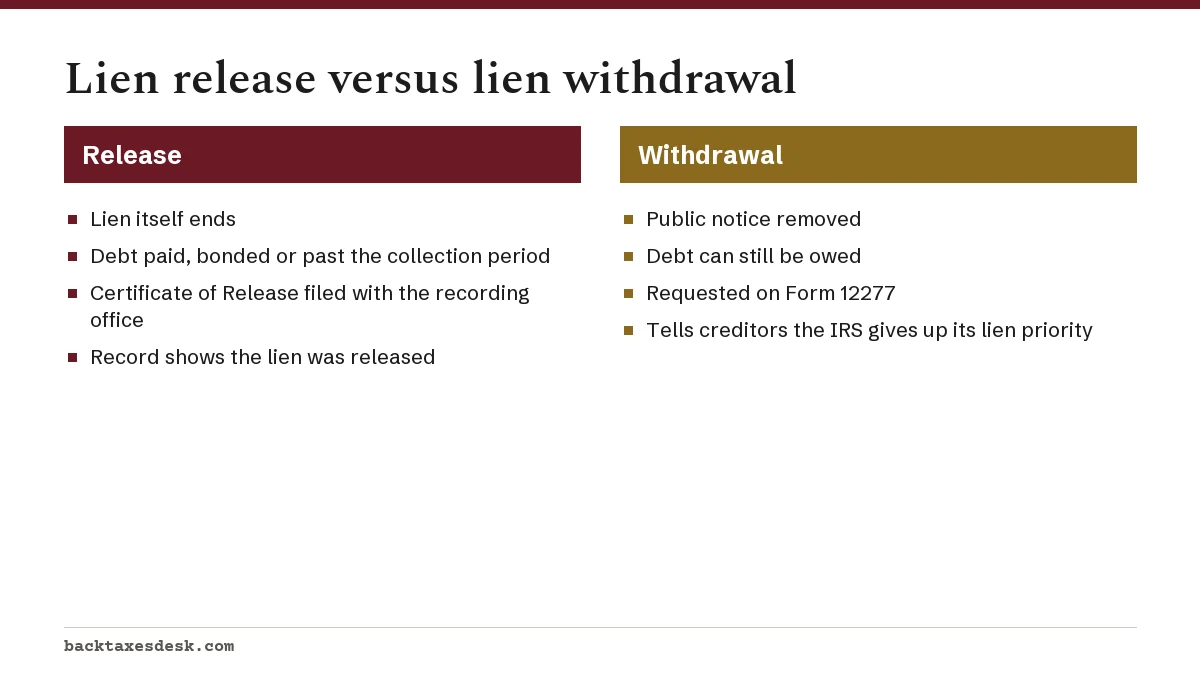
| Release | Ends the lien and clears the public notice | No, paid, bonded or unenforceable | Publication 1450 |
| Discharge | Removes the lien from one specific property | Yes | Form 14135, Publication 783 |
| Subordination | Lets another creditor go ahead of the IRS | Yes | Form 14134, Publication 784 |
| Withdrawal | Removes the public notice from the record | Yes, unless already paid | Form 12277 |
Release is the usual endpoint: the IRS releases the lien within 30 days after full payment, a bond, completion of an accepted offer, or the end of the collection period. Our IRS lien release guide covers payoff figures and what to do if the certificate does not arrive.
Withdrawal is the option that matters for credit because it removes the notice from the public record. Under the Fresh Start rules, the IRS may withdraw a notice for taxpayers on a Direct Debit installment agreement of $25,000 or less once three consecutive payments have been made. The details, including withdrawal after a lien is released, are on the IRS lien withdrawal page.
Common questions
What does an IRS lien mean?
It means the federal government has a legal claim against your property because a tax bill went unpaid. It secures the debt; it does not by itself take anything from you.
Does the IRS notify you before filing a lien?
Collection notices such as CP501 and CP503 warn that a lien may be filed. After the Notice of Federal Tax Lien is filed, the IRS sends Letter 3172 within five business days with your hearing rights.
Can the IRS put a lien on a house owned with a spouse?
The lien attaches to the property and rights to property of the person who owes the tax. If only one spouse owes, it reaches that spouse's interest, and a title company will still flag it on a sale or refinance of the shared home.
How much do you have to owe for the IRS to file a lien?
The law does not set a minimum balance for a lien to arise; it arises on any unpaid assessed tax after notice and demand. Whether the IRS files a public notice is an internal decision based on the account.
Does an IRS lien go away after 10 years?
The lien ends when the collection period ends, which is generally 10 years from assessment unless suspended. Publication 594 says the release in that case is automatic.
Can I get a mortgage with an IRS lien?
It is difficult while the lien has priority. A refinance can work if the IRS grants subordination on Form 14134, and a lien withdrawal after a qualifying direct debit plan can also help.
Sources
- Understanding a federal tax lien irs.gov
- Publication 594, The IRS Collection Process irs.gov
- Publication 783, How to Apply for a Certificate of Discharge irs.gov
- Collection Due Process (CDP) FAQs irs.gov
We check figures against these official pages. Rules change; confirm anything that affects a deadline or payment with the agency before you act.
Tell us what happened
Describe your situation and our editors will use it to improve this guide. If you leave your email, we may reply with a pointer to the right page or official contact. We never share your details.
Related guides
 IRS Collection Process: Liens, Levies and Your Rights
The IRS collection process starts with a bill (usually Notice CP14) and escalates through reminder notices to a Final Notice of I…
IRS Lien Release: How and When the IRS Removes a Tax Lien
An IRS lien release is required by law within 30 days after the tax debt is fully paid, becomes legally unenforceable, or is cove…
IRS Lien Withdrawal With Form 12277: Who Qualifies and How
A withdrawal of a federal tax lien removes the public Notice of Federal Tax Lien from the records where it was filed, while a rel…
IRS Levy: What the IRS Can Take and How to Stop It
An IRS levy is the legal seizure of your property or rights to property, such as wages, bank balances, Social Security payments o…
Collection Due Process Hearing: Form 12153 Step by Step
A collection due process hearing is an independent review by the IRS Independent Office of Appeals of a proposed levy or a filed…