
IRS wage garnishment: how much of your paycheck the IRS can take
Short answer
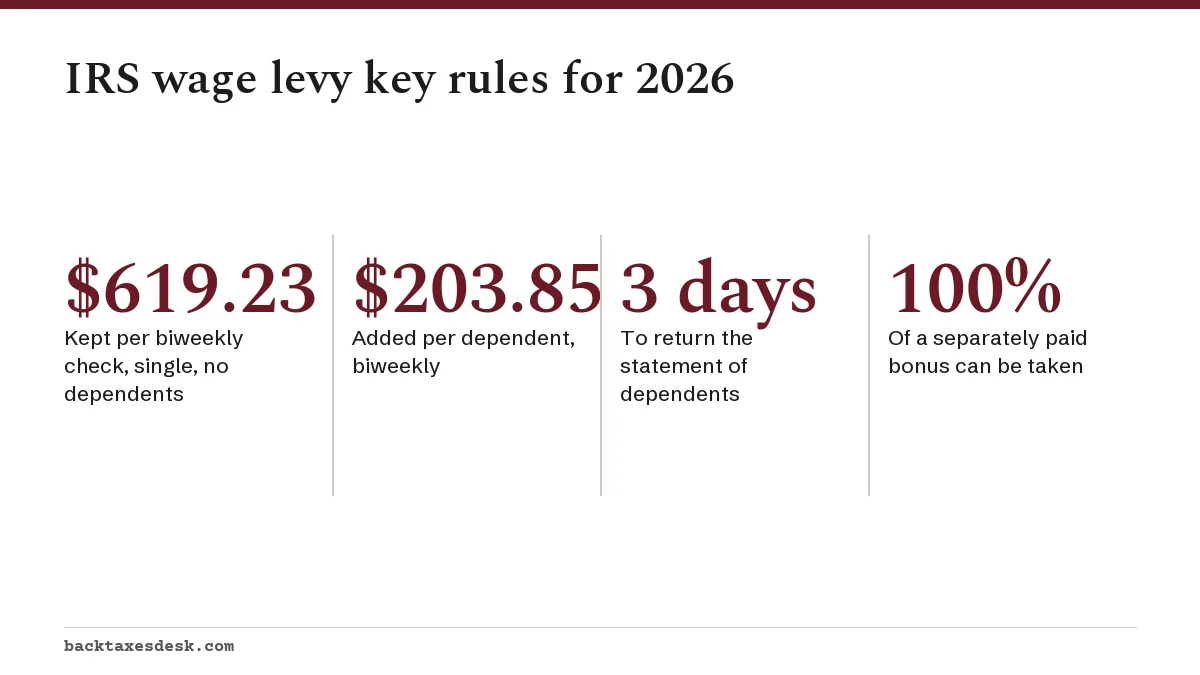
In a wage garnishment, IRS rules let the agency take all of your take-home pay above an exempt amount set in Publication 1494. For 2026, a single filer paid every two weeks with no dependents keeps $619.23 per paycheck, plus $203.85 for each dependent. The levy repeats every payday until the debt is paid, released or the collection period ends.
- 012026 exempt amount, single, biweekly, no dependents
- $619.23 per paycheck
- 02Extra exempt amount per dependent, biweekly
- $203.85
- 03Deadline to return the dependents statement
- 3 days
- 04Notice required before a wage levy
- Final Notice of Intent to Levy, at least 30 days before
- 05Separately paid bonus
- Can be taken in full
How wage garnishment by the IRS works
An IRS wage levy, often called wage garnishment, is a standing order to your employer to send part of every paycheck to the IRS. The IRS serves it once, and it keeps working each payday until the balance is paid, you make other arrangements, the levy is released, or the 10-year collection period ends (IRS Publication 594).
Wage garnishment IRS style differs from a creditor garnishment in one key way: the IRS does not first sue you. It can levy once three things have happened: the tax was assessed and billed, you did not pay, and the IRS sent a Final Notice of Intent to Levy and Notice of Your Right to a Hearing at least 30 days earlier. That notice usually arrives as LT11 or Letter 1058.
Your employer receives Form 668-W, a notice of levy on wages, salary and other income, together with Publication 1494. The employer's payroll office uses that publication to work out how much of each check you keep. Where a wage levy fits in the wider sequence of bills, liens and seizures is covered in our overview of the IRS collection process.
How much can the IRS garnish from my paycheck?
The IRS can take everything above your exempt amount, not a fixed percentage. The exempt amount equals your standard deduction plus an allowance for each dependent, spread across your pay periods. Whatever take-home pay is left above that figure goes to the IRS.
That is why IRS wage levies often feel harsher than a consumer garnishment. A single worker with no dependents who takes home $2,000 every two weeks keeps $619.23 and sends $1,380.77 to the IRS each payday under the 2026 tables.
Wage garnishment: IRS exempt amounts for 2026 (Publication 1494)
Publication 1494 (Rev. 12-2025) lists the take-home pay exempt from a wage levy in 2026. The table below shows the base amount with no dependents and the amount added for each dependent you list on your statement.
| Filing status | Weekly | Biweekly | Monthly |
|---|---|---|---|
| Single or married filing separately, no dependents | $309.62 | $619.23 | $1,341.67 |
| Head of household, no dependents | $464.42 | $928.85 | $2,012.50 |
| Married filing jointly, no dependents | $619.23 | $1,238.46 | $2,683.33 |
| Add for each dependent (any status) | $101.92 | $203.85 | $441.67 |
Taxpayers who are 65 or older or blind get a small extra amount. For a single or head of household filer paid biweekly, it is $78.85 for each condition claimed; for other statuses it is $63.46. The 2027 edition of Publication 1494 is not yet published; the 2026 edition was revised in December 2025, so a new version usually appears around year end.
Worked example: what one paycheck looks like under a wage levy
Maria is single, is paid every two weeks, supports two children and takes home $1,900 per check. Her exempt amount is $619.23 plus two times $203.85, which is $1,026.93. Her employer sends $873.07 to the IRS each payday and pays her the rest.
If Maria never returns her statement of dependents, payroll must treat her as married filing separately with no dependents. Her exempt amount drops to $619.23, and the IRS receives $1,280.77 per check. Missing one form costs her $407.70 every payday.
| Scenario | Exempt amount | Sent to IRS |
|---|---|---|
| Statement returned, 2 dependents | $1,026.93 | $873.07 |
| Statement not returned | $619.23 | $1,280.77 |
The three-day statement of dependents and filing status
Your employer must give you a Statement of Dependents and Filing Status that comes with the levy. The IRS says you should complete it and return it to your employer within three days. Payroll then uses your real filing status and dependents to set the exempt amount.
- List the dependents you are entitled to claim and your filing status for the year.
- If you or your spouse are 65 or older or blind, enter the number in the additional standard deduction space.
- Keep a copy and note the date you handed it to payroll.
- If child support was ordered before your employer received the levy, contact the IRS; it releases the amount needed for that order, though the child then cannot also be counted as a dependent.
Can the IRS take my bonus or commissions?
Yes. Bonuses, commissions and fees count as wages for levy purposes. Because the exempt amount applies once per pay period, a bonus paid on its own check can be taken in full: your regular paycheck already used up that period's exemption.
Commissions paid in the same period as salary are added to your pay, and only one exempt amount applies. If you expect a large bonus, settle a payment arrangement before it is paid. The steps are laid out in our guide on how to stop IRS wage garnishment.
Can the IRS garnish my wages and other income at the same time?
Yes. A wage levy can run alongside a bank levy, a state refund levy or a levy on federal payments. Social Security benefits are handled differently: the Federal Payment Levy Program can generally take up to 15% of each payment, explained on our page about the IRS levy on Social Security.
Some income is exempt from levy altogether, including unemployment benefits, workers' compensation, certain public assistance and certain service-connected disability payments (Publication 594). For the difference between a lien, a levy and a seizure, see what an IRS levy is.
Common questions
Does the IRS need a court order to garnish wages?
No. The IRS levies administratively once the tax is assessed and billed, you have not paid, and it has sent a Final Notice of Intent to Levy at least 30 days earlier. No lawsuit or judgment is needed.
What percentage of my paycheck can the IRS take?
There is no fixed percentage. The IRS takes all take-home pay above your exempt amount in Publication 1494, so the share depends on your pay, filing status, pay frequency and dependents.
How long does an IRS wage garnishment last?
Until the debt is paid, you arrange a payment plan or other resolution and the levy is released, or the 10-year collection period ends. The IRS does not need to serve a new levy each payday.
What happens if I do not return the statement of dependents?
Your employer must figure the exempt amount as if you were married filing separately with no dependents, which is the lowest amount. For 2026 that is $619.23 per biweekly paycheck.
Will the IRS wage levy exempt amount change in 2027?
Probably, but the 2027 figures are not yet published. The exempt amount is built from the standard deduction and a per-dependent amount, both adjusted for inflation, and the IRS usually issues the new Publication 1494 around December.
Sources
- Information about wage levies irs.gov
- Publication 1494, Tables for Figuring Amount Exempt from Levy (2026) irs.gov
- Publication 594, The IRS Collection Process irs.gov
- Levy irs.gov
We check figures against these official pages. Rules change; confirm anything that affects a deadline or payment with the agency before you act.
Tell us what happened
Describe your situation and our editors will use it to improve this guide. If you leave your email, we may reply with a pointer to the right page or official contact. We never share your details.
Related guides
 IRS Collection Process: Liens, Levies and Your Rights
The IRS collection process starts with a bill (usually Notice CP14) and escalates through reminder notices to a Final Notice of I…
Can IRS Garnish Wages From Social Security? Levy Rules
Can the IRS garnish wages from Social Security? Yes. Through the Federal Payment Levy Program the IRS can generally take up to 15…
IRS Levy Release: How to Get a Levy Lifted Fast and Legally
The IRS must grant an IRS levy release when you pay the debt, the collection period ended before the levy, a payment plan's terms…