
How to stop IRS wage garnishment
Short answer
To stop IRS wage garnishment, contact the IRS office on your levy notice and agree on a way to resolve the debt: full payment, a payment plan whose terms do not keep the levy in place, or proof that the levy leaves you unable to meet basic living expenses. The IRS must then release the levy and notify your employer.
- 01Legal grounds that require a levy release
- Paid in full, payment plan, economic hardship, expired collection period, and others (Publication 594)
- 02Online payment plan limit, individuals
- $50,000 or less in tax, penalties and interest
- 03Online direct debit plan setup fee
- $29
- 04Appeal form for a levy (Collection Appeals Program)
- Form 9423
- 05Time to ask for return of levied money
- 2 years from the levy date
What stops an IRS wage garnishment
You stop IRS wage garnishment by giving the IRS a legal reason to release the levy, not by waiting. Publication 594 lists the situations in which the Internal Revenue Code says the IRS must release a levy.
| Situation | What you need to show or do |
|---|---|
| You paid the amount you owe | Full payment, including penalties and interest |
| You enter into a payment plan | An installment agreement whose terms do not allow the levy to continue |
| The levy causes economic hardship | Financial proof that the levy prevents you from meeting basic, reasonable living expenses |
| Release will help you pay | A realistic proposal showing release speeds up collection |
| The collection period ended before the levy | The Collection Statute Expiration Date had passed |
| The levy was issued improperly | For example, before the required notice or during a bankruptcy stay |
The IRS also cannot issue a new levy while a payment plan or offer in compromise request is pending or in effect, or once it agrees you cannot pay because of hardship. How the levy itself works, including the exempt amount you keep, is on our page about IRS wage garnishment.
Step 1: Call the number on your levy notice right away
Speed matters because the levy takes money from every paycheck until it is released. Call the phone number on the levy notice or the letter you received. If you already work with a specific IRS employee, such as a revenue officer, contact that person instead.
Have these ready before you call so the IRS can agree to a resolution in one conversation:
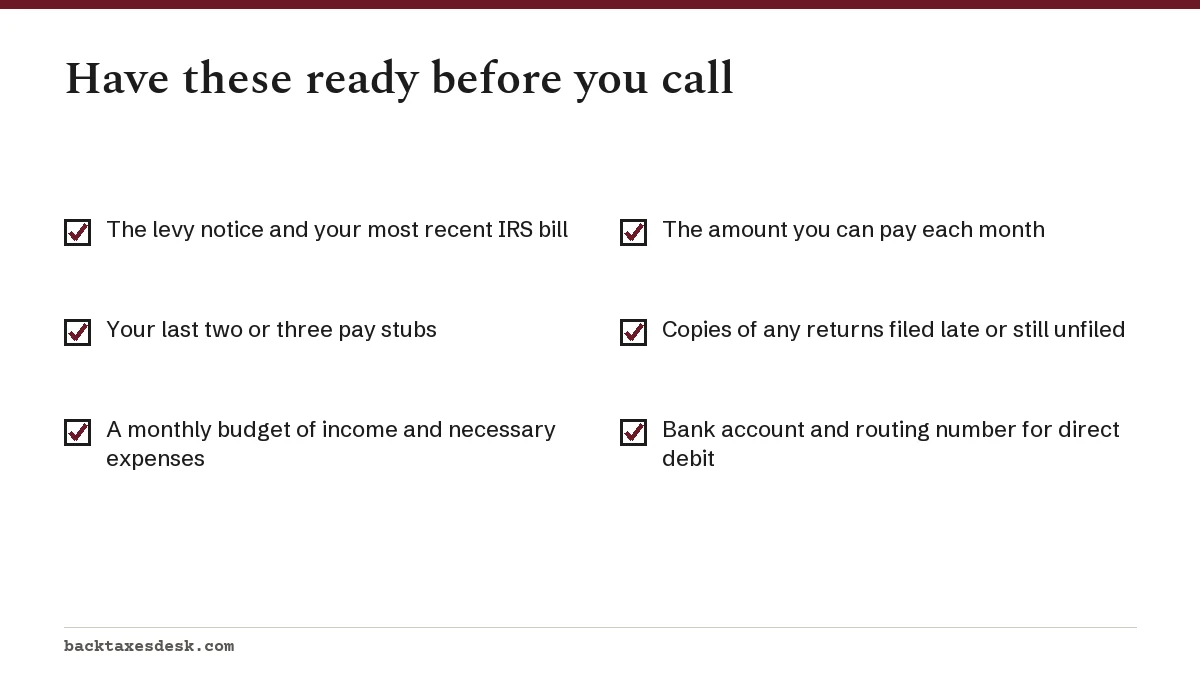
Ask two direct questions at the end of the call: whether the IRS will release the levy, and how and when your employer will be told. Write down the employee's name, ID number and the date. Tell your payroll office you have called, but keep sending money through payroll until the release actually arrives.
Step 2: File any missing tax returns
The IRS will not approve a payment plan while required returns are missing, because individuals must be current on filing to get an installment agreement. If a year is unfiled, prepare it now, even if you cannot pay the tax on it.
If you need income figures for an old year, request a wage and income transcript through Get Transcript or Form 4506-T. Our guide to filing unfiled tax returns walks through the order to file them in.
Step 3: Use a payment plan to stop wage garnishment
A wage garnishment IRS payment plan is the most common way out. Once you enter into an installment agreement whose terms do not allow the levy to continue, the IRS must release it. Individuals who owe $50,000 or less in combined tax, penalties and interest can apply online through the Online Payment Agreement.
| Plan | Who qualifies | Setup fee |
|---|---|---|
| Short-term plan | Pay in full within 180 days; owe under $100,000 | $0 |
| Long-term plan online, direct debit | Owe $50,000 or less | $29 |
| Long-term plan online, other payment | Owe $50,000 or less | $69 |
| Long-term plan by phone, mail or in person, direct debit | Applying other than online | $107 |
| Long-term plan by phone, mail or in person, other payment | Applying other than online | $178 |
Low-income applicants, with adjusted gross income at or below 250% of the federal poverty guidelines, have the direct debit fee waived. Interest and some penalties keep running while you pay. Compare plan types on our installment agreement page.
Worked example: levy versus payment plan
Say a single filer with no dependents takes home $2,000 every two weeks and owes $18,000. Under the 2026 levy tables the employer sends $1,380.77 per check to the IRS, about $2,990 a month over 26 paychecks, and the worker keeps $619.23 per check. A long-term plan at, for example, $500 a month instead leaves about $3,830 of the worker's roughly $4,330 monthly take-home pay in hand while the debt is paid down.
Step 4: Ask for wage garnishment IRS hardship relief
If the levy leaves you unable to pay rent, food, utilities or other basic, reasonable living expenses, the IRS must release it for economic hardship. You prove hardship with numbers, not a description of stress.
- Complete Form 433-F, Collection Information Statement, or Form 433-A if the IRS asks for the longer version.
- List monthly income from all sources and your necessary expenses: housing, utilities, food, transportation, health care, court-ordered payments and current-year taxes.
- Gather proof: recent pay stubs, recent bank statements, your lease or mortgage statement, and utility and medical bills.
- Send or discuss the statement with the IRS office on your notice and ask for a hardship release of the levy.
- If the IRS agrees you cannot pay anything, ask whether your account will be placed in Currently Not Collectible status.
Currently Not Collectible status pauses collection but does not erase the debt. Interest and penalties keep growing, the IRS may still file a tax lien, and it reviews your finances again later.
Step 5: Appeal the levy if the IRS says no
If you cannot reach agreement, ask to speak with the employee's manager. If that fails, appeal through the Collection Appeals Program (CAP). CAP covers levies before or after they are placed on wages, and it usually produces a faster Appeals decision than other routes.
- Contacted by a revenue officer: request a conference with the collection manager first, then submit Form 9423, Collection Appeal Request, to that collection office. Publication 1660 says to tell the officer within 2 business days of the manager conference that you plan to appeal and postmark Form 9423 within 3 business days.
- Contacted only by notice or phone: call the number on the notice, ask for a manager, and if the manager's decision goes against you, your case goes to Appeals. A written request is not required in that route.
- CAP limits: you cannot dispute the amount of tax in CAP, and you cannot take a CAP decision to court.
If your levy notice was recent, check whether a Collection Due Process hearing is still open to you. A request within 30 days of the Final Notice of Intent to Levy generally blocks levies for those periods while the hearing runs; after that, an equivalent hearing can be requested within one year of the notice, though it does not prohibit levy. Details are in our Collection Due Process hearing guide.
Step 6: Get help from the Taxpayer Advocate Service
The Taxpayer Advocate Service (TAS) is an independent organization inside the IRS that helps people whose IRS problem is causing financial difficulty or who have tried and failed to fix it through normal channels. A wage levy that threatens rent or a car payment is the kind of case it accepts.
TAS cannot extend the deadline for a CDP, equivalent or CAP hearing, so file any appeal on time while TAS works the case. Low Income Taxpayer Clinics can also represent qualifying taxpayers for free or a small fee. See our page on the Taxpayer Advocate Service.
How quickly does an IRS wage levy stop?
The IRS does not publish a standard number of days between an agreement and the release. Timing depends on how fast the release reaches your employer and when payroll closes for the next check, so one more paycheck may be levied after you reach a deal.
If money was taken after the IRS agreed to release, or the levy was wrongful, you can ask the IRS to return it. For levies made on or after March 23, 2017, the request must be made within 2 years of the levy date (Publication 1660). The mechanics of release letters are covered on our IRS levy release page.
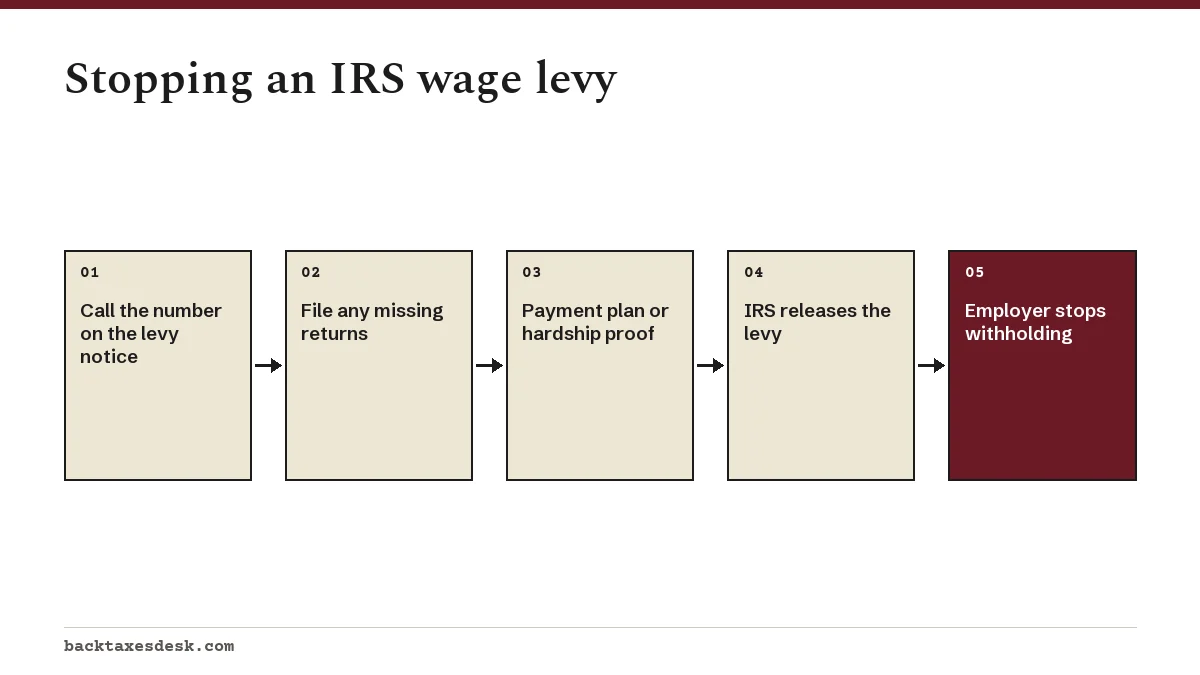
Step by step
Call the IRS
Call the phone number on your levy notice as soon as the levy starts and have your notice, pay stubs and a monthly budget ready.
File missing returns
File every required return; the IRS will not approve a payment plan while returns are missing.
Propose a resolution
Pay in full, apply for a short-term or long-term payment plan, or submit Form 433-F to show economic hardship.
Confirm the release
Ask the IRS to release the levy and how your employer will be notified, and record the employee's name and the date.
Appeal if refused
Ask for a manager, then file Form 9423 under the Collection Appeals Program, or request a CDP or equivalent hearing if still available.
Get help
Contact the Taxpayer Advocate Service or a Low Income Taxpayer Clinic if the levy causes financial hardship and the IRS has not resolved it.
Common questions
Does a payment plan stop IRS wage garnishment?
Usually, yes. The IRS must release a levy when you enter into an installment agreement whose terms do not allow the levy to continue. Ask for the release when you agree to the plan and confirm it in the call notes.
Can hardship stop a wage levy?
Yes. If the levy prevents you from meeting basic, reasonable living expenses, the IRS must release it. You will need a financial statement such as Form 433-F with proof of income and expenses.
Can I stop an IRS wage garnishment myself without a lawyer?
Yes. Calling the IRS, applying for a payment plan online and filing Form 9423 do not require a representative. Enrolled agents, CPAs, attorneys and Low Income Taxpayer Clinics can help if the case is complicated.
Will filing bankruptcy stop an IRS wage levy?
A bankruptcy filing triggers an automatic stay, and a levy issued during the stay must be released. Whether the tax itself can be discharged depends on its age and other rules, so talk to a bankruptcy attorney first.
Can I get back wages the IRS already took?
Sometimes. The IRS may return levied money if the levy was premature, wrongful or broke procedure, or if you enter a payment plan that allows it. For levies since March 23, 2017, ask within 2 years.
Sources
- Publication 594, The IRS Collection Process irs.gov
- Publication 1660, Collection Appeal Rights irs.gov
- Payment plans; installment agreements irs.gov
- Temporarily delay the collection process irs.gov
- Information about wage levies irs.gov
We check figures against these official pages. Rules change; confirm anything that affects a deadline or payment with the agency before you act.
Tell us what happened
Describe your situation and our editors will use it to improve this guide. If you leave your email, we may reply with a pointer to the right page or official contact. We never share your details.
Related guides
 IRS Collection Process: Liens, Levies and Your Rights
The IRS collection process starts with a bill (usually Notice CP14) and escalates through reminder notices to a Final Notice of I…
Can IRS Garnish Wages From Social Security? Levy Rules
Can the IRS garnish wages from Social Security? Yes. Through the Federal Payment Levy Program the IRS can generally take up to 15…
Collection Due Process Hearing: Form 12153 Step by Step
A collection due process hearing is an independent review by the IRS Independent Office of Appeals of a proposed levy or a filed…
Currently Not Collectible Status: IRS Hardship Explained
Currently not collectible (CNC) is an IRS account status that pauses most collection when paying anything toward your tax debt wo…