
How to find your IRS CSED date on an account transcript
Short answer
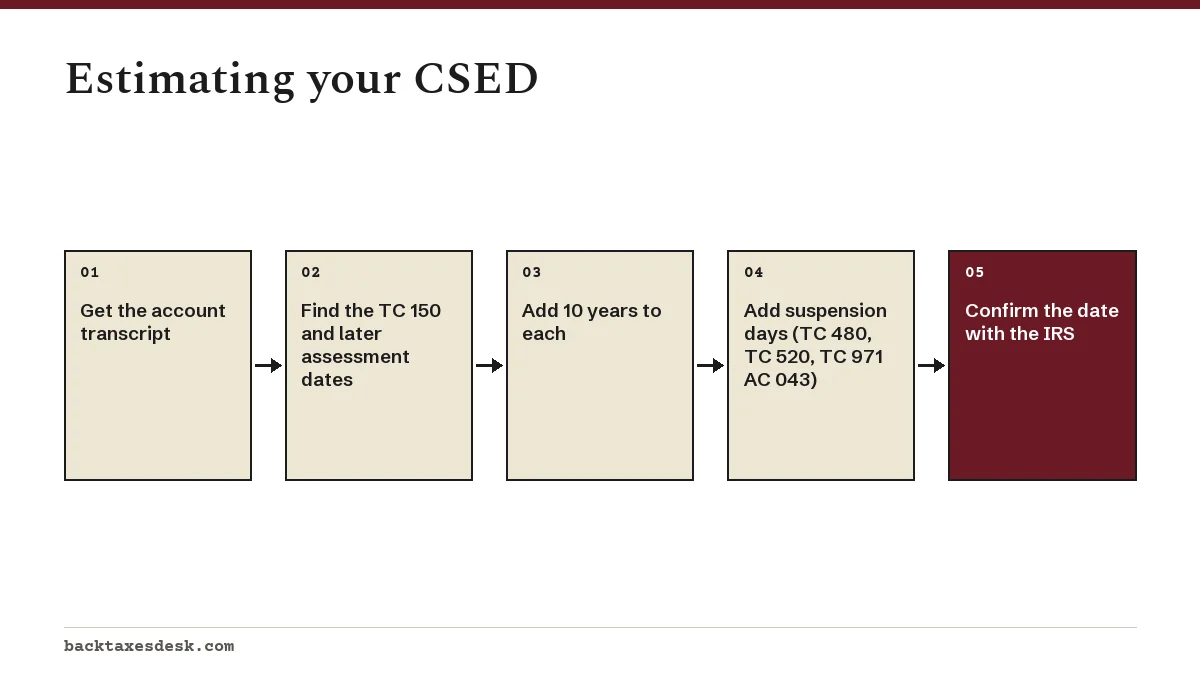
Your IRS CSED date is generally 10 years after the date a tax was assessed, pushed later by any period when collection was legally suspended. You estimate it from the assessment dates on your IRS account transcript, one date for each tax year and each additional assessment, then add suspension time such as a pending payment plan, offer or bankruptcy.
- 01Basic collection period
- 10 years from the assessment date
- 02Where to find assessment dates
- Transactions section of the IRS account transcript
- 03Bankruptcy suspension
- Case length plus 6 months
- 04Rejected payment plan or offer
- Pending time plus 30 days
- 05Combat zone service
- Service period plus 180 days
What is the IRS CSED date?
The IRS CSED date, or Collection Statute Expiration Date, is the last day the IRS can legally collect a particular tax assessment. Under IRC 6502 the IRS generally has 10 years from the date of assessment to collect the tax, penalties and interest, and the CSED marks the end of that window.
In plain terms, the CSED IRS meaning is 'the expiration date on a tax debt.' After it passes, the IRS generally must stop collection on that assessment and may not issue new levies for it. The broader rules, including what the IRS can still do near the end, are on our IRS collection statute of limitations page. This guide focuses on the practical job of finding and checking your own date.
How do you get an IRS account transcript?
You get an account transcript, the record that shows assessment dates, through your IRS Online Account, the Get Transcript tool, or Form 4506-T by mail. The IRS also runs an automated transcript phone line listed on its collection-time page.
- Sign in to your IRS Online Account and open the tax records section.
- Choose Account Transcript, not Tax Return Transcript. The return transcript shows line items from your return, but not later assessments or payments.
- Select each tax year you owe for and download or print it.
- If you cannot verify your identity online, send Form 4506-T, Request for Transcript of Tax Return, and check the box for an account transcript.
- Repeat for every year that has a balance. The check if you owe back taxes guide shows how to find which years those are.
How do you read your IRS CSED on the transcript?
To read your IRS CSED transcript information, go to the Transactions section and find each three-digit transaction code (TC) that records an assessment, with the date beneath it. The IRS says to use that date as the starting point. The standard account transcript does not print a labeled CSED line, so you work it out from those codes and dates.
| Code | What it means | Effect on the CSED |
|---|---|---|
| TC 150 | Original return filed and tax assessed | Starts a 10-year clock from its date |
| TC 290 or TC 300 | Additional tax assessed (for example after a CP2000 or audit) | Starts its own 10-year clock |
| TC 160 or TC 166, TC 170 or TC 176 | Failure-to-file or estimated tax penalty assessed | Penalty assessments carry their own CSED |
| TC 480 | Offer in Compromise pending | Suspends the CSED while pending |
| TC 971 AC 043 | Installment agreement request pending | Suspends the CSED while pending |
| TC 520 (certain closing codes) | Bankruptcy or other litigation | Suspends the CSED |
| TC 550 | Waiver extending the collection period | Moves the CSED to the agreed date |
The Internal Revenue Manual (IRM 5.1.19) lists these codes. The code list is also a guide to how the IRS tracks your file, so any TC 480, TC 520 or TC 971 entry deserves a note with its start date and, if one appears, its reversal date.
Which date to use for TC 150
Use the date printed next to TC 150, not the date you mailed the return and not the April due date. The assessment date reflects when the IRS processed the return, which can be weeks after it arrived. For a late return or a substitute for return, the assessment can come years after the tax year ended, which is why late filers often have later CSEDs than they expect.
How do suspensions change your collection statute expiration date?
Suspensions add time to the collection statute expiration date because the 10-year clock stops while certain events are in progress. The IRS lists these main suspension events:
| Event | Time added |
|---|---|
| Installment agreement request pending | While pending, plus 30 days if rejected or withdrawn |
| Offer in Compromise pending | While pending, plus 30 days if rejected, plus any appeal time |
| Bankruptcy | From filing until discharge, dismissal or closure, plus 6 months |
| Collection Due Process hearing | Until the final determination |
| Innocent spouse request | Until a waiver is filed or the 90-day period to petition the Tax Court expires |
| Combat zone service | The service period plus 180 days |
| Living outside the U.S. for 6 months or more in a row | The time abroad |
Overlapping suspensions are not double-counted, according to the Taxpayer Advocate Service. If an offer was pending while a bankruptcy case was open, the overlapping days count only once. An equivalent hearing, unlike a Collection Due Process hearing, does not suspend the CSED, as Publication 594 notes.
Is there an IRS CSED calculator?
The IRS does not offer a public IRS CSED calculator. You can build your own estimate with a spreadsheet or a calendar by counting days, as the worked example below shows.
Worked example
Suppose a 2020 return was filed late and the account transcript shows TC 150 dated May 24, 2021. The base CSED is May 24, 2031. The transcript also shows TC 480 for an Offer in Compromise that was pending for 150 days before it was rejected, with no appeal. That adds 150 days plus 30 days after rejection, or 180 days.
| Step | Result |
|---|---|
| TC 150 assessment date | May 24, 2021 |
| Add 10 years | May 24, 2031 |
| Add offer suspension (150 days pending + 30 days) | +180 days |
| Estimated CSED for the original assessment | November 20, 2031 |
| TC 290 assessment on March 7, 2023 (after a CP2000) | Separate estimated CSED: March 7, 2033, plus the same suspension if it overlapped |
In this example the extra tax from the CP2000 remains collectible about 16 months longer than the original balance. Unless you designate a voluntary payment in writing, the IRS decides how to apply it, so do not assume a payment reduced the newer assessment first.
How do you confirm your CSED with the IRS?
You confirm your CSED by asking the IRS directly or through an authorized representative, because the IRS's internal systems display a computed CSED for each assessment even though your transcript does not. Call the number on your most recent notice and ask for the CSED for each tax period and each assessment.
- Have your transcript with your own estimate ready, so you can spot differences.
- Ask which suspension events the IRS has recorded and their start and end dates.
- If you have a representative, they can request the same information using Form 2848, Power of Attorney.
- If the IRS figure differs from yours and you cannot resolve it, the Taxpayer Advocate Service can help review the account.
Some IRS letters, including agreements to extend the period, will also show the date. If you are asked to sign Form 900, Tax Collection Waiver, read it carefully; the IRS Manual says it is used only with certain partial payment installment agreements and limits the extension to no more than five years, plus up to one year.
Why your IRS CSED date matters when choosing an option
Your CSED shapes which relief options make sense. A partial payment installment agreement is sized to pay what you can until the CSED, and the remaining balance expires. A debt with little time left can also affect whether an Offer in Compromise is worth filing, since the offer itself suspends the clock.
The date also matters when a private collection agency contacts you. Accounts assigned to private debt collection are still subject to the same CSED, and a collector cannot extend it. The IRS collection process hub puts the statute in context with liens, levies and notices.
Step by step
Download account transcripts
Get an account transcript for every year with a balance from your IRS Online Account, Get Transcript or Form 4506-T.
Find each assessment date
In the Transactions section, note the date of TC 150 and of every additional assessment such as TC 290 or TC 300.
Add 10 years
Add 10 years to each assessment date to get a base CSED for that assessment.
List suspension events
Record start and end dates for pending payment plans, offers, bankruptcy, CDP hearings, innocent spouse requests, combat zone service and long stays abroad.
Add suspension time without double-counting
Add the suspension days, plus the extra 30 days, 6 months or 180 days the rules require, counting overlapping days only once.
Confirm with the IRS
Call the number on your latest notice, or have your representative ask, and compare the IRS CSED with your estimate.
Common questions
Does each tax year have its own CSED?
Yes. Each tax year starts its own 10-year period from its assessment date, and later assessments within the same year, such as a TC 290 after an audit, carry separate CSEDs.
Does filing a return late extend the CSED?
In effect, yes. The clock starts on the assessment date, and a late return is assessed only when the IRS processes it, so the 10 years run from that later date.
Does making a payment restart the CSED?
No. A payment does not reset the 10-year period. Suspension events, such as a pending installment agreement request, an offer or bankruptcy, are what add time.
Can the IRS collect after the CSED?
Generally no. After the CSED the IRS must stop collecting on that assessment, and Publication 594 lists a levy issued after the collection period ended as one the IRS must release.
Is the CSED shown on the IRS online account balance page?
The online account shows balances by year and the transcripts behind them, but you should not expect a labeled CSED. Estimate it from the transcript codes and confirm by calling the number on your notice.
How accurate is my own CSED estimate?
A careful estimate is usually close, but it can miss suspensions the IRS recorded that are not obvious to you, such as time living abroad. Treat it as a starting point and confirm with the IRS before relying on it.
Sources
- Time IRS can collect tax irs.gov
- IRM 5.1.19, Collection Statute Expiration irs.gov
- Taxpayer Advocate Service: Collection Statute Expiration Date (CSED) taxpayeradvocate.irs.gov
- Get Transcript irs.gov
- Publication 594, The IRS Collection Process irs.gov
We check figures against these official pages. Rules change; confirm anything that affects a deadline or payment with the agency before you act.
Tell us what happened
Describe your situation and our editors will use it to improve this guide. If you leave your email, we may reply with a pointer to the right page or official contact. We never share your details.
Related guides
 IRS Collection Process: Liens, Levies and Your Rights
The IRS collection process starts with a bill (usually Notice CP14) and escalates through reminder notices to a Final Notice of I…
Owe IRS Money? What Happens Next and What to Do First
When you owe IRS money, a 0.5% monthly late payment penalty and daily compounding interest (7% a year through December 2026) begi…
Partial Payment Installment Agreement (PPIA) Explained
A partial payment installment agreement (PPIA) is an IRS payment plan for people who cannot pay their full tax debt before the 10…
Private Debt Collection IRS: Is That Collector Legit?
Under the private debt collection IRS program, three contracted agencies, CBE Group, Coast Professional and ConServe, collect som…