
Withdrawal of a federal tax lien: who qualifies and how to apply with Form 12277
Short answer
A withdrawal of a federal tax lien removes the public Notice of Federal Tax Lien from the records where it was filed, while a release only shows the debt is satisfied. You apply on Form 12277. People who owe $25,000 or less and pay by direct debit within 60 months can often qualify after three consecutive payments.
- 01Application form
- Form 12277, Application for Withdrawal of Filed Notice of Federal Tax Lien
- 02Direct debit route: balance limit
- $25,000 or less
- 03Direct debit route: payoff period
- Within 60 months
- 04Direct debit route: payments first
- Three consecutive direct debit payments
- 05Document the IRS files if approved
- Form 10916(c), Withdrawal of Filed Notice of Federal Tax Lien
What is a lien withdrawal?
A withdrawal of a federal tax lien removes the public Notice of Federal Tax Lien (Form 668(Y)) from the county or state records where the IRS filed it. The IRS says a withdrawal tells other creditors it is abandoning its lien priority. It does not cancel the tax: you still owe whatever balance remains.
The lien itself arises automatically once the IRS assesses tax, sends a bill and you do not pay, and it attaches to all your current and future property. The notice is the public filing that alerts lenders. How the lien starts and what it touches is covered on our IRS tax lien page, and where it fits among bills and levies is in the IRS collection process guide.
What is the difference between a lien release and a withdrawal?
A release ends the lien because the debt is gone; a withdrawal removes the public notice, even if a balance remains. The IRS releases a lien within 30 days after the debt is paid, while a withdrawal must be requested and approved.
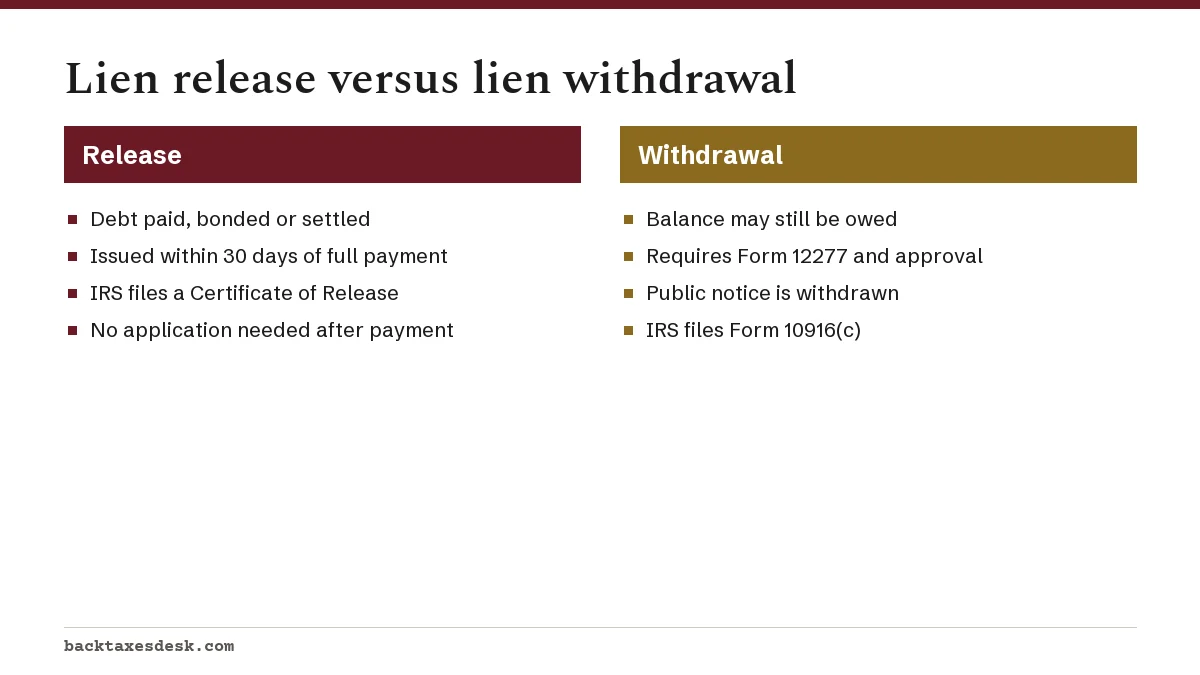
| Option | What it does | How to get it |
|---|---|---|
| Release | Clears the lien and the public notice once the debt is paid, bonded, settled by an accepted offer, or the collection period ends | Automatic within 30 days of full payment; Publication 1450 explains how to request a certificate |
| Withdrawal | Removes the public notice from the records; debt still owed if unpaid | Form 12277 |
| Discharge | Removes the lien from one specific property, such as a home being sold | Publication 783 |
| Subordination | Lets another creditor, such as a refinancing lender, move ahead of the IRS | Publication 784 |
Paying in full and getting a release is covered on our IRS lien release page. You can also ask for a withdrawal after a release: the Form 12277 instructions say that someone seeking withdrawal of a released notice should generally check the best interest box.
Selling or refinancing: when discharge or subordination fits better
If the lien is standing in the way of one transaction rather than your credit in general, a withdrawal may not be the right tool. Publication 594 gives the example of selling property where the government receives its interest through the sale: a Certificate of Discharge frees that property from the lien so the closing can go ahead.
For a refinance, the IRS example is a new mortgage that cannot close because the federal tax lien has priority. Subordination lets the new lender go first. Both options still leave the debt, and the lien on your other property, in place.
Who qualifies for a withdrawal of a federal tax lien?
The IRS may withdraw a Notice of Federal Tax Lien in the situations listed in Publication 594 and on Form 12277. Check the boxes on line 11 of the form that match your case:
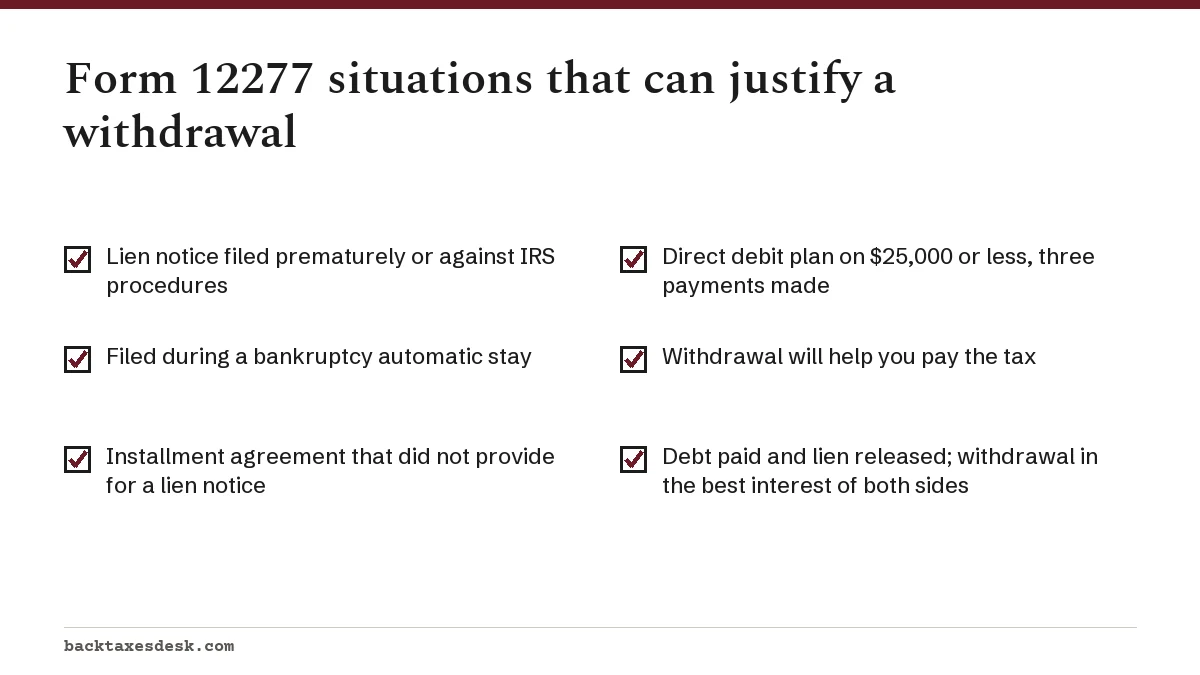
- Filed too early or against procedure: the notice was filed prematurely or not in line with IRS procedures, including a filing during a bankruptcy automatic stay.
- Installment agreement: you entered a payment plan for the debt and the agreement did not provide for a lien notice to be filed.
- Direct Debit Installment Agreement: you pay by automatic withdrawal from your bank account and meet the conditions below.
- Withdrawal will help collection: for example, the public notice is blocking a loan or job that would let you pay faster.
- Best interest of you and the government: for example after the debt is paid and the lien released; the Taxpayer Advocate can also make this request for you.
Lien withdrawal with a direct debit payment plan: the $25,000 route
The most predictable path for people who still owe is the direct debit route. The IRS lists these conditions on its Understanding a federal tax lien page:
- You owe $25,000 or less.
- Your Direct Debit Installment Agreement will pay the full amount you owe within 60 months.
- You are in full compliance with other filing and payment requirements.
- You have made three consecutive direct debit payments.
- You have not defaulted on this or any previous direct debit agreement.
Worked example
Ana owes $21,600 and a lien notice was filed. She sets up a direct debit plan online, which carries a $29 setup fee. Her payment must be more than $360 a month: $21,600 over 60 months is $360 before interest, and underpayment interest, 7% a year for October to December 2026, keeps accruing. After her third consecutive debit clears, she files Form 12277 and checks the Direct Debit Installment Agreement box.
See the IRS installment agreement page for plan types, fees and how to apply.
How do I file Form 12277?
Form 12277, Application for Withdrawal of Filed Form 668(Y), Notice of Federal Tax Lien, is a one-page application with instructions on the back. There is no filing fee.
- Lines 1 and 2: your name and Social Security number or EIN exactly as they appear on the lien notice.
- Line 3: your representative, or for a business the name and title of the contact person.
- Lines 4 to 8: current address and phone number.
- Line 9: attach a copy of the lien notice, or give its serial number, filing date and the recording office where it was filed.
- Line 10: mark the lien's status: open (balance still owed), released, or unknown.
- Line 11: check every reason that applies. For an already released lien, the instructions say to generally check the best interest box.
- Line 12: explain the facts in detail and attach proof, such as your installment agreement letter and bank records showing three debits.
- Sign and date under penalties of perjury, adding your title for a business.
Where to send it
Mail it to the IRS office assigned to your account. If no office is assigned or you are not sure, send it to IRS, Attn: Advisory Group Manager, in the area where you live or where the business is based, using Publication 4235, Advisory Group Addresses, to find the office.
After approval: what the IRS files and who gets told
If the IRS approves your application, it files Form 10916(c), Withdrawal of Filed Notice of Federal Tax Lien, in the same recording office as the original notice and sends you a copy. Keep that copy with your tax records.
The IRS will also send the withdrawal to credit reporting agencies, lenders or other creditors, but only if you ask in writing and list their names and addresses. Your written request authorizes that disclosure. If you need more copies later, write to the Advisory Group Manager with your details, a copy of the withdrawal and the list of recipients.
What if the IRS denies my lien withdrawal?
A denial letter comes with Form 9423, Collection Appeal Request, and Publication 1660. You can appeal the denial under the Collection Appeals Program, which usually decides faster than other routes but cannot be taken to court.
If you receive Letter 3172, the lien filing notice, you can also ask for withdrawal inside a Collection Due Process hearing by checking the lien withdrawal reason on Form 12153 before the deadline printed on the letter.
Step by step
Check eligibility
Confirm a reason on line 11 of Form 12277 applies, such as a direct debit plan on a balance of $25,000 or less with three consecutive payments made.
Gather documents
Get a copy of the lien notice or its serial number, filing date and recording office, plus your payment plan letter and bank records.
Complete Form 12277
Fill in lines 1 to 12, explain the facts in detail, then sign and date the form.
Mail the application
Send it to the IRS office handling your account or the Collection Advisory Group listed in Publication 4235.
Ask for notices to creditors
Include a written list of credit reporting agencies and lenders you want the IRS to notify.
Keep the withdrawal
File the Form 10916(c) copy with your records, or appeal a denial with Form 9423.
Common questions
Does a lien withdrawal remove the lien from my credit report?
The IRS files a withdrawal in the public records and, if you ask in writing, sends it to the credit reporting agencies you list. Whether and how a credit file changes is up to each bureau, so follow up with them directly.
Can I get a lien withdrawn after paying in full?
Yes. Once the lien is released, you can still file Form 12277 and check the best interest box. A release clears the lien; a withdrawal also withdraws the public notice that was filed.
How long does Form 12277 take to process?
The IRS does not publish a standard processing time. It may ask for more information, then contacts you with a decision; an incomplete form slows it down.
Is there a fee for Form 12277?
No. The form has no filing fee. A direct debit payment plan has its own setup fee, $29 online as of September 2026, and the low-income fee waiver may apply.
Does a lien withdrawal mean I no longer owe the tax?
No. Publication 594 says a withdrawal does not release the lien or end your liability. Any unpaid balance, penalties and interest remain until paid or the collection period ends.
Can a business apply for a lien withdrawal on Form 12277?
Yes. A business enters its EIN, the name and title of the person applying, and signs with that title. The same line 11 reasons apply, and a denial can be appealed with Form 9423.
Sources
- Form 12277, Application for Withdrawal of Filed Form 668(Y) irs.gov
- Understanding a federal tax lien irs.gov
- Publication 594, The IRS Collection Process irs.gov
- Publication 1660, Collection Appeal Rights irs.gov
- About Form 12277 irs.gov
We check figures against these official pages. Rules change; confirm anything that affects a deadline or payment with the agency before you act.
Tell us what happened
Describe your situation and our editors will use it to improve this guide. If you leave your email, we may reply with a pointer to the right page or official contact. We never share your details.
Related guides
 IRS Collection Process: Liens, Levies and Your Rights
The IRS collection process starts with a bill (usually Notice CP14) and escalates through reminder notices to a Final Notice of I…
IRS Installment Agreement Types: Which One Fits Your Debt
An IRS installment agreement is a long-term monthly payment plan whose type depends mostly on how much you owe. Tax of $10,000 or…
IRS Levy: What the IRS Can Take and How to Stop It
An IRS levy is the legal seizure of your property or rights to property, such as wages, bank balances, Social Security payments o…
Collection Due Process Hearing: Form 12153 Step by Step
A collection due process hearing is an independent review by the IRS Independent Office of Appeals of a proposed levy or a filed…