
Topic
Back taxes relief: the official IRS options and how to pick one
Back taxes relief from the IRS comes through a short list of official programs, not a secret settlement deal. Most people who owe end up in a payment plan. Smaller groups qualify for an offer in compromise, Currently Not Collectible hardship status, penalty relief or innocent spouse relief. Each has its own test, and you can request every one of them yourself.
9 guides in this topic Updated October 20, 2026
- Currently Not Collectible Status: IRS Hardship ExplainedCurrently not collectible (CNC) is an IRS account status that pauses most collection when paying anything toward your tax debt would leave you unable…
- Does the IRS Forgive Tax Debt? What Is Actually PossibleDoes the IRS forgive tax debt? Not in the way ads suggest. There is no general forgiveness program. A balance can shrink or end only through specific…
- Form 433-F: IRS Collection Information Statement GuideForm 433-F is the IRS Collection Information Statement, a short financial snapshot the IRS uses to decide how much you can pay each month on a tax de…
- IRS Fresh Start Program 2027: Still Available? How to ApplyThere is no separate IRS Fresh Start program to apply for in 2027 or 2026, and no program deadline. Fresh Start was the name the IRS gave to a packag…
- Injured Spouse vs Innocent Spouse: Form 8379 or Form 8857An injured spouse uses Form 8379 to get back their share of a joint refund that was taken for a debt only the other spouse owes. An innocent spouse u…
- Innocent Spouse Relief: Form 8857 and Who QualifiesInnocent spouse relief lets you avoid tax, interest and penalties caused by a spouse or former spouse's errors on a joint return. You apply on Form 8…
- Is an Offer in Compromise Worth It? Pros, Cons and CostsAn IRS offer in compromise is worth it mainly when your assets and future income clearly cannot cover the debt before the collection deadline runs ou…
- Offer in Compromise Pre-Qualifier: Check Eligibility FreeThe offer in compromise pre-qualifier is a free IRS web tool at IRS.gov/OICtool that asks about your filing status, assets, income and expenses, then…
- Offer in Compromise: How to Settle IRS Debt for LessAn offer in compromise is an agreement to settle IRS tax debt for less than the full balance. The IRS accepts one only when your offer is at least wh…
Back taxes relief at a glance
Back taxes relief means one of six official IRS arrangements. Two of them let you pay the full balance over time, one can settle it for less, one pauses collection, and two remove specific parts of what you owe. None of them requires a middleman.
The table below lines them up by who they fit and what they cost to request. Setup fees and thresholds come from the IRS payment plan and offer in compromise pages as of September 2026.
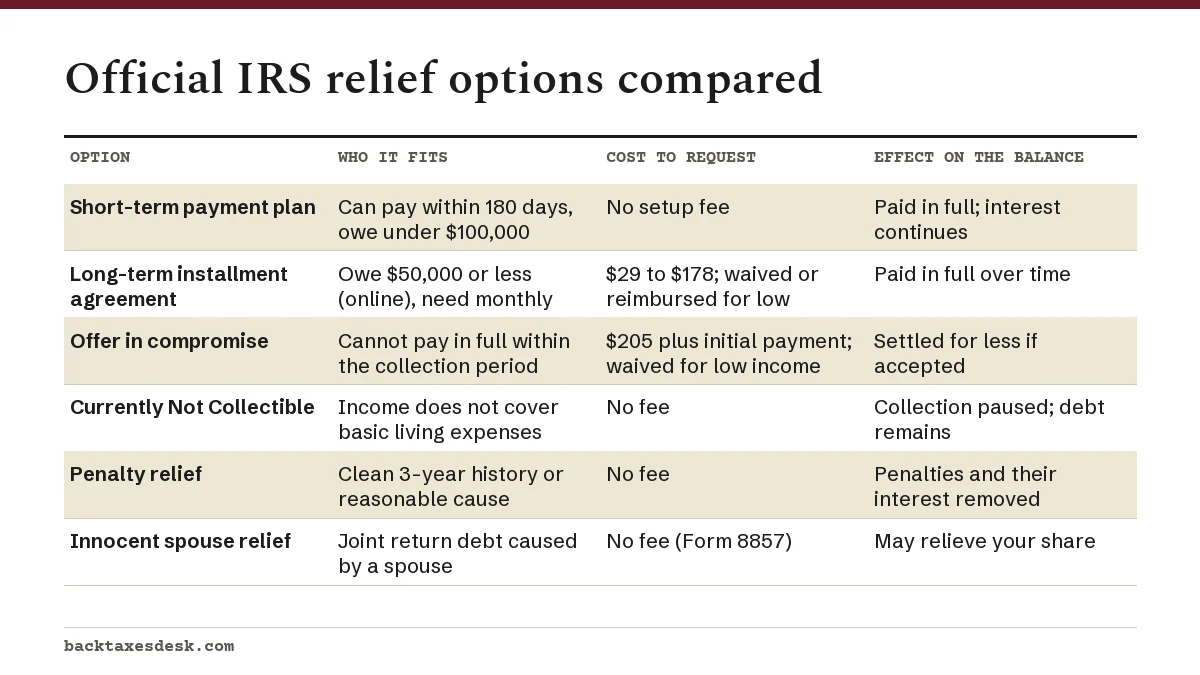
What IRS debt relief actually changes
Every IRS debt relief option does one of three things: it spreads the payments out, it lowers the amount you must pay, or it stops collection for a while. Knowing which of the three you need narrows the choice quickly.
A worked example with a $14,000 balance
Suppose you owe $14,000 in tax, penalties and interest. If you can clear it within 180 days, a short-term plan costs nothing to set up. If you need monthly payments, the online long-term plan fits because the balance is under $50,000, and choosing direct debit keeps the setup fee at $29.
An offer in compromise only makes sense if the IRS formula for what it could collect from you, based on equity in assets plus leftover monthly income, comes out well below $14,000. Currently Not Collectible status only fits if your income does not cover basic living costs at all.
Penalty relief is separate from all of these. If part of the $14,000 is failure-to-file or failure-to-pay penalties and you had a clean record for the prior three years, those penalties and the interest charged on them can come off, while the underlying tax stays.
Which of the tax debt relief programs fits your situation
Work through the questions in order. Filing comes first because the IRS generally will not approve an installment agreement or consider an offer while required returns are missing.
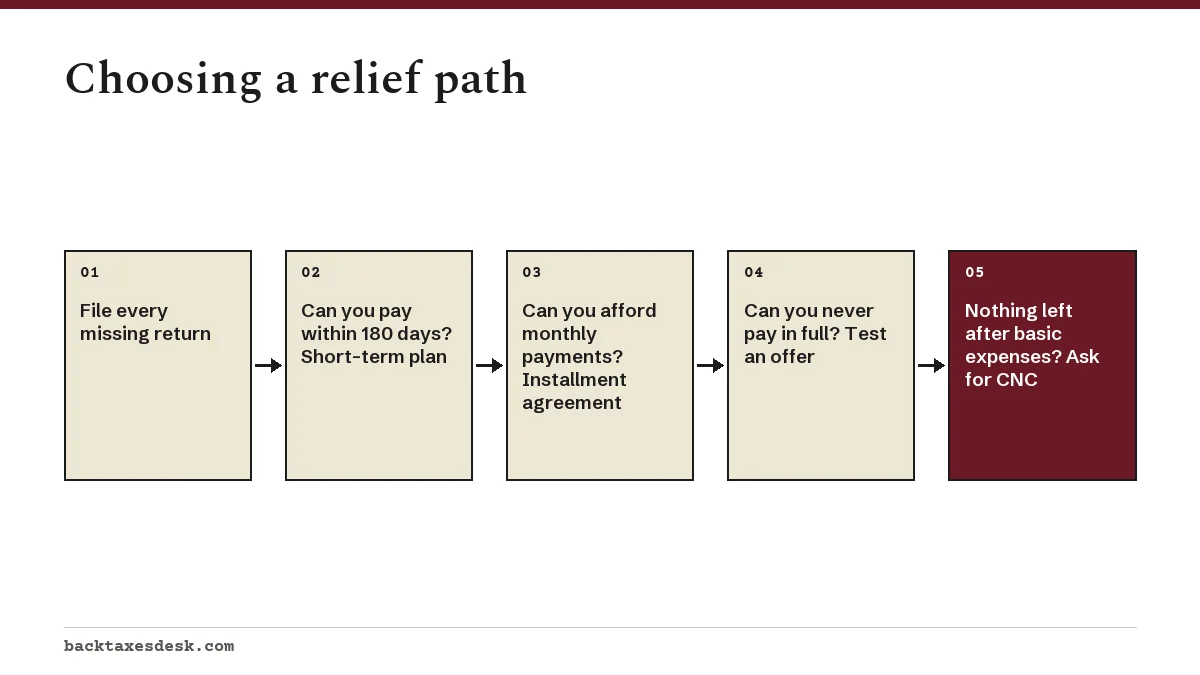
You can pay, just not today
Ask for a payment plan. Individuals who filed on time and have an approved plan see the failure-to-pay penalty drop from 0.5% to 0.25% per month, so a plan costs less than simply ignoring the bill.
You will never be able to pay the full amount
Test an offer in compromise with the free IRS Pre-Qualifier before paying anyone. The IRS generally rejects offers from people who could pay in full through a payment plan, equity in assets or both.
Nothing is left after rent, food and utilities
Ask for Currently Not Collectible status. Expect to complete a financial statement, usually Form 433-F, and to send proof of income and expenses.
Most of the balance is penalties
Request First Time Abate or reasonable cause relief. For returns originally due on or after January 1, 2027, the IRS plans to apply eligible penalty relief automatically during processing under its new Automatic Exemption from Penalty.
The debt came from a spouse or former spouse
File Form 8857 for innocent spouse relief. Requests under innocent spouse and separation of liability rules are generally due within 2 years after the IRS first tries to collect from you.
Is there back taxes forgiveness from the IRS?
There is no general IRS forgiveness program. The closest thing is an accepted offer, which settles the debt for what the IRS calculates it could collect, and the 10-year collection period, after which the IRS can no longer collect a balance unless the clock was suspended.
Ads often describe these rules as forgiveness or as a special Fresh Start program. Both topics have their own pages in the list below, including what the Fresh Start name really referred to.
Tax relief options when collection has already started
The right relief option can still be requested after enforcement begins, but the deadlines get shorter. Check the notice number in the corner of your latest letter before deciding anything, and confirm it against your IRS online account.
| What you received | Time that matters | What to do |
|---|---|---|
| LT11 or Letter 1058, final notice of intent to levy | 30 days | Request a Collection Due Process hearing on Form 12153 and propose a payment plan, offer or hardship status there |
| Missed the 30-day window | Up to one year | Ask for an equivalent hearing, which still lets you raise collection alternatives |
| Bank levy | 21 days before the bank sends funds | Contact the IRS at once with proof of hardship or a payment proposal |
| Wage levy | Continuous until released | Return the dependents statement to your employer within three days and ask the IRS about release options |
If the notice is a CP523, your existing payment plan is in default. Contact the IRS within 30 days of the notice date to ask about reinstatement, which may carry a fee.
Missing a hearing deadline does not close the door on relief. A payment plan, an offer or hardship status can still be requested at any point before the balance is paid or the collection period ends.
What relief companies can and cannot do
You do not need a company to get any of these IRS tax relief options. Every form, the Pre-Qualifier and the online payment agreement are open to you directly, and low-income applicants pay no offer fee.
A licensed representative can still help with complex finances or an active levy. Enrolled agents, CPAs and attorneys have unlimited rights to represent taxpayers before the IRS, and you can check a preparer's credentials in the IRS Directory of Federal Tax Return Preparers (IRS credentials guide).
The IRS put misleading offer in compromise marketing on its 2026 Dirty Dozen list. It describes firms, sometimes called OIC mills, that charge high fees to people who were unlikely to qualify.
- A company cannot get you a program the IRS does not offer.
- No one can know your settlement amount before reviewing your income, expenses and assets.
- Payments on any IRS debt go to the US Treasury, never to a company account.
- Free help exists: Low Income Taxpayer Clinics and the Taxpayer Advocate Service are listed on IRS.gov.
Pages in this section
- Offer in compromise: eligibility, the minimum offer formula, Forms 656 and 433-A (OIC), and what happens during review.
- Is an offer in compromise worth it: weighing the fee, the five-year compliance period and the odds against a payment plan.
- OIC Pre-Qualifier walkthrough: what the free IRS tool asks and how to read the result.
- Currently Not Collectible status: the hardship test, what continues during CNC and how it ends.
- Form 433-F: the collection information statement behind most hardship and payment plan requests.
- Does the IRS forgive tax debt: the real ways a balance shrinks or expires.
- IRS Fresh Start program: where the name came from and why there is nothing separate to apply for.
- Innocent spouse relief: Form 8857 and the three types of relief for joint return debt.
Common questions
What tax relief options does the IRS offer?
The IRS offers short-term and long-term payment plans, the offer in compromise, Currently Not Collectible hardship status, penalty relief such as First Time Abate and reasonable cause, and innocent spouse relief. Each is requested directly from the IRS.
Do I need a tax relief company to get IRS debt relief?
No. Every official option can be requested by you, and the IRS provides a free Pre-Qualifier for offers. If you want representation, only enrolled agents, CPAs and attorneys have unlimited rights to represent you before the IRS.
Can I be on a payment plan and apply for an offer in compromise?
Yes. According to the Form 656 booklet, you do not have to make installment agreement payments while the IRS considers your offer, and the plan is reinstated if the offer is not accepted and you have not run up new tax debt.
Does applying for tax relief stop IRS collection?
It depends on the option. While an offer is pending, the IRS suspends other collection activity, though it may still file a lien. Currently Not Collectible status suspends most collection but lets the IRS keep future refunds.
How long does the IRS take to decide on tax relief?
There is no single timeline. An offer in compromise is treated as accepted if the IRS does not decide within two years, not counting appeal time, and innocent spouse requests can take about six months to review.