
Injured spouse vs innocent spouse relief: which form you need
Short answer
An injured spouse uses Form 8379 to get back their share of a joint refund that was taken for a debt only the other spouse owes. An innocent spouse uses Form 8857 to be released from tax, interest and penalties on a joint return that trace to the other spouse. In short, injured spouse vs innocent spouse is a refund problem versus a liability problem, and some couples have both.
- 01Injured spouse form
- Form 8379, Injured Spouse Allocation
- 02Innocent spouse form
- Form 8857, Request for Innocent Spouse Relief
- 03Form 8379 processing time
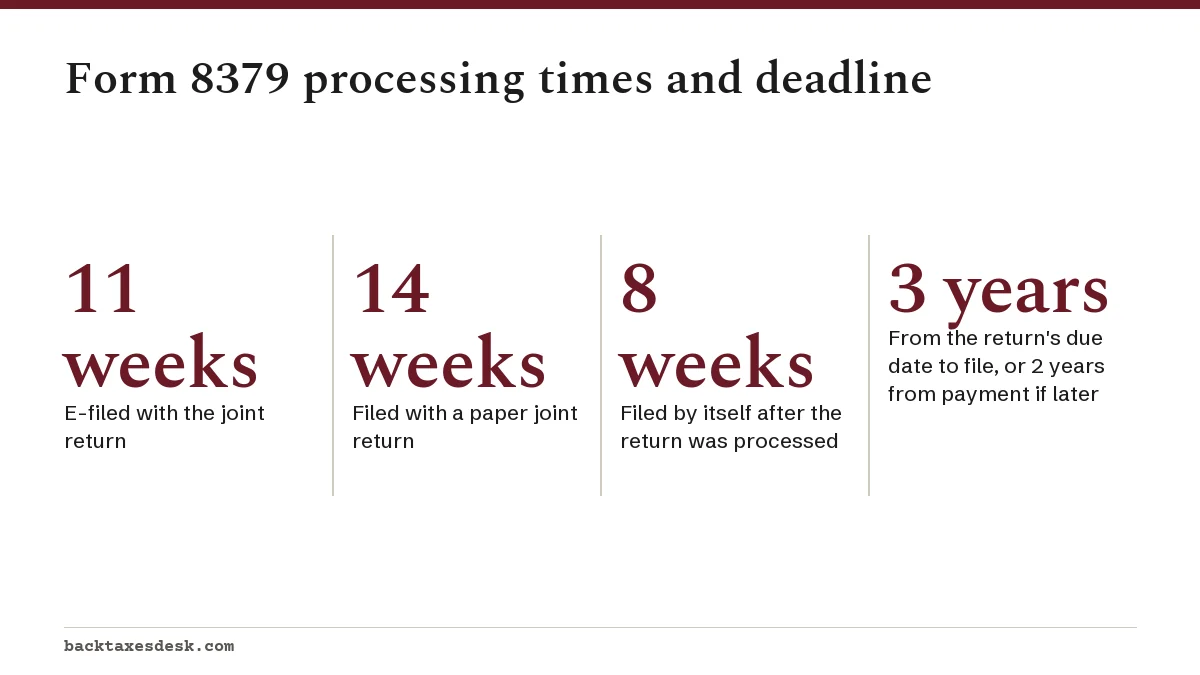
- About 11 weeks e-filed with the return, 14 weeks on paper, 8 weeks filed alone
- 04Form 8379 deadline
- Later of 3 years from the return's due date, including extensions, or 2 years after the tax was paid
- 05Form 8857 deadline, innocent spouse and separation of liability
- Generally 2 years after the first IRS collection attempt against you
What is the difference between injured spouse and innocent spouse relief?
Both start with a joint return. When you file jointly, the refund is one joint overpayment and the tax is one joint liability. The two forms deal with those two halves. An injured spouse is not responsible for the debt that swallowed the refund and wants their part of it back. An innocent spouse is, on paper, liable for the joint tax and asks the IRS to release them from it.
The quickest test is to ask what the IRS took or is asking for. If money you expected as a refund went to your spouse's old tax bill, child support or student loan, look at Form 8379. If the IRS says the two of you owe more tax because of your spouse's income or deductions, or because your spouse never paid what the return showed, look at Form 8857.
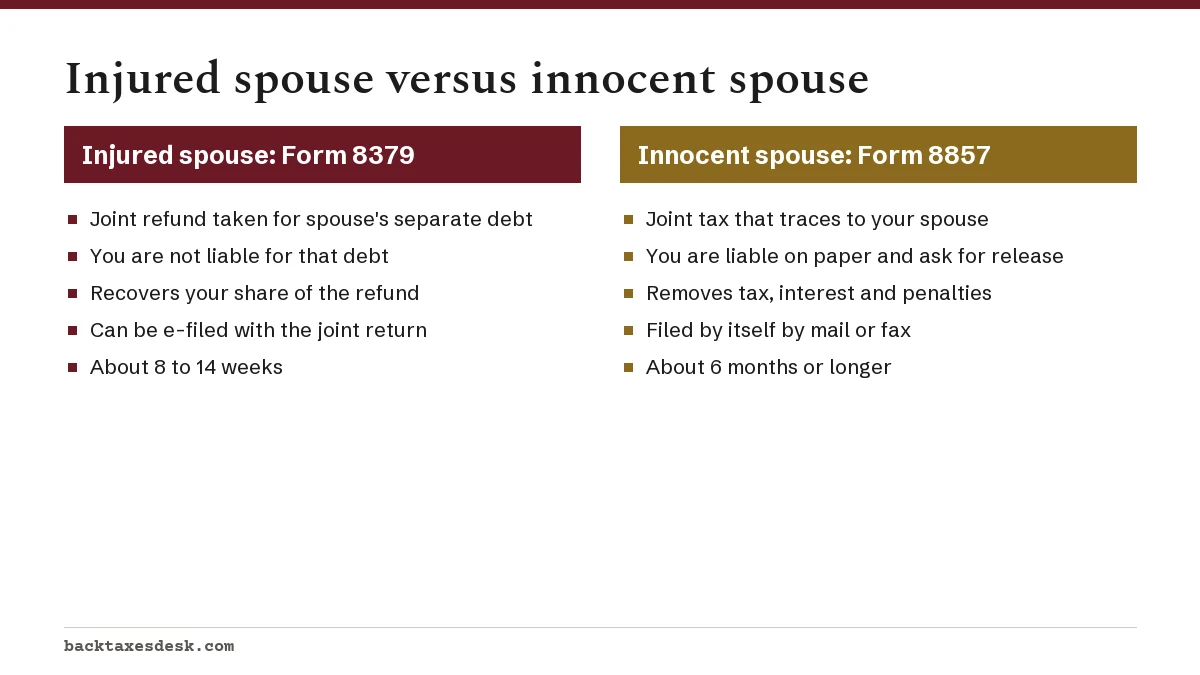
| Feature | Injured spouse (Form 8379) | Innocent spouse (Form 8857) |
|---|---|---|
| The problem | Your share of a joint refund was, or will be, taken for your spouse's separate past-due debt | You are held liable for tax on a joint return that traces to your spouse |
| Debts covered | Federal tax, state income tax, state unemployment compensation, child support, spousal support or federal nontax debt owed only by your spouse | Understated tax from your spouse's erroneous items, or tax reported but not paid (equitable relief only) |
| What you get | Your allocated share of the joint refund | Relief from the tax, interest and penalties, sometimes a refund of tax you paid |
| Deadline | Later of 3 years from the return's due date, including extensions, or 2 years after the tax was paid | Generally 2 years after the first collection attempt against you; longer for equitable relief |
| How to file | With the joint return, e-filed or on paper, or by itself after the offset | By itself, by mail or fax, never attached to your tax return |
| Typical wait | About 11 weeks e-filed with the return, 14 weeks on paper, 8 weeks filed alone | About 6 months, sometimes longer |
Who is considered the injured spouse?
Part I of Form 8379 is the test, and you answer it for one tax year at a time. You are an injured spouse for that year only if all four of these are true.
- You filed, or will file, a joint return for the year.
- The IRS used, or will use, the joint overpayment to pay a legally enforceable past-due debt owed only by your spouse: federal tax, state income tax, state unemployment compensation, child support, spousal support, or a federal nontax debt such as a student loan.
- You are not legally obligated to pay that debt yourself.
- Part of the refund is yours: you lived in a community property state, made and reported payments such as withholding or estimated tax, had earned income and claimed the earned income credit or additional child tax credit, or claimed another refundable credit.
If you fail any of the first three, the form tells you to stop: you are not an injured spouse. The fourth point checks that there is something to recover. A spouse with no withholding, no payments and no refundable credits has no share of the overpayment to claim.
Who is an innocent spouse?
Innocent spouse relief covers the opposite situation: the joint tax itself is the problem. When you sign a joint return, each spouse is responsible for the full tax, even after a divorce. Form 8857 asks the IRS to release you from tax, interest and penalties that trace to your spouse or former spouse. One Form 8857 is weighed under three types of relief.
- Innocent spouse relief: removes understated tax from your spouse's erroneous items when you did not know and had no reason to know about them.
- Separation of liability: divides understated tax as if you had filed separately; you must be divorced, legally separated, widowed or have lived apart for the 12 months before you file.
- Equitable relief: the fallback when the other two do not fit, and the only type that can cover tax that was correctly reported but never paid.
You do not have to pick the type yourself. Our full innocent spouse relief guide covers the requirements, the deadlines and how the review works, including the rule that the IRS must tell your spouse or former spouse about the request.
How do you file Form 8379?
There are two ways. If you expect the refund to be taken, file Form 8379 with the joint return; it can be e-filed with the return or mailed with a paper return, and on paper you write "Injured Spouse" in the upper left corner of page 1 of the return. If the refund has already been offset, file the form by itself when you learn about it.
- Answer Part I for the tax year. If the form tells you to stop, you are not an injured spouse for that year.
- In Part II, list both names and Social Security numbers in the same order as on the joint return.
- In Part III, allocate income, adjustments, deductions, credits, withholding and payments between the two of you as if you had filed separately.
- If you file it by itself, sign Part IV and attach copies of all Forms W-2 and W-2G for both spouses and any Form 1099 that shows withholding. Do not attach a copy of the joint return.
- Mail a standalone form to the IRS center where you filed a paper original, or to the center for your area if the original was e-filed. A local Taxpayer Assistance Center is not an IRS center.
- File a separate Form 8379 for each year you want your share back.
The allocation follows set rules. Income, adjustments and credits go to the spouse who would have reported them on a separate return, and items that do not clearly belong to either spouse are split equally. Each spouse gets half of the basic standard deduction, plus any age or blindness amounts that are theirs. Joint estimated tax payments can be divided however you agree. The IRS then works out the refund that belongs to you.
How long does an injured spouse claim take?
The Form 8379 instructions give three processing times, depending on how and when you file. If you already know a debt is on file, sending the form with an e-filed return saves waiting for the offset and then filing separately.
Do not file the form just in case. The instructions warn that filing Form 8379 when no past-due debt exists only delays your refund. If you are not sure whether a debt is on file, call the Treasury Offset Program at 800-304-3107 before you decide. If the refund was already reduced and no notice arrived, the same number can tell you which agency received the money.
Can you need both forms?
Yes. Picture a couple who file jointly for 2026. The husband has a federal tax balance from a year before the marriage that is his alone, and the IRS applies the whole joint refund to it. Part of that refund came from the wife's withholding, so she files Form 8379 to get her share back. If the IRS later found that the same 2026 return understated tax because the husband left out side income she knew nothing about, she could also file Form 8857 for that year.
The two forms answer different questions, so one does not replace the other. The Form 8379 instructions tell you not to use it to claim innocent spouse relief; Form 8857 is the form for that, and it is never attached to your return.
If the refund went to your own back taxes rather than your spouse's, neither form helps. Our page on whether the IRS will take your refund if you owe back taxes explains the offset and the narrow hardship exception.
Where to get help
Both forms can be filed without a professional, but the questions on Form 8857 in particular reward care. If your income is limited, a Low Income Taxpayer Clinic can help with either claim for free or a small fee. The Taxpayer Advocate Service can step in if a claim stalls and the delay is causing financial hardship. For other ways out of a tax debt, see our tax debt relief options.
Step by step
Identify the problem
Decide whether a joint refund was taken for your spouse's separate debt or whether you are being held liable for joint tax.
Check Part I of Form 8379
Confirm you filed jointly, the debt is only your spouse's, and part of the refund came from your withholding, payments or credits.
File the right form
Use Form 8379 for your share of a refund and Form 8857 for relief from the tax itself; file both if both problems apply.
Track the claim
Expect about 8 to 14 weeks for Form 8379 and about 6 months or longer for Form 8857.
Common questions
What is the difference between injured spouse and innocent spouse?
An injured spouse asks for their share of a joint refund that was taken for the other spouse's separate debt, using Form 8379. An innocent spouse asks to be released from joint tax caused by the other spouse, using Form 8857.
Who is considered the injured spouse?
The spouse who filed a joint return, is not legally obligated for the past-due debt the refund paid, and had withholding, payments, earned income credits or other refundable credits that make part of the refund theirs.
Can I file Form 8379 electronically?
Yes, when you file it with the joint return. A Form 8379 filed by itself after the refund was offset is mailed to the IRS center for your return.
How long does Form 8379 take?
The Form 8379 instructions say about 11 weeks when it is e-filed with the return, about 14 weeks with a paper return, and about 8 weeks when it is filed by itself.
Does Form 8379 help if my spouse owes child support?
Yes. Past-due child support owed only by your spouse is one of the debts listed on the form, so you can ask for your share of the joint refund back.
Is there a deadline for an injured spouse claim?
Generally the later of 3 years from the due date of the original return, including extensions, or 2 years after the tax that was offset was paid. You file a separate claim for each year.
Sources
- Injured spouse relief irs.gov
- Instructions for Form 8379 irs.gov
- Form 8379, Injured Spouse Allocation irs.gov
- Innocent spouse relief irs.gov
- Instructions for Form 8857 irs.gov
- Topic no. 203, Reduced refund irs.gov
We check figures against these official pages. Rules change; confirm anything that affects a deadline or payment with the agency before you act.
Tell us what happened
Describe your situation and our editors will use it to improve this guide. If you leave your email, we may reply with a pointer to the right page or official contact. We never share your details.