
Offer in compromise: how the IRS settles tax debt for less
Short answer
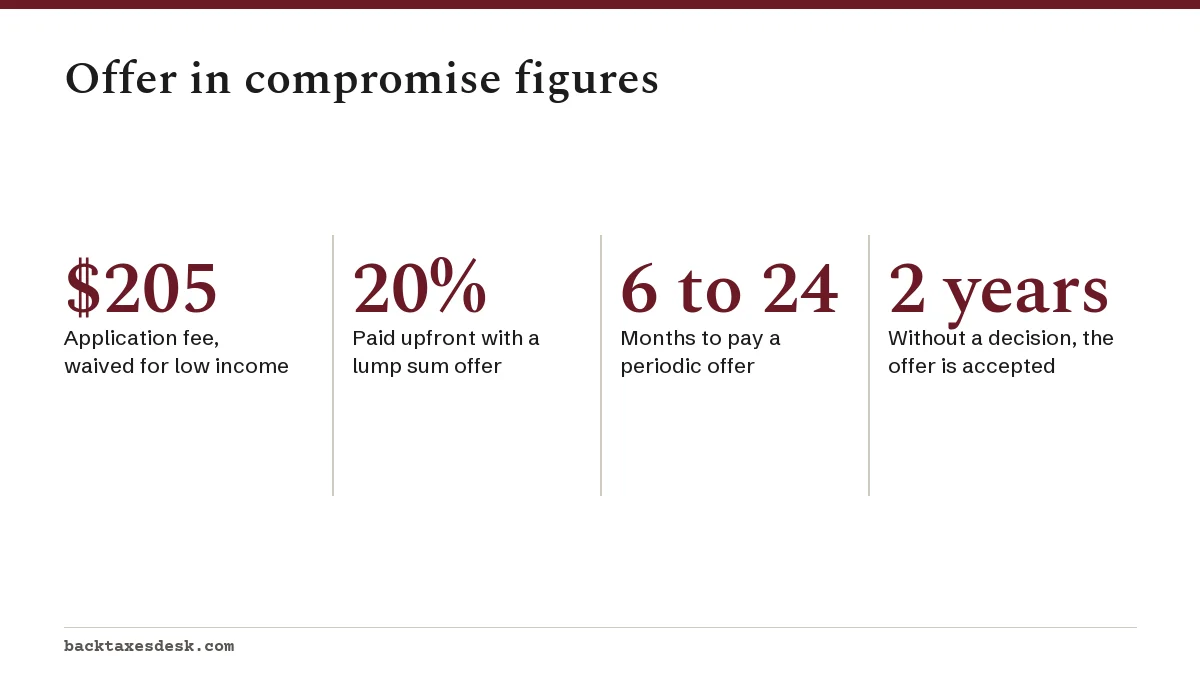
An offer in compromise is an agreement to settle IRS tax debt for less than the full balance. The IRS accepts one only when your offer is at least what it could realistically collect from your assets and future income. You apply with Form 656 and Form 433-A (OIC), a $205 fee and an initial payment, unless you meet the low-income certification.
- 01Application fee
- $205, non-refundable
- 02Lump sum offer
- 20% paid with the application
- 03Periodic offer
- Paid monthly within 6 to 24 months
- 04No decision within two years
- Offer treated as accepted
- 05Appeal a rejection
- Within 30 days, Form 13711
What an offer in compromise is
An offer in compromise is a contract between you and the IRS that settles specific tax periods for a set amount below what you owe. Once accepted and paid, the liability for those periods is conclusively settled, and you give up the right to reopen them with an amended return.
The IRS does not bargain over a fair-sounding number. It accepts an offer when the amount equals or exceeds the most it could expect to collect within a reasonable time, a figure it calls reasonable collection potential.
The three grounds for an offer
- Doubt as to collectibility: you cannot pay the full balance from assets and income. This is the most common basis.
- Effective tax administration: you could technically pay, but doing so would cause economic hardship or would be unjust because of exceptional circumstances.
- Doubt as to liability: you believe you do not owe some or all of the tax. This uses a separate form, Form 656-L, and cannot be combined with the other two at the same time.
The law requires the IRS to make certain information about accepted offers available for public inspection, so an accepted offer is not fully private.
Offer in compromise eligibility
The IRS screens every package against basic conditions before it looks at the dollar amount. According to the Form 656 booklet (revised April 2026), you must meet all of these.
- Every legally required tax return is filed.
- You have received a bill for at least one of the tax debts in the offer.
- All estimated tax payments for the current year are made.
- Business owners with employees have made federal tax deposits for the current quarter and the two before it.
- You are not in an open bankruptcy case.
- Any open audit or pending innocent spouse claim is resolved first.
- Your ITIN, if you use one, is active.
Ability to pay is the second filter. The IRS generally will not accept an offer if you could pay the full balance through an installment agreement, equity in your assets, or both.
How the IRS calculates your minimum offer
Reasonable collection potential has two parts. The first is the net equity in your assets, where most property is valued at 80% of its current market value, a quick-sale figure, minus any loan against it. The second is future remaining income: your monthly household income minus allowable expenses, multiplied by 12 for a lump sum offer or by 24 for a periodic offer.
For individuals who cannot pay in full, Form 433-A (OIC) allows $1,000 of a bank balance and $3,450 of a vehicle's value to be excluded. Those allowances only apply after the IRS confirms you cannot pay in full another way.
| Item | Figure | Counted toward offer |
|---|---|---|
| Checking account | $2,500 minus $1,000 allowance | $1,500 |
| Car | $12,000 x 80% = $9,600, minus $7,000 loan, minus $3,450 allowance | $0 |
| Remaining monthly income | $5,200 income minus $4,950 allowable expenses | $250 per month |
| Lump sum offer | $1,500 + ($250 x 12) | $4,500 |
| Periodic offer | $1,500 + ($250 x 24) | $7,500 |
In this example the lump sum route needs an initial payment of $900 (20% of $4,500) plus the $205 fee. The periodic route costs more in total because the IRS counts two years of leftover income instead of one. Before relying on your own math, run your figures through the free IRS Pre-Qualifier, and weigh the result against a payment plan using our guide on whether an offer is worth it.
Expenses the IRS generally will not count include private school tuition, college costs, charitable giving and payments on unsecured debt such as credit cards.
Offer in compromise Form 656 and the application package
Everything you need is in Form 656-B, the Offer in Compromise Booklet, which contains the forms, instructions and mailing addresses. Individuals can also prepare, pay for and submit an offer through their IRS Individual Online Account.
- Gather tax returns, bank statements, W-2s and 1099s, mortgage and loan statements, and retirement account statements.
- Complete Form 433-A (OIC) for individuals and sole proprietors, or Form 433-B (OIC) for corporations, partnerships and LLCs.
- Attach copies, not originals, of the documents listed at the end of each financial form.
- Complete Form 656, listing the tax years, the offer amount and your payment option. The amount must be at least what the 433-A (OIC) calculation produces.
- Pay the $205 fee and the initial payment through EFTPS, your online account, or separate checks payable to United States Treasury.
- Mail the package to the Centralized Offer in Compromise Unit at the Memphis or Brookhaven IRS Center listed for your state, and keep a full copy.
Some situations need more than one Form 656, each with its own fee. Spouses who share joint debt but also have separate debts file one form each, and anyone with both personal and business debt files one form for each.
Offer in compromise cost: fees and payment options
The fee and any payments sent with the offer are applied to your tax and are generally not returned, even if the offer is rejected. Choose the payment option before you apply, because it changes both the initial payment and the minimum amount.
| Option | Paid with application | Remaining balance | Income multiplier |
|---|---|---|---|
| Lump sum | 20% of the offer | 5 or fewer payments within 5 months of acceptance | 12 months |
| Periodic payment | First monthly payment | Monthly payments within 6 to 24 months, continuing during review | 24 months |
Low-income certification removes the fee and all payments during review. You qualify if your adjusted gross income, or your household gross monthly income times 12, is at or below the chart in Form 656 for your family size and location. Your first payment is then due 30 days after acceptance.
You cannot fund the offer with an expected tax refund, money the IRS already holds or funds taken by a levy. Cashing out an IRA or 401(k) to pay is allowed but can create a new tax bill.
What happens while the IRS reviews your offer?
Once the offer is accepted for processing, the IRS suspends most other collection. It may still file a Notice of Federal Tax Lien, and it can levy up to the moment an IRS official signs the offer as pending, so call the number on any levy notice immediately if one arrives after you mail the package.
- Penalties and interest keep growing on the full balance.
- The 10-year collection period is extended while the offer is pending.
- Refunds for returns assessed before acceptance can be kept and applied to the debt; they do not count as offer payments.
- If you already have an installment agreement, you can stop its payments during review; it is reinstated if the offer fails and no new debt has built up.
- You must file and pay all new returns and estimated taxes on time, or the IRS can return the offer.
Answer every IRS request for more information by the date given. A late reply gets the offer returned, and a returned offer, unlike a rejected one, has no appeal rights. If the IRS makes no decision within two years of receiving the offer, not counting appeal time, it is treated as accepted.
If the IRS accepts or rejects your offer
After acceptance you must pay on the agreed schedule and stay current on all filing and payments through the fifth year after acceptance. Missing that obligation lets the IRS default the offer and reinstate the original balance, minus payments, plus accrued interest and penalties. Any lien stays in place until the offer terms are satisfied.
If the offer is rejected, you can appeal within 30 days using Form 13711. You can also move to a payment plan, or, if a review shows you cannot pay anything, ask for Currently Not Collectible status.
Be wary of anyone who promises a settlement figure before seeing your finances. The IRS named misleading offer marketing on its 2026 Dirty Dozen list, and our page on tax relief scams shows the common pitches. For the other options side by side, see back taxes relief options.
Step by step
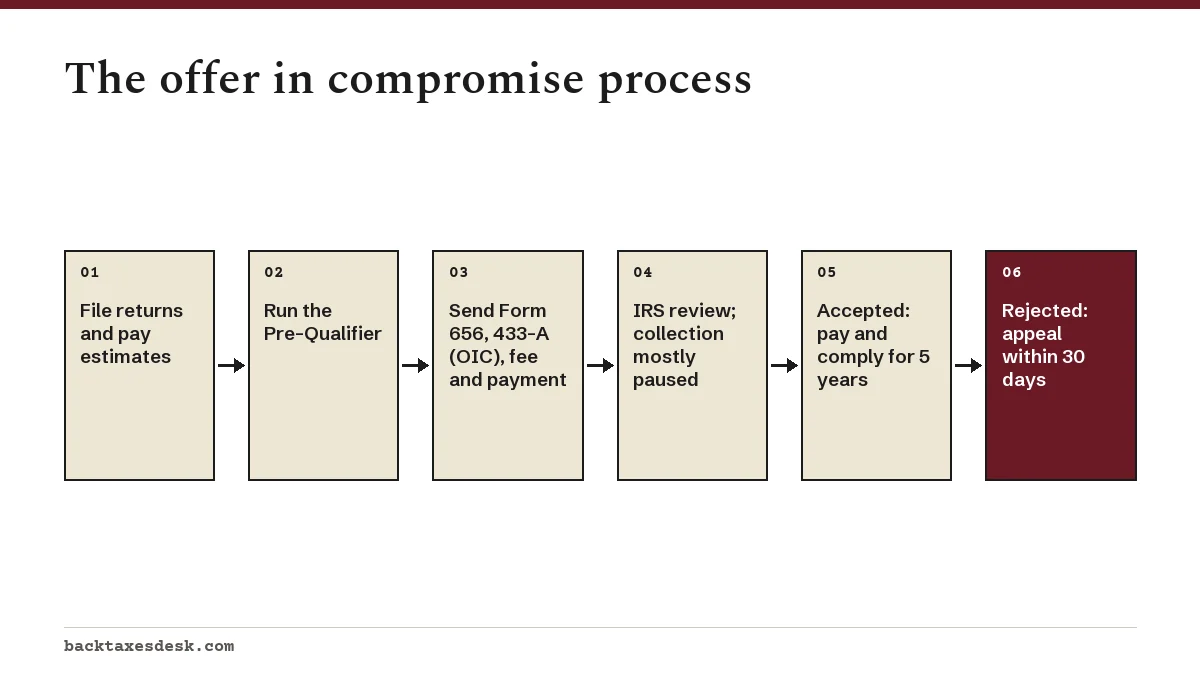
Confirm eligibility
File all required returns, make current estimated payments and make sure you are not in an open bankruptcy case.
Run the Pre-Qualifier
Enter your assets, income and expenses in the free IRS Pre-Qualifier to see whether an offer is realistic and to estimate the minimum amount.
Complete Form 433-A (OIC)
Report household income, allowable expenses and asset equity, and attach copies of the listed documents.
Complete Form 656
List the tax periods, the offer amount and your lump sum or periodic payment choice.
Pay the fee and initial payment
Send the $205 fee and 20% of a lump sum offer, or the first periodic payment, unless you meet low-income certification.
Submit and keep complying
Apply online or mail the package to the correct IRS center, then file and pay all new taxes on time while the IRS reviews it.
Respond or appeal
Answer information requests by the deadline, and if the offer is rejected, appeal within 30 days with Form 13711.
Common questions
How long does an offer in compromise take?
The IRS publishes no fixed processing time. If it has not made a decision within two years of receiving your offer, excluding any time in appeals, the offer is treated as accepted.
Do I get the $205 offer in compromise fee back if I am rejected?
No. The fee and any initial or monthly payments are applied to your tax debt and generally are not refunded. The exception is when the IRS returns an offer for missing returns, in which case the fee is sent back but the initial payment is kept.
Does an offer in compromise stop a levy?
Once an IRS official signs the offer as pending, the IRS suspends other collection, including new levies. A levy made before that point can stand, and the IRS may keep what it collected.
Will the IRS accept any amount I offer?
No. Your offer must be at least the amount your Form 433-A (OIC) calculation produces, which is the net equity in your assets plus 12 or 24 months of leftover income. An offer below that figure is normally rejected.
Can I file an offer in compromise without my spouse?
Yes. If your spouse does not want to join, you can submit your own Form 656 to settle your responsibility for joint debt. Divorced or legally separated spouses living apart must file separate offers.
Does an accepted offer remove a federal tax lien?
Not right away. The IRS keeps the lien in place until you have met every term of the offer, including paying the full offer amount.
Is an offer in compromise the same as tax debt settlement?
Yes. An offer in compromise is the IRS's own program for settling tax debt for less than you owe. When a company advertises tax debt settlement with the IRS, this is the agreement it means: the same Form 656 package, the same reasonable collection potential test and the same $205 fee unless you meet the low-income certification. No one can promise a settlement amount before the IRS reviews your finances.
Sources
- Offer in compromise irs.gov
- Form 656-B, Offer in Compromise Booklet irs.gov
- About Form 656-B irs.gov
- Time IRS can collect tax irs.gov
- Dirty Dozen tax scams for 2026 irs.gov
We check figures against these official pages. Rules change; confirm anything that affects a deadline or payment with the agency before you act.
Tell us what happened
Describe your situation and our editors will use it to improve this guide. If you leave your email, we may reply with a pointer to the right page or official contact. We never share your details.