
Topic
IRS notices and letters: what each one means and what to do next
An IRS notice is a letter the IRS mails when it needs something from you: payment of a balance, a reply to a proposed change, a missing return, or confirmation that it plans to collect. The notice code, such as CP14 or LT11, sits in the top or bottom right corner and tells you which kind of letter it is and how long you have to act.
20 guides in this topic Updated October 20, 2026
- CP11 Notice: IRS Math Error Correction and What You OweA CP11 notice means the IRS corrected one or more mistakes it found on your tax return, such as a math error or a missing Social Security number, and…
- CP2000 Notice: IRS Says Your Income Doesn't Match RecordsA CP2000 notice is an IRS proposal to change your return because income or payment information from employers, banks or brokers does not match what y…
- CP3219A: Notice of Deficiency After an Income MismatchCP3219A is a Statutory Notice of Deficiency. The IRS compared your return with W-2, 1099 and other reports from employers and banks, found income or…
- CP508C Notice: Tax Debt Certified to the State DepartmentCP508C is the IRS notice telling you it certified your tax debt as seriously delinquent to the US Department of State. After that, a passport applica…
- How to Respond to a CP2000: Agree, Disagree or AmendTo respond to a CP2000, compare each income item the IRS lists with your records, then sign the response form and mark whether you agree or disagree.…
- How to Respond to an IRS Notice (and What If You Ignore It)To respond to an IRS notice, reply by the due date printed on it, using the upload, fax or mail method it names. If you agree, do what the letter ask…
- IRS Final Notice of Intent to Levy (LT11 and Letter 1058)An IRS final notice of intent to levy, sent as LT11 or Letter 1058, is the last letter before the IRS can take wages, bank accounts or other property…
- IRS Notice CP14: Your Balance Due and What to Do NextIRS notice CP14 is the first bill the IRS sends when a tax return shows a balance that was not paid in full. It lists the tax, penalties and interest…
- IRS Notice CP22A: You Owe After a Change to Your ReturnA CP22A notice means the IRS changed your tax return because you asked it to, usually through an amended return, and the change left you with a balan…
- IRS Notice CP501: Reminder of a Balance You Still OweIRS notice CP501 is a reminder that you still owe on a tax account after an earlier bill, usually a CP14, went unpaid. It is not an enforcement notic…
- IRS Notice CP503: Second Reminder Before EnforcementIRS notice CP503 is the second reminder that you owe, sent because the IRS has not heard from you since earlier bills. It warns that a federal tax li…
- IRS Notice CP504: Intent to Levy and What to Do Right NowIRS notice CP504 is a Notice of Intent to Levy under Internal Revenue Code section 6331(d), sent when earlier bills went unpaid. It lets the IRS levy…
- IRS Notice CP518: Final Reminder to File a Missing ReturnA CP518 notice is the IRS's final reminder that it still has no record of a prior-year tax return from you. Respond now by filing the return with For…
- IRS Notice CP523: Payment Plan Default and What to Do NowA CP523 notice tells you that your IRS installment agreement is in default and that the IRS intends to terminate it and seize (levy) assets. Contact…
- IRS Notice CP59: No Record of Your Tax Return on FileA CP59 notice means the IRS has no record of a prior-year personal tax return from you. File that return right away, or explain why you did not have…
- IRS Notice CP71: Annual Reminder of an Unpaid Tax BalanceA CP71 notice is an annual reminder from the IRS that a balance of tax, penalties and interest is still unpaid on one of your accounts. It arrives ev…
- IRS Notice CP90: Final Levy Notice and Your Hearing RightsA CP90 notice from the IRS is a final notice of intent to levy that also tells you of your right to a Collection Due Process hearing. You have 30 day…
- IRS Notice LT16: Unpaid Tax or Missing Returns ExplainedAn LT16 from the IRS is a collection letter saying you have unpaid tax, unfiled returns, or both, and asking you to file and pay. It is not a final n…
- IRS Notice of Deficiency (Letter 3219): The 90-Day LetterA notice of deficiency is the IRS's formal legal notice that it intends to assess more tax. You have 90 days from the notice date (150 if it is addre…
- Why Did I Get a Letter From the IRS? 7 Common ReasonsYou got a letter from the IRS because it needs something about your account: most often you owe a balance, it changed or has a question about your re…

What an IRS notice is and why the code matters
An IRS notice is an official letter about your federal tax account. The IRS begins almost every contact by mail, and each letter carries a code: a CP number or an LT or LTR number. That code is the fastest way to know whether you are holding a bill, a warning, a proposed change or a request for information.
Once you know the code, you can look up the IRS explanation page for that notice, which says what the letter means and what response the IRS expects. If you are not sure why the envelope arrived at all, start with why you got an IRS letter.
How to read an IRS letter in the right order
Most IRS letters follow the same layout. Reading these parts in order takes a few minutes and tells you nearly everything you need.
- Notice code and date. Look in the top or bottom right corner. The date printed there usually starts the clock for your response.
- Tax year and form. The letter names the year and the return type, such as Form 1040 for 2024. Pull your copy of that return.
- Amount. A bill shows tax, penalties and interest separately. A proposal such as CP2000 shows the change the IRS wants to make.
- Response date. Many notices print a specific date. Others state a number of days from the notice date.
- What the IRS wants. Payment, a signed response form, a missing return or documents.
- Where to reply. The mailing address, fax number or upload instructions printed on the notice.
Keep the original letter with your tax records. The IRS asks every recipient to review the notice carefully and hold on to it, and you will need its code and date when you call, write or upload.
The balance-due sequence: CP14 to the final levy notice
When you file a return but do not pay in full, the IRS sends a series of IRS notices that grow firmer over time. The first is the CP14 balance due notice. Reminders follow as CP501 and CP503, then a CP504 notice of intent to levy, and then the final notice that gives you a hearing right.
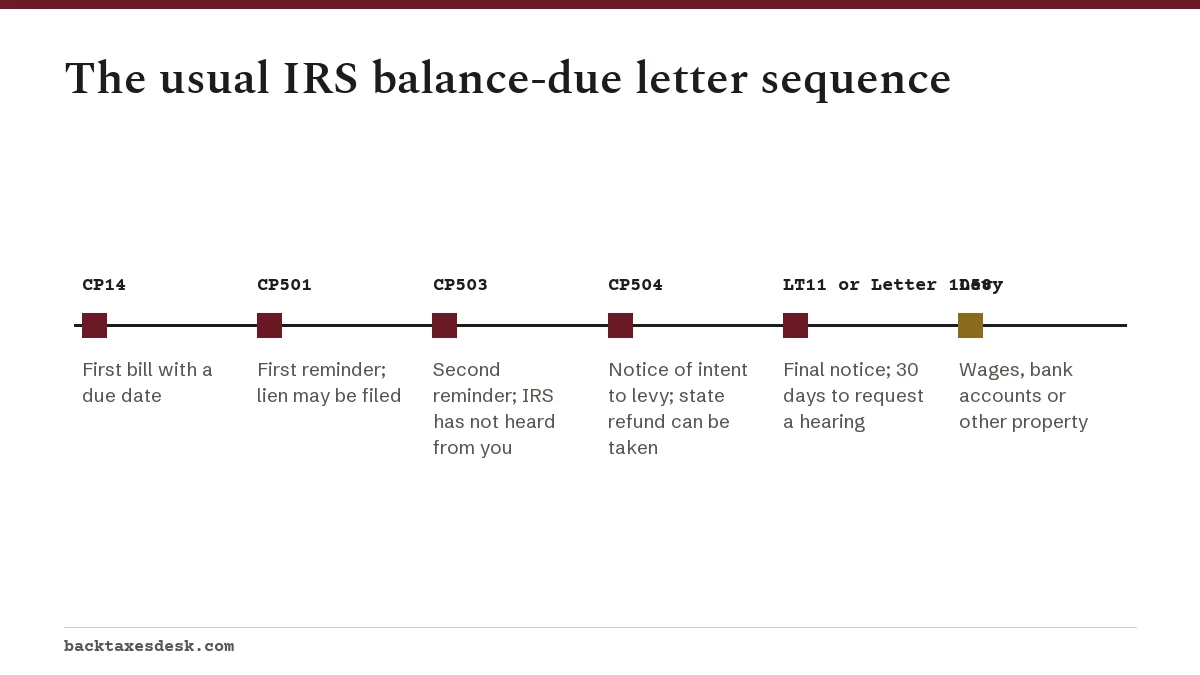
The gap between letters varies, and a letter can be skipped when the IRS moves an account along faster. What stays the same is the direction of travel: each stage adds consequences. After the CP504, for example, the IRS may take a state tax refund, and the failure-to-pay penalty can rise from 0.5% to 1% a month if the balance is not paid within 10 days of a notice of intent to levy.
Why the early letters are the cheapest to answer
At the CP14 stage you have the most choices and the lowest cost. A short-term plan of up to 180 days has no setup fee for balances under $100,000, and a long-term plan set up online with direct debit costs $29. By the time a final notice arrives, the balance is larger and the IRS can levy wages and bank accounts after the 30-day window closes.
Enforcement and hearing-rights notices
A handful of letters carry legal weight because they trigger or protect rights. Treat any of these as urgent and note the date printed on the letter.
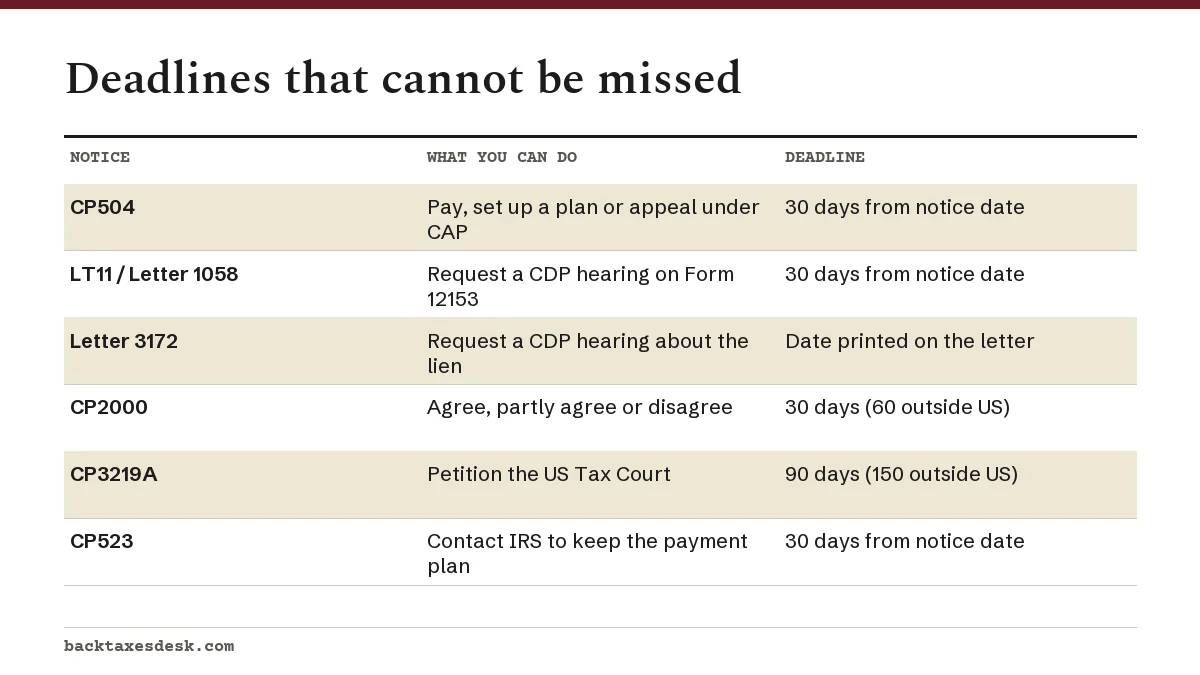
- CP504, Notice of Intent to Levy. Issued under Internal Revenue Code section 6331(d). It allows the IRS to levy a state tax refund, but it does not by itself give Collection Due Process rights. See our CP504 notice guide.
- LT11 or Letter 1058, Final Notice of Intent to Levy and Notice of Your Right to a Hearing. You have 30 days from the date of the notice to request a Collection Due Process hearing on Form 12153. Our page on the final notice of intent to levy covers the hearing in detail.
- CP90. Intent to levy certain assets, plus the right to a Collection Due Process hearing.
- Letter 3172. Tells you a Notice of Federal Tax Lien was filed and gives a separate 30-day hearing right; the letter states the date that window ends.
- CP523. The IRS plans to end a defaulted installment agreement and levy. Contact the IRS within 30 days of the notice date.
- CP508C. Your seriously delinquent tax debt was certified to the State Department, which can deny or revoke a passport. The 2026 threshold is $66,000; the 2027 figure is not yet announced and usually appears with the October or November inflation adjustments.
Adjustment and deficiency notices
Not every IRS letter is a bill. Some propose a change to a return that is already filed, and they come with a response window instead of a payment due date.
- CP2000. Income or payments reported by employers, banks or brokers do not match your return. The IRS calls it a proposal, not a bill. Reply within 30 days of the notice date, or 60 days if you live outside the US. Read our CP2000 notice explainer.
- CP3219A, Statutory Notice of Deficiency. You have 90 days (150 if the notice is addressed outside the US) to petition the US Tax Court, and that deadline cannot be extended. See CP3219A.
- CP11. The IRS corrected what it sees as a math or clerical error on your return, and you now owe. Ask for a reversal by the date on the notice; you have 60 days. See our CP11 notice page.
- CP22A. The IRS changed your return because you asked it to, and you now owe.
- CP59. The IRS has no record of a prior-year return. File it, or explain why you did not need to file.
IRS notice codes: full list with meanings and deadlines
This table lists the IRS notice codes this site covers, in rough order from first bill to enforcement, followed by adjustment letters. Deadlines come from the IRS explanation page for each notice.
| Notice | What it means | Time to act |
|---|---|---|
| CP14 | First bill for an unpaid balance | Due date printed on the notice |
| CP501 | Reminder that the balance is still unpaid; lien warning | Pay or contact the IRS promptly |
| CP503 | Second reminder; the IRS has not heard from you | Pay or contact the IRS promptly |
| CP504 | Notice of intent to levy under IRC 6331(d) | 30 days from the notice date |
| LT11 / Letter 1058 | Final notice of intent to levy and right to a hearing | 30 days to request a CDP hearing |
| CP90 | Intent to levy certain assets and right to a hearing | 30 days to request a CDP hearing |
| LT16 | Unpaid tax and/or missing returns; enforcement may follow | File and pay, or contact the IRS |
| CP71 | Annual reminder of an unpaid balance | Pay or arrange a plan |
| CP523 | Intent to end a defaulted payment plan and levy | 30 days from the notice date |
| CP508C | Debt certified to the State Department for passport action | Resolve the debt to reverse it |
| CP2000 | Reported income or payments do not match the return | 30 days (60 if outside the US) |
| CP3219A | Statutory notice of deficiency | 90 days (150 if outside the US) |
| CP11 | Math or clerical error corrected; balance due | Date on the notice; 60 days to ask for a reversal |
| CP22A | Return changed at your request; balance due | Due date printed on the notice |
| CP59 | No record of a prior-year return | File now or explain on Form 15103 |
How to know an IRS letter is real
Scammers copy the look of IRS letters, so check before you act. The IRS contacts people about taxes by mail first and notifies audits by mail only. A real notice matches a tax year you recognize and asks you to pay the United States Treasury, never a gift card, payment app or private person.
- Sign in to your IRS online account; certain notices appear there and can be viewed and downloaded.
- Check that the notice code exists on IRS.gov and that the letter describes what that page says it should.
- If a private collection agency writes to you, you should first have received IRS Notice CP40. The only agencies the IRS uses are CBE Group, Coast Professional and ConServe, and they cannot ask you to pay them directly.
Our guide to IRS letter scams walks through the warning signs in more detail.
What happens if you ignore an IRS notice?
Ignoring an IRS letter does not pause anything. Balances keep collecting interest, currently 7% a year compounded daily through December 2026 (the January to March 2027 rate is not yet announced and usually comes out in late November). Penalties keep adding up to their caps.
Ignored balance-due letters move toward a filed lien and a levy on wages or bank accounts. An ignored CP2000 becomes a statutory notice of deficiency, and if that deadline passes too, the proposed tax can be assessed and billed. Missed hearing deadlines narrow your appeal options. To guarantee your appeal rights, the IRS says to reply by the due date on the notice. Our step-by-step guide to responding to an IRS notice shows how.
Common questions
Where is the notice number on an IRS letter?
It is printed in the top or bottom right corner of the first page. It starts with CP, LT or LTR, followed by numbers, for example CP14 or LTR 1058.
Why did I get a notice from the IRS?
The most common reasons are a balance due, a change to your return, a question about something you reported, a missing return, or a need to verify your identity. The notice code tells you which one applies.
What happens if I ignore an IRS notice?
Interest and penalties keep growing, and the IRS moves to the next, firmer letter. Balance-due letters can end in a tax lien or a levy on wages and bank accounts, and ignored adjustment letters can lead to tax being assessed without your input.
How do I know if an IRS letter is real?
Compare it with your IRS online account, where certain notices appear, and check that the notice code and wording match the explanation on IRS.gov. Real letters ask for payment to the United States Treasury, never to a person or gift card.
Do I have to reply to every IRS notice?
No. If you agree with a notice, the IRS says you only need to take the requested action, such as paying, and you do not need to reply unless the letter asks you to. If you disagree, follow the dispute instructions on the notice and include copies of your documents.
Which IRS letter gives me the right to a hearing?
LT11, Letter 1058 and CP90 give the right to a Collection Due Process hearing before a levy, and Letter 3172 gives it after a lien is filed. You request it on Form 12153 within the 30-day window the letter states.