
IRS notice CP503: the second reminder and what comes next
Short answer
IRS notice CP503 is the second reminder that you owe, sent because the IRS has not heard from you since earlier bills. It warns that a federal tax lien notice may be filed. The next letter in the usual sequence is CP504, a notice of intent to levy, so this is the last reminder before enforcement warnings begin.
- 01Sequence position
- CP14, CP501, then CP503; CP504 usually follows
- 02Why it was sent
- No payment and no contact since earlier notices
- 03Main risk named
- A Notice of Federal Tax Lien
- 04Appeal option before collection
- Collection Appeals Program (CAP)
- 05Online plan limit
- $50,000 or less in tax, penalties and interest
- 06Levy rule
- Final notice required at least 30 days before a levy
What does IRS notice CP503 mean?
IRS notice CP503 is a second reminder about an unpaid balance. The IRS sends it when an earlier bill and a first reminder produced neither full payment nor a reply. The wording is blunt: the IRS says it has not heard from you and the balance is still open.
The CP503 notice shows the current amount, including penalties and interest added since the first bill, and a due date. It repeats the warning that the IRS may file a Notice of Federal Tax Lien. It does not by itself allow the IRS to seize wages or bank funds.
How many notices before the IRS levies
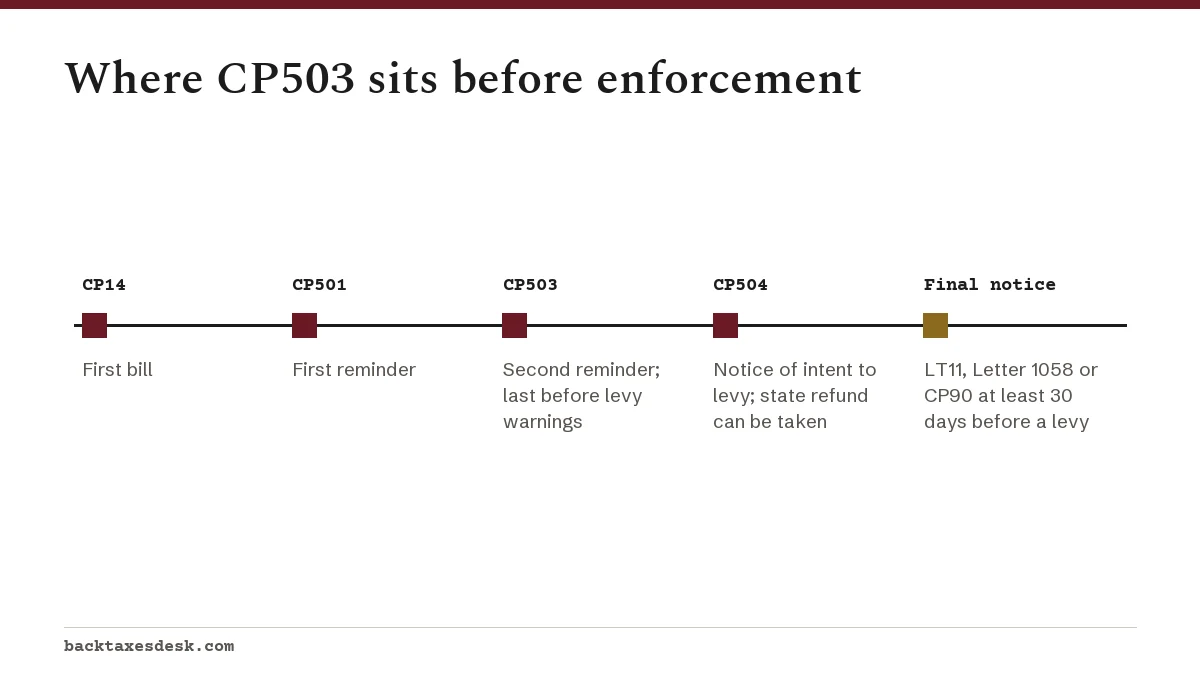
For most individual balances, the letters follow a set order. The CP503 is the third letter, and the next one, the CP504, is a notice of intent to levy that lets the IRS take a state tax refund and warns of levies on wages, bank accounts and Social Security benefits.
Before the IRS can levy those wider assets, it must send a final notice of intent to levy with your hearing rights at least 30 days in advance. That final notice is usually an LT11, Letter 1058 or CP90. Our page on the final notice of intent to levy explains that stage.
The number of letters is not a grace period. Penalties and interest grow each month, and a lien notice can be filed at any point once the reminders start.
Your options at the CP503 stage
At this point you still choose how the debt is resolved. Once enforcement starts, the IRS has more say. Pick the route that fits your finances and act before the due date on the notice.
- Pay the full balance online or by mail with the notice stub. Paying stops new penalties and interest.
- Pay within 180 days with a short-term plan if you owe less than $100,000 in total. There is no setup fee, though penalties and interest still run.
- Set up monthly payments online if you owe $50,000 or less, or file Form 9465. Online direct-debit plans cost $29 to set up; low-income applicants can have that fee waived.
- Report hardship if paying anything would leave you unable to meet basic living costs. The IRS may place the account in Currently Not Collectible status after reviewing Form 433-F.
- Dispute the amount by calling the number on the notice with your records.
Appealing through the Collection Appeals Program
The IRS CP503 page notes that you can ask for an appeal under the Collection Appeals Program before collection action, following the instructions on the notice. CAP is a separate route from a Collection Due Process hearing, which only opens with a final levy notice or a lien filing notice. Use it if you disagree with a proposed collection step and want Appeals to look at it now.
Is an IRS CP503 notice a scam
A real CP503 comes by US mail, carries the notice number in the top or bottom right corner, and shows the tax year and balance for your account. Scammers copy the look of IRS letters, so check the details rather than the design.
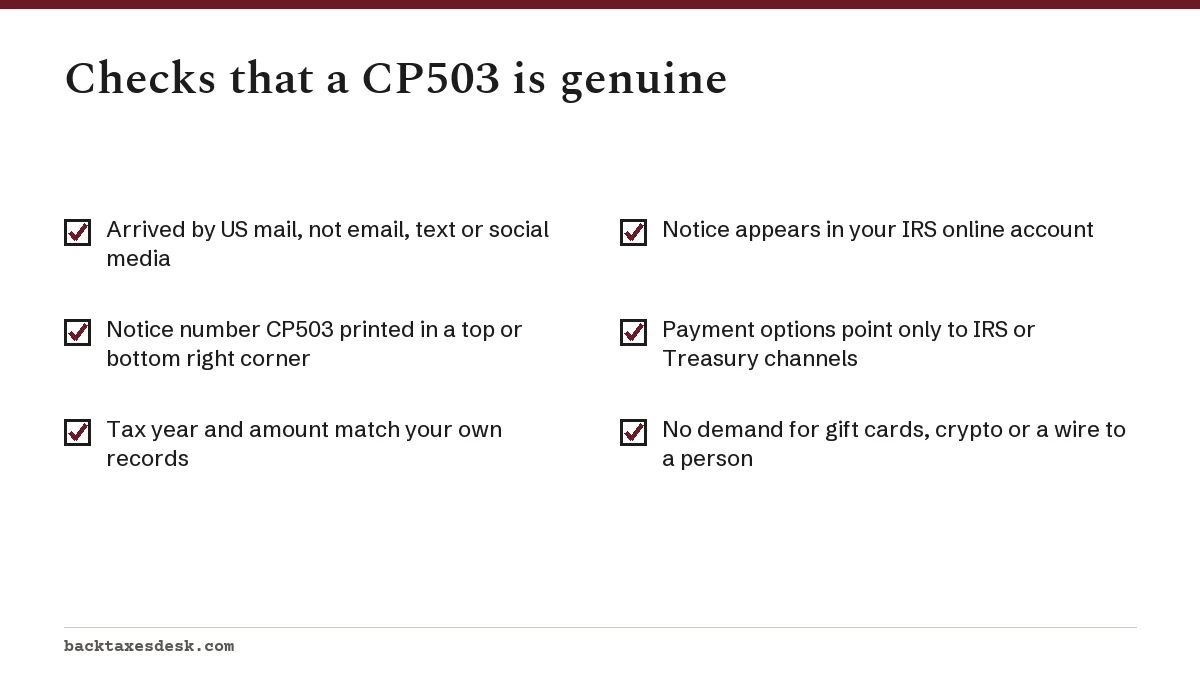
If anything looks off, sign in to your IRS online account and see whether the notice and balance appear there, or call the IRS using a number from irs.gov rather than one printed on a doubtful letter. Our guide to spotting a fake IRS letter lists the common tricks.
What should I do after a CP503 if I already paid
Payments and notices can cross in the mail. If you paid shortly before the notice date, allow time for posting, then check your IRS online account for the payment. If it does not show, call with your bank statement or payment confirmation number ready.
If you paid only part of the balance, the CP503 reflects the remainder. Interest and penalties on the unpaid part continue, so either pay the rest or set up a plan for it. The full letter order is set out in the IRS notices guide.
Common questions
What does CP503 mean?
It means the IRS has sent earlier bills, has not received full payment or a reply, and is reminding you a second time. It warns that a federal tax lien notice may be filed.
Is CP503 the last notice before a levy?
It is the last reminder before the CP504 notice of intent to levy. The IRS still has to send a final notice with hearing rights at least 30 days before levying wages or bank accounts.
Is a CP503 a scam?
Usually it is real, but you can confirm by checking your IRS online account or calling the IRS on a number listed on irs.gov. A real notice never asks for gift cards or payment to a private person.
Can I set up a payment plan after a CP503?
Yes. Individuals who owe $50,000 or less can apply online, and anyone who can pay within 180 days and owes under $100,000 can get a short-term plan.
Does a CP503 affect my credit score?
The risk the IRS names is the lien notice: once filed, it is public and the IRS says it can affect your ability to get credit. Paying or arranging a plan early lowers that risk.
Sources
- Understanding your CP503 notice irs.gov
- Understanding your CP504 notice irs.gov
- Levy irs.gov
- Payment plans; installment agreements irs.gov
- Understanding your IRS notice or letter irs.gov
We check figures against these official pages. Rules change; confirm anything that affects a deadline or payment with the agency before you act.
Tell us what happened
Describe your situation and our editors will use it to improve this guide. If you leave your email, we may reply with a pointer to the right page or official contact. We never share your details.
Related guides
 IRS Final Notice of Intent to Levy (LT11 and Letter 1058)
An IRS final notice of intent to levy, sent as LT11 or Letter 1058, is the last letter before the IRS can take wages, bank accoun…
IRS Letter Scam: How to Tell If an IRS Letter Is Real
To spot an IRS letter scam, look for the notice number (CP or LTR) in the right corner, look that number up on IRS.gov, and check…
Currently Not Collectible Status: IRS Hardship Explained
Currently not collectible (CNC) is an IRS account status that pauses most collection when paying anything toward your tax debt wo…
IRS Notice CP501: Reminder of a Balance You Still Owe
IRS notice CP501 is a reminder that you still owe on a tax account after an earlier bill, usually a CP14, went unpaid. It is not…
 IRS Notices and Letters: What Each One Means and Next Steps
An IRS notice is a letter the IRS mails when it needs something from you: payment of a balance, a reply to a proposed change, a m…