
IRS notice CP501: the first reminder that a balance is unpaid
Short answer
IRS notice CP501 is a reminder that you still owe on a tax account after an earlier bill, usually a CP14, went unpaid. It is not an enforcement notice yet, but it warns that the IRS can file a public Notice of Federal Tax Lien. Pay by the due date on the notice, set up a payment plan, or call the number on it if you disagree.
- 01Where it falls
- After the first bill (CP14), before CP503 and CP504
- 02Main warning
- A Notice of Federal Tax Lien may be filed
- 03Failure-to-pay penalty
- 0.5% of unpaid tax per month, up to 25%
- 04Interest rate, Oct to Dec 2026
- 7% a year, compounded daily
- 05Short-term plan
- Up to 180 days, under $100,000, no setup fee
- 06Check it is real
- Look for it in your IRS online account
What IRS notice CP501 means
IRS notice CP501 tells you that a balance on one of your tax accounts is still unpaid and that the IRS has not received payment or a reply to its earlier request. It lists the amount due, how it was built from tax, penalties and interest, and a new due date.
The CP501 notice is a reminder, not a levy notice. Nothing is being taken from your wages or bank account at this stage. The main risk it names is a Notice of Federal Tax Lien, a public filing that can affect your ability to get credit.
Why you got a CP501 after a CP14
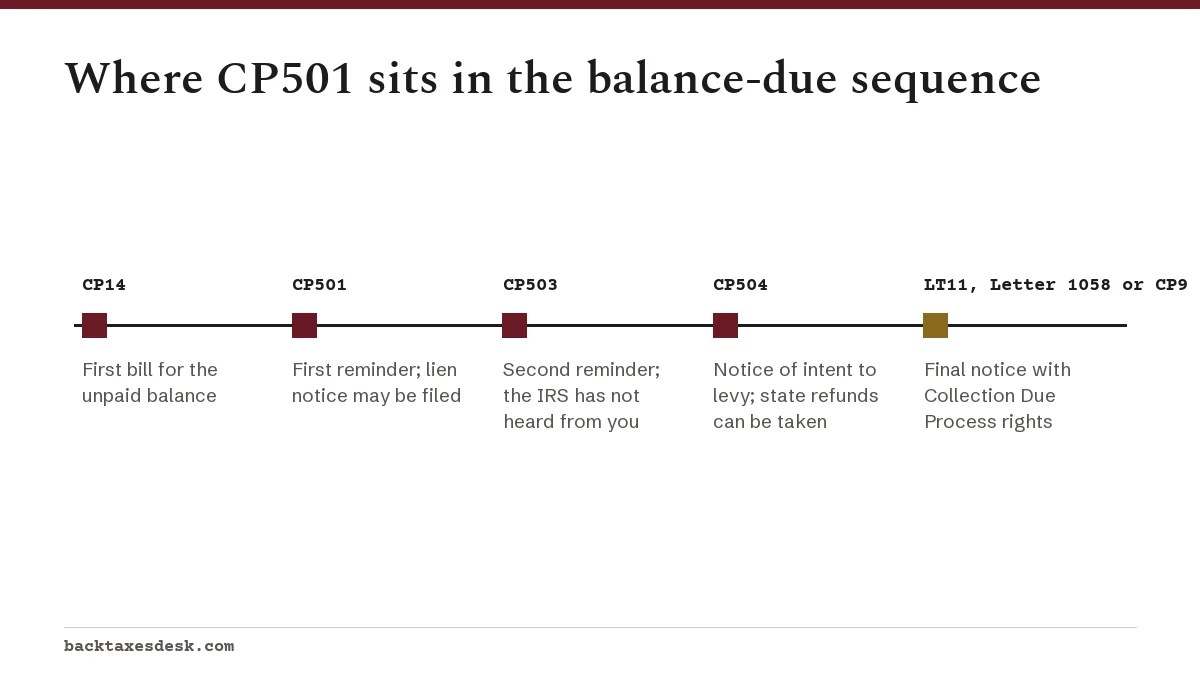
Most balance-due cases start with a CP14 notice, the first bill for an unpaid amount. If that due date passes without full payment or contact, the account moves on to CP501. You can also get a CP501 if you paid part of the CP14 amount, because the remaining balance keeps the reminder sequence going.
Common reasons people are surprised by a CP501 include a payment applied to the wrong year, a check that was never cashed, a return that showed a balance due that was not paid with it, or penalties and interest that were added after an earlier payment. Compare the notice against your records before you pay.
Is a CP501 serious? The lien warning explained
A federal tax lien already exists by law once tax is assessed, the IRS sends a demand for payment, and you do not pay. What the CP501 warns about is the IRS filing a public notice of that lien. Once filed, the notice tells creditors that the government has a claim against your current and future property, including a home or car.
The IRS releases a lien within 30 days after the debt is paid in full, but a filed notice can make borrowing harder in the meantime. Our page on the IRS tax lien covers release, discharge and withdrawal.
What waiting costs on a CP501 balance
Take a $4,000 unpaid tax balance. The failure-to-pay penalty adds 0.5% a month, about $20. Interest at the 7% annual rate in effect for October to December 2026 adds roughly $23 a month, and it compounds daily. That is around $43 a month before any lien or levy costs, and the IRS charges a full month of penalty even if you pay partway through it. For more detail, see the failure-to-pay penalty.
How to pay IRS notice CP501 or respond to it
| Situation | What to do |
|---|---|
| You can pay in full | Pay online by the due date on the notice, or mail a payment with the payment stub from the notice |
| You can pay within 180 days | Ask for a short-term plan; the total must be under $100,000 and there is no setup fee |
| You need monthly payments | Apply through the Online Payment Agreement if you owe $50,000 or less, or use Form 9465 |
| You think the amount is wrong | Call the number on the notice with your records; if the error is on your return, file Form 1040-X |
| You cannot pay anything | Ask about delaying collection due to hardship; the IRS may request Form 433-F |
Setting up a monthly plan online is cheaper than doing it by phone or mail. An online plan with direct debit has a $29 setup fee, compared with $107 by phone, mail or in person with direct debit. Our step-by-step page on the Online Payment Agreement shows what to enter.
If you filed on time and get an approved payment plan, the failure-to-pay penalty rate drops from 0.5% to 0.25% a month while the plan is in place. Interest continues until the balance is paid.
Is IRS notice CP501 legit or a scam
The IRS starts contact by mail, and the notice number, CP501, appears in the top or bottom right corner. The simplest way to confirm the letter is real is to sign in to your IRS online account, where many notices can be viewed and downloaded, and check that the balance matches.
Pay only through official IRS payment channels, never by gift card, wire to an individual, or a link in a text. If the letter asks for any of those, treat it as a scam.
What happens after CP501
If the balance stays unpaid and you do not contact the IRS, the next letter is usually a CP503, the second reminder. After that comes the CP504 notice of intent to levy, which allows the IRS to take a state tax refund. Each step gives you less room to choose how the debt is handled.
Acting at the CP501 stage keeps every option open: full payment, a plan, a hardship request, or penalty relief if you have a clean history. The IRS notices guide shows where each letter fits.
Common questions
What is a CP501 notice?
It is an IRS reminder that a tax balance is still unpaid after an earlier bill, usually a CP14. It shows the amount due, a new due date, and a warning that a federal tax lien notice may be filed.
Is a CP501 serious?
It is serious but early. The IRS is not levying yet, but penalties and interest keep growing and a public lien notice can be filed if you do not pay or respond.
Can I get a payment plan after a CP501?
Yes. You can ask for a short-term plan of up to 180 days if you owe under $100,000, or apply online for a monthly plan if you owe $50,000 or less.
What if I already paid the balance on my CP501?
Compare the payment date with the notice date, since payments can cross in the mail. If your payment is not reflected after a reasonable time, call the number on the notice with your bank record or confirmation number.
Can penalties on a CP501 be removed?
Possibly. If you have a clean compliance history for the prior three years, First Time Abate may remove failure-to-pay penalties, and reasonable cause relief is available for other situations. Interest on removed penalties is removed too.
Sources
- Understanding your CP501 notice irs.gov
- Understanding a federal tax lien irs.gov
- Payment plans; installment agreements irs.gov
- Failure to pay penalty irs.gov
- Quarterly interest rates irs.gov
We check figures against these official pages. Rules change; confirm anything that affects a deadline or payment with the agency before you act.
Tell us what happened
Describe your situation and our editors will use it to improve this guide. If you leave your email, we may reply with a pointer to the right page or official contact. We never share your details.
Related guides
 IRS Notices and Letters: What Each One Means and Next Steps
An IRS notice is a letter the IRS mails when it needs something from you: payment of a balance, a reply to a proposed change, a m…