
IRS notice CP504: intent to levy and your next 30 days
Short answer
IRS notice CP504 is a Notice of Intent to Levy under Internal Revenue Code section 6331(d), sent when earlier bills went unpaid. It lets the IRS levy your state tax refund and warns that wages, bank accounts and other property come next. You have 30 days from the notice date to pay, set up a plan or contact the IRS before collection escalates.
- 01Legal basis
- IRC section 6331(d) notice of intent to levy
- 02Time to act
- 30 days from the notice date
- 03What can be levied right away
- State tax refunds
- 04Collection Due Process right from CP504?
- No; that comes with LT11 or Letter 1058
What does IRS notice CP504 mean?
IRS notice CP504 is the IRS telling you, in legal terms, that it intends to levy. It usually arrives after a CP14 bill and the CP501 and CP503 reminders went unanswered. The notice shows your current balance with penalties and interest and asks for payment immediately.
The IRS describes it as your notice of intent to levy required by Internal Revenue Code section 6331(d). Its explanation of the matching CP504B says to pay or contact the IRS no later than 30 days from the notice date, and after that the IRS can take further collection steps. It may also file a public Notice of Federal Tax Lien, which can affect your credit.
What the IRS can take after a CP504 notice
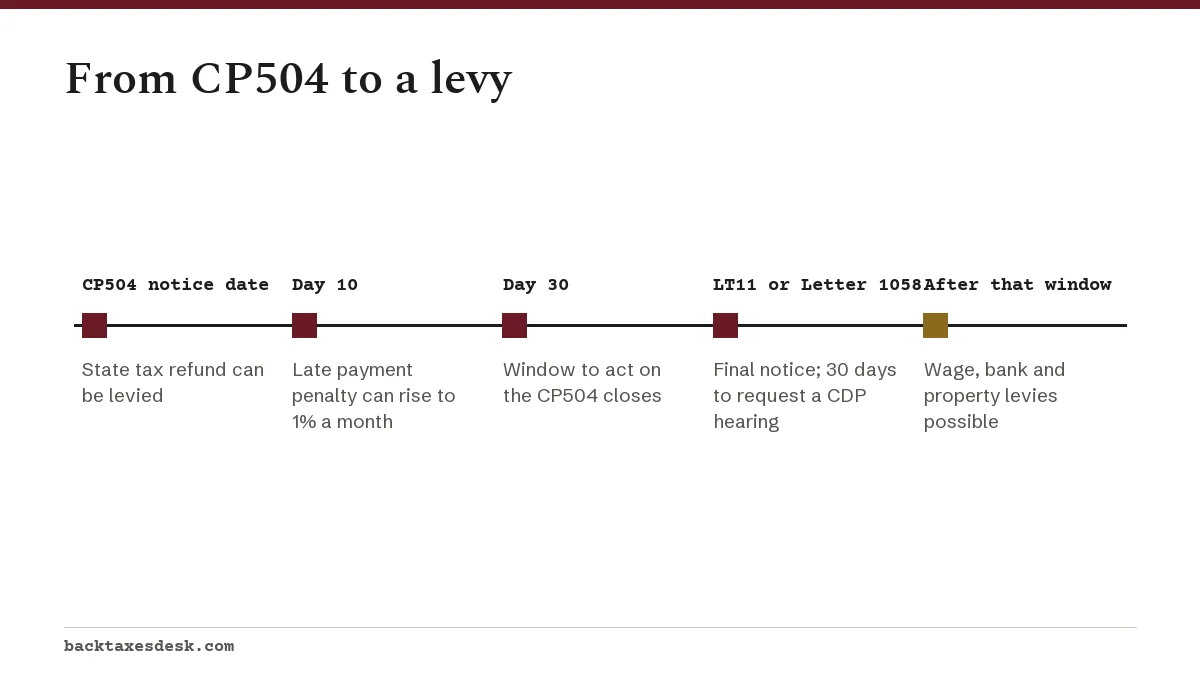
A CP504 does not let the IRS empty your bank account the next day. It does allow one type of levy immediately: your state tax refund. Levies on a state refund are one of the few exceptions where the IRS does not have to offer a hearing first, so a refund due from your state can be redirected to your federal balance.
Can the IRS take my paycheck after a CP504
Not on the strength of the CP504 alone. Before levying wages, bank accounts or other property, the IRS must send a Final Notice of Intent to Levy and Notice of Your Right to a Hearing at least 30 days in advance. That letter is the LT11 or Letter 1058. The CP504 warns that wages, real estate commissions and other income, bank accounts, business assets, personal assets such as your car and home, and Social Security benefits are all on the list once that step is complete.
Passport risk
The CP504 may also warn about passports. If your total assessed debt passes the seriously delinquent threshold, $66,000 for 2026, the IRS can certify it to the State Department, which can deny or revoke a passport. The 2027 threshold is not yet announced; it usually appears with the inflation adjustments in October or November. See passport revocation for tax debt.
Does a CP504 notice give me a hearing right
Not a Collection Due Process hearing. The IRS Independent Office of Appeals calls the CP504 a preliminary notice and says the IRS cannot levy with it alone; CDP rights begin only with the formal final notice. That comes later as an LT11 or Letter 1058, explained on our final notice of intent to levy page. Some people receive a CP90 instead, which also carries CDP rights.
You do have another route now. The IRS says you can use the Collection Appeals Program (CAP) before a levy happens. Under Publication 1660 you first ask for a conference with a collection manager, then appeal in writing, preferably on Form 9423. CAP cannot be used to challenge whether you owe the tax or how much, and its decisions cannot be taken to court, so it suits disputes about how collection is being handled.
How to stop a levy after a CP504
The goal in the next 30 days is to put your account into a status the IRS will not levy. Any of these works.
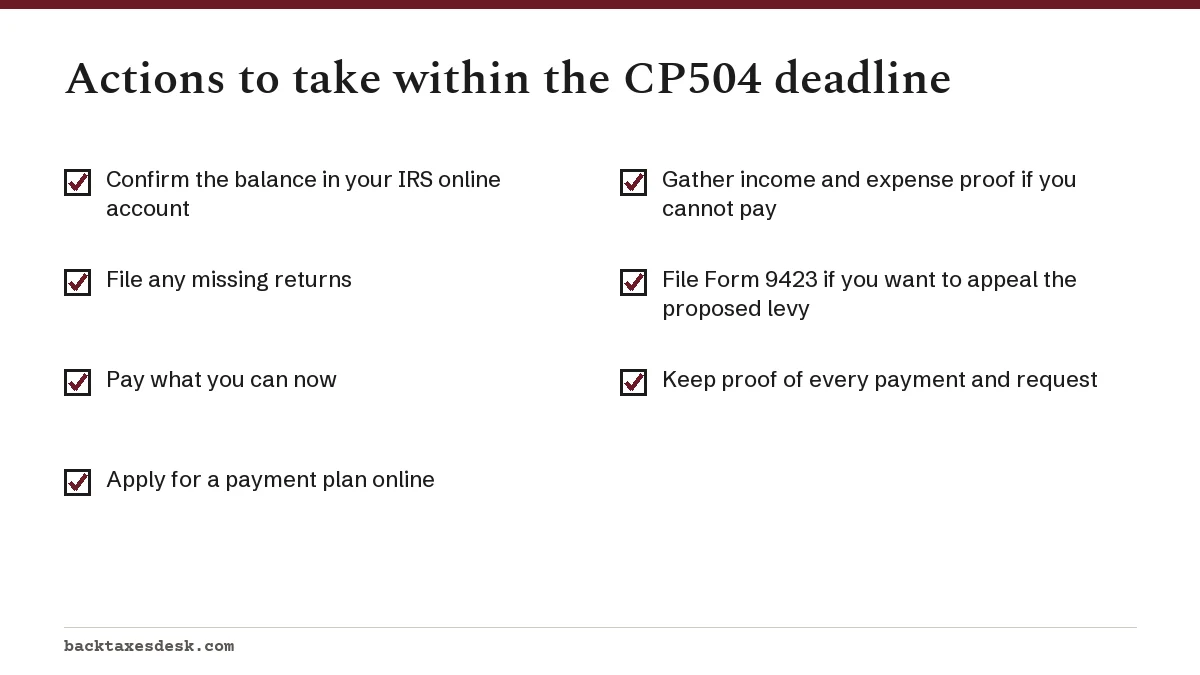
- Pay in full by IRS Direct Pay, card or check with the stub from the notice. This also releases any filed lien within 30 days.
- Set up a payment plan through the Online Payment Agreement. Individuals owing $50,000 or less can get a long-term plan online; the setup fee is $29 with direct debit. Balances under $100,000 can use a short-term plan of up to 180 days with no fee.
- Ask for Currently Not Collectible status if you cannot pay anything. The IRS may ask for Form 433-F and proof of income and expenses. Interest keeps running and a lien can still be filed.
- Submit an Offer in Compromise if you cannot pay the full debt. The application fee is $205 unless you meet the low-income certification.
- Call the number on the notice if you already paid or disagree with the balance, with your payment confirmation or documents ready.
You must have filed all required returns before the IRS will approve a plan. If a return is missing, file it now. For the mechanics of each kind of levy, see what an IRS levy is.
IRS notice CP504B and other versions
The IRS publishes a separate explanation page for CP504B. It carries the same message: a notice of intent to levy, a 30-day window from the notice date, and a warning about liens and passports. Its list of property the IRS may levy also names accounts receivable, which the CP504 list does not.
The responses are the same as for a CP504: pay, arrange a plan, request a hardship delay, submit an offer, or appeal under the Collection Appeals Program before a levy. For a business owing trust fund taxes, a streamlined plan is generally available only when the balance is $25,000 or less.
What comes after CP504
If nothing changes after 30 days, the next letter is normally the final notice of intent to levy with hearing rights. That starts a separate 30-day window to request a Collection Due Process hearing on Form 12153. Once that window closes, bank levies and continuous wage levies become possible. Our IRS notices hub shows the full sequence.
Common questions
What does a CP504 notice mean?
It is a Notice of Intent to Levy under IRC section 6331(d). It tells you the balance is still unpaid, lets the IRS levy your state tax refund, and warns that other levies and a tax lien may follow.
How long do I have after a CP504?
The IRS asks for payment immediately, and its CP504B explanation sets a limit of 30 days from the notice date to pay or contact it. Act as soon as you open the letter.
Can the IRS garnish my wages after a CP504?
Not yet. A wage levy requires the Final Notice of Intent to Levy and Notice of Your Right to a Hearing, sent at least 30 days before the levy. The CP504 is the step before that.
Is CP504 the final notice?
No, despite its tone. The final notice is the LT11 or Letter 1058, which also gives you 30 days to request a Collection Due Process hearing.
Will a payment plan stop a CP504 levy?
Generally yes. IRS Publication 1660 says the IRS cannot levy until 30 days after an installment agreement is rejected or terminated, and a debt with a pending plan request or a timely-paid plan is not certified for passport action.
Sources
- Understanding your CP504 notice irs.gov
- Failure to pay penalty irs.gov
- Collection due process (CDP) FAQs irs.gov
- Levy irs.gov
- Understanding your CP504B notice irs.gov
- Publication 1660, Collection Appeal Rights irs.gov
We check figures against these official pages. Rules change; confirm anything that affects a deadline or payment with the agency before you act.
Tell us what happened
Describe your situation and our editors will use it to improve this guide. If you leave your email, we may reply with a pointer to the right page or official contact. We never share your details.
Related guides
 IRS Notices and Letters: What Each One Means and Next Steps
An IRS notice is a letter the IRS mails when it needs something from you: payment of a balance, a reply to a proposed change, a m…
 IRS Final Notice of Intent to Levy (LT11 and Letter 1058)
An IRS final notice of intent to levy, sent as LT11 or Letter 1058, is the last letter before the IRS can take wages, bank accoun…
IRS Levy: What the IRS Can Take and How to Stop It
An IRS levy is the legal seizure of your property or rights to property, such as wages, bank balances, Social Security payments o…
IRS Notice CP90: Final Levy Notice and Your Hearing Rights
A CP90 notice from the IRS is a final notice of intent to levy that also tells you of your right to a Collection Due Process hear…
Can the IRS Take Your Passport? Tax Debt and Passport Rules
Can the IRS take your passport? Not by itself, but it can certify a seriously delinquent tax debt to the State Department, which…