
IRS levy: what it is, what can be taken and how to stop it
Short answer
An IRS levy is the legal seizure of your property or rights to property, such as wages, bank balances, Social Security payments or a car, to pay a tax debt. For most levies the IRS must send a Final Notice of Intent to Levy at least 30 days in advance. Some property is exempt, and hardship forces a release.
- 01Advance notice for most levies
- 30 days after LT11 or Letter 1058
- 02Bank levy hold
- 21 days
- 03Federal payment levy
- Generally up to 15% of each payment
- 04Wage levy
- Continuous; part of each check exempt (Publication 1494)
- 05Redeem seized real estate
- Within 180 days of sale
What is an IRS levy?
An IRS levy is a legal seizure of property to satisfy a tax debt. The IRS can use it to take money held by someone else, such as your employer or bank, or to seize and sell things you own, such as a vehicle or real estate. Publication 594 notes there is no legal difference between a seizure and a levy.
The plain IRS levy meaning is 'the IRS takes it.' That separates a levy from a lien, which only places a claim on property. A levy is also different from a refund offset, where the Treasury keeps a federal refund to cover a debt without any levy notice.
Levies come near the end of the IRS collection process. By the time one is issued, the IRS has assessed the tax, billed you, and mailed several notices that went unpaid or unanswered.
What IRS levy notice must come first?
The IRS levy notice that matters most is the Final Notice of Intent to Levy and Notice of Your Right to a Hearing, sent as LT11 or Letter 1058. The IRS must send it at least 30 days before levying wages, bank accounts or other property, and it starts your 30-day window to request a Collection Due Process hearing on Form 12153.
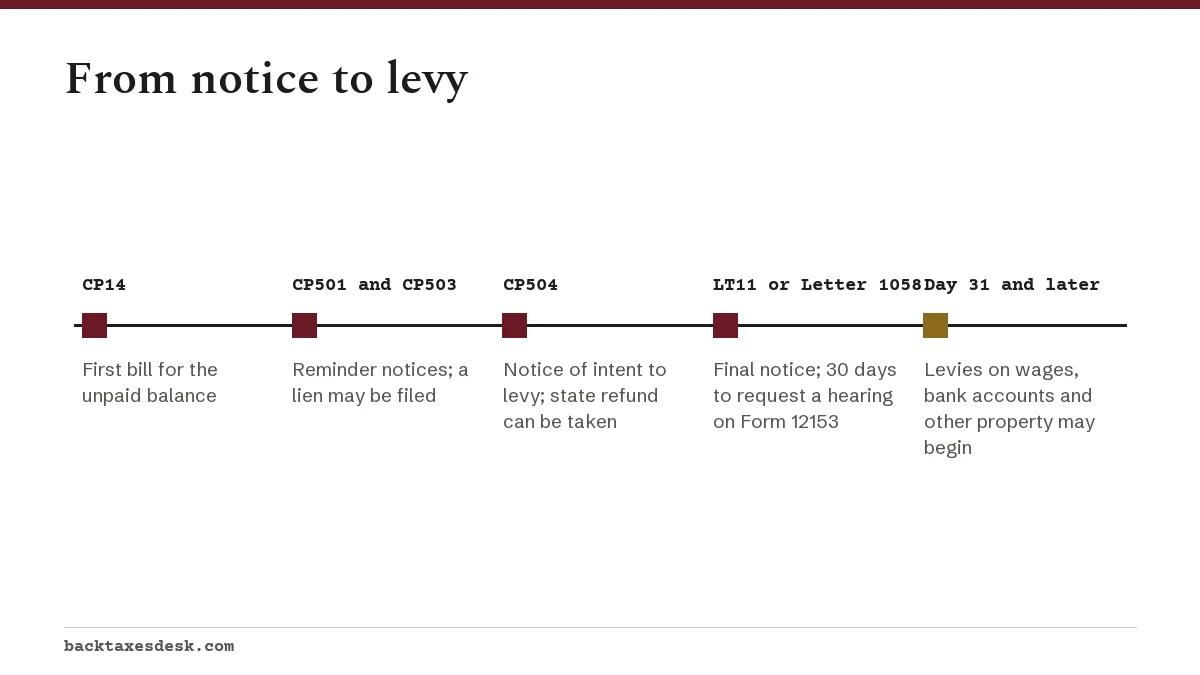
Notice CP504, which comes earlier, is itself a notice of intent to levy under IRC 6331(d). It allows the IRS to take a state tax refund, but it does not carry hearing rights. Our final notice of intent to levy page explains how to answer LT11 and Letter 1058 in detail.
What property can the IRS levy?
The IRS can levy almost any property or right to property you have, but the way it works depends on the asset. Some levies are one-time snapshots and others keep taking money every pay period.
| Asset | How the levy works | Duration |
|---|---|---|
| Bank or credit union account | Bank freezes available funds up to the levy amount, then sends them after 21 days | Reaches funds available when the levy arrives |
| Wages, salary, commissions | Employer withholds everything above the exempt amount each pay period | Continuous until paid, released or the collection period ends |
| Social Security and other federal payments | Federal Payment Levy Program takes generally up to 15% of each payment | Continuous |
| Retirement accounts (IRAs, 401(k), TSP) | Attaches to funds in which you have a vested right, depending on plan terms | Per levy |
| Vehicles, real estate, other property | Seized and sold after public notice and a minimum bid | Per seizure |
IRS levy on wages
An IRS levy on wages is served once and keeps running. Your employer gives you a Statement of Dependents and Filing Status to complete, and you have three days to return it; if you do not, the exempt amount is figured as married filing separately with no dependents. A bonus paid separately can be taken in full, because the exemption applies per pay period. See IRS wage garnishment for the exempt-amount tables.
IRS levy on property
An IRS levy on property such as a house or car ends in a public sale. The IRS calculates a minimum bid price, gives you a copy and a chance to challenge the value, announces the sale, and generally waits 10 days after public notice before selling. Sale money pays the seizure and sale costs first, then the tax, and any surplus goes back to you.
You can redeem seized real estate within 180 days of the sale by paying the buyer the purchase price plus interest at 20% a year, compounded daily. The IRS property seizure page covers the extra protections for a principal residence.
What the IRS cannot levy
Some property is exempt from levy by law. Publication 594 lists these examples, and a levy issued against exempt property must be released.
- Unemployment benefits and workers' compensation.
- Certain annuity and pension benefits and certain service-connected disability payments.
- Certain public assistance payments and assistance under the Job Training Partnership Act.
- Income needed for court-ordered child support payments.
- The minimum weekly exempt portion of wages.
- Necessary schoolbooks and clothing, and undelivered mail.
- Limited amounts of fuel, provisions, furniture and household personal effects, and of books and tools used in a trade or profession.
The IRS also cannot seize property unless it expects the sale to produce money toward the debt after costs, and there are legal limits on seizing a principal residence and certain business assets.
How do you stop an IRS levy?
You stop an IRS levy before it happens by responding to the final notice, and after it happens by getting it released. Timing decides which tools work.
| Where you are | Most effective step |
|---|---|
| Received CP504 | Pay, or request a payment plan; a pending plan blocks new levies |
| Received LT11 or Letter 1058, under 30 days | File Form 12153 for a Collection Due Process hearing |
| More than 30 days after the final notice | Request an equivalent hearing within one year, or a manager conference under the Collection Appeals Program |
| Bank levy already served | Act within the 21-day hold; ask for release for hardship or error |
| Wage levy running | Set up a payment plan or show hardship; the IRS must release in set cases |
Publication 594 says the IRS cannot issue a new levy while you have a current or pending payment plan or Offer in Compromise, or when it agrees a levy would leave you unable to meet basic, reasonable living expenses. For a levy already in place, the IRS levy release guide lists every ground the IRS must honor and how to ask.
For money already frozen in an account, speed matters most. The IRS bank levy page explains how to use the 21 days before the bank sends the funds.
Common questions
What is the difference between an IRS levy and garnishment?
A wage garnishment is one type of IRS levy. Levy is the broader term covering bank accounts, benefits, retirement funds and physical property as well as wages.
How long does an IRS levy last?
A wage or federal payment levy continues until the debt is paid, the levy is released or the collection period ends. A bank levy reaches only the funds available when the bank receives it.
Can the IRS levy without sending a final notice?
Only in listed exceptions: jeopardy cases, state tax refund levies, federal contractor levies and Disqualified Employment Tax Levies. In those cases the IRS explains your appeal rights after the levy.
Can the IRS levy my retirement account?
Yes. Publication 594 lists qualified plans, IRAs, SEP-IRAs, Keogh plans and the Thrift Savings Plan as property that can be levied, depending on the plan terms and your vested rights.
What happens if the IRS levies the wrong person's property?
A person whose property was taken for someone else's tax can file a wrongful levy claim under IRC 6343(b), generally within 2 years, as explained in Publication 4528.
Does an IRS levy mean I no longer owe interest?
No. Interest and penalties keep accruing on any unpaid balance, and the failure-to-pay rate rises to 1% a month if the tax is not paid within 10 days of a notice of intent to levy.
Sources
- Levy irs.gov
- Publication 594, The IRS Collection Process irs.gov
- Information about wage levies irs.gov
- Understanding your CP504 notice irs.gov
- Failure to pay penalty irs.gov
We check figures against these official pages. Rules change; confirm anything that affects a deadline or payment with the agency before you act.
Tell us what happened
Describe your situation and our editors will use it to improve this guide. If you leave your email, we may reply with a pointer to the right page or official contact. We never share your details.
Related guides
 IRS Collection Process: Liens, Levies and Your Rights
The IRS collection process starts with a bill (usually Notice CP14) and escalates through reminder notices to a Final Notice of I…
IRS Levy on a Bank Account: The 21-Day Hold and What to Do
When the IRS levies a bank account, the bank must freeze the available funds up to the amount of the levy and hold them for 21 da…
IRS Levy Release: How to Get a Levy Lifted Fast and Legally
The IRS must grant an IRS levy release when you pay the debt, the collection period ended before the levy, a payment plan's terms…
IRS Wage Garnishment: How Much of Your Pay the IRS Can Take
In a wage garnishment, IRS rules let the agency take all of your take-home pay above an exempt amount set in Publication 1494. Fo…
IRS Seizure of Property: Can the IRS Take Your House or Car?
An IRS seizure of property is a levy that takes a house, car or other asset and sells it to pay unpaid federal tax. It can happen…