
IRS Collection Appeals Program (CAP): how to appeal with Form 9423
Short answer
The Collection Appeals Program (CAP) lets you ask the IRS Independent Office of Appeals to review a lien, levy, seizure or installment agreement decision, usually faster than a Collection Due Process hearing. For most actions you first talk to a collection manager, then send Form 9423 postmarked within 3 business days. The decision is binding: a CAP case cannot go to court.
- 01Form
- Form 9423, Collection Appeal Request
- 02After a collection manager conference
- Tell the IRS within 2 business days; Form 9423 postmarked within 3 business days
- 03Rejected installment agreement
- Appeal on or before the 30th day after the rejection letter
- 04After a seizure
- Appeal to the collection manager within 10 business days of the Notice of Seizure
- 05Court review
- None; the CAP decision is binding
What is the Collection Appeals Program?
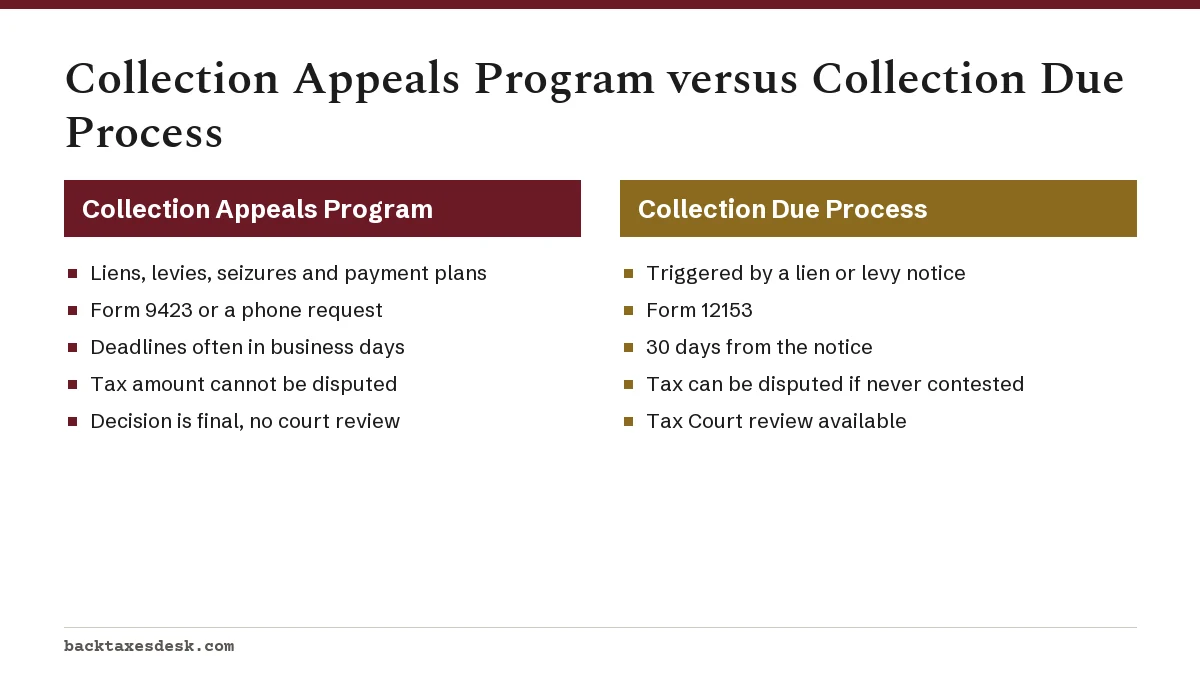
The Collection Appeals Program is one of the two main ways to challenge an IRS collection action; the other is the Collection Due Process (CDP) hearing. Both are described in IRS Publication 1660, Collection Appeal Rights, and both send your case to the IRS Independent Office of Appeals, which works separately from the collection office pursuing you.
CAP is broader and faster. It is available for more collection actions than CDP and generally produces a quicker decision. It has two limits you need to know before you choose it: you cannot argue that you do not owe the tax or that the amount is wrong, and you cannot go to court if you disagree with the result.
Which IRS actions can you appeal under CAP?
Publication 1660 and the instructions on Form 9423 list these actions. A third party whose property is caught up in a collection action can use CAP too.
| Action | What you can appeal | Key time limit |
|---|---|---|
| Notice of Federal Tax Lien | A proposed or actual lien filing, at the first and each later filing, and denied requests for withdrawal, discharge, subordination or non-attachment | Usually a manager conference, then Form 9423 within 3 business days |
| Levy | A levy before or after it is placed on wages, a bank account or other property, and a denied request to return levied proceeds | Request to return proceeds: within 2 years of a levy made on or after March 23, 2017 |
| Seizure | A seizure before or after it happens, as long as the property has not been sold | Appeal to the collection manager within 10 business days of the Notice of Seizure |
| Installment agreement rejected | The IRS turning down your payment plan request | On or before the 30th day after the rejection letter |
| Installment agreement terminated or modified | A proposed or actual termination, or a proposed or actual change to the terms | 30 days from the notice of intent to terminate, then 30 more days after termination |
| Wrongful levy | A denied request to release or return property that belongs to you, not to the person who owes the tax | Written request within 2 years of a levy or seizure made on or after March 23, 2017 |
Some disputes use other appeal procedures. Publication 1660 lists a rejected offer in compromise, a proposed Trust Fund Recovery Penalty, a denied Trust Fund Recovery Penalty claim and a denied penalty abatement request. To dispute a penalty, follow the protest requirements in Publication 5; in each of these cases, the letter you receive explains where to send your protest.
How do you appeal a lien, levy or seizure under CAP?
The steps depend on who has your case. If your only contact so far has been a notice or a phone call, the appeal can be made by phone:
- Call the number on the notice, explain which action you disagree with and why, and offer a solution to the tax problem.
- If you cannot reach agreement, say you want to appeal. The employee must refer you to a manager, who will speak with you then or call back within 24 hours.
- Explain your case to the manager. If you do not agree with the manager's decision, the case is forwarded to Appeals. You do not have to put the appeal in writing.
If a revenue officer has your case
- Ask for a conference with the revenue officer's collection manager.
- If the conference does not settle it, tell the revenue officer or manager within 2 business days that you want to appeal under CAP, or collection action resumes.
- Complete Form 9423: check the actions you disagree with, explain in block 15 why you disagree, and set out how you would resolve the tax problem. Attach copies of documents that support you.
- Send the form to that collection office, received or postmarked within 3 business days after the manager conference.
These limits count business days and are far shorter than the 30 days allowed for a CDP request. Prepare your proposed solution before the conference, for example a payment plan offer or records showing that a levy is causing hardship, so the form can go out the same week.
How do you appeal a rejected or terminated payment plan?
Payment plan appeals have longer windows. Call the number on the rejection letter or termination notice and say you want to appeal. A conference with a collection manager is strongly recommended but not required. The appeal does not have to be in writing unless a revenue officer sent the letter; in that case use Form 9423. Send it to the office that acted on your plan, never directly to Appeals.
- Rejected plan: appeal on or before the 30th day after the date of the rejection letter. A mailed request must be postmarked by that day.
- Termination: you have 30 days from the notice of intent to terminate. Unless you appeal or fix the default in that time, the plan ends, and your right to appeal continues for another 30 days. If you appeal before the termination takes effect, you cannot appeal again once it does.
- Modification: if the IRS proposes to change, or changes, your plan terms based on your financial information, follow the same steps as for a termination.
The deadline matters because of levy protection. The IRS cannot levy until 30 days after it rejects or terminates your agreement, and if you appeal within that 30-day period it cannot levy until the appeal is finished, unless it believes collection is in jeopardy. For why plans are turned down, see IRS payment plan rejected; for plans that break after approval, see installment agreement default.
What happens after you file a CAP appeal?
For a lien, levy or seizure appeal, the IRS normally takes no action to collect the tax for the periods Appeals is considering, unless it believes collection is at risk. Appeals usually asks the collection office to review any new information you send and shares those comments with you so you can respond.
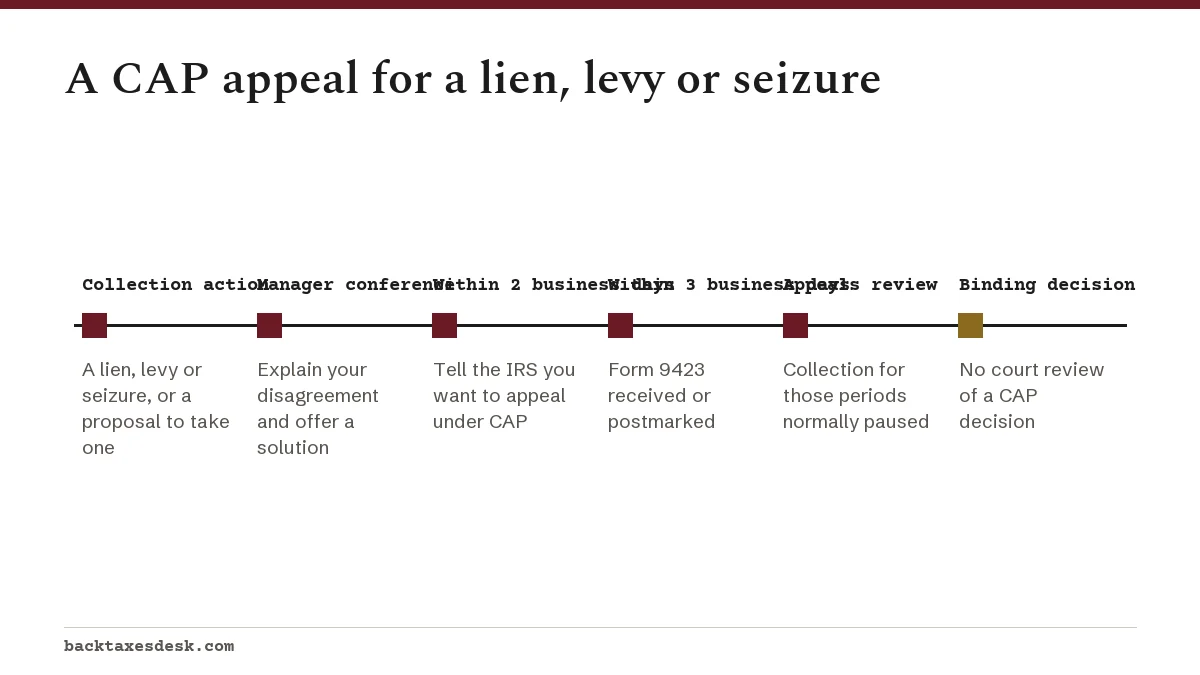
Once Appeals decides, the decision is binding on both you and the IRS, and there is no judicial review of a CAP decision. Publication 1660 notes that other routes may still exist for the underlying issue; a third party, for example, can contest a wrongful levy in district court. Giving false information, leaving out pertinent information or fraud voids the decision.
You can represent yourself, or be represented by an attorney, a certified public accountant, an enrolled agent or a member of your immediate family. A representative who will deal with the IRS without you needs Form 2848. If you qualify, a Low Income Taxpayer Clinic can represent you for free or a small fee.
CAP or Collection Due Process: which should you use?
If you received a notice that carries CDP rights, such as a Final Notice of Intent to Levy (LT11 or Letter 1058) or a lien filing notice, compare the two before the CDP deadline passes: the 30th day after the date of a levy notice, or the date shown on a lien notice. A timely CDP request lets you raise more issues, including the tax itself if you never had a chance to dispute it, suspends the 10-year collection period and leads to Tax Court if you disagree. CAP is quicker and covers actions CDP does not, such as a rejected payment plan, but its decision is final.
For the CDP route step by step, see our collection due process hearing guide, and for audit disputes and other appeals, the IRS appeals process. The Taxpayer Advocate Service can help if a collection problem is causing financial hardship, but it cannot extend the time to request a CDP, equivalent or CAP hearing.
Step by step
Talk to Collection first
Call the number on the notice, or ask for a conference with the collection manager, and offer a solution.
Say you want to appeal
Tell the revenue officer or manager within 2 business days after the conference.
Send Form 9423
Check the actions you dispute, explain why, propose a solution and have it postmarked within 3 business days of the conference.
Watch the payment plan deadline
Appeal a rejected plan on or before the 30th day after the rejection letter.
Common questions
What is Form 9423?
Form 9423, Collection Appeal Request, asks the IRS Independent Office of Appeals to review a lien, levy, seizure or installment agreement decision under the Collection Appeals Program. Publication 1660 says a written request is preferably made on this form.
How long do I have to file Form 9423?
For a lien, levy or seizure, tell the IRS within 2 business days after the collection manager conference that you want to appeal, and have Form 9423 received or postmarked within 3 business days of that conference. A rejected installment agreement can be appealed until the 30th day after the rejection letter.
Can I go to Tax Court after a CAP decision?
No. Appeals' decision in a CAP case is binding on you and the IRS and cannot be reviewed by a court. Collection Due Process is the route that can lead to Tax Court.
Can I dispute how much I owe in a CAP appeal?
No. Unlike Collection Due Process, CAP does not let you challenge the existence or amount of the tax. It reviews the collection action itself.
Does the IRS stop collecting during a CAP appeal?
Normally it takes no collection action for the periods under appeal unless it believes collection is at risk. For a rejected or terminated payment plan appealed within 30 days, the IRS cannot levy until the appeal is complete, except in jeopardy cases.
What is Publication 1660?
Publication 1660, Collection Appeal Rights, is the IRS publication that explains Collection Due Process hearings, the Collection Appeals Program and other collection appeals, including the deadlines for each.
Sources
- Publication 1660, Collection Appeal Rights irs.gov
- Form 9423, Collection Appeal Request irs.gov
- Forms and publications about your appeal rights irs.gov
- Payment plans; installment agreements irs.gov
We check figures against these official pages. Rules change; confirm anything that affects a deadline or payment with the agency before you act.
Tell us what happened
Describe your situation and our editors will use it to improve this guide. If you leave your email, we may reply with a pointer to the right page or official contact. We never share your details.
Related guides
 IRS Collection Process: Liens, Levies and Your Rights
The IRS collection process starts with a bill (usually Notice CP14) and escalates through reminder notices to a Final Notice of I…