
IRS rejected your payment plan: reasons, appeal rights and next steps
Short answer
When the IRS rejects a payment plan, you can appeal through the Collection Appeals Program by calling the number on the rejection letter within 30 days of its date. The IRS cannot levy until 30 days after the rejection, or while a timely appeal is pending. Most rejections come from unfiled returns, missing financial details or a payment too low to clear the debt in time.
- 01Appeal deadline
- On or before the 30th day after the rejection letter date
- 02Appeal route
- Collection Appeals Program (CAP), Publication 1660
- 03Levy protection
- No levy for 30 days after rejection, or during a timely appeal
- 04Court review of CAP decision
- Not available; the decision is binding
Can the IRS deny a payment plan?
Yes. An installment agreement is something you request, and the IRS can turn the request down. When it does, it sends a letter explaining the reason. An IRS rejected payment plan is not the end of the road, though. You have appeal rights, a short period of protection from levies, and several other ways to get the same result.
Start by reading the rejection letter closely. It names the reason, the date of the letter, and the phone number to call. The date matters most, because your 30-day appeal window counts from it.
Common reasons the IRS rejects a payment plan
The fix depends on the reason. These are the conditions in the Form 9465 instructions and IRS payment plan rules that most often lead to a declined request.
| Reason | Why it blocks the plan | What to do |
|---|---|---|
| Missing tax returns | You must be current on filing to get an installment agreement | File every required return, then reapply |
| Payment too low | The plan must clear the balance within 72 months or by the CSED, whichever is sooner, unless the IRS agrees to a partial payment plan | Raise the payment, or submit a full financial statement |
| No financial statement | Balances over $50,000, or lower offers on $25,001 to $50,000, need Form 433-F | Complete Form 433-F with proof of income and expenses |
| Equity in assets | The IRS may expect you to sell or borrow against property first | Show why the equity cannot be used, or use it |
| Pending bankruptcy or offer in compromise | The instructions say not to request a plan in either case | Resolve the other proceeding first |
| Incomplete or inaccurate information | The IRS can refuse or later end a plan based on materially wrong data | Correct the figures and resubmit with documents |
If you see an 'unable to process' message online
The Online Payment Agreement tool works only within set limits: individuals owing $50,000 or less for a long-term plan, or under $100,000 for a short-term plan. If the tool says it cannot process your request, treat that as a sign your case falls outside those limits, not as a rejection letter with appeal rights. Apply another way, by phone or with Form 9465, and the IRS will send a written decision on that request.
Appealing an IRS rejected payment plan
The Collection Appeals Program (CAP) in Publication 1660 covers rejected installment agreements. It is faster than a Collection Due Process hearing, but you cannot take the result to court.
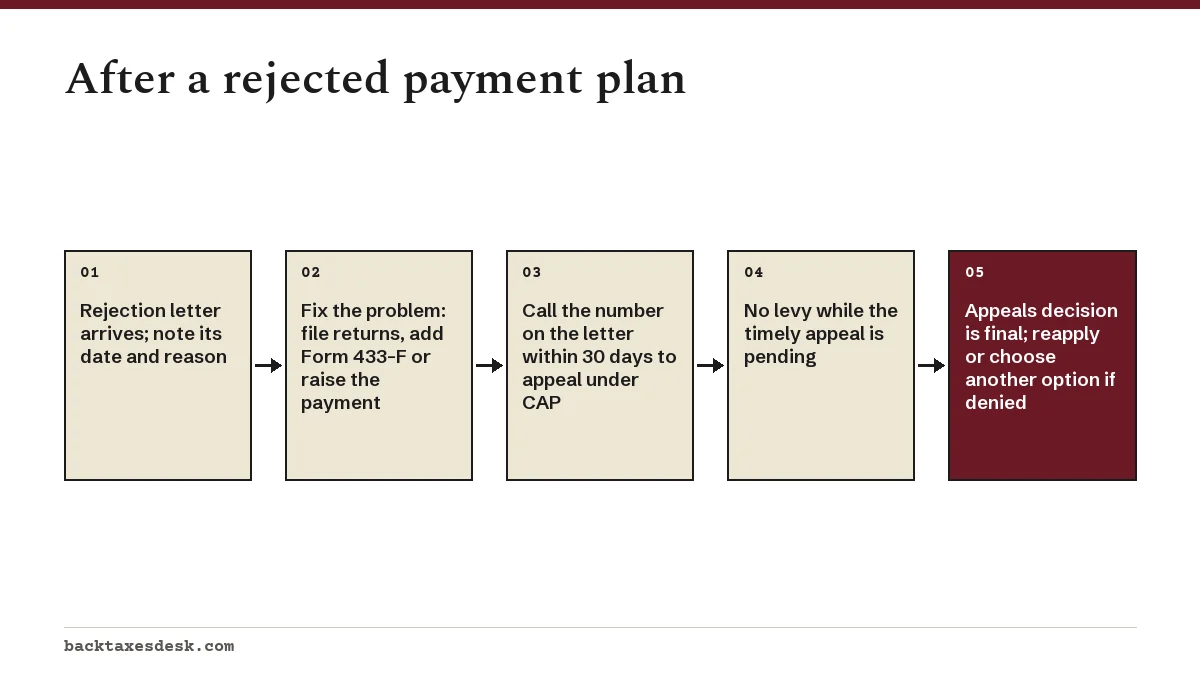
- Call the number on the rejection letter and say you want to appeal the rejection. A conference with a Collection manager is recommended but not required first.
- If a Revenue Officer sent the rejection, the appeal must be in writing. Use Form 9423, Collection Appeal Request.
- Make the request on or before the 30th day after the date on the rejection letter. A mailed request must be postmarked by that day.
- Explain why the plan should be approved and include any missing documents, such as a completed Form 433-F or proof that returns are now filed.
- Wait for the Appeals decision. It is binding on both you and the IRS.
Does a rejection pause collection?
Partly. Publication 1660 says the IRS cannot levy until 30 days after it rejects an installment agreement. If you appeal within those 30 days, the IRS cannot levy until the appeal is finished, unless it believes collection of the tax is in jeopardy.
Other steps can continue. Notices keep arriving, interest keeps accruing, and a federal tax lien may still be filed. If you receive a Final Notice of Intent to Levy, you also have a separate right to a Collection Due Process hearing within 30 days, where you can propose an installment agreement as an alternative to levy.
What happens to the collection statute
The 10-year collection clock stops while an installment agreement request is pending, and it stays stopped for 30 more days after a rejection. A long review therefore adds time to the IRS collection window.
Keep a record of when you applied and when the rejection letter was dated. Those dates help you or a representative confirm the updated end date later. Our collection statute of limitations page lists every event that suspends the clock.
Other options if your payment plan was declined
If an appeal is unlikely to succeed, change the request instead of repeating it. Match the option to the reason for the rejection.
- Short-term plan. If you can pay within 180 days and owe under $100,000, a short-term plan has no setup fee.
- Partial payment installment agreement. If you truly cannot pay in full before the CSED, a PPIA sets the payment by ability to pay. See our PPIA page.
- Currently Not Collectible status. If you cannot pay anything after basic living expenses, the IRS may pause collection. See Currently Not Collectible.
- Offer in compromise. If the debt is more than you could pay before the CSED, an offer may settle it for less; start with the IRS Pre-Qualifier tool.
- Pay down first, then reapply. Bringing the balance to $50,000 or less opens the online application and removes the Form 433-F requirement for many people.
If you had a plan that failed rather than a request that was rejected, the rules are different; see installment agreement default and payment plan not working. The IRS payment plan guide compares every plan type side by side.
Common questions
Why would the IRS reject my installment agreement?
The most common reasons are unfiled returns, a payment too low to clear the debt in time, a missing Form 433-F, equity in assets the IRS expects you to use, or a pending bankruptcy or offer in compromise. The rejection letter states the reason.
Can I appeal a rejected IRS payment plan?
Yes. Call the number on the rejection letter within 30 days of its date and request a Collection Appeals Program review. If a Revenue Officer sent the letter, appeal in writing, preferably on Form 9423.
Can the IRS levy my bank account after rejecting my payment plan?
Not right away. The IRS cannot levy until 30 days after the rejection, and a timely appeal extends that protection until Appeals decides, unless collection is in jeopardy.
Can I reapply after the IRS declined my payment plan?
Yes. Fix the problem named in the letter, such as filing missing returns or raising the payment, and submit a new request. A request that fixes the stated problem is usually a stronger position than appealing the old one unchanged.
Can I go to court if Appeals upholds the rejection?
Not under the Collection Appeals Program. Publication 1660 says CAP decisions are binding and cannot be reviewed by a court, which is the main trade-off for its speed.
Sources
- Publication 1660, Collection Appeal Rights irs.gov
- Instructions for Form 9465 irs.gov
- Payment plans, installment agreements irs.gov
- Time IRS can collect tax irs.gov
- Collection Due Process (CDP) FAQs irs.gov
We check figures against these official pages. Rules change; confirm anything that affects a deadline or payment with the agency before you act.
Tell us what happened
Describe your situation and our editors will use it to improve this guide. If you leave your email, we may reply with a pointer to the right page or official contact. We never share your details.
Related guides
 IRS Payment Plan: How It Works, Costs and Who Qualifies
An IRS payment plan lets you pay a tax bill over time: up to 180 days with no setup fee if you owe less than $100,000, or monthly…
Collection Appeals Program: Form 9423 Steps and Deadlines
The Collection Appeals Program (CAP) lets you ask the IRS Independent Office of Appeals to review a lien, levy, seizure or instal…
IRS Payment Plan Not Working Online? Fixes and Alternatives
When an IRS payment plan is not working online, the cause is usually one of five things: a missing tax return, a balance above th…
Currently Not Collectible Status: IRS Hardship Explained
Currently not collectible (CNC) is an IRS account status that pauses most collection when paying anything toward your tax debt wo…
IRS Installment Agreement Default: Fixing a Missed Payment
An IRS payment plan default happens when you miss a monthly payment, fail to file a return, or leave new tax unpaid. The IRS then…
Partial Payment Installment Agreement (PPIA) Explained
A partial payment installment agreement (PPIA) is an IRS payment plan for people who cannot pay their full tax debt before the 10…