
IRS payment plan not working online: causes, fixes and other ways to apply
Short answer
When an IRS payment plan is not working online, the cause is usually one of five things: a missing tax return, a balance above the online limit, a business account, a monthly offer below the minimum, or a sign-in problem. If the tool still refuses, you can apply by phone, in person or with Form 9465, and the IRS generally cannot levy while a request is pending.
- 01Online limit, monthly plan
- $50,000 combined balance
- 02Online limit, 180-day plan
- Under $100,000
- 03Tool hours
- 5 a.m. to midnight Eastern
- 04Backup route
- Phone, Taxpayer Assistance Center or Form 9465
Why the IRS payment plan is not working online
An IRS payment plan not working online almost always means the Online Payment Agreement tool has hit one of its built-in limits, not that the IRS has refused you a plan. The tool only approves cases that fit fixed rules. Anything outside them is sent to a person, by phone or mail.
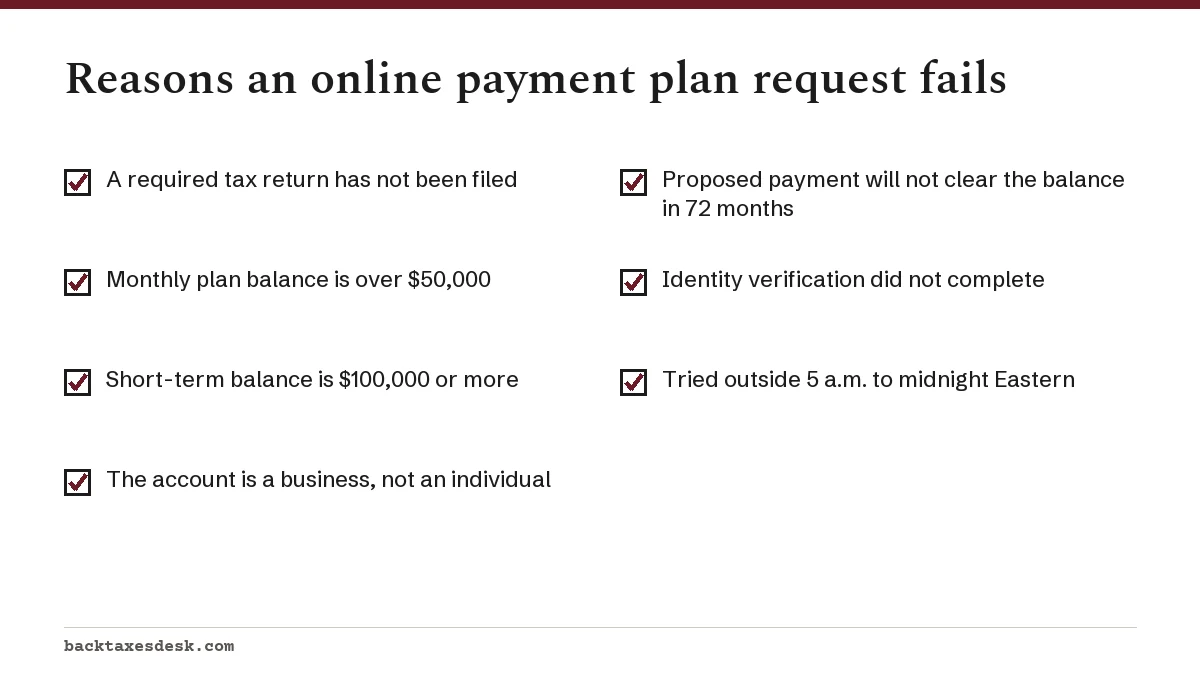
Work through the reasons in order. The first two, missing returns and balance limits, account for the cases where the tool loads fine but will not let you finish.
Unfiled returns and balance limits
A required return is missing
Individuals must have filed every required return to get an installment agreement. If the IRS shows a year as unfiled, the tool will stop you even if you owe nothing for that year. File the missing return, wait for it to be processed, then try again.
If you are not sure which years are missing, your IRS Online Account and account transcripts show what has been filed. The catch-up process is covered in filing unfiled tax returns.
The balance is over the online limit
Online, a monthly plan is capped at $50,000 in combined tax, penalties and interest, and a short-term plan at under $100,000. Interest adds up daily, so a balance that was $49,500 on your last notice can pass $50,000 by the time you apply.
- Pay enough through Direct Pay to bring the balance to $50,000 or less, then apply online once the payment has posted to your account.
- Ask for a short-term plan instead if you can pay in full within 180 days.
- Apply by phone and be ready to complete Form 433-F.
Minimum payment and account type problems
If your proposed monthly amount does not meet the IRS requirements, the tool asks you to raise it; if you cannot, it directs you to Form 9465 or another offline route. For a streamlined plan the payment generally has to clear the assessed balance within 72 months, so on $30,000 the floor is about $417 a month.
Business accounts cannot use the tool at all, and representatives without a Tax Pro Account must apply offline. If you are a sole proprietor, sign in as yourself, not with the business EIN; sole proprietors apply as individuals.
Account and identity problems
Sign-in problems stop you before any of the eligibility rules come into play. The tool runs through the IRS Online Account, which requires identity verification with a photo ID.
- Page will not load or times out: the application is only available from 5 a.m. to midnight Eastern.
- Identity verification fails: check that the name and details match your latest tax return, and retry on a device that can receive the verification code.
- Balance not listed: a recently filed return may not be posted yet. The tool asks for the balance due shown on the return in that case.
What an IRS payment plan submission error means
The IRS does not publish a list of error messages for the tool, so a submission error has no official meaning. In practice, retry once during the tool's hours with a different browser, then stop. Repeated attempts will not change an eligibility block, and the phone route produces a real answer.
IRS payment plan not showing in your account
If you applied and the plan is not showing, first find your confirmation. An online approval appears on screen at the end of the application. A mailed Form 9465 is usually answered within 30 days, and longer for returns filed after March 31, so a plan requested by mail may simply not be set up yet.
A request that is pending still helps you. The IRS is generally prohibited from levying while an installment agreement request is pending. Keep making the payment you proposed so the balance shrinks while you wait.
Other ways to apply
When the tool says no, the plan is still available through other routes. Fees are higher offline, but the same plan types are available and larger balances are only possible this way.
| Route | Best for | Long-term setup fee |
|---|---|---|
| Phone, using the number on your notice | Balances over $50,000, low payments, businesses | $107 direct debit, $178 other |
| Taxpayer Assistance Center appointment | Complex accounts, identity problems | $107 direct debit, $178 other |
| Form 9465 by mail | People who cannot pass online identity checks | $107 direct debit, $178 other |
If the IRS turns down the request itself, IRS payment plan rejected covers appeal rights and next steps. For a refresher on what the tool can do once you are in, see our Online Payment Agreement page, and the full set of plans is in the IRS payment plan guide.
Common questions
Why won't the IRS let me set up a payment plan online?
Usually because a return is unfiled, the balance is over $50,000 for a monthly plan, the account is a business, or your proposed payment is too low. The tool does not handle exceptions; apply by phone instead.
Why can't I access the IRS payment plan tool at night?
The Online Payment Agreement application is only available from 5 a.m. to midnight Eastern time each day. Try again after 5 a.m.
Can I apply for an IRS payment plan if I owe for a year I have not filed?
Not until that return is filed. File it first; you can include that year's balance in the plan once the return is processed.
Does a failed online application count against me?
A refusal by the online tool only means your case falls outside its automatic rules. You can apply by phone, in person or with Form 9465 right away.
Will the IRS levy while my payment plan is being set up?
Generally not. The IRS is generally prohibited from levying while an installment agreement request is pending, though there are exceptions.
Sources
- Online Payment Agreement application irs.gov
- Payment plans; installment agreements irs.gov
- Instructions for Form 9465 irs.gov
- Understanding your LT16 notice irs.gov
We check figures against these official pages. Rules change; confirm anything that affects a deadline or payment with the agency before you act.
Tell us what happened
Describe your situation and our editors will use it to improve this guide. If you leave your email, we may reply with a pointer to the right page or official contact. We never share your details.
Related guides
 IRS Payment Plan: How It Works, Costs and Who Qualifies
An IRS payment plan lets you pay a tax bill over time: up to 180 days with no setup fee if you owe less than $100,000, or monthly…
How to Set Up an IRS Payment Plan Online, by Phone or Mail
To set up an IRS payment plan, first make sure every required return is filed, then apply through the Online Payment Agreement to…
IRS Rejected Your Payment Plan? Why and What to Do Next
When the IRS rejects a payment plan, you can appeal through the Collection Appeals Program by calling the number on the rejection…
IRS Installment Agreement Default: Fixing a Missed Payment
An IRS payment plan default happens when you miss a monthly payment, fail to file a return, or leave new tax unpaid. The IRS then…