
Form 9465 instructions: filling out the installment agreement request line by line
Short answer
Form 9465 is the paper request for a monthly IRS installment agreement when you cannot pay what your return or notice shows. You list what you owe, what you can pay each month and the day you want to pay. Balances over $50,000 need Form 433-F attached. If you owe $50,000 or less, the online application costs less and answers faster.
- 01What it requests
- A monthly installment agreement (long-term payment plan)
- 02Form 433-F required
- When the balance on line 9 is over $50,000, or your offer is too low to meet the payoff limit
- 03Setup fee by mail
- $107 with direct debit, $178 without
- 04Usual IRS reply time
- About 30 days, longer for returns filed after March 31
What Form 9465 is used for
Form 9465, Installment Agreement Request, asks the IRS to let you pay a tax bill in monthly installments. You can use it for a balance shown on a return you are filing now, or for a balance shown on a notice the IRS already sent you.
The form is one page of requests plus a second page (Part II) that some people must complete. It is not an application for a lower tax bill. Interest and the failure-to-pay penalty keep running until the balance is paid, though the penalty rate drops to 0.25% a month for people who filed on time and have an approved plan.
The fillable Form 9465 PDF and the separate instructions (the current instructions carry a July 2024 revision date) are on the IRS About Form 9465 page. Download both from irs.gov rather than from a third-party site, so you get the current revision.
When to use Form 9465 instead of applying online
The IRS instructions steer most people away from the paper form when a faster route exists. Check these three cases before you print anything.
- You can pay within 180 days. A short-term plan has no setup fee, so Form 9465 would only add cost. See our short-term payment plan page.
- You owe $50,000 or less in combined tax, penalties and interest. The Online Payment Agreement tool is faster than mail and has the lowest fees ($29 with direct debit, $69 otherwise).
- You are in bankruptcy or have a pending or accepted offer in compromise. The instructions say not to file Form 9465 in either situation.
Form 9465 makes sense when you are mailing a paper return and want the plan request to travel with it, when you owe more than $50,000, or when you cannot or prefer not to use the online account. A business that is still operating and owes employment or unemployment taxes cannot use this form; it has to contact the IRS directly.
Form 9465 instructions, line by line
The form is short, but a few lines decide whether the IRS approves the plan without asking for more paperwork. Work through it in this order.
Lines 1a and 2: who you are
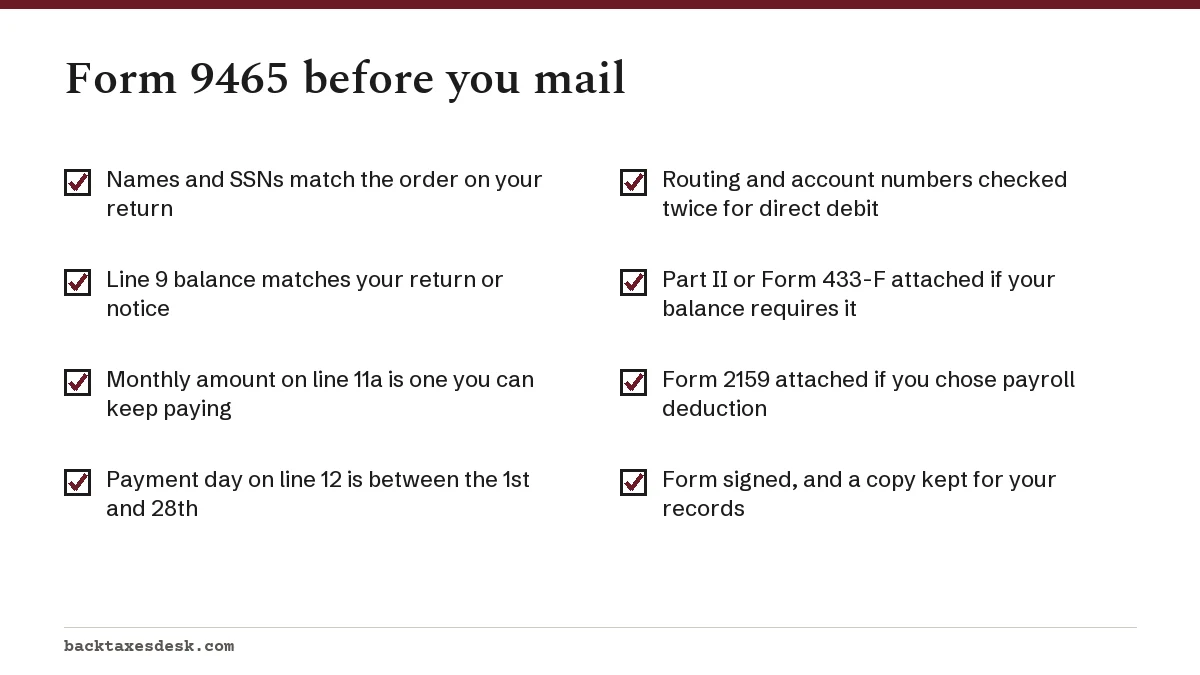
Line 1a takes your name and Social Security number, and your spouse's if you filed jointly, in the same order they appear on the return. Check line 1b if your address changed since your last return. Line 2 is only for a business that is no longer operating; enter its name and EIN. Fill in the remaining contact lines as well, so the IRS can reach you if it needs to clarify something before approving.
Lines 5 to 9: how much you owe
- Line 5: the total due on your return or notice.
- Line 6: any other balances not on line 5, including amounts already in an existing installment agreement.
- Line 7: add lines 5 and 6.
- Line 8: any amount you are paying now. Pay it with the return, or attach a check or money order payable to United States Treasury with your name, address, SSN, phone number, tax year and form number written on it.
- Line 9: line 7 minus line 8. This is the balance the plan must cover, and it sets which rules apply to you.
Lines 10 to 11b: the monthly payment
The IRS wants the balance paid within 72 months, or by the collection statute expiration date if that comes sooner. Line 10 is the benchmark the form compares your offer against. A quick check is line 9 divided by 72: on a $30,000 balance that is about $417 a month before interest.
Enter on line 11a the most you can pay each month. If you leave it blank, the IRS divides the balance by 72 and assigns that payment. If your line 11a amount is below line 10 and you can raise it, write the higher amount on line 11b. If you cannot raise it, check the box under line 11b and attach Form 433-F.
Line 12: the payment date
Pick a day from the 1st to the 28th. Choose a date a few days after your paycheck usually lands, because a returned payment can put the plan into default.
Lines 13a to 14: how you will pay
Lines 13a and 13b set up direct debit. The routing number has nine digits and must start with 01 to 12 or 21 to 32. The account number can be up to 17 characters; include hyphens but leave out spaces and symbols. Line 13c is for low-income taxpayers who cannot use direct debit and want the reduced fee reimbursed when the plan is finished. Check line 14 to pay by payroll deduction instead, and attach Form 2159 signed by both you and your employer.
When you must complete Part II
Part II on page 2 asks for basic financial information, including the spouse's income for married people who live together or live in a community property state. You need it when line 9 is more than $25,000 but not more than $50,000 and your monthly offer is below the line 10 amount.
You can often skip Part II and Form 433-F in that $25,001 to $50,000 range by agreeing to pay by direct debit (line 13) or payroll deduction (line 14). That trade is worth considering if the monthly amount fits your budget.
Attaching Form 433-F
Form 433-F, Collection Information Statement, is a fuller picture of your income, expenses, bank accounts and assets. The IRS uses it to decide what you can afford. Attach it in these cases:
| Balance on line 9 | Your monthly offer | Form 433-F needed |
|---|---|---|
| $25,000 or less | Any amount that clears the balance in time | Generally no |
| $25,001 to $50,000 | At or above line 10 | No, if you choose direct debit or payroll deduction |
| $25,001 to $50,000 | Below line 10 and cannot be raised | Yes |
| Over $50,000 | Any amount | Yes |
| Any amount | Will not pay in full by the collection statute date | Likely; the request may be reviewed as a partial payment agreement |
If your offer would not clear the debt before the collection statute runs out, the IRS may treat the request as a partial payment installment agreement, which always involves a full financial review. Our Form 433-F guide covers each section of that statement.
Form 9465 fees and direct debit
Filing Form 9465 by mail puts you in the higher fee bracket for a long-term plan. The fee is charged once the plan is approved.
| How you apply | Direct debit | Other payment method |
|---|---|---|
| Form 9465, phone or in person | $107 | $178 |
| Online Payment Agreement | $29 | $69 |
| Low-income (AGI at or below 250% of poverty guidelines) | Waived | $43, may be reimbursed at completion |
Payroll deduction through Form 2159 carries the $178 fee. If the IRS does not recognize you as low-income automatically, you can ask with Form 13844, Application for Reduced User Fee for Installment Agreements. Our IRS payment plan fees page covers revision and reinstatement costs as well.
Can I file Form 9465 with my tax return?
Yes. If you are mailing a paper return, attach Form 9465 to the front of it and send both to the address for your return. If you already filed, or you are responding to a notice, Form 9465 goes by itself to a different IRS address that depends on your state and whether you file Schedule C, E or F. Our page on where to mail Form 9465 lists every address.
The IRS says it usually tells you within 30 days whether the request is approved or denied. For tax due on a return filed after March 31, the reply may take longer. Keep paying what you can while you wait; any payment reduces the balance that interest is charged on.
What happens after the IRS decides
An approval letter confirms the payment amount, due date and fee. From that point, three things keep the plan alive: pay on time every month, file every future return on time, and pay any new balance in full when it is due. Missing one of those can lead to a CP523 default notice.
If the IRS turns the request down, the letter explains why and how to appeal. You generally have 30 days from the date of the rejection letter to ask for a Collection Appeals Program review. The rejected payment plan page walks through that process, and the IRS payment plan guide compares every plan type if you need to start over.
Step by step
Confirm the paper form is the right route
If you can pay within 180 days or owe $50,000 or less, the short-term plan or the online application is cheaper and faster.
Fill in lines 1 to 9
Enter your identifying details, the balance from the return or notice, any other balances and any amount you are paying now.
Set a realistic monthly payment
Compare your offer with the line 10 amount and raise it on line 11b if you can; otherwise check the box and attach Form 433-F.
Choose a date and payment method
Pick a day between the 1st and 28th and add bank details for direct debit, or check line 14 and attach Form 2159.
Complete Part II or Form 433-F if required
Use the thresholds in the instructions to decide which financial details to include.
Sign and mail
Attach the form to the front of a paper return, or mail it alone to the address in the instructions if you already filed or received a notice.
Common questions
What is Form 9465 used for?
It requests a monthly installment agreement when you cannot pay the full amount shown on your return or on an IRS notice. It does not reduce the tax, and interest keeps accruing until the balance is paid.
Is there a fillable Form 9465 PDF?
Yes. The IRS posts a fillable PDF on its About Form 9465 page. You can type into it, print it, sign it and mail it; there is no IRS option to submit the standalone form online, which is what the Online Payment Agreement tool is for.
Do I need Form 433-F with Form 9465?
Only in some cases. You need it when the balance on line 9 is over $50,000, or when you owe $25,001 to $50,000 and cannot offer the minimum monthly amount the form calculates.
Is there a fee with Form 9465?
Yes, once the plan is approved. Applying by mail costs $107 with direct debit or $178 with another payment method. Low-income taxpayers pay nothing with direct debit, or $43 that may be reimbursed at completion.
What happens if I leave the monthly payment line blank on Form 9465?
The IRS divides your balance by 72 months and sets that as your payment. That amount may be more than you can afford, so it is better to enter a realistic figure yourself.
Can my employer take the payments out of my paycheck?
Yes. Check line 14 and attach Form 2159, Payroll Deduction Agreement, with your employer's section completed and signed. The setup fee for payroll deduction is $178.
Sources
- Instructions for Form 9465 irs.gov
- About Form 9465, Installment Agreement Request irs.gov
- Payment plans, installment agreements irs.gov
- Failure to pay penalty irs.gov
We check figures against these official pages. Rules change; confirm anything that affects a deadline or payment with the agency before you act.
Tell us what happened
Describe your situation and our editors will use it to improve this guide. If you leave your email, we may reply with a pointer to the right page or official contact. We never share your details.
Related guides
 IRS Payment Plan: How It Works, Costs and Who Qualifies
An IRS payment plan lets you pay a tax bill over time: up to 180 days with no setup fee if you owe less than $100,000, or monthly…