
Topic
IRS audit guide: how audits start, run and end
An IRS audit is a review of a filed tax return to check that income, deductions and credits were reported correctly, and the IRS always starts one by mail, never by phone. Most audits are handled entirely by letter. The IRS generally audits returns filed in the last three years, and you can appeal a result you disagree with.
13 guides in this topic Updated September 19, 2026
- Does the IRS Use AI to Pick Audits? What Is KnownThe IRS uses AI-assisted models to score returns for non-compliance risk and recommend cases for examination. The published focus is large partnershi…
- How Long Does an IRS Audit Take? Typical TimeframesHow long an IRS audit takes depends on its type and how fast records arrive: the IRS says mail audits with complete documents or a signed agreement c…
- How to File a Tax Court Petition: Deadline, Fee and StepsA Tax Court petition asks the US Tax Court to review an IRS determination before you pay. For a notice of deficiency it must be filed within 90 days…
- IRS Appeals Process: How to Dispute an IRS DecisionThe IRS appeals process lets you ask the IRS Independent Office of Appeals, which is separate from the office that audited or billed you, to review a…
- IRS Audit Letter: What a Real One Looks Like and SaysA real IRS audit letter comes by US mail, shows a letter number such as Letter 566 or Letter 2205 in a corner, names the tax year and items under rev…
- IRS Audit Reconsideration: How to Reopen a Finished AuditAudit reconsideration is the IRS process for reopening a finished audit, or a return the IRS prepared for you, when you have information it never con…
- IRS Audit Statute of Limitations: The 3- and 6-Year RulesThe IRS audit statute of limitations is generally three years from the date a return was filed, under Internal Revenue Code section 6501. It becomes…
- IRS Audit Triggers: How Returns Get Selected for ReviewThe IRS names three audit triggers: random selection, computer screening that scores a return against statistical norms, and links to another taxpaye…
- IRS Correspondence Audit: How a Mail Audit Really WorksA correspondence audit is an IRS examination handled entirely by mail, where the IRS asks you to send copies of records supporting specific items on…
- IRS Field Audit: What Happens When the Auditor Comes to YouAn IRS field audit is an in-person examination held where your books and records are kept, usually your place of business, sometimes your home or you…
- IRS Letter 525: Proposed Audit Changes and Your 30 DaysLetter 525 IRS examiners send is the General 30-Day Letter: it closes a mail audit with proposed changes, usually on an enclosed Form 4549, and gives…
- IRS Letter 566: Start of a Mail Audit and How to ReplyIRS Letter 566 is the initial contact letter for a mail audit: it tells you a return has been selected for examination and lists the specific items y…
- IRS Office Audit: What to Expect at an In-Person ExamAn IRS office audit is an in-person interview at a local IRS office where an examiner reviews the specific items listed in your appointment letter. Y…

What is an IRS audit?
An IRS audit, which the IRS formally calls an examination, is a review of your accounts and records to confirm that a return follows the tax law and reports the right amount of tax. It is a check of specific items, not an accusation. The IRS says that being selected does not by itself mean an error was found (IRS, IRS audits).
The IRS audit process has three possible endings: no change (your return is accepted as filed), agreed (you accept the proposed changes and sign), or disagreed (you dispute the changes and can take them to a manager, mediation, the Independent Office of Appeals or the Tax Court). Everything on the pages in this section fits somewhere along that path.
Read the video transcript
IRS audit guide: how audits start, run and end
An IRS audit is a review of a filed tax return to check that income, deductions and credits were reported correctly, and the IRS always starts one by mail, never by phone.
How audits start: By mail only; the IRS does not open an audit by phone.
Usual look-back: Returns filed in the last 3 years; generally no more than 6.
Mail audit extension: One automatic 30-day extension, usually granted.
The IRS tells you about an audit by letter sent to the address on your latest return or the address the IRS has on file.
The IRS runs audits in three ways: by mail (a correspondence audit), in an IRS office (an office audit) or at your home, business or representative's office (a field audit).
The IRS selects returns in three ways: random selection, computer screening that compares a return against statistical norms for similar returns, and links to another taxpayer's audit, such as a business partner or investor.
What is the IRS audit meaning in simple terms? It means the IRS is double-checking some or all of a filed return against your records.
How will the IRS tell me I am being audited?
The IRS tells you about an audit by letter sent to the address on your latest return or the address the IRS has on file. The IRS states that it will notify you by mail and will not initiate an audit by telephone. An unexpected call, text or email that claims you are under audit and demands payment is a scam signal, not an audit notice.
The letter names the tax year, lists the items under review and gives a reply date. Mail audits usually start with a Letter 566 variant, while in-person audits usually start with an appointment letter such as Letter 2205. Our page on the IRS audit letter shows how to read one and how to confirm it is genuine, and the Letter 566 page covers the most common mail version.
Mail, office and field audits: which kind do you have?
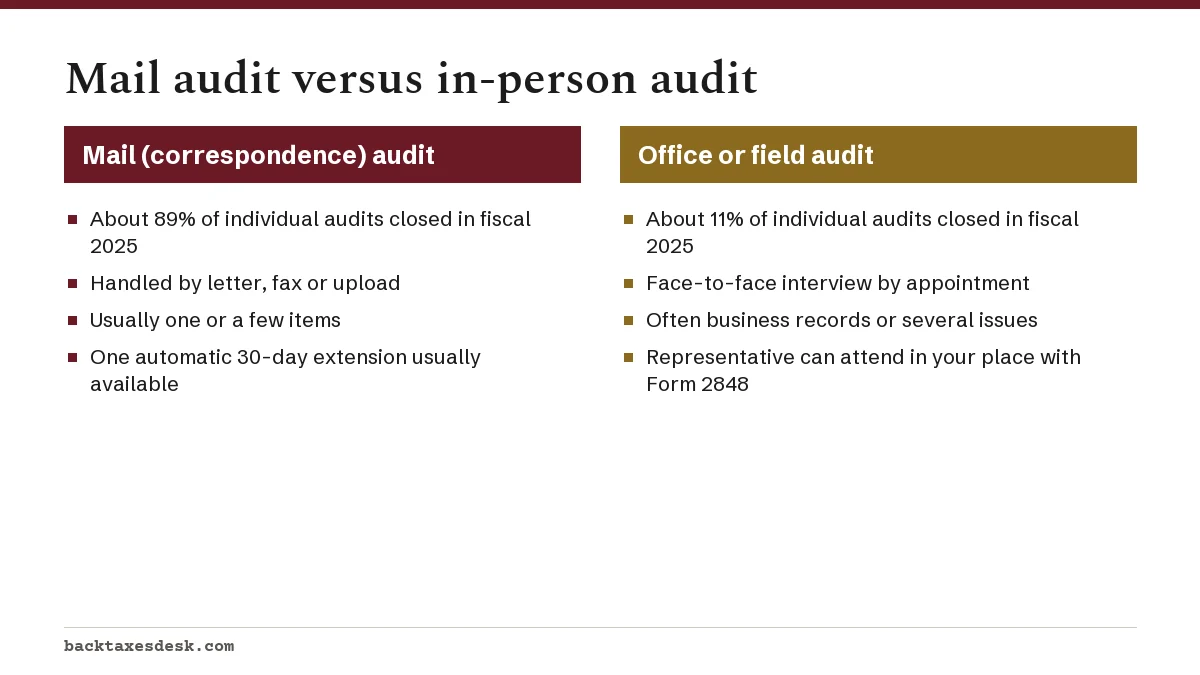
The IRS runs audits in three ways: by mail (a correspondence audit), in an IRS office (an office audit) or at your home, business or representative's office (a field audit). The type is set by the IRS and is shown in the first letter. Mail audits are by far the most common for individuals.
According to the IRS Data Book for fiscal year 2025, the IRS closed 441,578 examinations of individual income tax returns, and 393,767 of them, about 89%, were correspondence audits (IRS Data Book, Table 3-2). The remaining 47,811 were field examinations, a category the IRS uses for audits done in person by revenue agents and tax compliance officers.
| Audit type | Where it happens | Typical scope | Detailed page |
|---|---|---|---|
| Correspondence | By letter, fax or upload | One to a few items, such as a credit or a deduction | Correspondence audit |
| Office | IRS office, by appointment | Several items needing a conversation | Office audit |
| Field | Home, business or representative's office | Business records and broader issues | Field audit |
Why are returns selected for an IRS audit?
The IRS selects returns in three ways: random selection, computer screening that compares a return against statistical norms for similar returns, and links to another taxpayer's audit, such as a business partner or investor. The IRS builds those norms from its National Research Program studies.
Separately, the IRS matches your return against Forms W-2, 1099 and other third-party reports. A mismatch usually produces a CP2000 proposal rather than a full examination. Our page on IRS audit triggers looks at selection in detail, including published audit rates by income level.
How far back can an IRS audit go?
The IRS generally includes returns filed within the last three years in an audit, and it says it usually does not go back more than six years even when it finds a substantial error. The legal limit for assessing extra tax is normally three years from the date the return was filed, under Internal Revenue Code section 6501.
That window stretches to six years when more than 25% of gross income was left off the return, and it never closes for a fraudulent return or a year with no return at all. The IRS audit statute of limitations page breaks down each exception and how long to keep records.
What happens during an IRS audit, step by step?
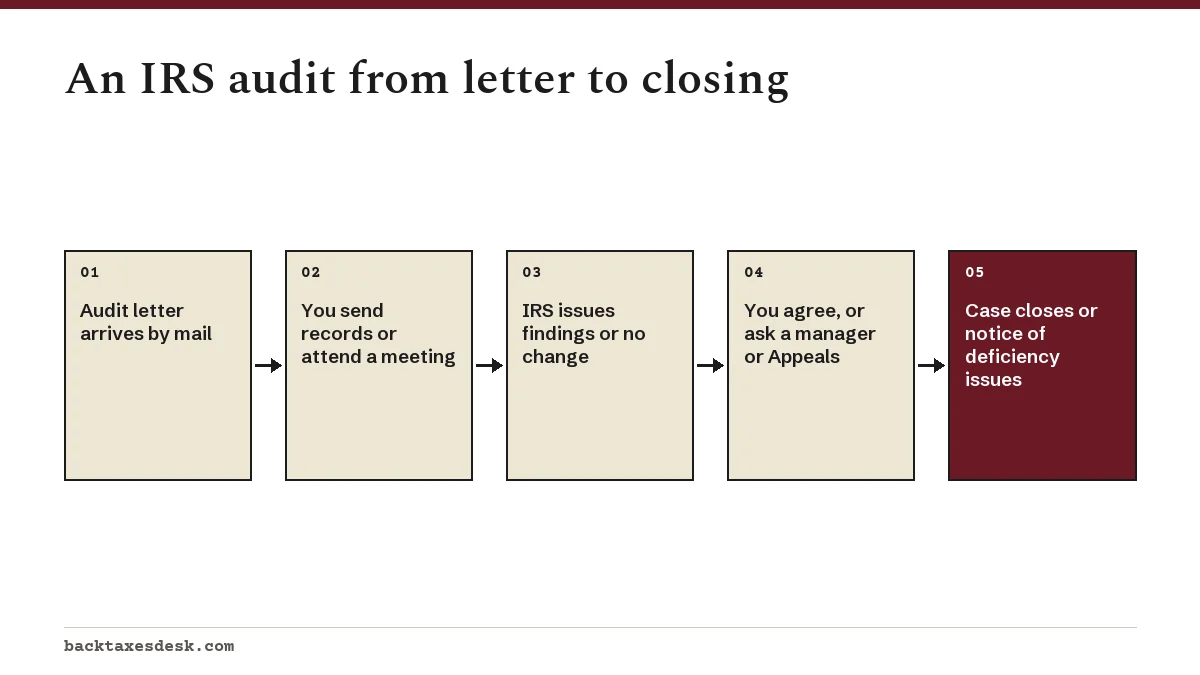
- Letter arrives. Note the reply date and the items listed. Mark the date on your calendar the day it arrives.
- Gather records. Pull receipts, bank statements, Forms 1099 and W-2, logs and anything else that supports the items named. Send copies, never originals.
- Respond or meet. For a mail audit, send documents by the deadline. For an office or field audit, attend the appointment or send a representative.
- Review the findings. The IRS either accepts the return, or sends a report of proposed changes, often Form 4549, Report of Income Tax Examination Changes.
- Agree or disagree. Sign the report if you agree. If you disagree, ask for a manager conference or an appeal before the date on the 30-day letter.
- Closing. An agreed case closes and any balance is billed. An unagreed case ends with a notice of deficiency that opens the door to the Tax Court.
If you already have a notice of deficiency, the 90-day clock is running. Read our page on the notice of deficiency before doing anything else.
How long does an IRS audit take?
There is no fixed length. The IRS says the time depends on the type of audit, how complex the issues are, how quickly information is provided, scheduling, and whether you agree with the findings. Its mail audit guide, Publication 3498-A, says audits closed with complete documents or a signed agreement can finish quickly, while others can take several months.
For mail audits the IRS can usually grant a one-time automatic 30-day extension if you need more time to gather records. Our page on how long an IRS audit takes explains what speeds a case up and what stretches it out.
Can I appeal an IRS audit result?
Yes. If you disagree with the examiner's proposed changes, you can ask to speak with the examiner's manager, request mediation, or file an appeal with the IRS Independent Office of Appeals, which is separate from the office that audited you. For a proposed change of $25,000 or less per tax period, a short small case request or Form 12203, Request for Appeals Review, is enough.
Above $25,000, you need a formal written protest. The IRS appeals process page walks through both. If you missed the audit or have new documents after it closed, audit reconsideration may reopen the case. If you receive a notice of deficiency, you can file a Tax Court petition within 90 days for a $60 filing fee, and a waiver is available.
Do you need IRS audit representation?
You have the right to represent yourself or to authorize someone else to represent you. Attorneys, certified public accountants and enrolled agents have unlimited rights to represent taxpayers before the IRS, including at Appeals. You authorize them with Form 2848, Power of Attorney and Declaration of Representative.
Representation is most useful when the amount at stake is large, the audit covers a business, or fraud or unfiled years are involved. Publication 3498-A notes that if you ask to consult a representative during an interview, the IRS must in most cases stop and reschedule. People with income at or below 250% of the federal poverty guidelines may qualify for free or low-cost help from a Low Income Taxpayer Clinic, generally for disputes under $50,000.
Pages in the audits and appeals section
- IRS audit triggers: how returns are picked and what the published audit rates show.
- How long an IRS audit takes: timing for each audit type and extensions.
- IRS audit statute of limitations: the 3-year, 6-year and no-limit rules.
- Correspondence audit: the mail audit from first letter to closing.
- Office audit and field audit: in-person examinations.
- IRS audit letter, Letter 566 and Letter 525: reading the letters.
- Audit reconsideration: reopening a closed audit.
- IRS appeals process and Tax Court petition: disputing the result.
Common questions
What is the IRS audit meaning in simple terms?
It means the IRS is double-checking some or all of a filed return against your records. Many audits end with no change. The IRS does not treat selection as proof of a mistake.
Will the IRS call me to say I am being audited?
No. The IRS says it notifies audits by mail and does not start an audit by phone. After a letter has been sent, an examiner may call to arrange details, so compare any caller's claims against the letter you received.
What are the chances of getting audited by the IRS?
Low for most filers. For tax year 2021, the IRS had examined about 0.3% of individual income tax returns as of its fiscal 2025 Data Book, with higher rates at the top of the income scale and for returns claiming the earned income tax credit.
What happens if I ignore an IRS audit letter?
The IRS disallows the items it asked about and proposes the extra tax, penalties and interest. If you still do not respond, it sends a notice of deficiency and then assesses the tax and bills you.
Can I be audited after I get my refund?
Yes. Receiving a refund does not close the year. The IRS can generally examine the return for three years after it was filed, and longer in the situations covered by IRC 6501.
Should I pay the audit amount while I appeal?
You do not have to, but interest keeps running on any tax that turns out to be owed. The IRS lets you stop interest on the amount you send by making a deposit or advance payment while the dispute continues.