
IRS field audit: when the examiner comes to your business or home
Short answer
An IRS field audit is an in-person examination held where your books and records are kept, usually your place of business, sometimes your home or your representative's office. A revenue agent reviews the questioned items, often tours the business and may reconcile bank deposits to reported income. You can ask to move it to an IRS office if it would disrupt a small business.
- 01Where it is held
- Where your original records are kept, usually your principal place of business
- 02Can you move it
- Yes, on request; the IRS weighs records location, residence and hardship
- 03Business tour
- IRS manual says tours should be done for all business entities
- 04Rep can attend without you
- Yes, with Form 2848, unless you are summoned
- 05Appeals needs on the statute
- Generally at least 365 days left on the assessment deadline
What is an IRS field audit?
An IRS field audit, which the regulations call a field examination, is an audit conducted at your residence, your place of business, or your accountant's or representative's office instead of at an IRS building. It is one of the three audit formats the IRS lists, alongside mail audits and office audits.
Under 26 CFR 301.7605-1, the IRS chooses between office and field format based on how complex the return is and which format examines it most efficiently. Returns with business activity, many records or questions about how income is earned are the typical candidates, because the examiner needs to see operations and books that cannot easily be mailed.
The appointment still starts with a letter; the IRS does not begin audits by phone or with an unannounced visit. Check the letter against our IRS audit letter guide, and read the IRS audit guide for how returns get selected.
Where does a field audit take place?
A field audit generally takes place where your original books, records and source documents are kept, which for a business is usually its principal place of business (26 CFR 301.7605-1). If you run a business from home, that can mean an IRS audit at home.
Asking for a different location
You can ask to move the audit. The IRS decides case by case, looking at where you live, where the business now operates, where the records are, where it can examine most efficiently, its staffing and whether the location causes you undue inconvenience. A written request with a short reason works best.
One rule helps very small businesses: if holding the audit on site would essentially force the business to close or would unduly disrupt operations, the IRS will move it to an IRS office once it verifies that. Examples include a one-person shop with no spare room or a home office in a small apartment.
Another common choice is to hold the audit at your representative's office. Many owners prefer this because the examiner then sees the records the representative has organized rather than the whole workplace. Scheduling is normally during IRS business hours on IRS workdays.
Office audit vs field audit
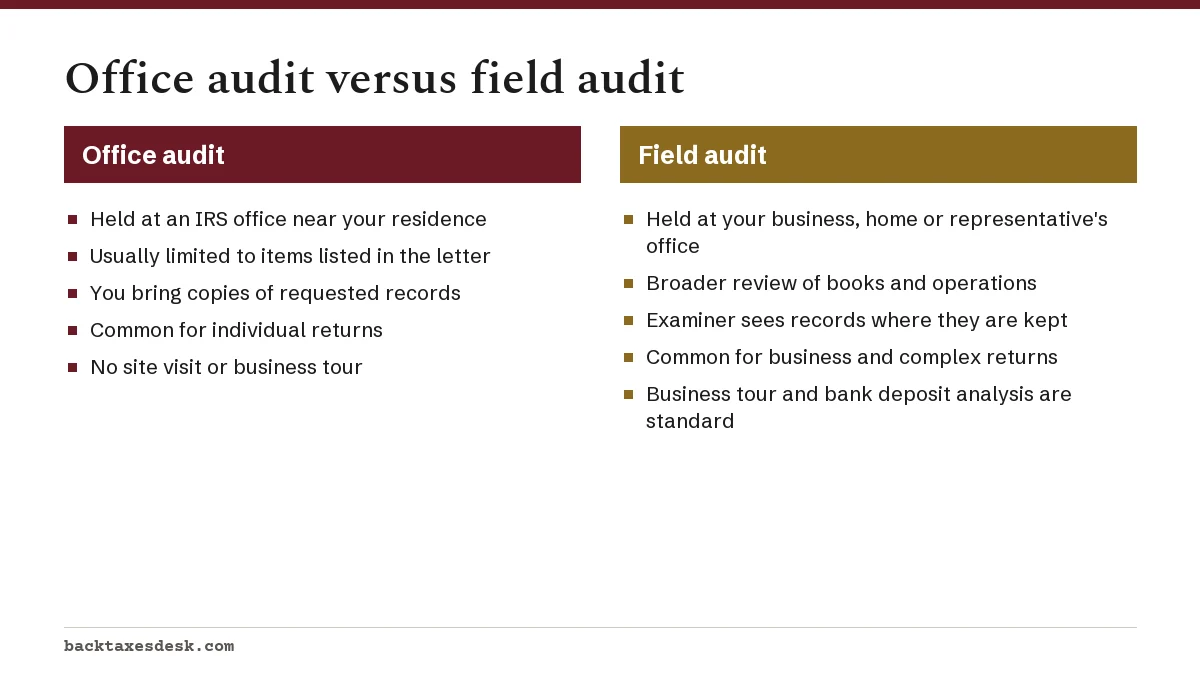
The biggest practical difference is scope. An office audit usually sticks to the few items in the appointment letter, while a field examination gives the revenue agent room to look at how the business runs and whether the books reflect reality.
What the examiner reviews in the IRS field audit process
The IRS field audit process usually runs in this order: initial interview, business tour, records review, follow-up requests and a closing discussion. The Internal Revenue Manual (IRM 4.10.3) describes each technique.
- Initial interview. The examiner confirms you received Publication 1, explains the process and asks how the business operates, who keeps the books and how income is received.
- Business tour. The manual says tours of business sites should be done in examinations of all business entities, early in the audit, to understand operations, check that the books match actual activity and observe internal controls.
- Books and bank records. Examiners reconcile bank deposits to gross receipts. Deposits that are not sales, such as loans, owner transfers or gifts, need records showing where they came from.
- Specific items. Expenses, depreciation, vehicle use, contract labor and inventory are tested against receipts, invoices, payroll records and logs.
- Information document requests. Anything not available on the day is requested in writing with a due date.
How long does a field audit take?
The IRS does not publish a standard length for field audits. Its audits page says duration depends on the type of audit, how complex the issues are, how quickly information arrives, scheduling on both sides and whether you agree with the findings. Field examinations tend to take longer than mail or office audits because they involve more records and on-site time.
The IRS generally has three years from the later of the due date or filing date to assess more tax. If that date is close, the agent may ask you to sign a consent extending it. Publication 3498 says you may refuse, negotiate the issues or length covered, or sign. The Independent Office of Appeals generally wants at least 365 days left on the assessment deadline when it receives a case, so refusing can cost you an administrative appeal.
Should I hire a representative for a field audit?
For most business field audits, representation is worth considering, because the agent's review is broader and questions about operations can open new issues. A representative with a signed Form 2848 can attend in your place; Publication 3498 confirms representation is allowed with or without you present, except when you appear under an administrative summons.
Enrolled agents, CPAs and attorneys can all represent you. A CPA or enrolled agent is often the natural fit for records-heavy business audits, while an attorney makes more sense if there is any risk of fraud findings or a later court case. Our comparison of a tax attorney vs a CPA walks through that choice.
If you expect to owe after the audit, you can make an advance payment or an IRC 6603 deposit during the examination to stop interest on the amount paid, according to Publication 3498. Interest already charged keeps compounding until paid.
After the field audit ends
The agent closes the case as no change, agreed or unagreed. If you agree, you sign the report and pay or arrange payment. If you disagree, you can meet with the agent's manager, ask about Fast Track Settlement with a neutral Appeals mediator, or wait for the 30-day letter and request a conference with the IRS Independent Office of Appeals. A proposed change over $25,000 for any period requires a formal written protest.
Common questions
Can the IRS come to my house for an audit?
Yes, if your records are kept there or you run your business from home, a field audit can be held at your home. You can ask to move it to an IRS office or your representative's office, and the IRS must relocate it if an on-site exam would essentially shut down or unduly disrupt a small business.
Does an IRS field audit mean I am suspected of fraud?
No. Field format is chosen because of return complexity and efficiency, not because fraud is suspected. Most field audits are civil examinations of whether income and expenses were reported correctly.
Can I refuse a business tour during a field audit?
The IRS manual treats a tour as a standard step for business examinations. If a tour at a given time would disrupt operations, discuss timing with the agent or have your representative arrange it.
What is a revenue agent?
A revenue agent is the IRS examiner who typically handles field audits of businesses and more complex individual returns. The agent's name and contact details appear on your appointment letter.
Should I sign a consent to extend the audit statute?
It depends. Signing gives time to provide documents and keeps your right to an Appeals conference, while refusing may lead the IRS to assess based on what it has. Publication 1035 explains the consent forms.
Sources
- IRS audits irs.gov
- 26 CFR 301.7605-1, Time and place of examination law.cornell.edu
- IRM 4.10.3, Examination Techniques irs.gov
- Publication 3498, The Examination Process irs.gov
- About Form 2848 irs.gov
We check figures against these official pages. Rules change; confirm anything that affects a deadline or payment with the agency before you act.
Tell us what happened
Describe your situation and our editors will use it to improve this guide. If you leave your email, we may reply with a pointer to the right page or official contact. We never share your details.
Related guides
 IRS Audit Guide: Types, Letters, Timelines and Appeals
An IRS audit is a review of a filed tax return to check that income, deductions and credits were reported correctly, and the IRS…
IRS Office Audit: What to Expect at an In-Person Exam
An IRS office audit is an in-person interview at a local IRS office where an examiner reviews the specific items listed in your a…
IRS Audit Letter: What a Real One Looks Like and Says
A real IRS audit letter comes by US mail, shows a letter number such as Letter 566 or Letter 2205 in a corner, names the tax year…
Tax Attorney vs CPA: When You Need a Lawyer for IRS Debt
In the tax attorney vs CPA decision, both have unlimited rights to represent you before the IRS, so most back-tax, payment plan a…
IRS Appeals Process: How to Dispute an IRS Decision
The IRS appeals process lets you ask the IRS Independent Office of Appeals, which is separate from the office that audited or bil…