
Correspondence audit: how the IRS mail audit works
Short answer
A correspondence audit is an IRS examination handled entirely by mail, where the IRS asks you to send copies of records supporting specific items on your return by a stated date. It is the most common audit type: about 89% of individual audits closed in fiscal 2025. You can usually get one automatic 30-day extension.
- 01Usual first letter
- Letter 566 or a variant (566-B, 566S, 566E)
- 02Extension
- One automatic 30-day extension, usually granted
- 03Receipt confirmation
- IRS aims to acknowledge mailed or faxed documents within 30 days
- 04Refund after a no-change or favorable result
- About 6 to 8 weeks
- 05Individual correspondence audits closed, FY2025
- 393,767
What is a correspondence audit?
A correspondence audit is an IRS audit carried out through letters instead of a meeting. The IRS mails a letter saying your return has been selected, names the items it wants to verify, and lists the documents to send. You reply with copies by mail, fax or upload, and the IRS decides based on what you send (IRS Publication 3498-A).
The correspondence audit IRS process is designed for narrow questions: whether you qualify for the earned income tax credit, whether a dependent lived with you, or whether you can prove a particular deduction. In fiscal year 2025 the IRS closed 393,767 correspondence examinations of individual returns, out of 441,578 individual audits in total (IRS Data Book).
Reading the mail audit letter
The first letter in an IRS mail audit is usually a version of Letter 566. Letter 566S is generally used for a specific item, Letter 566E for wages, withholding and refundable credits, and Letter 566-B arrives with a proposed report, Form 4549, showing what the IRS will change if you send nothing. Our Letter 566 page covers each version.
- Tax year and form: the return being examined, such as Form 1040 for 2024.
- Items under review: often listed on an attachment such as Form 886-A, Explanation of Items, or a document request.
- Reply date: the date the IRS must receive your response.
- Contact details: a phone number, fax number and mailing address for the examination unit.
- Letter number: printed in a corner, which lets you check the letter on IRS.gov.
Before gathering anything, confirm the letter is real by matching its number and contact details against IRS.gov or your IRS online account. Our IRS audit letter page explains how.
How do I respond to a mail audit?
- List each item the letter names. Write down every line or credit being examined, and match it with the records that prove it.
- Copy, do not send originals. The IRS asks for photocopies. Keep the originals and a copy of the full package you send.
- Explain gaps. If you cannot prove an amount, include a short written explanation of the item and how you arrived at the figure.
- Label every page. If you fax, put your name and Social Security number on each page so nothing gets separated from your file.
- Include the letter. Send a copy of the audit letter or its response page on top so the package routes to the right examiner.
- Send by the reply date with proof. Use the IRS Documents Upload Tool if the letter offers it, fax with a confirmation sheet, or certified mail.
If the volume of records is too large to fax or mail, Publication 3498-A says to call the number on the letter; you may be asked for an itemized list instead. The IRS aims to send a letter within 30 days confirming it received documents sent by mail or fax.
Can I get an extension on a mail audit?
Yes. For audits by mail, the IRS says it can ordinarily grant a one-time automatic 30-day extension. Request it before the reply date by calling or faxing the number on the letter, and note the name of the person you spoke with and the new date.
If you need more than 30 extra days, for example because a bank must reissue statements, explain why when you call. Further time is at the examiner's discretion. Our page on how long an IRS audit takes covers what happens to the overall timeline when you ask for more time.
What happens after I send documents?
The examiner reviews what you sent and responds in one of three ways. If the documents are accepted, you get a letter saying the return is accepted as filed; keep it with your records. If more is needed, the IRS writes again. If some items are not supported, the IRS sends a report of proposed changes, often with Letter 525, which gives you a set time to reply.
| Result | What you receive | Your next step |
|---|---|---|
| No change | Letter accepting the return as filed | File the letter with your tax records |
| Refund due | Report showing a decrease in tax | Sign and return the agreement page; refund in about 6 to 8 weeks |
| Changes you accept | Report of proposed changes (Form 4549) | Sign, return and pay, or set up a payment plan |
| Changes you dispute | Report with a response deadline, such as Letter 525 | Send more support, ask for a manager conference or request Appeals |
| No response | Statutory notice of deficiency by certified mail | Petition the Tax Court within 90 days or the tax is assessed |
If you do not reply by the due date, Publication 3498-A says the IRS disallows the items it asked about. Interest keeps building on any balance, and the case moves toward a notice of deficiency.
Correspondence audit process options if you disagree
You have three routes. You can request a telephone conference with the examiner, ask for an informal conference with the examiner's manager before the date on the letter, or ask for an Appeals conference before that date. The details of the Letter 525 response are on their own page.
For a disputed amount of $25,000 or less per tax period, Appeals only needs a brief written statement or Form 12203, Request for Appeals Review. Publication 3498-A notes that substantial new documents raised at Appeals are usually sent back to the examiner first, so send everything during the audit itself.
If a mail audit is too complex for letters, you can ask to move it to an in-person meeting. The request must be in writing and explain why; see office audits for what that involves. The IRS audit guide covers all audit types.
What if the correspondence audit already closed without you?
If you missed the letters, moved, or found records after the tax was assessed, you can ask for audit reconsideration under Publication 3598. It generally works only while the assessed tax is still unpaid; if you already paid, you file a refund claim instead. Reconsideration is common after correspondence audits because letters are easy to miss.
Step by step
Verify the letter
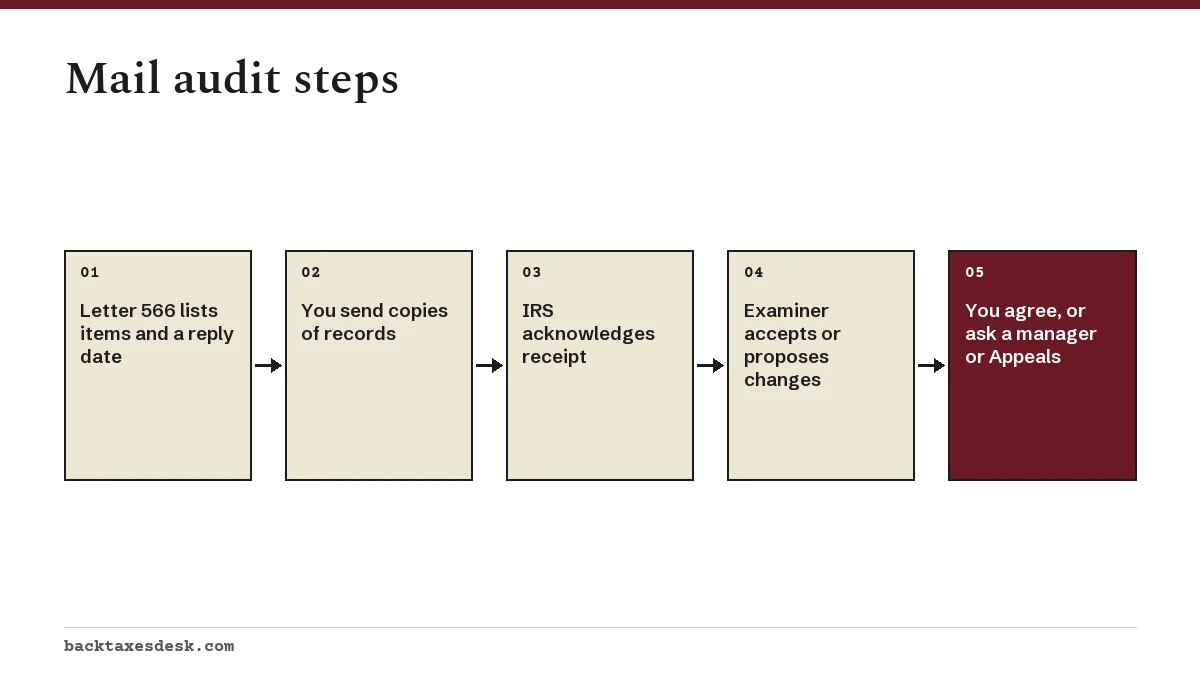
Match the letter number and contact details against IRS.gov or your IRS online account.
Match records to items
List each item under review and gather copies of the records that support it.
Ask for time if needed
Request the one-time 30-day extension before the reply date if records are not ready.
Send the response
Upload, fax or mail labeled copies with the letter on top, and keep proof of sending.
Review the result
Sign if you agree, or request a manager conference or Appeals before the date on the letter.
Common questions
Is a correspondence audit serious?
It is a formal examination, so a missed deadline can lead to extra tax. But it is usually limited to one or a few items, and many end with the return accepted or a small change once records are sent.
How do I send documents for an IRS mail audit?
Use the method listed on the letter: the IRS Documents Upload Tool if offered, the fax number on the letter, or the mailing address shown. Send copies, label each page, and keep proof of when you sent them.
Can I talk to the examiner handling my correspondence audit?
Yes. Call the number on the letter. Publication 3498-A says the examiner who answers should be able to help, and you can ask for a call back from the examiner assigned to your case.
Will the IRS contact my bank or employer during a mail audit?
It can if it needs information you could not provide or needs to verify something. The law limits what the IRS may disclose to those third parties, and you can ask for a list of anyone it contacted.
Can I have a tax professional handle a correspondence audit?
Yes. File Form 2848 so an attorney, CPA or enrolled agent can speak for you, receive copies of letters and send documents on your behalf.
Sources
- Publication 3498-A, The Examination Process (Audits by Mail) irs.gov
- IRS audits irs.gov
- Audit reconsideration process for correspondence examination irs.gov
- IRS Data Book, examination tables irs.gov
We check figures against these official pages. Rules change; confirm anything that affects a deadline or payment with the agency before you act.
Tell us what happened
Describe your situation and our editors will use it to improve this guide. If you leave your email, we may reply with a pointer to the right page or official contact. We never share your details.
Related guides
 IRS Audit Guide: Types, Letters, Timelines and Appeals
An IRS audit is a review of a filed tax return to check that income, deductions and credits were reported correctly, and the IRS…
IRS Letter 566: Start of a Mail Audit and How to Reply
IRS Letter 566 is the initial contact letter for a mail audit: it tells you a return has been selected for examination and lists…
IRS Letter 525: Proposed Audit Changes and Your 30 Days
Letter 525 IRS examiners send is the General 30-Day Letter: it closes a mail audit with proposed changes, usually on an enclosed…
IRS Office Audit: What to Expect at an In-Person Exam
An IRS office audit is an in-person interview at a local IRS office where an examiner reviews the specific items listed in your a…
How Long Does an IRS Audit Take? Typical Timeframes
How long an IRS audit takes depends on its type and how fast records arrive: the IRS says mail audits with complete documents or…