
IRS Letter 525: what the 30-day audit letter means
Short answer
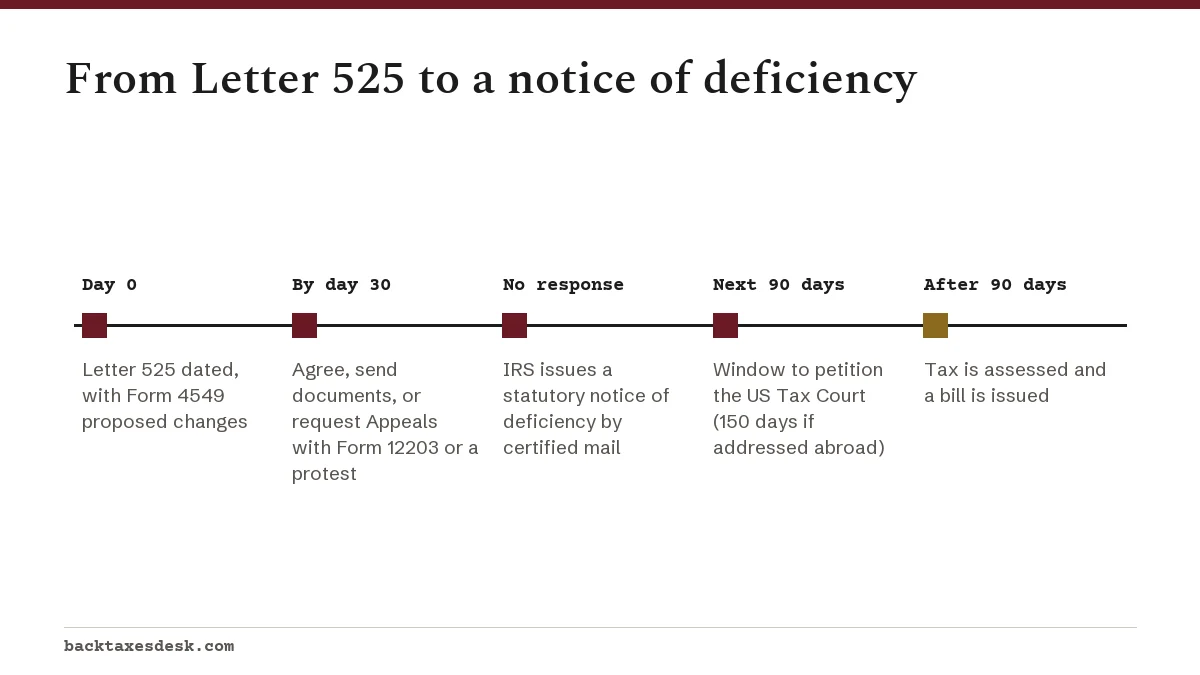
Letter 525 IRS examiners send is the General 30-Day Letter: it closes a mail audit with proposed changes, usually on an enclosed Form 4549, and gives you 30 days from the letter date to agree, send more evidence or request an Appeals conference. If you do nothing, the next step is a statutory notice of deficiency, your last chance to go to Tax Court before assessment.
- 01Official name
- Letter 525, General 30-Day Letter
- 02Response window
- 30 days from the date on the letter
- 03Main enclosure
- Form 4549, Report of Income Tax Examination Changes
- 04Small case request limit
- $25,000 or less per tax period (Form 12203)
- 05If you ignore it
- Statutory notice of deficiency, then assessment
- 06In-person audit equivalent
- Letter 915, Examination Report Transmittal
What is an IRS Letter 525?
An IRS Letter 525 is the General 30-Day Letter the IRS sends when an audit ends with proposed adjustments to your return. The IRS lists it among the letters that offer an appeal opportunity, and the letter itself says to file a protest within 30 days of its date if you want the Independent Office of Appeals to review the changes.
The letter usually follows a mail audit that began with Letter 566. After an in-person audit, the equivalent is Letter 915, Examination Report Transmittal. Letters marked with suffixes, such as an IRS Letter 525-T, serve the same purpose for particular exam programs; read the enclosures and deadline the same way.
Enclosed you will normally find Form 4549, Report of Income Tax Examination Changes, which shows each adjusted line, the added tax, any penalties and interest to date. Many letters also include an explanation of items (often Form 886-A) and a copy of Form 12203, Request for Appeals Review.
How long do I have to respond to Letter 525?
You have 30 days from the date printed on Letter 525, not from the day you opened it. Publication 3498 confirms the general 30-day window for accepting the changes or asking for an appeal.
If you need more time to gather documents, call the number on the letter before the 30 days run out. Get any extension confirmed in writing, because the next letter in the sequence carries a deadline set by law that no one at the IRS can move.
IRS Letter 525 response options: agree or disagree
Your IRS Letter 525 response comes down to three choices: agree in full, agree in part, or disagree. Each has a different set of papers to send.
| If you | What to send | What happens next |
|---|---|---|
| Agree with all changes | Signed Form 4549 and payment, or a request for a payment plan | Tax is assessed; you get a bill for any unpaid part |
| Agree with some changes | Documents and explanation for the disputed items; do not sign | Examiner reviews; a revised report may follow |
| Disagree and want an appeal | Form 12203 or a written protest by the deadline | Case goes to the Independent Office of Appeals |
| Do nothing | Nothing | Statutory notice of deficiency by certified mail |
If you agree
Sign the agreement form and return it with payment, or pay what you can and request a plan. Publication 3498 says that if the amount due is under $100,000 and you pay within 21 calendar days of the bill, no more interest or penalties accrue; at $100,000 or more the window is 10 business days. If paying in full is not possible, see how to set up an IRS payment plan.
If you disagree
Do not sign. Send any records the examiner has not seen with a short explanation of each disputed item. Publication 3498-A lets you ask for an informal conference with the examiner's manager before the letter's date, and separately to request Appeals before that same date.
Can I appeal a Letter 525?
Yes. Letter 525 is specifically an appeal-rights letter, and the request must reach the office named on the letter within the 30 days. Do not mail it to Appeals directly; the IRS says that only delays the case.
- Small case request: if the proposed change in tax and penalties is $25,000 or less for each tax period, use Form 12203 or a brief written statement listing the items you dispute and why.
- Formal written protest: required if any single period exceeds $25,000. It must list the disputed issues, the facts and law you rely on, and be signed under penalties of perjury, as described in Publication 5.
- Appeals also needs time on the statute: generally at least 365 days left on the assessment deadline when it receives the case, so you may be asked to sign an extension.
Worked example: the report proposes $3,100 of added tax plus a $620 penalty for 2024, a total of $3,720 for one period. That is under $25,000, so a Form 12203 small case request is enough. If the same audit added $26,000 for 2023, that year alone would need a formal protest. The IRS appeals process page covers what happens at the conference.
What happens if I don't respond to Letter 525?
If you ignore Letter 525, the IRS sends a statutory notice of deficiency by certified mail. You then have 90 days from that notice (150 if it is addressed to you outside the US) to file a Tax Court petition. If you miss that, the tax is assessed and collection notices follow.
Skipping the 30-day letter costs you the cheaper, less formal route through Appeals before a court case exists. You can still reach Appeals later through a Tax Court case, but the petition deadline cannot be extended even while you keep talking to the IRS.
Once the tax is assessed and unpaid, audit reconsideration remains available if you have documents the examiner never considered.
Common questions
Is Letter 525 a bill?
No. Letter 525 proposes changes; nothing is assessed yet. You get a bill only after you agree, or after the notice of deficiency period ends without a Tax Court petition.
What is a general 30 day letter?
It is the common name for Letter 525, which tells you the audit results and gives you 30 days to accept them or request an Appeals review.
What is the difference between Letter 525 and Letter 3219?
Letter 525 is the earlier, administrative step with a 30-day window and access to Appeals. Letter 3219 is the statutory notice of deficiency with a 90-day legal deadline to petition the Tax Court.
Can I send new documents after receiving Letter 525?
Yes, before the deadline. If you send substantial new evidence to Appeals instead, Publication 3498-A says the case is usually returned to the examiner to review it first.
Does signing Form 4549 give up my appeal rights?
Signing means you agree to the assessment of the amounts shown, so you would no longer dispute them through Appeals or Tax Court. If you paid and later find new evidence, a refund claim is the usual route.
Sources
- Letters and notices offering an appeal opportunity irs.gov
- Preparing a request for Appeals irs.gov
- Publication 3498-A, The Examination Process (Audits by Mail) irs.gov
- Publication 3498, The Examination Process irs.gov
- Petitioners: starting a case ustaxcourt.gov
We check figures against these official pages. Rules change; confirm anything that affects a deadline or payment with the agency before you act.
Tell us what happened
Describe your situation and our editors will use it to improve this guide. If you leave your email, we may reply with a pointer to the right page or official contact. We never share your details.
Related guides
 IRS Audit Guide: Types, Letters, Timelines and Appeals
An IRS audit is a review of a filed tax return to check that income, deductions and credits were reported correctly, and the IRS…
IRS Appeals Process: How to Dispute an IRS Decision
The IRS appeals process lets you ask the IRS Independent Office of Appeals, which is separate from the office that audited or bil…
IRS Notice of Deficiency (Letter 3219): The 90-Day Letter
A notice of deficiency is the IRS's formal legal notice that it intends to assess more tax. You have 90 days from the notice date…
IRS Audit Reconsideration: How to Reopen a Finished Audit
Audit reconsideration is the IRS process for reopening a finished audit, or a return the IRS prepared for you, when you have info…
IRS Letter 566: Start of a Mail Audit and How to Reply
IRS Letter 566 is the initial contact letter for a mail audit: it tells you a return has been selected for examination and lists…