
How to file a Tax Court petition
Short answer
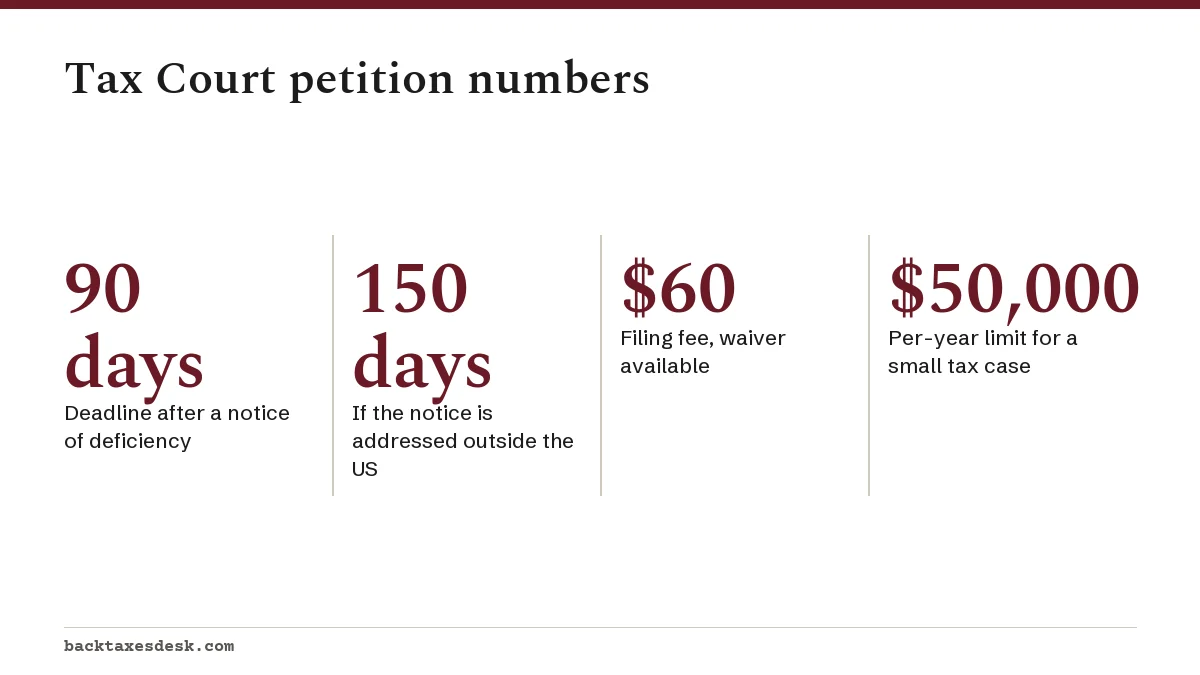
A Tax Court petition asks the US Tax Court to review an IRS determination before you pay. For a notice of deficiency it must be filed within 90 days of the notice date (150 if addressed outside the US), and no one can extend that. The filing fee is $60, waivable for hardship, and you can e-file through DAWSON or mail it.
- 01Deadline after a notice of deficiency
- 90 days (150 if addressed outside the US)
- 02Deadline after a CDP notice of determination
- 30 days
- 03Filing fee
- $60, waiver available if you cannot pay
- 04Small tax case limit
- $50,000 or less per year in dispute
- 05Forms
- Petition (Form 2), Form 4 (taxpayer ID), Form 5 (place of trial)
- 06E-filing cutoff
- 11:59 pm Eastern on the last day, in DAWSON

What is a Tax Court petition?
A Tax Court petition is the document that starts a case in the United States Tax Court, an independent federal court that reviews certain IRS decisions. A US Tax Court petition lets you dispute a proposed tax increase without paying it first, which is why the IRS describes the court as a prepayment forum in Publication 3498-A.
The court is not part of the IRS. It hears cases from people and businesses that received a qualifying IRS notice, and many petitioners represent themselves. You can still settle with the IRS after filing, and most cases end that way before any trial.
When can you go to Tax Court?
You can petition the Tax Court only after the IRS sends you a notice that gives you that right. The court lists three kinds of qualifying notices, plus one situation where no notice is needed.
| Notice or situation | Typical cause | Petition deadline |
|---|---|---|
| Notice of deficiency (for example CP3219A or Letter 3219) | Audit or income-matching changes you did not agree to | 90 days; 150 if addressed outside the US |
| Notice of determination, collection due process | Appeals decision after a lien or levy hearing | 30 days |
| Notice of certification | Seriously delinquent tax debt certified for passport action | Stated on the notice |
| Innocent spouse claim with no IRS decision | Six months passed since you filed Form 8857 | No notice needed |
Most people arrive from an audit: a notice of deficiency follows an ignored or disputed 30-day letter. If your case comes from a lien or levy hearing, see the collection due process hearing guide, and for spousal disputes see innocent spouse relief.
What is the Tax Court petition deadline?
The Tax Court petition deadline for a notice of deficiency is the 90th day after the IRS mailed the notice, or the 150th day if the notice is addressed to a person outside the United States. The Tax Court says that by law it cannot extend this time, and continuing to talk with an examiner or Appeals does not pause it.
The IRS normally prints the last day to file on the notice itself. Use that date. As an example, a notice mailed October 1, 2026 has a 90-day deadline of Wednesday, December 30, 2026.
Mailed petitions generally count as timely if they arrive in an envelope with a legible US Postal Service postmark dated within the deadline. Certified or registered mail gives you a receipt proving the mailing date. E-filed petitions must be received in DAWSON by 11:59 pm Eastern time on the last day.
Tax Court petition form and filing fee
The Tax Court petition form is Petition (Simplified Form), Form 2, which you complete with two companion forms. The court publishes all three on its petitioners page.
- Form 2, Petition: identifies the notice, the years and amounts in dispute, and each reason you disagree with the IRS.
- Form 4, Statement of Taxpayer Identification Number: the only document that should show your Social Security number.
- Form 5, Request for Place of Trial: you may choose any trial city the court lists, regardless of your home state.
- A complete copy of the IRS notice, including the explanation of adjustments, with your Social Security number blacked out.
- The $60 filing fee, or an Application for Waiver of Filing Fee with financial information signed under penalty of perjury.
Keep the reasons factual and specific. A line such as "The IRS disallowed $12,000 of business mileage; I have a contemporaneous log and fuel receipts" gives the IRS attorney and the judge something concrete to evaluate.
How to file a petition with the Tax Court: DAWSON or mail
You file through DAWSON, the court's electronic filing and case management system, or on paper by mail or hand delivery. E-filing is usually safer near a deadline because the timestamp is immediate.
- Create a DAWSON account on the Tax Court website.
- Start a new case and upload the petition, the IRS notice, Form 4 and Form 5 as prompted.
- Choose whether you want the small tax case procedure.
- Pay the $60 fee online, or by check or money order, or submit the fee waiver application.
- Save the confirmation and docket number; you will need them for every later filing.
To file on paper, mail the documents to the United States Tax Court, 400 Second Street, N.W., Washington, D.C. 20217-0002. Hand delivery is accepted weekdays from 8 a.m. to 4:30 p.m. Eastern time.
Tax Court small case option
A Tax Court small case, called an S case, is a simpler procedure for disputes of $50,000 or less for any one year, counting the deficiency plus additions to tax and penalties. Pretrial and trial steps are less formal, and the judge can consider any relevant evidence.
| Case type | S case limit |
|---|---|
| Deficiency | $50,000 or less for any one year, including penalties |
| Collection due process (lien or levy) | $50,000 or less total unpaid tax for all years combined |
| Innocent spouse | $50,000 or less of relief sought for all years |
| Interest abatement | $50,000 or less of abatement sought |
The catch is finality: if you lose an S case, in whole or in part, you cannot appeal the decision. You can switch a case to or from small case status any time before trial begins, but not after.
What happens after you file?
After the petition is filed, an IRS attorney files an Answer, and the case is normally sent to the IRS Independent Office of Appeals to try to settle before trial, according to Publication 3498-A. You must send a copy of everything you file with the court to the IRS attorney assigned to your case.
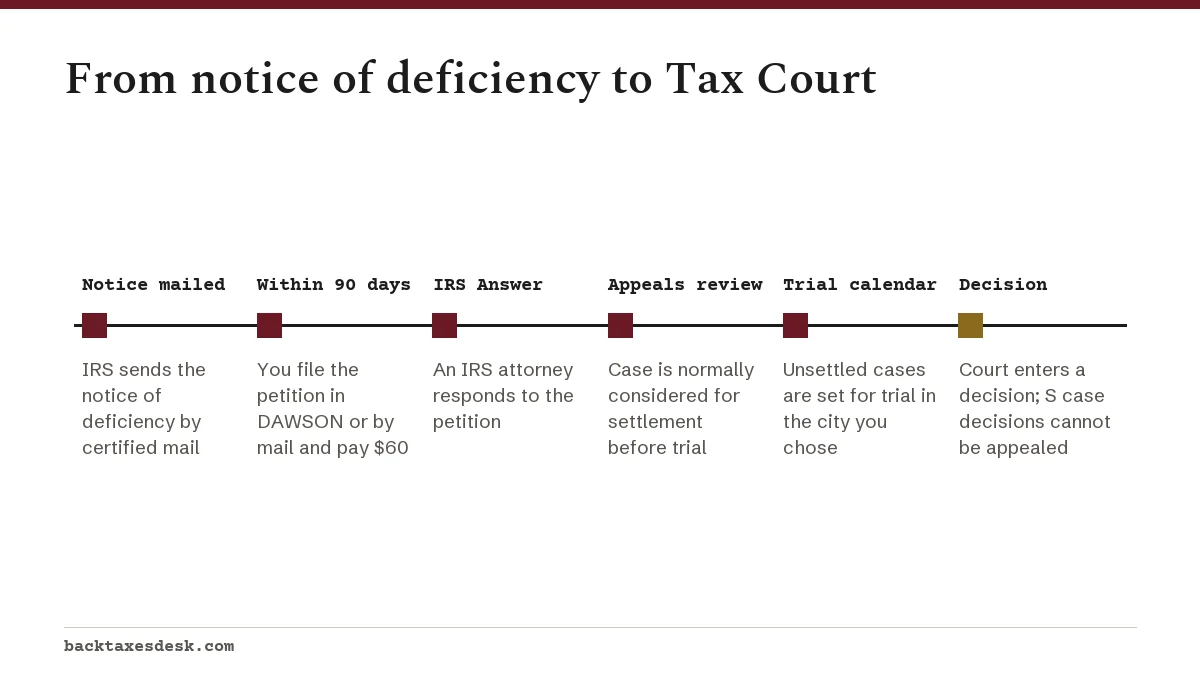
If Appeals and you reach agreement, the parties file a decision document and the case ends without trial. If not, the court sets the case on a trial calendar in the city you chose. While the case is pending, the IRS generally cannot assess or collect the disputed deficiency.
Interest keeps running on any tax you end up owing. A payment or deposit during the case stops interest on the amount paid. To understand why the return was picked in the first place, see IRS audit triggers, and for help with representation, a Low Income Taxpayer Clinic can take Tax Court cases for eligible taxpayers. The IRS audit guide maps every step from the first letter to court.
Step by step
Confirm you have a qualifying notice
Check that you received a notice of deficiency, notice of determination or notice of certification, and note the last date to petition.
Complete the forms
Fill in Petition Form 2, Form 4 with your taxpayer ID and Form 5 with your preferred trial city.
Attach the notice
Include a complete copy of the IRS notice with your Social Security number removed.
Choose regular or small case
Elect the small tax case procedure if the dispute is $50,000 or less per year and you accept that there is no appeal.
File and pay
E-file in DAWSON by 11:59 pm Eastern on the last day or mail with a timely USPS postmark, and pay the $60 fee or request a waiver.
Serve the IRS attorney
After the Answer is filed, send copies of all your filings to the IRS attorney and work with Appeals on settlement.
Common questions
How much does it cost to file a petition in Tax Court?
The filing fee is $60. The court can waive it if you show you cannot pay, using its Application for Waiver of Filing Fee.
Do I need a lawyer to file a Tax Court petition?
No. You can file and represent yourself; the court's simplified petition form is designed for that. Low Income Taxpayer Clinics and other practitioners admitted to the court can also represent you.
Can the IRS extend the 90-day Tax Court deadline?
No. The deadline is set by law and neither the IRS nor the Tax Court can extend it, even if you are still talking with an examiner or Appeals.
Do I have to pay the tax before going to Tax Court?
No. The Tax Court is a prepayment forum, so you can dispute a deficiency without paying it first. The district courts and the Court of Federal Claims generally require payment and a refund claim first.
What is a small tax case in Tax Court?
It is an optional, less formal procedure for disputes of $50,000 or less per year. Decisions in small tax cases cannot be appealed by either side.
Where do I mail a Tax Court petition?
Mail it to the United States Tax Court, 400 Second Street, N.W., Washington, D.C. 20217-0002, not to the IRS. Certified mail gives you proof of a timely postmark.
Sources
- US Tax Court, Petitioners: starting a case ustaxcourt.gov
- US Tax Court, Case procedure ustaxcourt.gov
- Publication 3498-A, The Examination Process (Audits by Mail) irs.gov
- Understanding your CP3219A notice irs.gov
We check figures against these official pages. Rules change; confirm anything that affects a deadline or payment with the agency before you act.
Tell us what happened
Describe your situation and our editors will use it to improve this guide. If you leave your email, we may reply with a pointer to the right page or official contact. We never share your details.
Related guides
 IRS Audit Guide: Types, Letters, Timelines and Appeals
An IRS audit is a review of a filed tax return to check that income, deductions and credits were reported correctly, and the IRS…
IRS Notice of Deficiency (Letter 3219): The 90-Day Letter
A notice of deficiency is the IRS's formal legal notice that it intends to assess more tax. You have 90 days from the notice date…
IRS Appeals Process: How to Dispute an IRS Decision
The IRS appeals process lets you ask the IRS Independent Office of Appeals, which is separate from the office that audited or bil…
IRS Audit Triggers: How Returns Get Selected for Review
The IRS names three audit triggers: random selection, computer screening that scores a return against statistical norms, and link…
IRS Audit Reconsideration: How to Reopen a Finished Audit
Audit reconsideration is the IRS process for reopening a finished audit, or a return the IRS prepared for you, when you have info…