
Low Income Taxpayer Clinic: eligibility, cost and how to find one
Short answer
A Low Income Taxpayer Clinic (LITC) is an independent, IRS-funded organization that represents low-income people in audits, appeals, collection disputes and Tax Court for free or a small fee. You generally qualify if your income is at or below 250% of the federal poverty guidelines, about $39,900 for a single person in 2026, and the amount in dispute is usually under $50,000.
- 01Income limit
- Generally 250% of federal poverty guidelines
- 02250% limit, one person, 2026 (48 states)
- $39,900
- 03Amount in dispute
- Usually under $50,000
- 04Cost
- Free or a small fee
- 05Official clinic list
- Publication 4134 (Rev. 1-2026)
What is a Low Income Taxpayer Clinic?
A Low Income Taxpayer Clinic is a nonprofit or academic program, often run by a law school or legal aid office, that receives an IRS grant to help low-income taxpayers with disputes against the IRS. The IRS states that LITCs, their employees and their volunteers are completely independent of the IRS, even though part of their funding comes from it.
LITCs do three things: represent taxpayers, educate them about their rights and responsibilities, and advocate for changes that affect low-income taxpayers. For someone with back taxes, the first of those is what matters: the clinic's representative handles your case with the IRS so you do not face it alone.
What can an LITC help with?
An LITC can represent you in audits, appeals, tax collection matters and other disputes with the IRS, and can represent you in federal court, including the U.S. Tax Court. Clinics also explain taxpayer rights in other languages for people who speak English as a second language.
- Responding to an audit letter or a CP2000 proposed adjustment you disagree with
- Requesting a Collection Due Process hearing after a final notice of intent to levy
- Preparing an Offer in Compromise or a Currently Not Collectible request, including the financial statement
- Filing a petition in Tax Court within the 90-day window after a notice of deficiency
- Requesting innocent spouse relief on Form 8857 when a current or former spouse caused the debt
- Sorting out a levy or lien on a low-wage earner's pay or bank account
Publication 4134 also lists Taxpayer Education Clinics. These are funded only to teach people who speak English as a second language about their tax rights, and may offer limited consultation rather than full representation.
Low income taxpayer clinic eligibility: income and dispute limits
To qualify, your income generally cannot exceed 250% of the federal poverty guidelines, and the amount in dispute with the IRS is usually under $50,000. Each clinic confirms eligibility itself, so contact the nearest one even if you are slightly over.
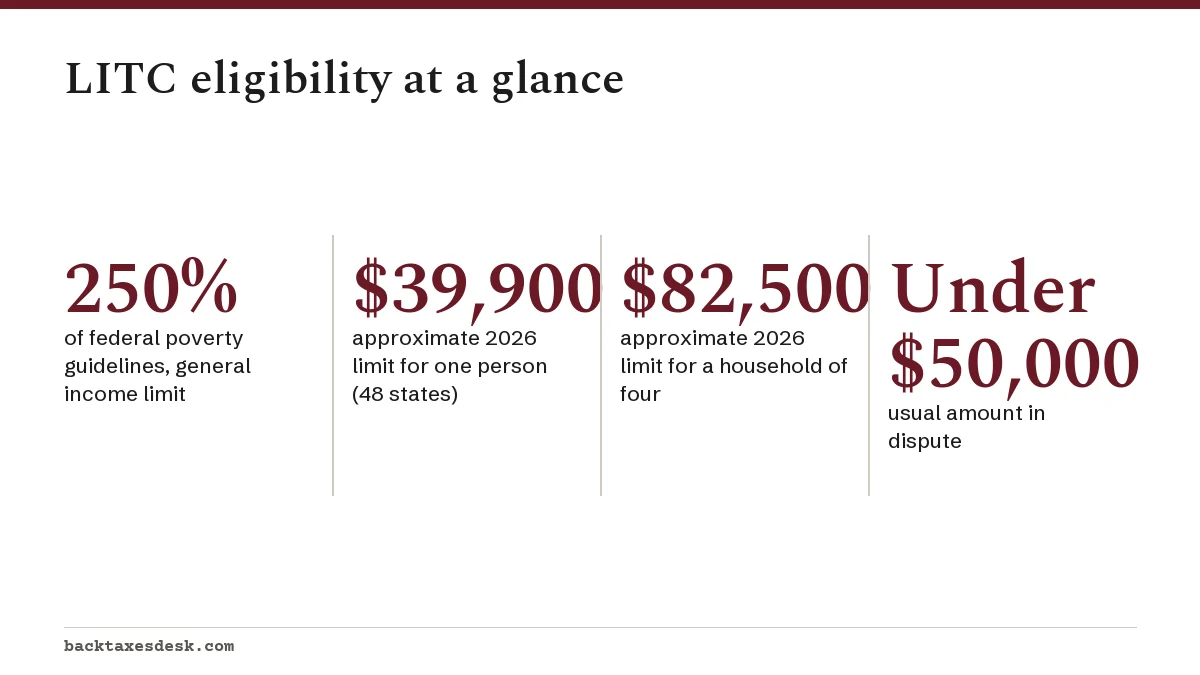
The Department of Health and Human Services publishes the poverty guidelines each January. The table below multiplies the 2026 guidelines for the 48 contiguous states and DC by 2.5. These are our calculations, not an IRS table, and clinics may count income differently.
| Household size | 2026 guideline | 250% ceiling (our calculation) |
|---|---|---|
| 1 | $15,960 | $39,900 |
| 2 | $21,640 | $54,100 |
| 3 | $27,320 | $68,300 |
| 4 | $33,000 | $82,500 |
| 5 | $38,680 | $96,700 |
| 6 | $44,360 | $110,900 |
Alaska and Hawaii have higher guidelines: $19,950 and $18,360 for one person in 2026, which works out to about $49,875 and $45,900 at 250%. For larger households in the 48 states, add $5,680 to the guideline per extra person, or $14,200 to the 250% ceiling.
Worked example
A married couple with two children in Ohio earns $71,000. Their 250% ceiling for a household of four is $82,500, so they likely qualify on income. If their dispute is a $6,800 audit adjustment, it is well under the usual $50,000 level, and a clinic would normally consider the case.
How much does a Low Income Taxpayer Clinic cost?
LITC services are free or cost a small fee, according to the IRS. The clinic will tell you at intake whether it charges anything. The fee does not include the tax you owe or any IRS user fee, such as the $205 Offer in Compromise application fee.
Low income can also reduce IRS costs directly. Applicants with adjusted gross income at or below 250% of the poverty guidelines have the direct-debit payment plan setup fee waived, and individuals who meet the low-income certification do not pay the Offer in Compromise application fee or the payments normally due while the offer is reviewed.
How do you find a low income taxpayer clinic near you?
Find a clinic in IRS Publication 4134, Low Income Taxpayer Clinic List, or with the "Find your local clinic" search tool on the LITC page of the Taxpayer Advocate Service website, which the publication says has the most current information.
- Open Publication 4134. The current edition is Rev. 1-2026.
- Find your state. Clinics are listed alphabetically by state abbreviation, then by city.
- Check the languages column. Many clinics serve Spanish speakers, and many offer all languages through interpreter services.
- Note that the listed city is the main office. Call the clinic to ask about other locations.
- If no local clinic fits, look for clinics marked as accepting cases nationwide; the 2026 list shows at least one in Washington, DC.
Each clinic takes a limited number of cases. Call early, especially if you face a 30-day or 90-day IRS deadline.
What should you bring to an LITC appointment?
Bring every IRS letter about the dispute, proof of household income, and the returns for the years involved. The clinic uses these to confirm eligibility and to see which deadline applies first.
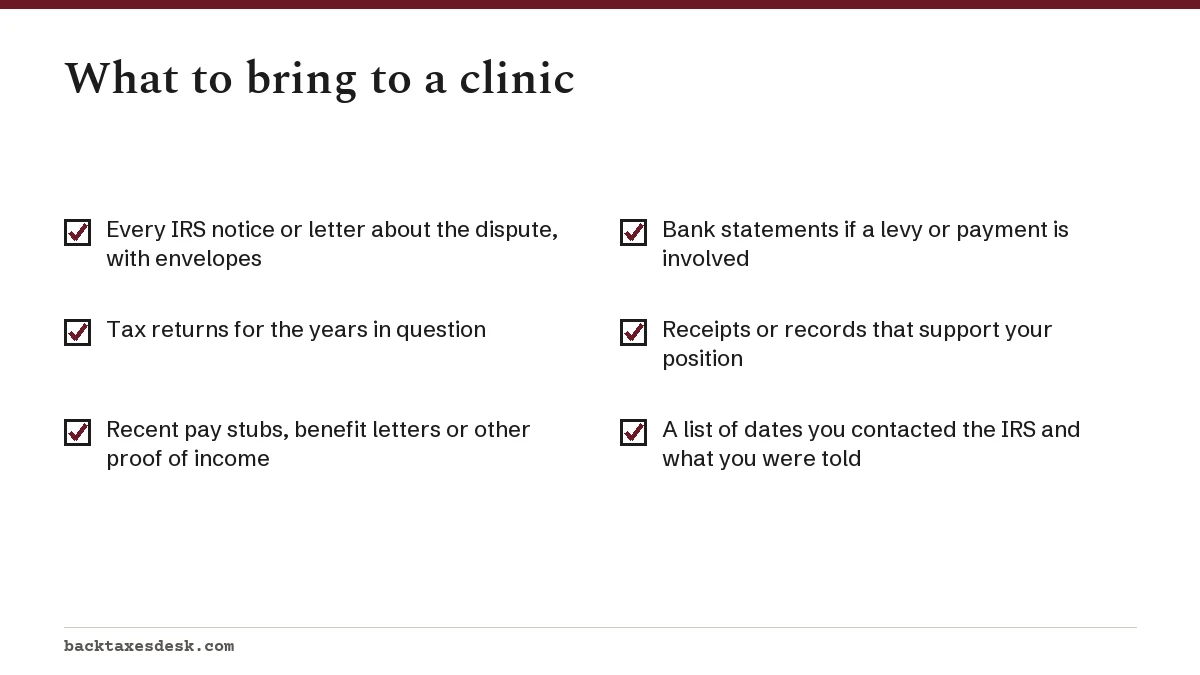
The clinic will usually ask you to sign Form 2848 so it can speak to the IRS for you. Read it before signing: it should list the tax form, the years in dispute and the representative's name.
LITC or Taxpayer Advocate Service?
Use an LITC when you need someone to argue your side of a dispute, and the Taxpayer Advocate Service when the IRS process itself is stuck or causing hardship. The two often work on the same case: TAS pushes a delayed IRS office, while the clinic represents you on the substance.
If your income is above the clinic limit, see help with IRS problems for paid options and how to check a professional's credential. Companies that promise results without asking about your income are covered in tax relief scams.
Common questions
Do Low Income Taxpayer Clinics charge a fee?
Some do not charge at all, and others charge a small fee. The IRS describes LITC services as free or low cost; ask the clinic about any fee when you first call.
Can an LITC represent me in Tax Court?
Yes. Publication 4134 states that LITCs can represent taxpayers in federal courts as well as before the IRS.
Is an LITC part of the IRS?
No. LITCs receive IRS grants but are independent organizations, and the IRS says their employees and volunteers are completely independent of the agency.
What if my income is just over 250% of the poverty level?
Call the clinic anyway. Income is a general guide, and each clinic decides who it can accept.
Can an LITC help if I owe more than $50,000?
The IRS says the amount in dispute is usually under $50,000, so larger cases may not be accepted. Ask the clinic; if it cannot help, it may be able to refer you.
Do LITCs help people who do not speak English?
Yes. Many clinics serve clients in languages other than English, and Publication 4134 lists the languages each clinic serves.
Sources
- Low Income Taxpayer Clinics irs.gov
- Publication 4134, Low Income Taxpayer Clinic List (Rev. 1-2026) irs.gov
- HHS poverty guidelines aspe.hhs.gov
- Payment plans; installment agreements irs.gov
- Offer in Compromise irs.gov
We check figures against these official pages. Rules change; confirm anything that affects a deadline or payment with the agency before you act.
Tell us what happened
Describe your situation and our editors will use it to improve this guide. If you leave your email, we may reply with a pointer to the right page or official contact. We never share your details.
Related guides
 Help With IRS Problems: Who Can Represent You and How
Help with IRS problems comes from three places: tools you can use yourself on IRS.gov, free help from the Taxpayer Advocate Servi…
Taxpayer Advocate Service: Free Help When the IRS Is Stuck
The Taxpayer Advocate Service (TAS) is a free, independent organization within the IRS that steps in when a federal tax problem i…
Innocent Spouse Relief: Form 8857 and Who Qualifies
Innocent spouse relief lets you avoid tax, interest and penalties caused by a spouse or former spouse's errors on a joint return.…
Offer in Compromise: How to Settle IRS Debt for Less
An offer in compromise is an agreement to settle IRS tax debt for less than the full balance. The IRS accepts one only when your…
Tax Relief Scams: How to Spot a Bad Tax Debt Company Early
Tax relief scams are companies that charge large upfront fees to settle IRS debt, often promising an Offer in Compromise to peopl…