
Tax relief scams: how bad tax debt companies work and how to avoid them
Short answer
Tax relief scams are companies that charge large upfront fees to settle IRS debt, often promising an Offer in Compromise to people who do not qualify. The IRS listed these "OIC mills" on its 2026 Dirty Dozen scam list. The IRS's own Pre-Qualifier tool, payment plans and free help from TAS and LITCs cover most of what these firms sell.
- 01IRS warning
- OIC mills, 2026 Dirty Dozen (IR-2026-30, March 5, 2026)
- 02IRS Offer in Compromise application fee
- $205, non-refundable
- 03Free eligibility check
- IRS Offer in Compromise Pre-Qualifier
- 04Report an abusive promoter
- Form 14242
- 05Online payment plan setup
- $29 with direct debit
How do tax relief scams work?
Tax relief scams work by selling fear and a promised shortcut: a company advertises that it can wipe out most of your IRS debt, collects a large fee before doing any work, and then either does little or files an application you were never likely to win. The IRS debt stays, and interest and penalties keep growing while you wait.
A tax relief company is any private firm that offers to resolve IRS debt for a fee. Some employ enrolled agents, CPAs or attorneys and do honest work. The problem firms share a pattern:
- An ad or robocall mentions a "new IRS program" or "Fresh Start" and says you may qualify to settle for less.
- A salesperson, not a tax professional, qualifies you on the phone in minutes, without seeing your IRS transcripts or finances.
- You are asked to pay thousands up front, sometimes framed as an "investigation fee" or "retainer".
- Weeks pass with little contact. Meanwhile IRS notices keep arriving.
- An Offer in Compromise is filed, rejected, or never filed. The fee is not refunded.
The Fresh Start name comes from real IRS policy changes, explained on our page about the IRS Fresh Start program. The IRS does not partner with private companies to deliver it.
What is an OIC mill?
An OIC mill is a company that aggressively markets the IRS Offer in Compromise program, overpromises results, and charges high fees to taxpayers who do not qualify. The IRS put OIC mills twelfth on its 2026 Dirty Dozen list of tax scams, announced in IR-2026-30 on March 5, 2026, and told taxpayers to use free IRS tools to check eligibility instead.
An Offer in Compromise lets some taxpayers settle for less than the full amount, but only when the IRS agrees the offer reflects what it could realistically collect. You file Form 656 with Form 433-A (OIC) and pay a $205 non-refundable application fee plus an initial payment, such as 20% of the offer amount for a lump-sum offer. People who meet the low-income certification skip the fee and payments. Our Offer in Compromise guide explains the full process.
An illustration of the cost of a failed offer
Suppose a company charges a $4,000 fee to someone who owes $18,000 and earns enough to pay $350 a month. The figures are hypothetical. That person could likely have set up an online payment plan for a $29 setup fee. If the company files an offer anyway, the $205 fee and any initial payment sent with it are kept by the IRS and applied to the tax, not refunded, even if the offer is rejected.
What are the red flags in tax relief ads and calls?
The biggest red flags are a promised result before anyone reviews your finances, a large fee before work begins, and a salesperson who cannot tell you who will represent you. Any one of these is reason to stop and check.
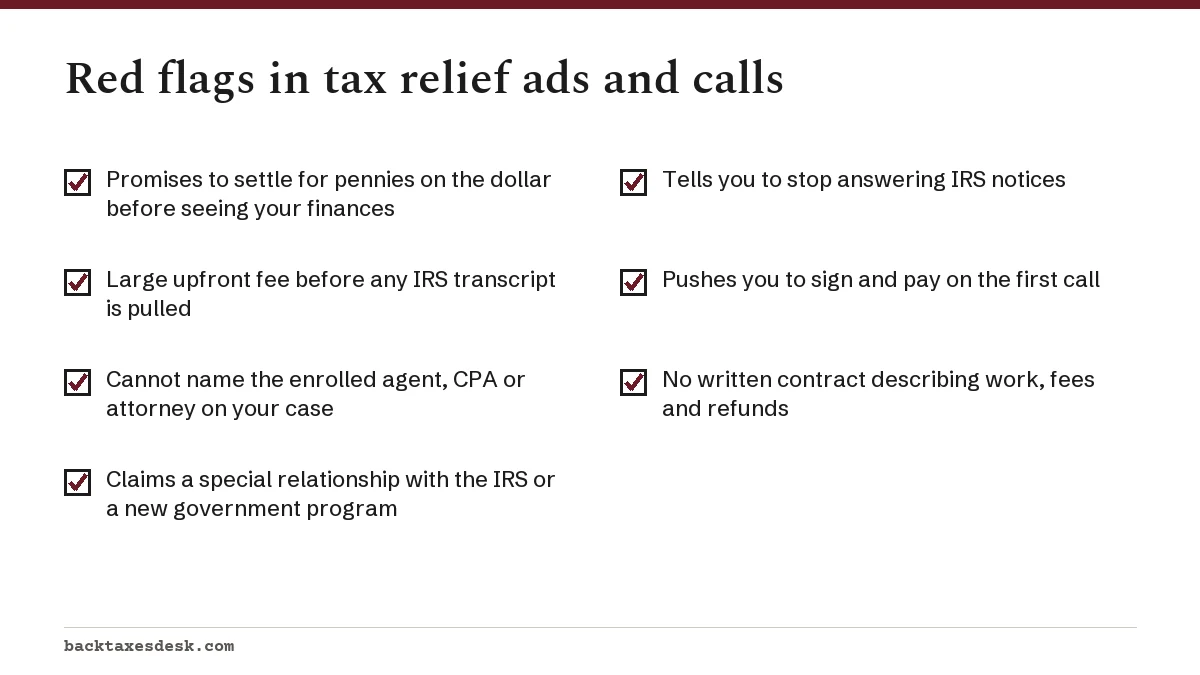
Tax relief scams calls and robocalls
Unsolicited tax relief calls often borrow official-sounding names, such as a "tax resolution department" or "federal debt relief center", to suggest a government link. A private company calling you is not the IRS. The IRS generally first contacts people by U.S. mail, and a contact that rushes you, threatens you or demands payment now is not from the IRS. See IRS letter scams for how to verify official notices.
Are tax relief agencies scams?
Not all of them. A legitimate firm assigns an enrolled agent, CPA or attorney you can look up, pulls your IRS transcripts before recommending anything, puts the fee and scope in writing, and tells you plainly when a payment plan is your best option. Our checklist on whether tax relief companies are legit lists the questions to ask.
What free official options should you try first?
Before paying any tax relief company, run the IRS Offer in Compromise Pre-Qualifier and check whether a payment plan covers your balance. Most of what these companies sell uses the same IRS forms you can file yourself. Our walkthrough of the Offer in Compromise Pre-Qualifier explains how to use the tool, and the page on Currently Not Collectible status covers the hardship route.
| What the company offers | Official option | IRS cost |
|---|---|---|
| "Settle for less" | IRS Pre-Qualifier, then Form 656 if eligible | Pre-Qualifier free; $205 application fee (waived for low income) |
| "Stop collections" | Payment plan online (balances of $50,000 or less) | $29 to $69 online setup |
| "Hardship program" | Currently Not Collectible status | No fee; Form 433-F may be requested |
| "Penalty removal" | Automatic Exemption from Penalty or First Time Abate | No fee |
| "We deal with the IRS for you" | Taxpayer Advocate Service or a Low Income Taxpayer Clinic | TAS free; LITC free or small fee |
If your case genuinely needs a professional, for example several unfiled years or a business payroll debt, hire a credentialed one directly. The overview of help with IRS problems explains who can represent you and how to check their license.
Where do you report a tax relief scam?
Report a tax relief company to the IRS on Form 14242, Report Suspected Abusive Tax Promotions or Preparers, and to the Federal Trade Commission at ReportFraud.ftc.gov. Your state attorney general's consumer protection office also takes complaints about debt relief businesses.
- Form 14242: for abusive tax promotions or preparer schemes, listed on the IRS page for reporting tax fraud, scams and law violations.
- IRS return preparer complaint process: for misconduct by a person who prepared your return.
- Treasury Inspector General for Tax Administration (TIGTA): if someone claimed to be from the IRS.
- [email protected]: for emails or texts that impersonate the IRS or Treasury.
- Federal Trade Commission and your state attorney general: for misleading advertising, fees and refund disputes.
The IRS asks for specific and credible information in reports. Include the company name, website, the ads or scripts used, what you paid and when, and copies of any contract or receipts.
Common questions
Can a tax relief company really settle my IRS debt for pennies on the dollar?
Only the IRS decides whether to accept an Offer in Compromise, and it depends on your income, expenses and assets. No company can promise a settlement before reviewing your finances.
Why does the IRS call them OIC mills?
The IRS uses the term for firms that push Offers in Compromise at volume, charging high fees to people who are unlikely to qualify. It listed them on the 2026 Dirty Dozen.
Is it legal for tax relief companies to charge upfront fees?
Rules on advance fees vary by service and state. Whatever the law allows, ask for a written engagement letter and avoid paying large sums before any IRS transcript has been reviewed.
How do I get my money back from a tax relief company?
Start with a written refund request to the company, then contact your card issuer and file complaints with the FTC and your state attorney general. Keep copies of every payment and contract.
Does the IRS work with tax relief companies?
No private company is an IRS partner for debt relief. The IRS does contract three private collection agencies, which collect for the IRS and never take payments themselves.
Can I apply for an Offer in Compromise without a company?
Yes. You can use the IRS Pre-Qualifier, then submit Form 656 with Form 433-A (OIC) yourself. Instructions are in Form 656-B, the Offer in Compromise Booklet.
Sources
- Dirty Dozen tax scams for 2026 (IR-2026-30) irs.gov
- Offer in Compromise irs.gov
- Report tax fraud, a scam or law violation irs.gov
- Understanding tax return preparer credentials and qualifications irs.gov
- How to know it's really the IRS calling or knocking on your door irs.gov
We check figures against these official pages. Rules change; confirm anything that affects a deadline or payment with the agency before you act.
Tell us what happened
Describe your situation and our editors will use it to improve this guide. If you leave your email, we may reply with a pointer to the right page or official contact. We never share your details.
Related guides
 Help With IRS Problems: Who Can Represent You and How
Help with IRS problems comes from three places: tools you can use yourself on IRS.gov, free help from the Taxpayer Advocate Servi…
Are Tax Relief Companies Legit? Questions to Ask First
Are tax relief companies legit? Some are licensed firms that do real work, but none has access to a special IRS program: they use…
Offer in Compromise Pre-Qualifier: Check Eligibility Free
The offer in compromise pre-qualifier is a free IRS web tool at IRS.gov/OICtool that asks about your filing status, assets, incom…
IRS Letter Scam: How to Tell If an IRS Letter Is Real
To spot an IRS letter scam, look for the notice number (CP or LTR) in the right corner, look that number up on IRS.gov, and check…
IRS Fresh Start Program 2027: Still Available? How to Apply
There is no separate IRS Fresh Start program to apply for in 2027 or 2026, and no program deadline. Fresh Start was the name the…
Offer in Compromise: How to Settle IRS Debt for Less
An offer in compromise is an agreement to settle IRS tax debt for less than the full balance. The IRS accepts one only when your…