
Are tax relief companies legit? How to vet one before you pay
Short answer
Are tax relief companies legit? Some are licensed firms that do real work, but none has access to a special IRS program: they use the same payment plans, Offers in Compromise and penalty relief you can request yourself. The IRS listed misleading "OIC mills" on its 2026 Dirty Dozen, and the FTC warns against firms that want the whole fee upfront or promise a specific settlement.
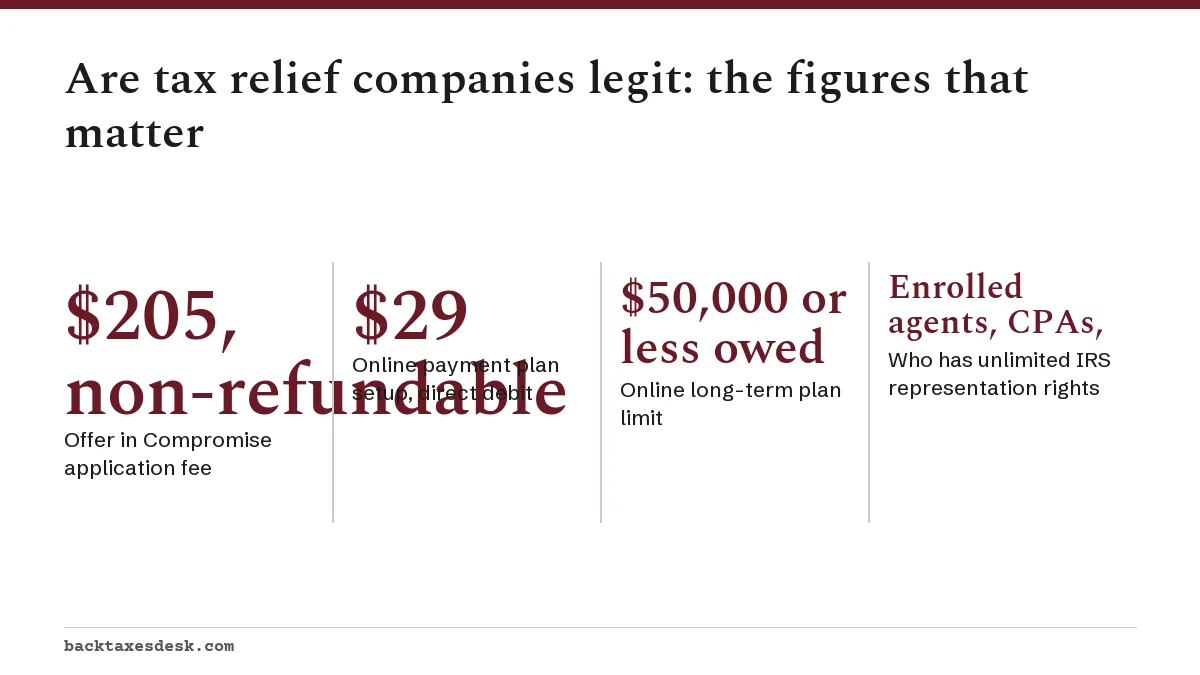
- 01Offer in Compromise application fee
- $205, non-refundable
- 02Online payment plan setup, direct debit
- $29
- 03Online long-term plan limit
- $50,000 or less owed
- 04Who has unlimited IRS representation rights
- Enrolled agents, CPAs, attorneys
- 05IRS warning on OIC mills
- 2026 Dirty Dozen, IR-2026-30
Are tax relief companies legit or a scam?
Tax relief companies are legit when a licensed enrolled agent, CPA or attorney does the work, the fee is disclosed in writing, and nothing is promised before your finances are reviewed. They cross into scam territory when they sell a result, such as settling for a fraction of the debt, that only the IRS can decide.
A tax resolution company is a private business that represents people who owe the IRS, usually by preparing missing returns, requesting payment plans, submitting Offers in Compromise and asking for penalty relief. There is no government license for the company itself; what matters is the credential of the person assigned to your file.
The IRS put aggressive Offer in Compromise marketing on its 2026 Dirty Dozen list (IR-2026-30, March 5, 2026), describing firms that overpromise and charge high fees to people who do not qualify. The Federal Trade Commission gives similar advice: walk away from any company that wants its whole fee upfront.
Do tax relief companies really work?
A good firm works in the sense that it can file the right forms correctly and keep your case moving, but it cannot make the IRS accept terms it would reject from you. Every option a company offers is an ordinary IRS procedure with published rules.
| Relief option | What the IRS charges you | Can you do it yourself? |
|---|---|---|
| Long-term payment plan (online, direct debit) | $29 setup fee | Yes, online if you owe $50,000 or less |
| Short-term plan (180 days or less) | No setup fee | Yes, if you owe under $100,000 |
| Offer in Compromise | $205 application fee plus initial payment (waived for low-income certification) | Yes, with Form 656 and Form 433-A (OIC) |
| Currently Not Collectible status | No fee | Yes, usually with Form 433-F and proof of expenses |
| Penalty relief (First Time Abate or reasonable cause) | No fee | Yes, by phone, letter or Form 843 |
Where a firm earns its fee is in the harder cases: several unfiled years, a business with payroll tax debt, a levy already in place, or an offer that needs a carefully documented financial statement. For a single-year balance that fits an online payment agreement, paying a company is rarely worth it.
What can a tax relief company do that I cannot?
The only thing a tax relief company can do that you cannot is talk to the IRS in your place. With a signed Form 2848, its credentialed representative can call, correspond, attend meetings and pull your transcripts without you on the line.
That has real value if you work long hours, find IRS calls stressful, or have a complicated case. It does not come with access to special programs, insider settlement rates or a faster queue. The phrase "Fresh Start program" in advertising refers to IRS policy changes to liens, payment plans and offers that apply to everyone.
What can tax relief companies not promise?
No legitimate company can promise that you qualify for an Offer in Compromise, that your debt will be cut by a set percentage, or that collection will stop on a given date. The IRS decides each case on your income, expenses, assets and future ability to pay.
- "Pennies on the dollar" before seeing your finances. The IRS accepts an offer only when the amount reflects what it could reasonably collect.
- "You qualify" on the first call. The FTC notes that only the IRS or your state can determine your options.
- "We'll stop all collection." Some requests pause certain actions, but a representative cannot guarantee it.
- "Stop talking to the IRS." Ignoring notices can cost you appeal deadlines, such as the 30-day window to request a Collection Due Process hearing.
How much do tax relief companies charge?
There is no official price list, and fees vary widely by firm and case. What you can control is the structure: a written engagement letter, a fee tied to defined stages of work, and a clear refund policy.
A worked comparison
Suppose you owe $30,000 from one tax year and can afford $600 a month. You can apply for a long-term plan online with a $29 direct-debit setup fee. Interest keeps running (7% for individuals in the October to December 2026 quarter), but the failure-to-pay penalty drops to 0.25% a month because you filed on time and have an approved plan. A company charging a large fee for this case would be billing you for an application you can complete yourself on IRS.gov.
Now suppose you have no disposable income after basic expenses. The IRS may place the account in Currently Not Collectible status at no charge, although interest and penalties continue and the IRS reviews your finances again later. A fee that eats into money you need for rent is a poor trade here too; a Low Income Taxpayer Clinic may take the case for free.
Questions to ask a tax relief company before paying
Ask these questions on the first call and expect written answers. A firm that avoids them is telling you what you need to know.
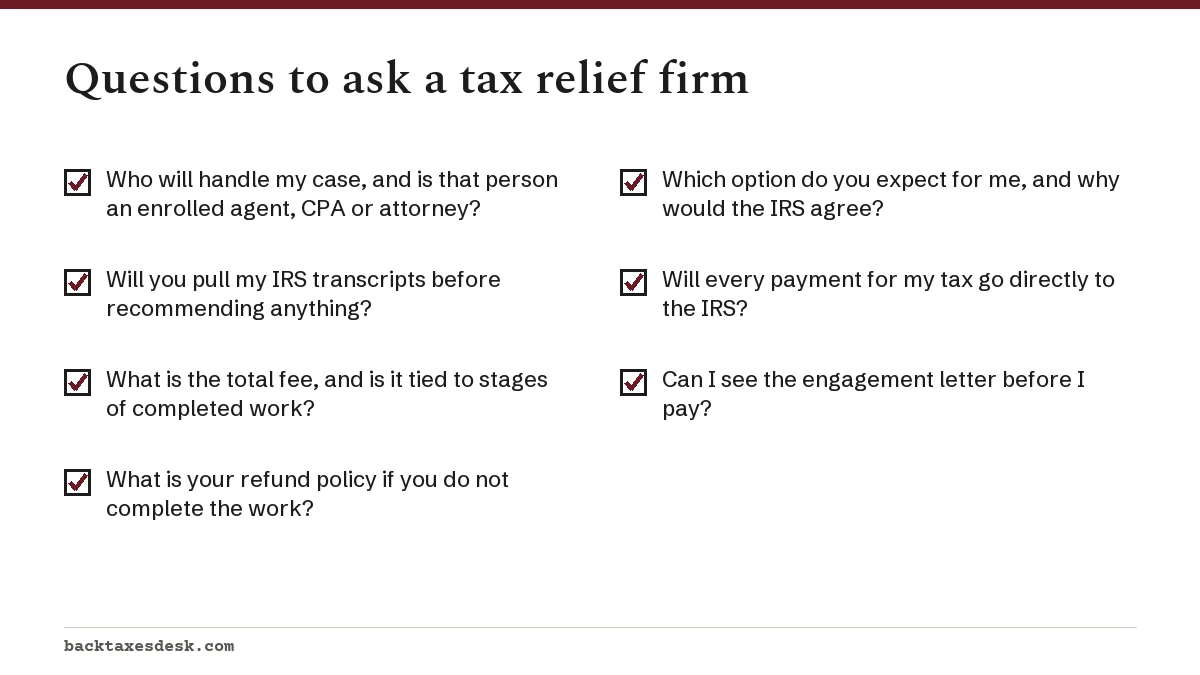
Pay attention to how the answers are framed. A careful firm talks about pulling your transcripts and reviewing your finances first; a sales operation talks about how much you will save.
How do I check a tax relief company's credentials and complaints?
Check the person, not the brand. Get the full name of the enrolled agent, CPA or attorney who will sign your Form 2848 and verify that credential before you pay.
- Search the IRS Directory of Federal Tax Return Preparers with Credentials and Select Qualifications for the named representative.
- For a CPA, confirm the license with the state board of accountancy; for an attorney, use the state bar's lawyer search.
- Search complaints with your state attorney general's consumer protection office and the FTC.
- Read the contract for the total fee, what is included, and when you can cancel and get money back.
- Confirm that any payment to the IRS will go directly to the IRS, never through the company's account.
If something goes wrong, report the company to the FTC at ReportFraud.ftc.gov. Our page on tax relief scams shows how the common pitches work, and enrolled agent vs CPA explains which credential suits which case. Letters that push you toward a company can also be fakes dressed as IRS mail; see IRS letter scam. Free routes are listed in help with IRS problems.
Common questions
Is tax relief legitimate?
Yes, IRS tax relief is real: payment plans, Offers in Compromise, Currently Not Collectible status and penalty relief are official programs. What is not legitimate is a company promising a result before the IRS has reviewed your finances.
Are tax relief programs legit if advertised on TV or radio?
The programs mentioned are usually real IRS options, but the ad is for a private company, not the IRS. Anyone can apply for those options directly, often for a small fee or none.
Can a tax relief company get my penalties removed?
It can request penalty relief, but so can you, at no cost, by phone, letter or Form 843. Since summer 2026 the IRS also applies an Automatic Exemption from Penalty to eligible returns without any request.
Should I pay a tax relief company upfront?
The FTC advises against paying a company its whole fee upfront. Prefer a written engagement letter with fees tied to completed stages of work.
What happens if a tax relief company does nothing?
Your IRS balance keeps growing with interest and penalties, and deadlines on your notices still apply to you. Contact the IRS directly, revoke the company's Form 2848, and report the company to the FTC and your state attorney general.
Can a tax relief company negotiate with the IRS for me?
Only through a person with representation rights. An enrolled agent, CPA or attorney at the firm must be named on your Form 2848; unlicensed sales staff cannot represent you.
Sources
- Dirty Dozen tax scams for 2026 (IR-2026-30) irs.gov
- FTC, Tax relief companies consumer.ftc.gov
- Offer in Compromise irs.gov
- Payment plans; installment agreements irs.gov
- Understanding tax return preparer credentials and qualifications irs.gov
- Temporarily delay the collection process irs.gov
We check figures against these official pages. Rules change; confirm anything that affects a deadline or payment with the agency before you act.
Tell us what happened
Describe your situation and our editors will use it to improve this guide. If you leave your email, we may reply with a pointer to the right page or official contact. We never share your details.
Related guides
 Help With IRS Problems: Who Can Represent You and How
Help with IRS problems comes from three places: tools you can use yourself on IRS.gov, free help from the Taxpayer Advocate Servi…
Tax Relief Scams: How to Spot a Bad Tax Debt Company Early
Tax relief scams are companies that charge large upfront fees to settle IRS debt, often promising an Offer in Compromise to peopl…
Enrolled Agent vs CPA: Who Should Handle Your IRS Problem
In the enrolled agent vs CPA choice, both credentials carry unlimited rights to represent you before the IRS in audits, collectio…
IRS Letter Scam: How to Tell If an IRS Letter Is Real
To spot an IRS letter scam, look for the notice number (CP or LTR) in the right corner, look that number up on IRS.gov, and check…
Offer in Compromise Pre-Qualifier: Check Eligibility Free
The offer in compromise pre-qualifier is a free IRS web tool at IRS.gov/OICtool that asks about your filing status, assets, incom…
Currently Not Collectible Status: IRS Hardship Explained
Currently not collectible (CNC) is an IRS account status that pauses most collection when paying anything toward your tax debt wo…