
Topic
Help with IRS problems: free help, paid representatives and what to avoid
Help with IRS problems comes from three places: tools you can use yourself on IRS.gov, free help from the Taxpayer Advocate Service and Low Income Taxpayer Clinics, and paid representation from an enrolled agent, CPA or attorney, the only professionals with unlimited rights to represent you before the IRS. Many back-tax problems can be settled without paying anyone.
10 guides in this topic Updated September 19, 2026
- AI Got Your Tax Return Wrong: Who Pays the PenaltyYou are responsible. Signing a return is a declaration that it is true and complete to the best of your knowledge, and nothing about using AI changes…
- Are Tax Relief Companies Legit? Questions to Ask FirstAre tax relief companies legit? Some are licensed firms that do real work, but none has access to a special IRS program: they use the same payment pl…
- Enrolled Agent vs CPA: Who Should Handle Your IRS ProblemIn the enrolled agent vs CPA choice, both credentials carry unlimited rights to represent you before the IRS in audits, collections and appeals, so e…
- IRS Letter Scam: How to Tell If an IRS Letter Is RealTo spot an IRS letter scam, look for the notice number (CP or LTR) in the right corner, look that number up on IRS.gov, and check whether the notice…
- IRS Phone Scam: Back Taxes Calls and How to Respond SafelyAn IRS phone scam is a call from someone posing as the IRS who demands immediate payment of back taxes, often by gift card, wire or crypto, and threa…
- IRS Scam Alert 2026: Dirty Dozen Scams Aimed at Tax DebtThe main IRS scam alert of 2026 is the Dirty Dozen list, released March 5, 2026 in news release IR-2026-30, which names 12 schemes the IRS is warning…
- Low Income Taxpayer Clinic: Free IRS Representation GuideA Low Income Taxpayer Clinic (LITC) is an independent, IRS-funded organization that represents low-income people in audits, appeals, collection dispu…
- Tax Attorney vs CPA: When You Need a Lawyer for IRS DebtIn the tax attorney vs CPA decision, both have unlimited rights to represent you before the IRS, so most back-tax, payment plan and audit cases do no…
- Tax Relief Scams: How to Spot a Bad Tax Debt Company EarlyTax relief scams are companies that charge large upfront fees to settle IRS debt, often promising an Offer in Compromise to people who do not qualify…
- Taxpayer Advocate Service: Free Help When the IRS Is StuckThe Taxpayer Advocate Service (TAS) is a free, independent organization within the IRS that steps in when a federal tax problem is causing financial…

Where can you get help with IRS problems?
You can get help with IRS problems from the IRS's own self-service tools, from two free programs (the Taxpayer Advocate Service and Low Income Taxpayer Clinics), or from a paid representative who holds one of three credentials. Which one fits depends on how much you owe, your income, and whether the IRS is already taking money.
Representation means someone you have authorized, usually on Form 2848, Power of Attorney and Declaration of Representative, talks to the IRS for you, signs agreements for you and attends meetings in your place. A person who only prepares returns or gives advice is not necessarily allowed to do that.
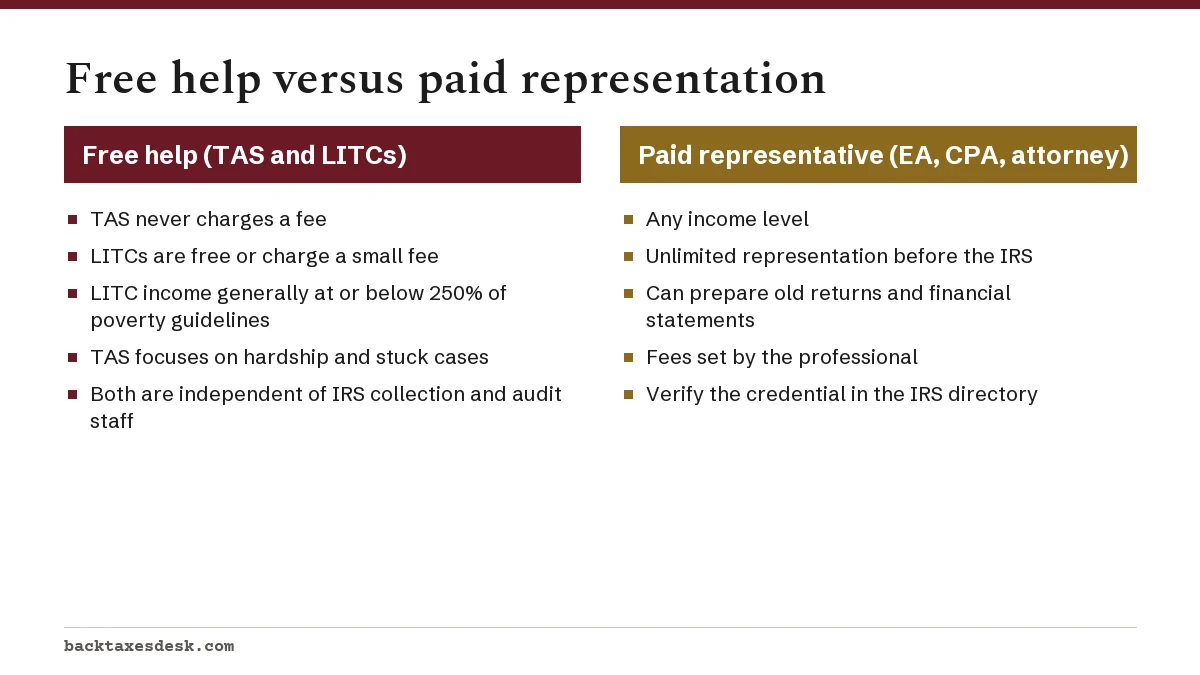
This section of Back Taxes Desk covers each route: how to pick between credentialed professionals, how the two free programs work, and how to recognize companies and letters that are designed to take your money rather than solve the tax problem.
Read the video transcript
Help with IRS problems: free help, paid representatives and what to avoid
Unlimited representation rights: Enrolled agents, CPAs and attorneys.
Taxpayer Advocate Service cost: Always free.
LITC income limit: Generally 250% of federal poverty guidelines.
Most people who owe back taxes can set up a payment plan, request penalty relief and check their balance on their own, at no cost beyond any IRS user fee.
Form 2848, Power of Attorney and Declaration of Representative, lets an eligible professional represent you and act on your behalf with the IRS.
Choose a tax help company by checking who will actually handle your case and what that person's credential is, then compare the proposed fee with what the IRS itself charges.
Match the help to the problem: simple balances need self-service, stuck cases need TAS, low-income disputes suit an LITC, and complex or high-stakes cases justify a paid representative.
What can you fix yourself before paying anyone?
Most people who owe back taxes can set up a payment plan, request penalty relief and check their balance on their own, at no cost beyond any IRS user fee. Try these steps before you hire a company, because a representative would do the same things through the same channels.
- See the real balance. Sign in to your IRS Online Account, which shows your balance and certain notices the IRS has sent you.
- Set up a payment plan online. Individuals who owe $50,000 or less in combined tax, penalties and interest can apply for a long-term plan online. The setup fee is $29 with direct debit or $69 with another payment method; the same plan costs $107 or $178 if set up by phone, mail or in person.
- Ask for penalty relief. The IRS's new Automatic Exemption from Penalty, announced July 8, 2026, removes failure-to-file and failure-to-pay penalties during processing for people with a clean compliance history, and First Time Abate can still be requested during the transition.
- Test an Offer in Compromise yourself. The IRS's free Offer in Compromise Pre-Qualifier tells you whether you are likely to qualify before you pay the $205 application fee.
- Protect your appeal rights. If you receive a Final Notice of Intent to Levy (LT11 or Letter 1058), you have 30 days to request a Collection Due Process hearing on Form 12153.
If a self-help step fails, for example your plan is rejected or a levy has frozen your bank account, that is the point where outside help becomes worth the time or money.
Is there free help with IRS debt?
Yes. Free tax debt help is available from the Taxpayer Advocate Service (TAS), which does not charge anyone, and from Low Income Taxpayer Clinics (LITCs), which work for free or for a small fee if your income is low enough. Both are independent of the IRS collection and audit staff you are dealing with.
The Taxpayer Advocate Service
TAS is an independent organization within the IRS. According to the Form 911 instructions (June 2026 revision), it may help when a federal tax problem is causing financial difficulty, when you have tried and failed to resolve the issue through normal IRS channels, or when an IRS system or procedure is not working as it should. You ask for help on Form 911. Our guide to the Taxpayer Advocate Service walks through the form line by line.
Low Income Taxpayer Clinics
LITCs are independent organizations, many run by law schools and legal aid groups, that receive IRS grants to represent low-income taxpayers in audits, appeals and collection disputes, including in federal court. Eligibility generally requires income at or below 250% of the federal poverty guidelines, and the amount in dispute is usually under $50,000.
| Household size | 2026 poverty guideline | 250% of guideline |
|---|---|---|
| 1 | $15,960 | $39,900 |
| 2 | $21,640 | $54,100 |
| 3 | $27,320 | $68,300 |
| 4 | $33,000 | $82,500 |
Each clinic applies its own screening, so treat these figures as a guide and confirm with the clinic. Alaska and Hawaii use higher guidelines. The Low Income Taxpayer Clinic page explains how to find a clinic in Publication 4134 and what to bring.
Who can help with back taxes as a paid representative?
Only enrolled agents, certified public accountants and attorneys have unlimited rights to represent any taxpayer before the IRS on audits, payment problems, collections and appeals. Anyone offering help with back taxes should hold one of those three credentials, or be working under someone who does.
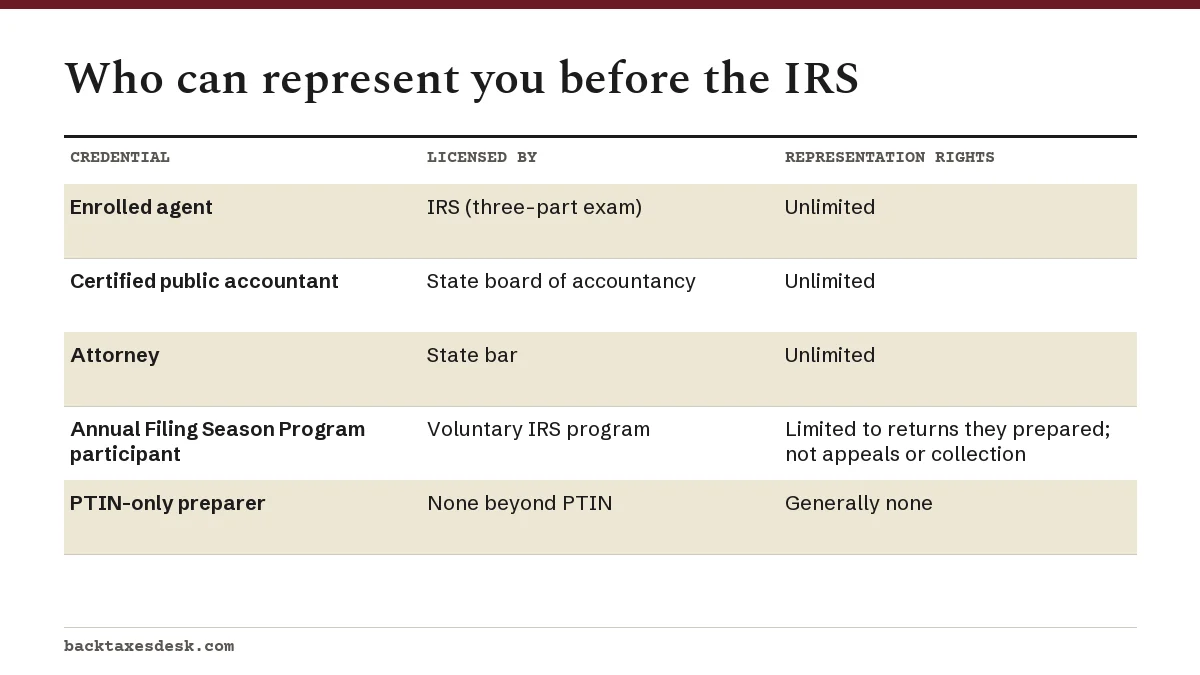
Enrolled agents are licensed by the IRS itself after passing a three-part exam and must complete 72 hours of continuing education every three years. CPAs are licensed by state boards of accountancy, and attorneys by state bars. Preparers in the Annual Filing Season Program can represent you only on returns they prepared, and only before revenue agents, customer service representatives and similar IRS employees, not in appeals or collection. A preparer with only a PTIN has no authority to represent you, apart from returns they prepared and filed by December 31, 2015.
Do I need a tax attorney?
Most people with back taxes do not need a tax attorney. An attorney makes the most sense when there is any chance of a criminal investigation, when a case is headed to Tax Court beyond the small tax case procedure, or when attorney-client privilege matters. For payment plans, offers and penalty requests, an enrolled agent or CPA has the same representation rights. We compare the two in tax attorney vs CPA.
Enrolled agent or CPA for an IRS problem?
An enrolled agent's license is focused entirely on federal tax, while a CPA's covers accounting and auditing more broadly. For a collection or audit case either works; what matters more is how many cases like yours the person has handled. See enrolled agent vs CPA for the questions to ask.
Form 2848 or Form 8821: how do you let someone act for you?
Form 2848, Power of Attorney and Declaration of Representative, lets an eligible professional represent you and act on your behalf with the IRS. Form 8821, Tax Information Authorization, only lets a person see or receive your tax information; it does not let them argue your case, sign agreements or represent you.
| Question | Form 2848 | Form 8821 |
|---|---|---|
| Can the person talk to the IRS for you? | Yes, as your representative | No, they can only receive information |
| Can they sign waivers or agreements? | Yes, within the limits you set | No |
| Who can be named? | Enrolled agents, CPAs, attorneys and certain others | Any person or organization |
| Typical use | Audit, appeal, collection case | A bookkeeper or relative who needs copies of notices |
Limit the form to the tax types and years in dispute. You can revoke either authorization later, and you should do so promptly if you end a relationship with a representative.
How do you choose a tax help company safely?
Choose a tax help company by checking who will actually handle your case and what that person's credential is, then compare the proposed fee with what the IRS itself charges. A firm that cannot name the enrolled agent, CPA or attorney assigned to you is a warning sign.
The IRS put misleading Offer in Compromise marketing, which it calls "OIC mills", on its 2026 Dirty Dozen list (IR-2026-30, March 5, 2026). These outfits overpromise and charge high fees to people who do not qualify. Our guide to tax relief scams shows how the pitch works, and are tax relief companies legit covers how to vet a specific firm.
- A guarantee to settle for "pennies on the dollar" before anyone has seen your finances
- A large upfront fee before any work is done or any IRS transcript is pulled
- Advice to stop talking to the IRS or to ignore notices
- No written engagement letter describing the work and the fee
- Pressure to decide on the first call
Scammers also pose as the IRS itself. A real IRS letter arrives by U.S. mail and carries a notice number such as CP14 or LTR 1058; see how to tell if an IRS letter is real and IRS phone scams for the checks.
Which kind of help fits your IRS problem?
Match the help to the problem: simple balances need self-service, stuck cases need TAS, low-income disputes suit an LITC, and complex or high-stakes cases justify a paid representative. The table below is a starting point, not a rule.
| Your situation | Try first | Why |
|---|---|---|
| You owe under $50,000 and can pay monthly | Online payment plan yourself | Lowest fee, instant approval in many cases |
| A levy has left you unable to pay rent or bills | Taxpayer Advocate Service | Financial difficulty is a core TAS criterion |
| Low income and an audit or dispute under $50,000 | Low Income Taxpayer Clinic | Free or low-cost representation, including Tax Court |
| You think you qualify for an Offer in Compromise | IRS Pre-Qualifier, then an EA or CPA | Confirms eligibility before paying the $205 fee |
| Several unfiled years or a business with payroll tax debt | Enrolled agent or CPA | Needs returns, financial statements and negotiation |
| Any sign of a criminal investigation | Tax attorney | Attorney-client privilege and criminal defense |
Whatever route you take, keep copies of every notice and write down the date and name of each IRS contact. That record is what TAS, a clinic or a paid representative will ask for first.
Pages in this section
The Getting Tax Help section covers who can help, what free options exist and how to avoid scams. Each page answers one question in detail:
- Enrolled agent vs CPA: how the two credentials differ for IRS problems
- Tax attorney vs CPA: when legal representation is worth the cost
- Taxpayer Advocate Service: who qualifies and how to file Form 911
- Low Income Taxpayer Clinic: income limits, costs and Publication 4134
- Tax relief scams: how OIC mills and upfront-fee firms operate
- Are tax relief companies legit: questions to ask before signing
- IRS letter scam: how to confirm a letter really came from the IRS
- IRS phone scam: what the IRS does and does not do by phone
- Tax scams Dirty Dozen: the IRS's annual list of the most common schemes
Common questions
Who can help me with back taxes for free?
The Taxpayer Advocate Service helps for free when an IRS problem causes financial difficulty or normal channels have failed. Low Income Taxpayer Clinics represent eligible low-income taxpayers for free or a small fee.
Can a tax preparer talk to the IRS for me?
Only if they hold representation rights. Enrolled agents, CPAs and attorneys can represent you on any matter; Annual Filing Season Program participants only on returns they prepared; PTIN-only preparers generally cannot represent you.
How much does it cost to hire someone to deal with the IRS?
There is no set price. Ask for a written engagement letter that describes the work and the fee, and compare it with what the IRS charges directly, for example a $29 online payment plan setup with direct debit.
Can I negotiate with the IRS myself?
Yes. You can set up payment plans, request penalty relief, submit an Offer in Compromise and request appeals yourself. Representatives use the same forms and procedures.
What is the difference between Form 2848 and Form 8821?
Form 2848 lets a qualified representative act for you before the IRS. Form 8821 only lets someone receive your tax information and cannot be used to represent you.
Is a tax help company the same as the IRS Fresh Start program?
No. Fresh Start is the name of IRS policy changes to liens, payment plans and offers. Private companies that use the name are not part of the IRS.