
IRS phone scam: how to tell a fake back taxes call from a real one
Short answer
An IRS phone scam is a call from someone posing as the IRS who demands immediate payment of back taxes, often by gift card, wire or crypto, and threatens arrest. The real IRS normally contacts you first by U.S. mail, does not threaten arrest and does not demand payment without letting you question or appeal the amount. Hang up and check your balance on IRS.gov.
- 01How the IRS makes first contact
- By U.S. mail
- 02Payment methods the IRS never asks for
- Gift cards, wire transfers, cryptocurrency
- 03Payee for in-person payments
- United States Treasury
- 04Where to report phishing emails and texts
- [email protected]
- 05Dirty Dozen listing
- AI-enabled IRS phone impersonation, IR-2026-30 (March 5, 2026)
Does the IRS call you about back taxes?
The IRS can call about back taxes, but only after it has written to you first. Its own guidance says first contact normally comes by letter through the U.S. Postal Service, so a call about a debt you have never received a notice for is the single biggest sign of an IRS phone scam.
An IRS phone scam is a call, voicemail or robocall from a criminal pretending to be an IRS employee, usually claiming you owe back taxes or skipped a return and must pay today. In its 2026 Dirty Dozen list (IR-2026-30, March 5, 2026) the IRS warned that these calls now use spoofed caller ID and computer-generated voices, which makes the number and the voice unreliable as proof.
Real phone contact does happen in three situations: a revenue officer handling your collection case may call to set up a meeting, an auditor may call to discuss a mail or office exam already announced in writing, and a private collection agency working for the IRS may call after you receive Notice CP40. In every case, a letter came first.
What do IRS scam calls say?
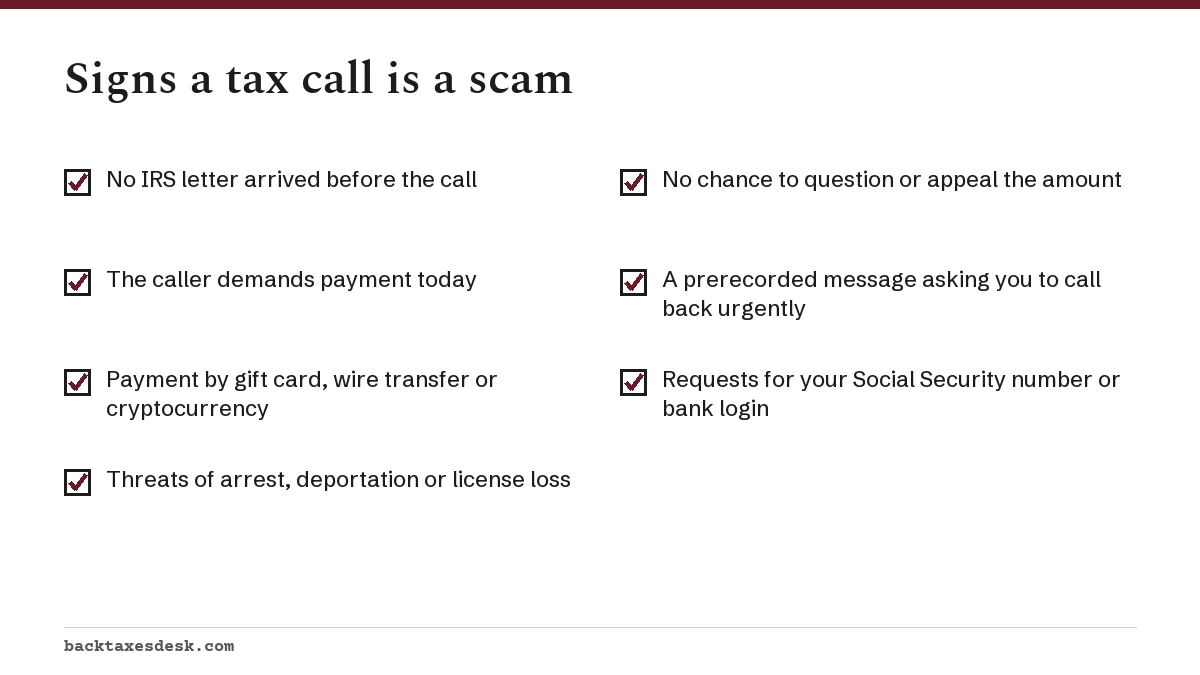
Back taxes scam calls follow a short script built on fear and a deadline. The caller tells you a debt or unfiled tax returns problem has reached a legal stage, then offers a way to make it go away if you pay in the next hour.
Scripts reported most often
- The warrant script: a "lawsuit" or "arrest warrant" has been issued for unpaid back taxes, and local police will come unless you pay now.
- The unfiled tax returns scam call: you failed to file for several years and face a fine that must be settled on the call.
- The license or immigration threat: your driver's license, business license or immigration status will be revoked.
- The prerecorded urgent message: a robotic voicemail asks you to call back a number about a "final notice" on your tax account.
- The refund twist: you are owed money, but must first confirm your Social Security number or bank details.
The IRS says it does not leave urgent, threatening prerecorded messages, does not call to demand immediate payment and does not threaten arrest. It also says impersonators refuse to let you question or appeal the amount, which the real agency always allows.
What should I do if I get an IRS scam call?
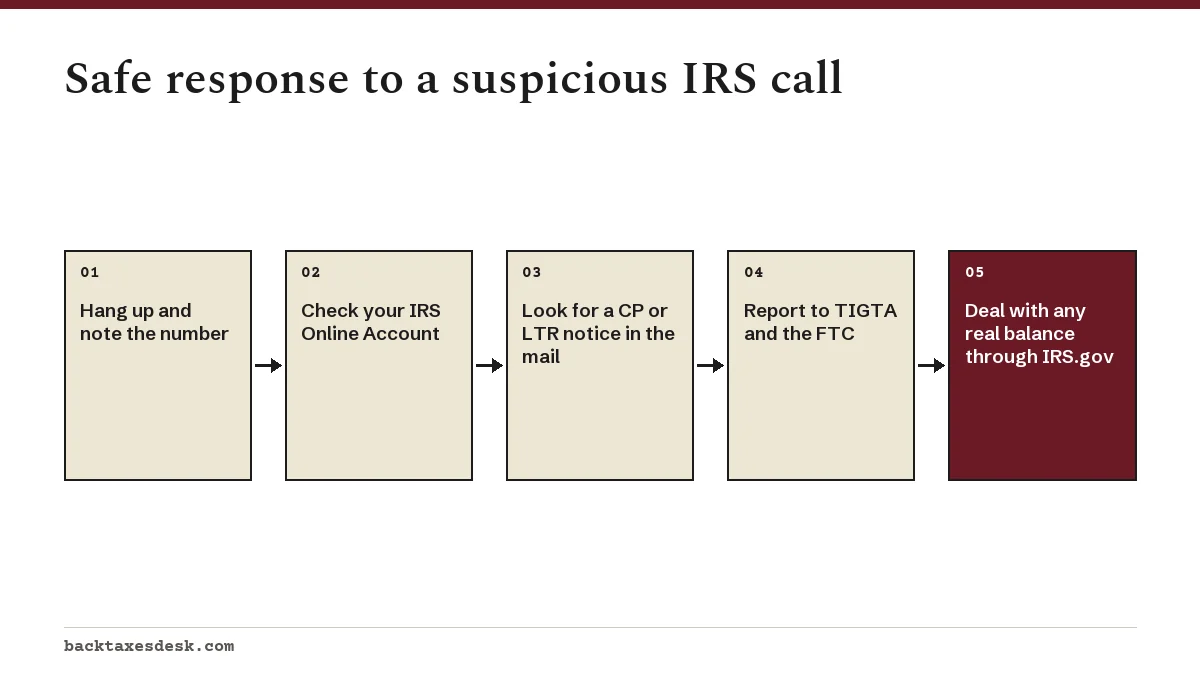
Hang up, write down the number and the time, and then check your real account through a channel you open yourself. Never call back a number the caller gives you, and never read out your Social Security number, bank login or card details.
- End the call. You do not need to argue or explain; the IRS's report-phishing page simply says to record the number and hang up.
- Note the caller ID, the name and "badge number" the caller used, the amount claimed and any payment instructions.
- Sign in to your IRS Online Account at IRS.gov to see whether you actually have a balance. Our guide on how to check if you owe back taxes explains what the account screen shows.
- Look through your mail for a real notice. A genuine IRS notice has a CP or LTR number in the top or bottom right corner.
- Report the call to the Treasury Inspector General for Tax Administration (TIGTA) and, if you lost money, to the Federal Trade Commission at ReportFraud.ftc.gov.
- If you already paid or shared personal data, see the section below on what to do next.
Can a real IRS collector call me?
Yes, a real IRS collector can call, but only in a case you already know about from the mail. A revenue officer usually sends Letter 725-B or phones to schedule a meeting after earlier notices, and three private agencies (CBE Group, Coast Professional and ConServe) may call about older accounts the IRS assigned to them.
| Question | Legitimate IRS or IRS contractor | Scam caller |
|---|---|---|
| Was there a letter first? | Yes: a notice, Letter 725-B or Notice CP40 | Usually no letter at all |
| Who do you pay? | The IRS or U.S. Treasury only | The caller, a gift card, wire or crypto |
| Can you dispute the amount? | Yes, with appeal rights explained in writing | No, you must pay now |
| Threats of arrest? | Never | Common |
| Identity check | Pocket commission and HSPD-12 card in person; taxpayer authentication number for private collectors | Made-up badge number |
Private collection agencies cannot take payment themselves. The IRS says every payment goes to the Treasury, either on IRS.gov or by check payable to the U.S. Treasury, and that you and the agency confirm each other by exchanging parts of the taxpayer authentication number printed on your CP40. Our page on IRS private debt collection covers that process in detail.
How to verify an IRS employee who calls or visits
Ask for the caller's name, office and a callback reference, then hang up and contact the IRS through the phone number on your notice or on IRS.gov. Revenue officers and revenue agents who visit carry two credentials, a pocket commission and an HSPD-12 card, each with a photo and serial number.
What if I already paid or gave information to an IRS scam caller?
Act the same day. Money sent by gift card, wire or crypto is hard to recover, so the goal is to stop further losses and protect your identity.
- Gift cards: contact the card issuer immediately with the card numbers and receipts and ask whether the funds can be frozen.
- Bank transfer or debit card: call your bank's fraud department using the number on your card and ask for a recall or dispute.
- Social Security number shared: review the identity theft steps at IRS.gov/idtheft and consider a credit freeze with the three credit bureaus.
- Remote access allowed: disconnect the device from the internet and have it checked before you log in to any financial account.
- Report the loss: include the payment details in your reports to TIGTA and the FTC.
None of this changes what you actually owe the IRS. If your real account does show a balance, the safe next step is an official plan; see how to set up an IRS payment plan.
Where do you report IRS scam calls?
Report IRS scam calls to TIGTA, the independent watchdog that investigates IRS impersonation, through the report page at tigta.gov. Report financial losses to the FTC as well.
| What you received | Where to report | Include |
|---|---|---|
| Phone call or voicemail | TIGTA; FTC if money was lost | Caller ID, date, time, what was demanded |
| [email protected], as an attachment if possible | The full email with header | |
| Text message | [email protected] with subject "Text"; forward to 7726 (SPAM) | Sender number, your number, date, time and time zone |
| Social media message | The platform, then [email protected] with subject "Social media" | The full profile URL |
Letters that look official need a separate check, covered in how to spot an IRS letter scam. The wider list of schemes the IRS is watching this year is in our summary of the Dirty Dozen tax scams, and other sources of real help are in help with IRS problems.
Common questions
Will the IRS call me if I owe back taxes?
Only after you have received letters about the debt. The IRS says it normally makes first contact by mail, and it never calls demanding immediate payment or threatening arrest.
Does the IRS leave voicemails about lawsuits?
No. The IRS says it does not leave urgent, threatening prerecorded messages. A voicemail about a lawsuit, warrant or final notice is a scam.
Can the IRS have me arrested over the phone?
No. The IRS does not threaten arrest by phone, and police do not come to collect a tax bill. Unpaid tax is handled through notices, liens, levies and appeal rights explained in writing.
Is a call from a private collection agency about my taxes real?
It can be, if you first received IRS Notice CP40 naming the agency. The caller should verify a taxpayer authentication number with you and must never ask you to pay the agency itself.
What happens if I answered an IRS scam call but gave nothing?
Nothing further is required beyond reporting it. Expect more calls, since answering can mark your number as active, and keep hanging up.
Sources
- How to know it's really the IRS calling or knocking on your door irs.gov
- Report phishing and online scams irs.gov
- Private debt collection irs.gov
- Dirty Dozen tax scams for 2026 (IR-2026-30) irs.gov
- Recognize tax scams and fraud irs.gov
- Understanding your IRS notice or letter irs.gov
We check figures against these official pages. Rules change; confirm anything that affects a deadline or payment with the agency before you act.
Tell us what happened
Describe your situation and our editors will use it to improve this guide. If you leave your email, we may reply with a pointer to the right page or official contact. We never share your details.
Related guides
 Help With IRS Problems: Who Can Represent You and How
Help with IRS problems comes from three places: tools you can use yourself on IRS.gov, free help from the Taxpayer Advocate Servi…
Owe IRS Money? What Happens Next and What to Do First
When you owe IRS money, a 0.5% monthly late payment penalty and daily compounding interest (7% a year through December 2026) begi…