
IRS private debt collection: how to tell if a collector is real
Short answer
Under the private debt collection IRS program, three contracted agencies, CBE Group, Coast Professional and ConServe, collect some overdue federal tax accounts. A real assignment always starts with IRS Notice CP40 and a matching agency letter that share a 10-digit taxpayer authentication number. The agency cannot take payment itself; every payment goes to the IRS or the U.S. Treasury.
- 01Agencies under contract
- CBE Group, Coast Professional, ConServe
- 02First notice from the IRS
- CP40
- 03Identity check
- 10-digit taxpayer authentication number on both letters
- 04Where payments go
- Only to the IRS or United States Treasury
- 05Longest agency payment plan
- Up to 7 years
Does the IRS use private debt collectors?
Yes. The Fixing America's Surface Transportation (FAST) Act, signed on December 4, 2015, requires the IRS to use private collection agencies for certain overdue federal tax accounts. As of September 2026 the IRS lists three agencies under contract: CBE Group, Coast Professional and ConServe.
An IRS private collection agency works on the IRS's behalf. It calls and writes to help you choose a way to pay. It is not the IRS, and it has far fewer powers than an IRS employee.
| Private collection agency can | Private collection agency cannot |
|---|---|
| Call and write to you about the balance | Accept payments made out to itself |
| Explain payment options | File a Notice of Federal Tax Lien |
| Set up a payment plan of up to 7 years | Issue a levy on wages, bank accounts or property |
| Research a payment you say was not credited | Threaten arrest, deportation or license loss |
| Verify your identity with your authentication number | Demand payment by gift card, prepaid card or wire |
Publication 4518 says the agencies must follow the Fair Debt Collection Practices Act, with some exceptions in the tax code, and that its rules bar them from threatening or intimidating you. The IRS keeps its own power to use liens and levies, covered in what an IRS levy is and how an IRS tax lien works.
What is Notice CP40?
Notice CP40 is the IRS letter that tells you your unpaid balance has been assigned to a private collection agency. It names the agency, gives its contact details, and includes a unique 10-digit taxpayer authentication number. Save it, because the agency will use that number to confirm your identity.
After CP40 arrives, the agency sends its own first letter. That letter repeats the same taxpayer authentication number. When the agency calls, its employee uses the number in a two-party check so both of you know the other is genuine.
How do you know an IRS collection agency is real?
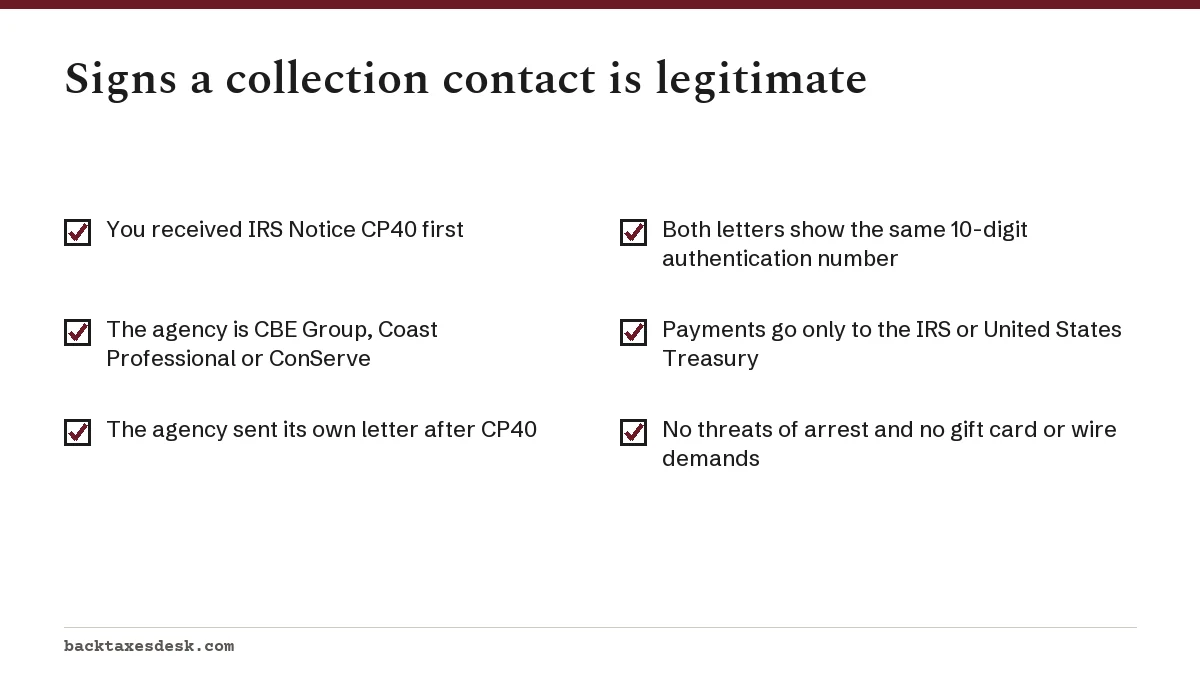
An IRS collection agency is real only if you got CP40 from the IRS first, the caller works for one of the three contracted agencies, and the taxpayer authentication number they cite matches your letters. If any of those three is missing, treat the contact as a possible scam.
- Find your CP40. If you never received one, sign in to your IRS Online Account to see which notices the IRS has sent and whether you owe.
- Compare the agency name on CP40 with the IRS private debt collection page on IRS.gov.
- Check that the agency letter shows the same 10-digit authentication number as CP40.
- If a caller pressures you, hang up and call the agency back using the number printed on CP40, not a number the caller gives you.
- Never pay by gift card, cryptocurrency, prepaid debit card or wire to a person.
Scammers copy the names of real agencies. Our IRS phone scam page lists the scripts fraudsters use and where to report them.
Is ConServe legit for IRS debts?
Yes, ConServe is one of the three agencies the IRS names on its private debt collection page, along with CBE Group and Coast Professional. A call that uses the ConServe name is still legitimate only if it matches a CP40 you received and the authentication number lines up.
Can you pay the collection agency directly?
No. Private collection agencies cannot ask you to pay them, and all payments go to the IRS. The agency can explain how to pay, but the money itself must go through IRS channels.
- IRS Direct Pay, free from a checking or savings account, at IRS.gov/payments. See our IRS Direct Pay guide.
- EFTPS, the Electronic Federal Tax Payment System, free online or by phone.
- Debit or credit card through an IRS-approved payment processor, which charges a fee.
- Check or money order payable to United States Treasury, with your name, Social Security number and tax year written on it, mailed to the IRS address the agency gives you.
Which accounts are not sent to private collection?
The tax code excludes several groups from the private debt collection IRS program. Under IRC 6306(d), accounts are not assigned if the taxpayer is deceased, under 18, serving in a designated combat zone, a victim of tax-related identity theft, or has income made up substantially of Social Security Disability Insurance or Supplemental Security Income. Taxpayers whose adjusted gross income is at or below 200% of the poverty level are also excluded.
Accounts are also excluded if they are under examination, litigation, criminal investigation or levy, have a pending or active Offer in Compromise or installment agreement, are classified as innocent spouse cases, or are in a pending appeal. If one of these applies and you still got CP40, tell the agency and the IRS.
How to stop working with a private collection agency or report a problem
If you do not want to work with the assigned agency, you must say so in writing to the agency, according to Publication 4518. Your account is not forgiven; it simply goes back into IRS inventory, where the IRS can still use liens and levies.
To report misconduct or a suspected impersonator, contact the Treasury Inspector General for Tax Administration (TIGTA) through its misconduct reporting page at tigta.gov. The Taxpayer Advocate Service can help when the account itself is stuck or causing hardship.
Before agreeing to a plan with an agency, check how long the IRS can legally collect. The IRS CSED date guide shows how to estimate it, and the IRS collection process hub explains every other stage of collection.
Common questions
Why was my IRS debt sent to a collection agency?
The FAST Act requires the IRS to assign certain overdue accounts to private agencies. Assignment does not mean new penalties or a new debt.
Can a private collection agency garnish my wages for IRS debt?
No. Publication 4518 says private collection agencies cannot take enforcement action such as filing a lien or issuing a levy. Only the IRS can do that.
Does interest stop while a private agency has my account?
No. Interest and any failure-to-pay penalty keep accruing on the unpaid balance until it is paid, just as they would if the IRS were handling the account.
What if I already paid the balance the agency is asking about?
Tell the agency and give the payment details it requests. Publication 4518 says the information is used to research where the payment went so it can be credited correctly.
Is CBE Group or Coast Professional a scam?
No. Both are named on the IRS private debt collection page as contracted agencies. A specific call is genuine only if it matches a CP40 you received and uses the same authentication number.
Can I set up a payment plan with the collection agency?
Yes. The agencies can offer an installment agreement that pays the balance in full within up to 7 years, with payments still made to the IRS.
Sources
- Private debt collection irs.gov
- Understanding your CP40 notice irs.gov
- Publication 4518, What You Can Expect When the IRS Assigns Your Account to a Private Collection Agency irs.gov
- 26 U.S. Code 6306, Qualified tax collection contracts uscode.house.gov
- Recognize tax scams and fraud irs.gov
We check figures against these official pages. Rules change; confirm anything that affects a deadline or payment with the agency before you act.
Tell us what happened
Describe your situation and our editors will use it to improve this guide. If you leave your email, we may reply with a pointer to the right page or official contact. We never share your details.
Related guides
 IRS Collection Process: Liens, Levies and Your Rights
The IRS collection process starts with a bill (usually Notice CP14) and escalates through reminder notices to a Final Notice of I…
IRS Phone Scam: Back Taxes Calls and How to Respond Safely
An IRS phone scam is a call from someone posing as the IRS who demands immediate payment of back taxes, often by gift card, wire…
IRS Levy: What the IRS Can Take and How to Stop It
An IRS levy is the legal seizure of your property or rights to property, such as wages, bank balances, Social Security payments o…
IRS Liens Explained: What a Federal Tax Lien Means for You
IRS liens are the government's legal claim against everything you own, created automatically when a tax is assessed, the IRS send…
IRS CSED Date: How to Find It on Your Account Transcript
Your IRS CSED date is generally 10 years after the date a tax was assessed, pushed later by any period when collection was legall…