
IRS lien release: when it happens and how to request one
Short answer
An IRS lien release is required by law within 30 days after the tax debt is fully paid, becomes legally unenforceable, or is covered by an accepted bond (Publication 1450). The IRS files a Certificate of Release of Federal Tax Lien in the office that recorded the lien and mails you a copy. If nothing arrives in 30 days, request it in writing.
- 01Legal deadline to release
- 30 days after payment, unenforceability or bond
- 02Document issued
- Certificate of Release of Federal Tax Lien
- 03Instructions
- Publication 1450
- 04Immediate release
- Pay the balance with guaranteed funds at a local IRS office
- 05After the collection period ends
- Release is automatic
When does the IRS release a tax lien?
The IRS must release a federal tax lien within 30 days after one of these events: the liability is paid in full, it becomes legally unenforceable, or the IRS accepts a bond for its payment. Publication 594 adds a fourth trigger: you have met the payment terms of an accepted Offer in Compromise.
An IRS lien release clears both the lien itself and the public Notice of Federal Tax Lien. The IRS does this by filing a Certificate of Release of Federal Tax Lien in the same county or state office where the notice was recorded, so the release appears in the same public record the lien did.
Release is different from withdrawal. A release says the debt is resolved; a withdrawal removes the notice from the record as a matter of IRS discretion. If you want the notice itself taken off the public record after paying, you can ask for a withdrawal on top of the release; see IRS lien withdrawal.
How to get an IRS lien payoff amount
The amount printed on the lien notice is not your payoff. It shows only the assessed balance on the day the notice was prepared, without later interest, penalties or the IRS's own charges for filing and releasing the lien (Publication 594).
Worked example: a Notice of Federal Tax Lien lists $12,000 assessed. At the 7% underpayment rate the IRS set for July through December 2026, compounded daily, one year of interest alone adds roughly $870, before any failure-to-pay penalty. Paying the $12,000 figure from the notice would leave a balance, and the lien would stay.
Publication 1450 lists three ways to get a current IRS lien payoff:
- Contact the IRS office assigned to your account, if a revenue officer is working your case.
- Check your balance in your IRS online account on IRS.gov (the View Your Account page).
- Request a payoff figure from the IRS Centralized Lien Operation, whose phone and fax numbers are listed in Publication 1450.
What happens after you pay: the release timeline
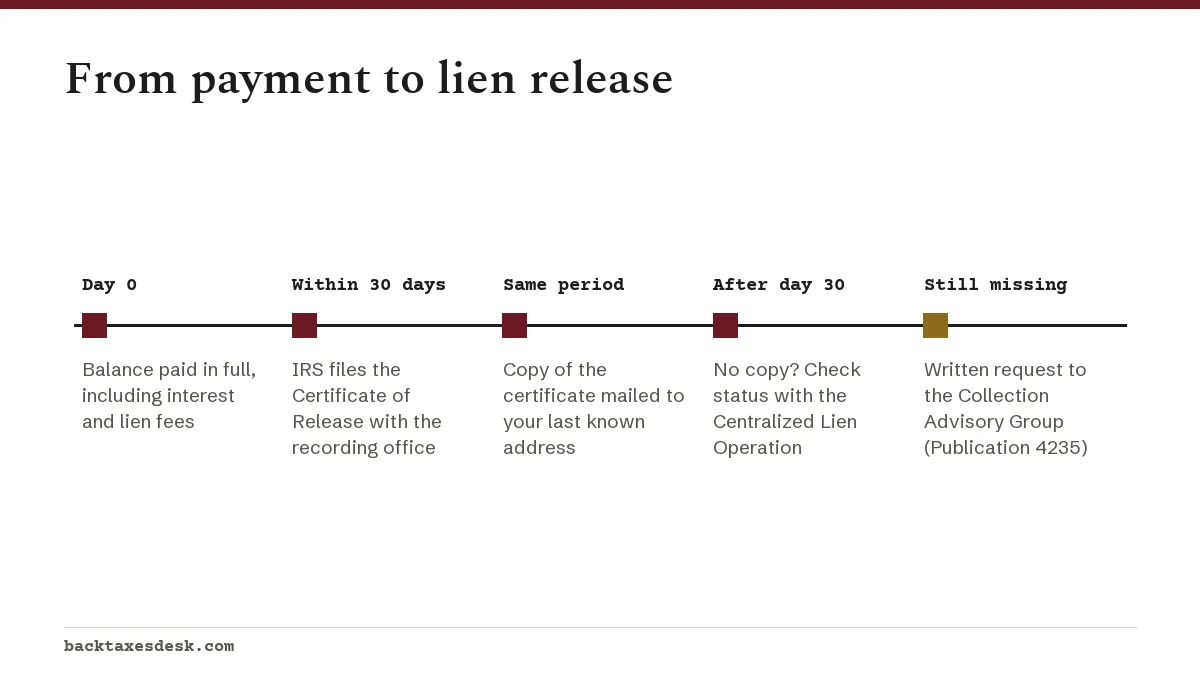
After full payment, the IRS processes the release on its own; you do not have to file anything. The certificate goes to the recording office, and a copy goes to your last known address.
The copy mailed to you does not show the official recording information such as book and page numbers. If a lender or title company needs the recorded version, get it from the recording office where the certificate was filed, which may charge its own copy fee.
How to make an IRS lien release request
If the lien has not been released within 30 days of satisfying the debt, you can make a written IRS lien release request. First check status with the Centralized Lien Operation by mail, phone or fax, since the certificate may already be on its way.
If it has not been issued, send a written request to the Collection Advisory Group that serves your area. Publication 4235, Collection Advisory Group Addresses, lists the offices. Publication 1450 says the request must include:
- The date of your request.
- The taxpayer's name and address.
- A phone number and the best time to reach you.
- A copy of each Notice of Federal Tax Lien you want released.
- An explanation of why the lien should be released.
- Proof of payment, such as a copy of the canceled check, if applicable.
The IRS may research the account before issuing the certificate. Keep the request short and attach the evidence; the explanation can be one sentence such as 'The balance for tax years 2021 and 2022 was paid in full on March 3, 2026; proof attached.'
Getting an IRS certificate of lien release fast
For an urgent IRS certificate of lien release, for example a home closing next week, visit or call a local IRS office. Bring proof of payment or other documents showing the liability is satisfied.
If a balance remains, Publication 1450 says the certificate can be issued immediately only if you pay with guaranteed funds: a certified check, cashier's check, official bank check or an acceptable money order. With other payment methods, the certificate is issued within 30 days after the debt is satisfied.
| How you pay the final balance | When the certificate is issued |
|---|---|
| Guaranteed funds at a local IRS office | Immediately |
| Electronic payment, personal check or card | Within 30 days after the liability is satisfied |
| Proceeds at a sale, after a discharge certificate | Lien removed from that property; lien on other property stays until the debt is paid |
Does an IRS lien release after 10 years?
Yes, an IRS lien ends when the collection period ends, and Publication 594 says the release in that case is automatic. The collection period is generally 10 years from the date of assessment, known as the Collection Statute Expiration Date (CSED).
The catch is that 10 years is a starting point, not a guarantee. Pending installment agreement requests and offers, bankruptcy plus 6 months, Collection Due Process hearings and long periods abroad all suspend the clock. A lien filed on tax assessed in 2016 can still be valid in 2027 if the CSED was extended by those events.
Before relying on an expired statute, confirm your CSED for each tax year. The IRS CSED date guide explains how to read it from an account transcript. If the date has clearly passed and the notice still shows in the record, send a written request under Publication 1450 explaining that the liability is legally unenforceable.
What if you cannot pay the full balance?
Without full payment, a release is not available, but the lien's effects can still be limited. A certificate of discharge removes the lien from one property you are selling, and subordination lets a refinance lender go first. Both are covered on our IRS liens page.
A payment plan can also lead to a withdrawal of the public notice. Under the Fresh Start rules, taxpayers on a Direct Debit installment agreement for $25,000 or less may qualify after three consecutive payments. Liens are only one part of enforcement; the IRS collection process overview shows how they fit with levies.
Step by step
Get a current payoff
Use your IRS online account, the revenue officer assigned to you, or the Centralized Lien Operation to get a payoff figure good through your payment date.
Pay the full balance
Pay electronically or, for an urgent release, with guaranteed funds at a local IRS office.
Wait up to 30 days
The IRS files the Certificate of Release with the recording office and mails you a copy.
Check status if nothing arrives
Contact the Centralized Lien Operation to confirm whether the certificate was issued.
Send a written request
Mail a request with the lien notice copy, explanation and proof of payment to the Collection Advisory Group listed in Publication 4235.
Common questions
How long does it take the IRS to release a lien after payment?
The law requires release within 30 days after the debt is paid in full. Paying with guaranteed funds at a local IRS office can get the certificate issued immediately.
What form does the IRS use to release a lien?
The IRS issues a Certificate of Release of Federal Tax Lien, filed in the same recording office as the lien notice. Publication 1450 explains how to request one if it is not issued on time.
Do I have to record the lien release myself?
No. The IRS files the certificate with the recording office and mails you a copy. For a certified recorded copy, contact that recording office.
Why does my lien still show after I paid the amount on the notice?
The notice shows only the assessed balance at filing. Interest, penalties and lien fees added since then mean a balance may remain, so get a current payoff figure and pay the difference.
Can an IRS lien be released without paying?
Yes, in limited cases: when the collection period expires, when a bond is accepted, or when you complete the terms of an accepted Offer in Compromise.
Does a lien release remove the lien from my credit history?
A release updates the public record to show the lien was released, but the original filing remains in that record. A withdrawal on Form 12277 is the tool that removes the notice itself.
Sources
- Publication 1450, Instructions for Requesting a Certificate of Release of Federal Tax Lien irs.gov
- Understanding a federal tax lien irs.gov
- Publication 594, The IRS Collection Process irs.gov
- Time IRS can collect tax irs.gov
- Quarterly interest rates irs.gov
We check figures against these official pages. Rules change; confirm anything that affects a deadline or payment with the agency before you act.
Tell us what happened
Describe your situation and our editors will use it to improve this guide. If you leave your email, we may reply with a pointer to the right page or official contact. We never share your details.
Related guides
 IRS Collection Process: Liens, Levies and Your Rights
The IRS collection process starts with a bill (usually Notice CP14) and escalates through reminder notices to a Final Notice of I…
IRS CSED Date: How to Find It on Your Account Transcript
Your IRS CSED date is generally 10 years after the date a tax was assessed, pushed later by any period when collection was legall…
IRS Levy: What the IRS Can Take and How to Stop It
An IRS levy is the legal seizure of your property or rights to property, such as wages, bank balances, Social Security payments o…