
Collection Due Process hearing: how to request one on Form 12153
Short answer
A collection due process hearing is an independent review by the IRS Independent Office of Appeals of a proposed levy or a filed tax lien. You request it on Form 12153, postmarked within 30 days of a levy notice or by the date printed on a lien notice. A timely request generally blocks levies for those periods and lets you go to Tax Court afterward.
- 01Form
- Form 12153, Request for a Collection Due Process or Equivalent Hearing
- 02Levy notice deadline
- Postmarked by the 30th day after the notice date
- 03Lien notice deadline
- The date printed on Letter 3172
- 04Late request (equivalent hearing), levy
- Within one year of the levy notice date
- 05Tax Court petition after the determination
- Within 30 days
What is a collection due process hearing?
A collection due process hearing, usually shortened to CDP hearing, is your legal right to have an IRS Appeals officer review a collection action before or shortly after it happens. Appeals is separate from the collection office pursuing you and follows rules that bar it from discussing the strengths of your case privately with that office (Publication 1660).
At the hearing, Appeals reviews the lien or levy action, considers the collection alternatives you propose, and can decide whether the lien should stay filed, be withdrawn or be released. You get one CDP hearing for a lien notice and one for a levy notice per tax period. It is one step in the broader IRS collection process.
Which IRS notices give you CDP hearing rights?
Only specific letters open a CDP hearing. The earlier bills, including CP14, CP501, CP503 and the CP504 notice of intent to levy, do not. Look for the words 'Notice of Your Right to a Hearing' in the title.
| Notice | What it covers | Your CDP deadline |
|---|---|---|
| LT11, Final Notice of Intent to Levy and Notice of Your Right to a Hearing | Proposed levy | 30 days from the notice date |
| Letter 1058, Final Notice of Intent to Levy | Proposed levy | 30 days from the notice date |
| CP90, Intent to levy certain assets and notice of your right to a hearing | Proposed levy | 30 days from the notice date |
| Letter 3172, Notice of Federal Tax Lien Filing and Your Right to a Hearing | Filed tax lien | The expiration date printed on the letter |
| Notice of levy on your state tax refund, jeopardy levy notice or post-levy CDP notice | Levy already made | 30 days from the notice date |
For a lien, the IRS must notify you within 5 business days after it files the Notice of Federal Tax Lien, and you then have 30 days after that 5-day period. Our page on the final notice of intent to levy explains the LT11 letter itself.
How long do I have to request a CDP hearing?
For a levy notice, your Form 12153 must be postmarked on or before the 30th day after the date printed on the letter. The clock starts on the notice date, not the day the envelope reached you. Calling the IRS does not extend the 30 days.
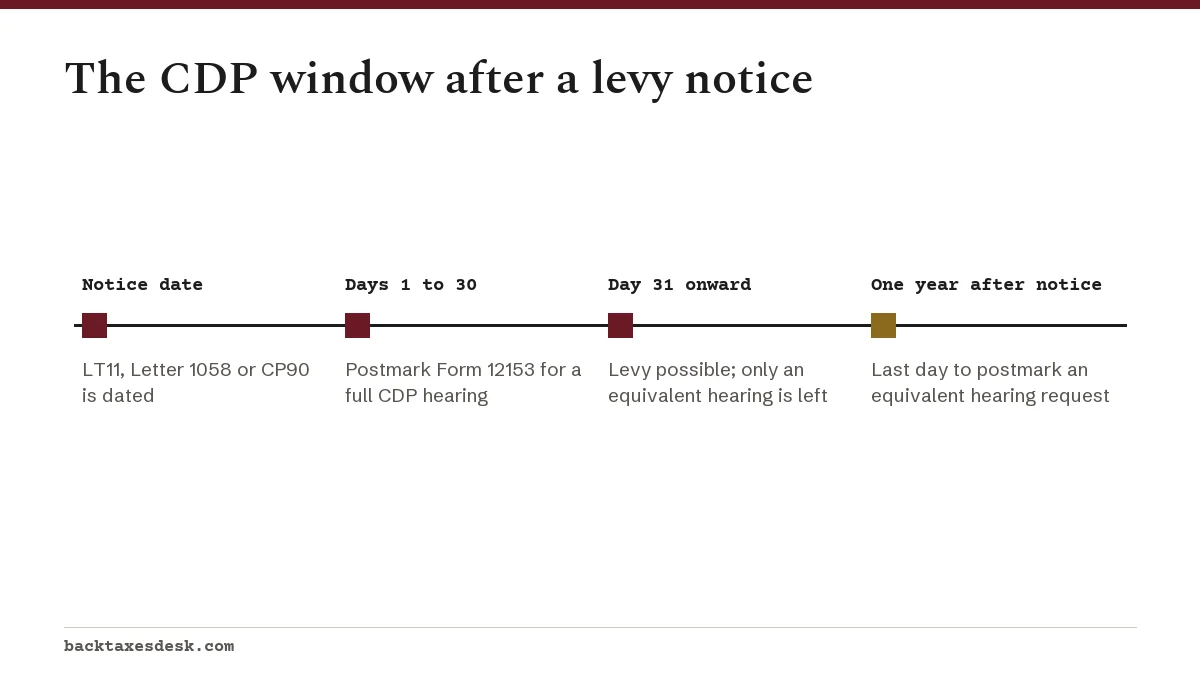
Worked example: counting the 30 days
An LT11 dated Wednesday, March 3, 2027 gives you until Friday, April 2, 2027 to postmark a CDP request. If you miss that, an equivalent hearing request must be postmarked by March 3, 2028. Send it by certified mail with a return receipt, or by another method that gives you dated proof, and keep a copy.
What if I miss the 30-day deadline? The equivalent hearing
You can still ask for an equivalent hearing IRS Appeals will hold on the same issues. Check the Equivalent Hearing box (item 2 on the July 2022 revision of Form 12153). The deadline is one year from the date of a levy notice, or one year plus five business days from the filing date of a tax lien.
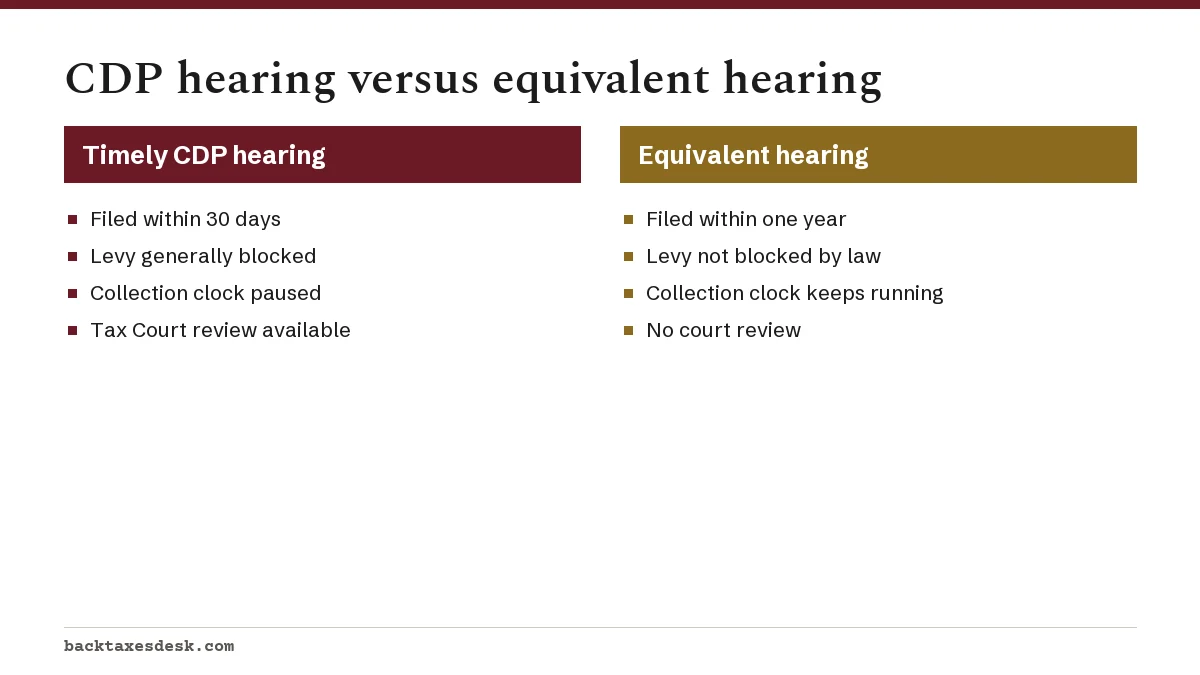
Publication 594 adds one safety valve: if your request was late but you can show you were diligent and the delay came from extraordinary circumstances beyond your control, your right to a CDP or equivalent hearing may still be preserved. Explain those circumstances in writing with proof.
How to fill out Form 12153, item by item
Form 12153 is two pages to complete. Send it to the hearing address on your notice, which is not the payment address. If you are unsure of the address or want to fax the request, call the number on the notice.
- Item 1, basis for hearing: check Filed Notice of Federal Tax Lien, Notice of Proposed or Actual Levy, or both if you received both notices.
- Item 2, equivalent hearing: check this box so a late request is treated as an equivalent hearing instead of being rejected.
- Items 3 to 6: names, taxpayer identification numbers, current address and the best phone number and time to reach you. Both spouses complete this for a joint liability.
- Item 7, tax information: type of tax, form number and each tax period. You can skip this if you attach a copy of the notice, which the IRS asks you to include anyway.
- Item 8, reason for the hearing: a request without a reason will not be honored. Choose from options such as not liable, innocent spouse, discharged in bankruptcy, payments not applied, lien withdrawal, financial hardship or a collection alternative, and explain in your own words.
- Item 9, proposed alternative: currently unable to pay, installment agreement, offer in compromise or other. Attach Form 433-A for individuals or Form 433-B for businesses; it is not required, but it speeds resolution.
- Item 10, signatures: you or your representative signs, not both. A representative needs Form 2848 on file. Both spouses sign a joint request.
What can I raise at a CDP hearing?
You can raise any issue about the unpaid tax or the proposed action, within limits set by Publication 1660:
- Collection alternatives: installment agreement, offer in compromise or Currently Not Collectible status.
- Lien options: withdrawal, subordination or discharge of the lien.
- Spousal defenses such as innocent spouse relief, which also needs Form 8857.
- Economic or other hardship caused by collection.
- Penalty relief for reasonable cause.
- The existence or amount of the tax, but only if you did not receive a notice of deficiency or otherwise have a chance to dispute it.
You cannot re-raise an issue that was decided at an earlier administrative or court hearing in which you meaningfully took part. If the amount itself is wrong and CDP is closed to that argument, other routes include audit reconsideration or a refund claim.
What happens at the hearing and while it is pending
After you file, the collection office may still try to settle the issue with you; if it does, you can withdraw the request. Otherwise the case goes to Appeals, which contacts you to schedule a conference by phone, by correspondence, or face to face at the nearest Appeals office if you qualify.
| Protection | Timely CDP hearing | Equivalent hearing |
|---|---|---|
| Levy on the periods at issue | Generally prohibited during the hearing | Not prohibited by law |
| 10-year collection clock | Suspended | Keeps running |
| Tax Court review of the decision | Available | Not available |
| A tax lien can still be filed | Yes | Yes |
Exceptions to the levy prohibition cover jeopardy levies, state tax refund levies, federal contractor levies and disqualified employment tax levies. Appeals also keeps jurisdiction after its decision, so you can return if collection does not follow the determination or your circumstances change. How CDP fits among the other appeal routes is set out in our guide to the IRS appeals process.
Tax Court review of the Appeals determination
When the hearing ends, Appeals issues a Notice of Determination. If you disagree, you have 30 days after the determination to petition the U.S. Tax Court, according to Publication 594. The Tax Court may accept a late petition only if you show diligence and extraordinary circumstances beyond your control.
Raise every issue and submit all your evidence at the Appeals stage. Publication 1660 warns that the court may refuse issues you did not raise and may limit evidence to what Appeals saw. The Tax Court filing fee is $60, and a waiver is available; see our guide to a Tax Court petition.
How a CDP hearing affects the collection statute and your passport
A timely CDP request suspends the 10-year collection period until the determination becomes final or you withdraw in writing, and that time is added to the end of the period. If fewer than 90 days remain when the suspension ends, the period is extended to 90 days. See the IRS collection statute of limitations for the other pause events.
A debt tied to a levy for which a CDP hearing was timely requested is also excluded from passport certification, which is explained on our page about whether the IRS can take your passport.
Step by step
Find the notice date
Confirm you received LT11, Letter 1058, CP90 or Letter 3172 and note the date printed on it or the deadline it states.
Complete Form 12153
Check the lien, levy or both boxes, check the equivalent hearing box, and give a specific reason and proposed alternative.
Attach financial information
Include Form 433-A or 433-B and a copy of the notice if you want a payment plan, offer or hardship status.
Mail with proof
Send the form to the hearing address on the notice by a method that proves the postmark date and keep a copy.
Attend the conference
Present every issue and all evidence to Appeals by phone, correspondence or in person.
Review the determination
If you disagree with the Notice of Determination, petition the Tax Court within 30 days.
Common questions
What does IRS Appeals decide at a CDP hearing?
Appeals decides whether the proposed levy or filed lien should go ahead, and whether an alternative you proposed, such as a payment plan, offer or hardship status, should replace it. It then issues a Notice of Determination.
Does a CDP hearing stop a bank levy?
A timely request after a levy notice generally prohibits levy on the tax periods in the hearing, including bank accounts, until the determination is final. Jeopardy, state refund, federal contractor and disqualified employment tax levies are exceptions.
Can I request a CDP hearing by phone?
No. The request must be in writing on Form 12153 or a letter with the same information, sent to the hearing address on your notice. A phone call to the IRS does not extend the 30-day deadline.
How long does a collection due process hearing take?
The IRS does not publish a standard time frame. Hearings run longer when Appeals asks the collection office to verify new financial information, so sending Form 433-A or 433-B with your request helps.
Can I get a CDP hearing for a CP504 notice?
No. CP504 warns that the IRS intends to levy but does not carry hearing rights. The hearing right comes with the later LT11, Letter 1058 or CP90, or with Letter 3172 for a lien.
Do I need a lawyer for a CDP hearing?
No. You can represent yourself, or use an attorney, CPA or enrolled agent with Form 2848. A Low Income Taxpayer Clinic may represent you for free or a small fee if you qualify.
Sources
- Collection due process (CDP) FAQs irs.gov
- Form 12153, Request for a Collection Due Process or Equivalent Hearing irs.gov
- Publication 1660, Collection Appeal Rights irs.gov
- Publication 594, The IRS Collection Process irs.gov
- Time IRS can collect tax irs.gov
We check figures against these official pages. Rules change; confirm anything that affects a deadline or payment with the agency before you act.
Tell us what happened
Describe your situation and our editors will use it to improve this guide. If you leave your email, we may reply with a pointer to the right page or official contact. We never share your details.
Related guides
 IRS Final Notice of Intent to Levy (LT11 and Letter 1058)
An IRS final notice of intent to levy, sent as LT11 or Letter 1058, is the last letter before the IRS can take wages, bank accoun…
Collection Appeals Program: Form 9423 Steps and Deadlines
The Collection Appeals Program (CAP) lets you ask the IRS Independent Office of Appeals to review a lien, levy, seizure or instal…
 IRS Collection Process: Liens, Levies and Your Rights
The IRS collection process starts with a bill (usually Notice CP14) and escalates through reminder notices to a Final Notice of I…
IRS Appeals Process: How to Dispute an IRS Decision
The IRS appeals process lets you ask the IRS Independent Office of Appeals, which is separate from the office that audited or bil…
Can the IRS Take Your Passport? Tax Debt and Passport Rules
Can the IRS take your passport? Not by itself, but it can certify a seriously delinquent tax debt to the State Department, which…
 How to File a Tax Court Petition: Deadline, Fee and Steps
A Tax Court petition asks the US Tax Court to review an IRS determination before you pay. For a notice of deficiency it must be f…