
IRS appeals process: how to challenge an audit or collection decision
Short answer
The IRS appeals process lets you ask the IRS Independent Office of Appeals, which is separate from the office that audited or billed you, to review a decision you disagree with. For audit disputes of $25,000 or less per tax period, a brief written request or Form 12203 is enough; larger disputes need a formal written protest, sent within the time on your letter.
- 01Who decides
- IRS Independent Office of Appeals, separate from the examiner
- 02Small case request
- $25,000 or less per tax period: brief statement or Form 12203
- 03Formal written protest
- Required above $25,000 for any period
- 04Collection Due Process request
- Form 12153 within 30 days of the levy or lien notice
- 05Collection Appeals Program
- Form 9423, generally within 3 business days after the manager conference
- 06Tax Court petition
- 90 days from a notice of deficiency; $60 fee
What does the IRS Independent Office of Appeals do?
The IRS Independent Office of Appeals settles tax disputes without going to court. Publication 5 describes it as an independent function, separate from the IRS division that proposed the change, and the only level of administrative appeal inside the IRS. Appeals officers weigh both sides' arguments and apply tax law, including court decisions, to the facts (IRS Publication 5).
IRS appeals cover far more than audits. Publication 5 lists penalty abatement denials, rejected offers in compromise, innocent spouse denials and penalty determinations, among others. Collection actions such as levies, liens and payment plan rejections have their own appeal routes, covered further down this page.
How do I appeal an IRS audit result?
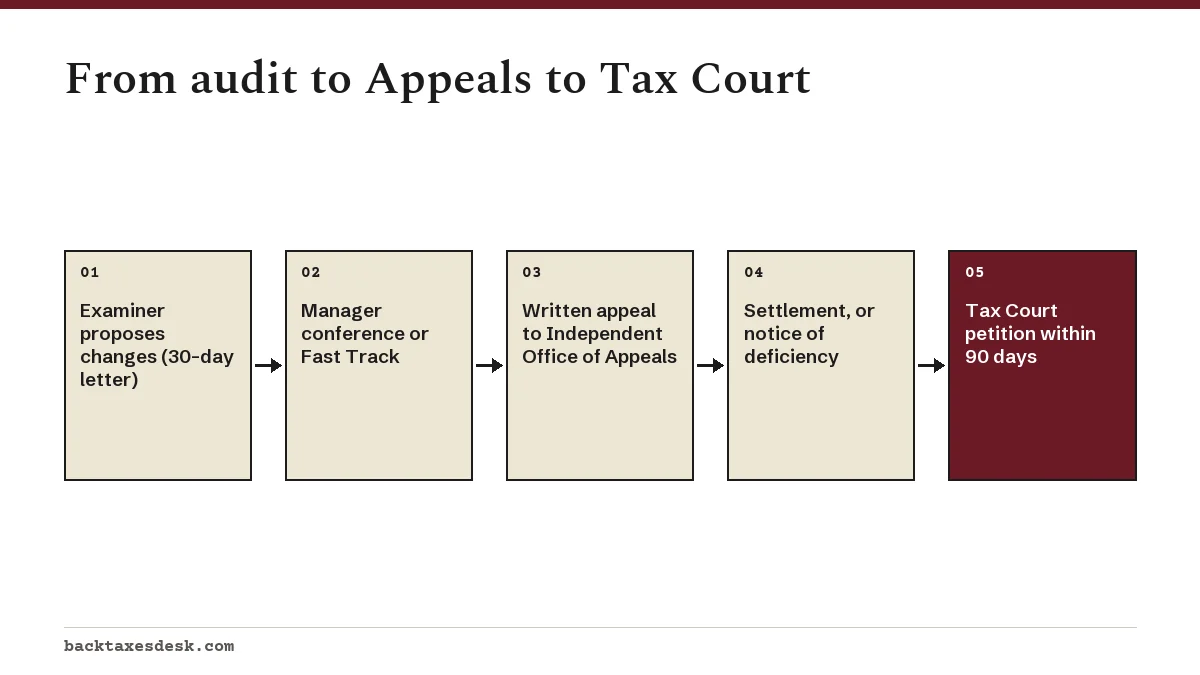
You appeal an audit result by sending a written request to the address on the letter that proposed the changes, before the deadline printed on it. That letter is often called a 30-day letter; for mail audits it is commonly Letter 525. Do not sign the agreement form if you plan to appeal.
Before appealing, give the examiner every document you want considered. Publication 5 warns that new information raised for the first time at Appeals is usually sent back to the examining office, which delays the case. You can also ask for a conference with the examiner's manager first; many disputes end there.
Small case request or formal written protest
| Amount in dispute per tax period | What to send | Notes |
|---|---|---|
| $25,000 or less | A brief written statement of the disputed items and why you disagree, the appeal form sent with your letter, or Form 12203 | Include proposed tax and penalties; for an offer in compromise, total unpaid tax, penalties and interest |
| More than $25,000 for any period | A formal written protest | If one period exceeds $25,000, a formal protest is needed for all periods |
| Partnership, S corporation, employee plan or exempt organization cases | A formal written protest | Required whatever the amount |
Example: an audit proposes $9,400 of extra tax and a $1,880 accuracy penalty for 2023. The total, $11,280, is under $25,000, so a one-page statement or Form 12203 is enough. If the same audit also proposed $26,000 for 2024, you would need a formal protest covering both years.
Preparing your protest
A formal written protest is a letter that states you want to appeal and sets out your case. Publication 5 says it must contain the following items. Missing pieces can delay the transfer to Appeals.
- Your name, address and a daytime phone number.
- A statement that you want to appeal the changes the IRS proposed.
- The tax periods involved and a list of each disputed issue with the proposed change.
- The facts supporting your position on each issue.
- The law or authority, if any, that supports your position.
- The penalties of perjury declaration from Publication 5, signed by you. A representative who prepares it signs a different declaration stating whether they know the facts personally.
Keep the protest factual and organized by issue. Attach exhibits, such as receipts or mileage logs, already given to the examiner so the Appeals officer has them in one place. Send it by a trackable method and keep a full copy.
What happens after you request an IRS appeal?
The examiner forwards your file to the IRS Appeals office, which contacts you to arrange a conference. Appeals conferences are informal and are usually held by phone or correspondence; the IRS Appeals website also describes virtual and in-person options. You can bring a representative or a witness.
Only attorneys, certified public accountants and enrolled agents can represent you at Appeals, using Form 2848. An unenrolled preparer may attend as a witness but cannot represent you. If you cannot afford help, a Low Income Taxpayer Clinic may represent you if you qualify.
The statute of limitations and Form 872
Publication 5 says an exam case generally needs more than 365 days left before the assessment deadline for Appeals to accept it. If less time remains, the IRS will ask you to sign an extension. If you refuse, Appeals will not take the case and the IRS will generally issue a notice of deficiency, leaving the Tax Court as your route. See the IRS audit statute of limitations for how the deadline works.
Fast Track Settlement and mediation
For some cases, you can ask for Fast Track Settlement while the case is still with the examiner. A specially trained Appeals employee acts as a neutral mediator, you can withdraw at any time, and you keep your normal appeal rights for anything left unresolved. The IRS also offers mediation for some collection and offer in compromise disputes.
How long does an IRS appeal take?
The IRS does not publish a standard time for appeals, and the length depends on the number of issues, how complete the file is when it arrives, and whether new information has to go back to the examiner. Plan for months rather than weeks for an audit appeal. Interest continues on any tax ultimately owed, but you can stop it on the amount you send by making a deposit while the appeal is pending.
Collection appeals move faster. The Collection Appeals Program is described by the IRS as generally giving a quicker decision than a Collection Due Process hearing, which is one reason people choose it for a single levy or lien issue.
Can I appeal a collection action?
Yes, through two programs described in Publication 1660, Collection Appeal Rights. The Collection Due Process (CDP) hearing is triggered by specific notices and allows later Tax Court review. The Collection Appeals Program (CAP) covers more actions but its decision is final.
| Feature | Collection Due Process (CDP) | Collection Appeals Program (CAP) |
|---|---|---|
| Triggered by | Final notice of intent to levy (LT11, Letter 1058) or lien filing notice (Letter 3172) | Liens, levies, seizures, and rejected, modified or terminated installment agreements |
| Form | Form 12153 | Form 9423 (or oral request for some installment agreement issues) |
| Deadline | 30 days from the notice; equivalent hearing within 1 year | Generally within 3 business days after the conference with a collection manager; 30 days for a rejected installment agreement |
| Can you dispute the tax itself | Only if you got no notice of deficiency or other chance to dispute it | No |
| Court review | Yes, Tax Court | No, the decision is binding |
For CAP, you normally ask for a conference with the collection manager first, then tell the revenue officer or manager within 2 business days if you want to appeal, and send Form 9423 postmarked within 3 business days after that conference. A timely CDP request also pauses the 10-year collection clock. Our collection due process hearing page has the step-by-step version.
Appeals versus Tax Court: which route to take?
You do not have to go through Appeals before going to court. If your audit ends with a notice of deficiency, you can file a Tax Court petition within 90 days (150 if the notice is addressed outside the US) without paying the tax first. The filing fee is $60 and can be waived.
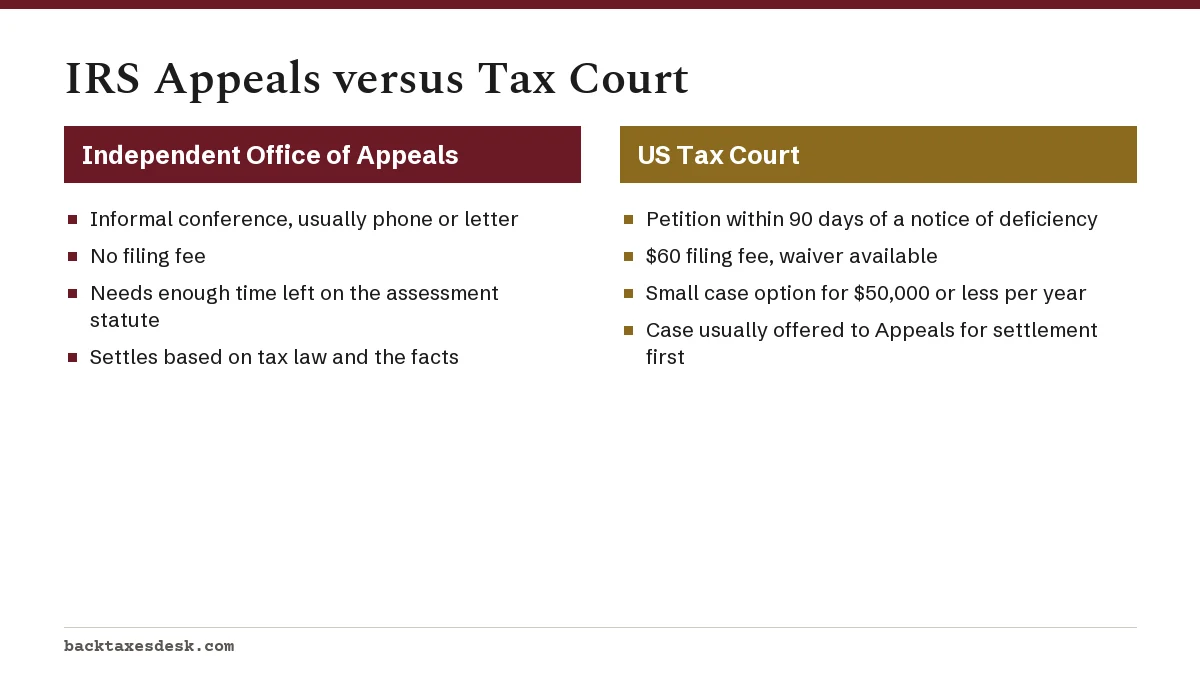
Even if you skip Appeals, a docketed Tax Court case is normally sent to Appeals for settlement talks before trial, so many cases still settle there. Disputes of $50,000 or less per year can use the Tax Court's small case procedure, which is less formal but cannot be appealed. The court can impose a penalty of up to $25,000 for a case filed mainly to delay or based on a frivolous position.
District Court and the Court of Federal Claims are also open, but generally only after you pay the tax in full and file a refund claim. A refund suit must be filed within 2 years of the notice disallowing your claim.
How to request an IRS appeal: checklist
- Find the deadline on your letter and aim to send your request at least a week early.
- Confirm you gave the examiner every document you want considered.
- Work out the amount in dispute for each tax period to choose between a small case request and a formal protest.
- Write the request or protest, sign it, and attach copies of the letter and key exhibits.
- Send it to the address on the letter by a trackable method and keep a full copy.
- If a notice of deficiency arrives while you are still talking to the IRS, the 90-day Tax Court deadline still runs.
For background on how the dispute started, see the IRS audit guide and our page on IRS audit triggers.
Step by step
Check the deadline
Find the response date on the 30-day letter or collection notice.
Finish with the examiner
Send any remaining documents and consider a manager conference.
Pick the request type
Use a small case request or Form 12203 at $25,000 or less per period; otherwise write a formal protest.
Send and keep proof
Mail the signed request to the address on the letter by a trackable method.
Prepare for the conference
Organize exhibits by issue and decide whether a representative will attend with Form 2848.
Common questions
Is the IRS appeals office really independent?
It is part of the IRS but works separately from the examiners and collectors who made the decision. Publication 1660 says Appeals protects that independence by prohibiting certain one-sided discussions with the office that made the decision, such as talks about the strengths or weaknesses of your case, under Revenue Procedure 2012-18.
Can I appeal after I have signed Form 4549?
Signing Form 4549 means you agreed to the changes and the tax can be assessed. After that, your options are generally a claim for refund once you pay, or audit reconsideration if you have new information.
What is Form 12203 used for?
Form 12203, Request for Appeals Review, is the IRS form for small case appeals, where the disputed tax and penalties are $25,000 or less for each period. It lists the items you disagree with and why.
Can I go to Tax Court if I lose at Appeals?
Yes, for audit disputes. If Appeals does not settle your case, it issues a notice of deficiency, and you then have 90 days to petition the Tax Court. CAP collection decisions cannot be taken to court.
Does an appeal stop IRS collection?
An audit appeal happens before tax is assessed, so there is nothing to collect on those items yet. A timely CDP request generally stops levies during the hearing, and a CAP appeal generally pauses the action being appealed unless the IRS believes collection is at risk.
Sources
- Publication 5, Your Appeal Rights and How to Prepare a Protest if You Disagree irs.gov
- Publication 1660, Collection Appeal Rights irs.gov
- IRS Independent Office of Appeals irs.gov
- Collection Due Process (CDP) FAQs irs.gov
- Publication 3498-A, The Examination Process (Audits by Mail) irs.gov
- US Tax Court, starting a case ustaxcourt.gov
We check figures against these official pages. Rules change; confirm anything that affects a deadline or payment with the agency before you act.
Tell us what happened
Describe your situation and our editors will use it to improve this guide. If you leave your email, we may reply with a pointer to the right page or official contact. We never share your details.
Related guides
 IRS Audit Guide: Types, Letters, Timelines and Appeals
An IRS audit is a review of a filed tax return to check that income, deductions and credits were reported correctly, and the IRS…
Collection Appeals Program: Form 9423 Steps and Deadlines
The Collection Appeals Program (CAP) lets you ask the IRS Independent Office of Appeals to review a lien, levy, seizure or instal…
 How to File a Tax Court Petition: Deadline, Fee and Steps
A Tax Court petition asks the US Tax Court to review an IRS determination before you pay. For a notice of deficiency it must be f…
Collection Due Process Hearing: Form 12153 Step by Step
A collection due process hearing is an independent review by the IRS Independent Office of Appeals of a proposed levy or a filed…
IRS Audit Triggers: How Returns Get Selected for Review
The IRS names three audit triggers: random selection, computer screening that scores a return against statistical norms, and link…
IRS Letter 525: Proposed Audit Changes and Your 30 Days
Letter 525 IRS examiners send is the General 30-Day Letter: it closes a mail audit with proposed changes, usually on an enclosed…