
IRS audit triggers: what actually gets a return selected
Short answer
The IRS names three audit triggers: random selection, computer screening that scores a return against statistical norms, and links to another taxpayer who is already under audit. Income that does not match Forms W-2 and 1099 is a separate trigger for a CP2000 proposal. For tax year 2021, about 0.3% of individual returns had been examined.
- 01Official selection methods
- Random or statistical screening, and related examinations
- 02Individual audit rate, tax year 2021
- About 0.3% of 161.7 million returns
- 03Rate for returns claiming EITC, tax year 2021
- About 0.8%
- 04Rate for income of $10 million or more, tax year 2021
- About 6.6%
- 05Minimum record-keeping period
- 3 years from the date the return was filed
What triggers an IRS audit, according to the IRS?
IRS audit triggers fall into two official categories. The first is random selection and computer screening: the IRS scores returns against statistical norms for similar returns, and sometimes a return is chosen purely by a statistical formula. The second is a related examination, where your return is pulled because it involves transactions with another taxpayer, such as a business partner or investor, whose return is already under audit (IRS, IRS audits).
The IRS does not publish its scoring formula, so any list of secret red flags for an IRS audit is an educated guess, not an official rule. What the IRS does say is that the norms come from its National Research Program, which studies randomly chosen returns in depth. A return that looks very different from similar returns is more likely to score high.
How often does the IRS audit individual returns?
Rarely, for most people. The IRS Data Book for fiscal year 2025 reports that about 0.3% of the 161.7 million individual returns filed for tax year 2021 had been examined, a year the IRS treats as largely settled because it is outside the normal three-year limit. Rates rise sharply at the top of the income scale and are higher for returns claiming the earned income tax credit (EITC).
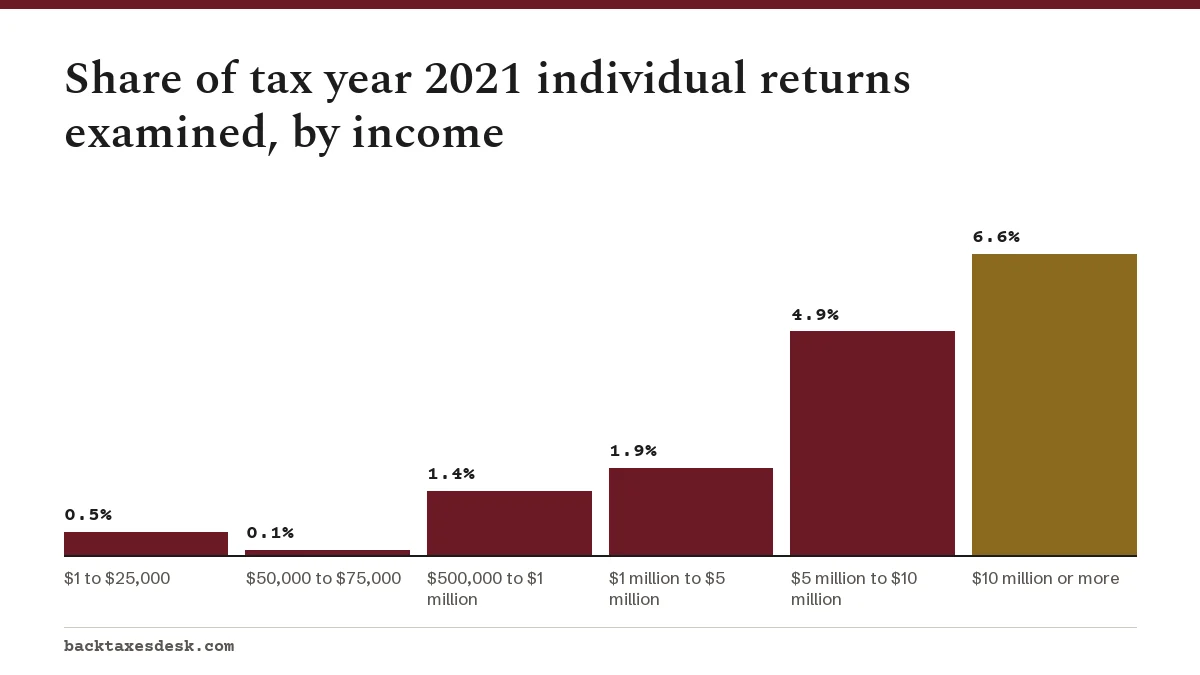
| Total positive income | Returns filed | Share examined |
|---|---|---|
| $1 under $25,000 | 42.5 million | 0.5% |
| $50,000 under $75,000 | 24.2 million | 0.1% |
| $100,000 under $200,000 | 26.8 million | 0.1% |
| $500,000 under $1,000,000 | 1.9 million | 1.4% |
| $1,000,000 under $5,000,000 | 839,856 | 1.9% |
| $10,000,000 or more | 42,191 | 6.6% |
Two points stand out. The lowest bracket is examined more often than the middle, largely because EITC claims are checked by mail; returns selected on the basis of an EITC claim had a 0.8% rate. And the very highest incomes face the most scrutiny, with 6.6% of returns showing $10 million or more examined.
Mismatched income: the most common IRS audit red flag in practice
The IRS receives copies of Forms W-2, 1099-NEC, 1099-K, 1099-B, 1099-INT, 1099-R and other information returns, and compares them with what you reported. When the numbers do not line up, the usual result is a CP2000 notice, a proposal to change your return, rather than a full examination.
Common mismatches include a forgotten brokerage account, a 1099-K from a payment app that was reported as a different amount, a retirement distribution left off, or a second W-2 from a short job. The CP2000 is resolved by agreeing or sending documents, and the steps are covered in how to respond to a CP2000.
Worked example
Suppose a freelancer reports $38,000 of business income on Schedule C, but three clients filed Forms 1099-NEC totaling $41,500. The $3,500 gap shows up in the matching program. If the freelancer can show that one client double-reported a $3,500 payment, a letter from that client or a corrected 1099 settles it. If the income was simply missed, the IRS proposes tax on the extra $3,500 plus interest and possibly an accuracy penalty.
What causes an IRS audit through a related examination?
A related examination happens when an audit of one taxpayer leads the IRS to others. The IRS gives business partners and investors as examples. If a partnership or S corporation you own a share of is audited, the IRS can look at how you reported your share of its income or loss.
Other links are possible too. A preparer whose returns are under review, a tax shelter promoter, or a former spouse who claimed the same dependent can all put your return in front of an examiner. In these cases the trigger has nothing to do with how your own return scored.
Are self-employed people audited more, and does a home office trigger an audit?
The IRS does not publish an official list saying that Schedule C filers or home office claims are audit triggers, and its Data Book coverage table does not break out audit rates for sole proprietors. What is true is that self-employment income has no employer withholding and relies on your own records, so an unsupported expense is harder to defend if you are chosen.
A home office deduction is legal when the space is used regularly and exclusively for business. Rather than avoiding a deduction you qualify for, keep proof: a floor plan with measurements, photos of the space, and the utility and rent or mortgage statements used in the calculation. Claiming what the law allows, with records, is the answer to worries about IRS audit red flags.
Records that protect you if you are selected
The IRS requires you to keep all records used to prepare a return for at least three years from the date the return was filed. Longer periods apply in some cases, which are covered on the IRS audit statute of limitations page. Good records turn an audit into a paperwork exercise instead of an argument.
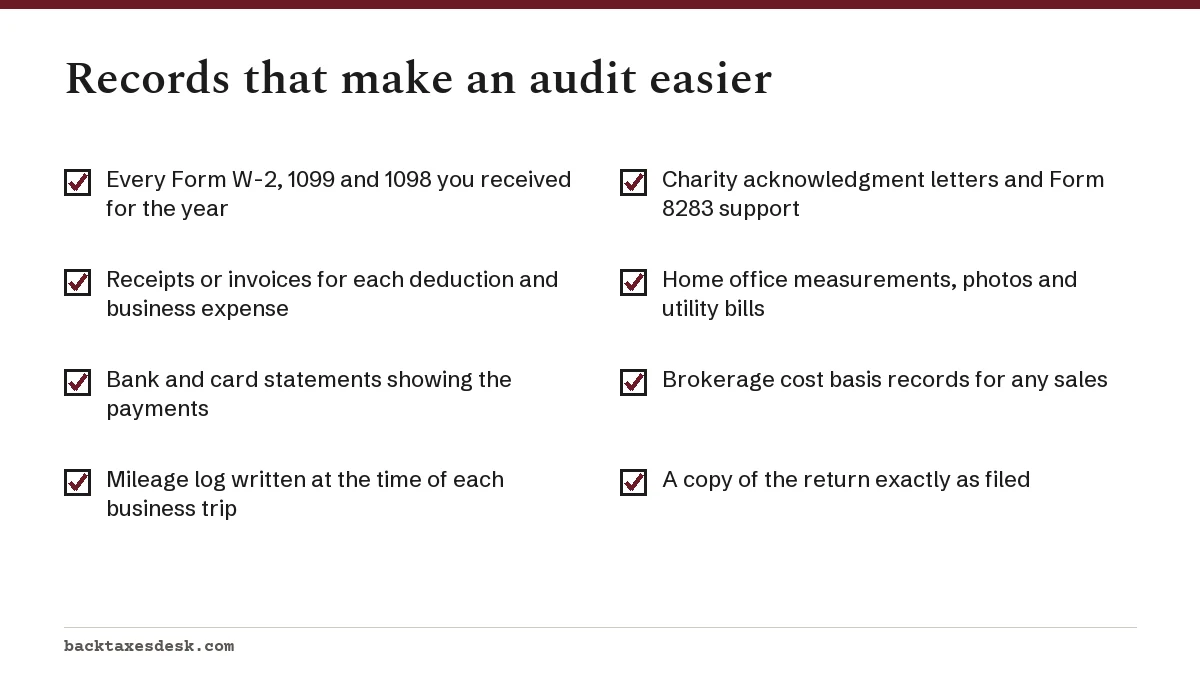
If you do get a letter, most audits are handled by mail. Our guide to the correspondence audit explains how to send these records, and how long an IRS audit takes covers timing. The IRS audit guide gives the full picture of the process.
Some of this screening is now done by AI-assisted models that score returns for non-compliance and recommend cases for examination. What is known about that, and what you are not told, is in how the IRS uses AI to select audits.
Common questions
Does the IRS audit randomly?
Yes, partly. The IRS says some returns are selected based solely on a statistical formula, and it also uses random samples from its National Research Program to build the norms that its screening compares returns against.
Do round numbers trigger an IRS audit?
The IRS has not published any rule about round numbers. The concern is really about estimates: if you round expenses instead of using actual receipts, you may not be able to prove the figure when asked.
Does filing an amended return increase audit risk?
The IRS does not list amended returns as a selection method. A Form 1040-X is reviewed when processed, and the IRS may ask for support for the change, but amending to correct a real error is the right step.
Are higher incomes audited more often?
Yes. For tax year 2021, the IRS had examined about 1.9% of returns with $1 million to $5 million of total positive income and about 6.6% of returns with $10 million or more, compared with 0.1% for many middle-income ranges.
Can a large charitable deduction cause an audit?
Any deduction that is large compared with similar returns can raise a screening score. Keep the written acknowledgment from the charity and, for noncash gifts over the thresholds on Form 8283, the required appraisal.
Sources
- IRS audits irs.gov
- IRS Data Book Table 3-1, examination coverage by type and size of return irs.gov
- Understanding your CP2000 notice irs.gov
- How long should I keep records? irs.gov
We check figures against these official pages. Rules change; confirm anything that affects a deadline or payment with the agency before you act.
Tell us what happened
Describe your situation and our editors will use it to improve this guide. If you leave your email, we may reply with a pointer to the right page or official contact. We never share your details.
Related guides
 IRS Audit Guide: Types, Letters, Timelines and Appeals
An IRS audit is a review of a filed tax return to check that income, deductions and credits were reported correctly, and the IRS…
IRS Correspondence Audit: How a Mail Audit Really Works
A correspondence audit is an IRS examination handled entirely by mail, where the IRS asks you to send copies of records supportin…
 CP2000 Notice: IRS Says Your Income Doesn't Match Records
A CP2000 notice is an IRS proposal to change your return because income or payment information from employers, banks or brokers d…