
How long does an IRS audit take?
Short answer
How long an IRS audit takes depends on its type and how fast records arrive: the IRS says mail audits with complete documents or a signed agreement can close quickly, while others take several months, and in-person audits of businesses often run longer. All of it must fit inside the assessment deadline, generally three years after filing.
- 01Mail audit extension
- One automatic 30-day extension, usually granted
- 02Receipt acknowledgment
- IRS aims to confirm mailed or faxed documents within 30 days
- 03Refund after the audit
- About 6 to 8 weeks once the result is final
- 04Outer time limit
- Assessment generally within 3 years of filing, unless extended
- 05Appeal time with a 30-day letter
- The period printed on the letter, often 30 days
How long does an IRS audit take to complete?
The IRS does not set a fixed length. It says the time depends on the type of audit, how complex the issues are, how quickly the requested information is available, both sides' availability for meetings, and whether you agree with the findings (IRS, IRS audits). Its mail audit guide adds that audits closed with all requested documents or a signed agreement can finish quickly, while other types can take several months.
So the honest answer to how long a tax audit takes is that a single-issue mail audit with complete records sits at the short end, while an in-person audit of a business return, or any audit that moves on to Appeals, runs longer because each added stage brings its own response periods. The IRS notifies you by mail if it needs more time.
What affects the IRS audit time frame?
| Factor | Shorter audit | Longer audit |
|---|---|---|
| Audit type | Mail audit on one item | Field audit of business records |
| Your records | Complete, labeled copies sent once | Missing records, partial replies, repeat requests |
| Response speed | Reply well before the due date | Extensions and late replies |
| Agreement | You sign the report | You dispute and request a manager or Appeals |
| Related returns | Single return | Other years or a linked partnership added |
| Third parties | No outside verification needed | IRS must contact banks, employers or clients |
The factor you control most is your records. Each round of letters asking for something you left out adds weeks: time for the IRS to write, time for you to reply, and time for the file to return to the examiner's queue.
Mail audit timing and extensions
A correspondence audit moves in rounds of letters, and each letter gives you a deadline, often 30 days. After you reply, the IRS aims to send a letter within 30 days confirming it received what you mailed or faxed. Then the examiner reviews it and either accepts the return or writes back.
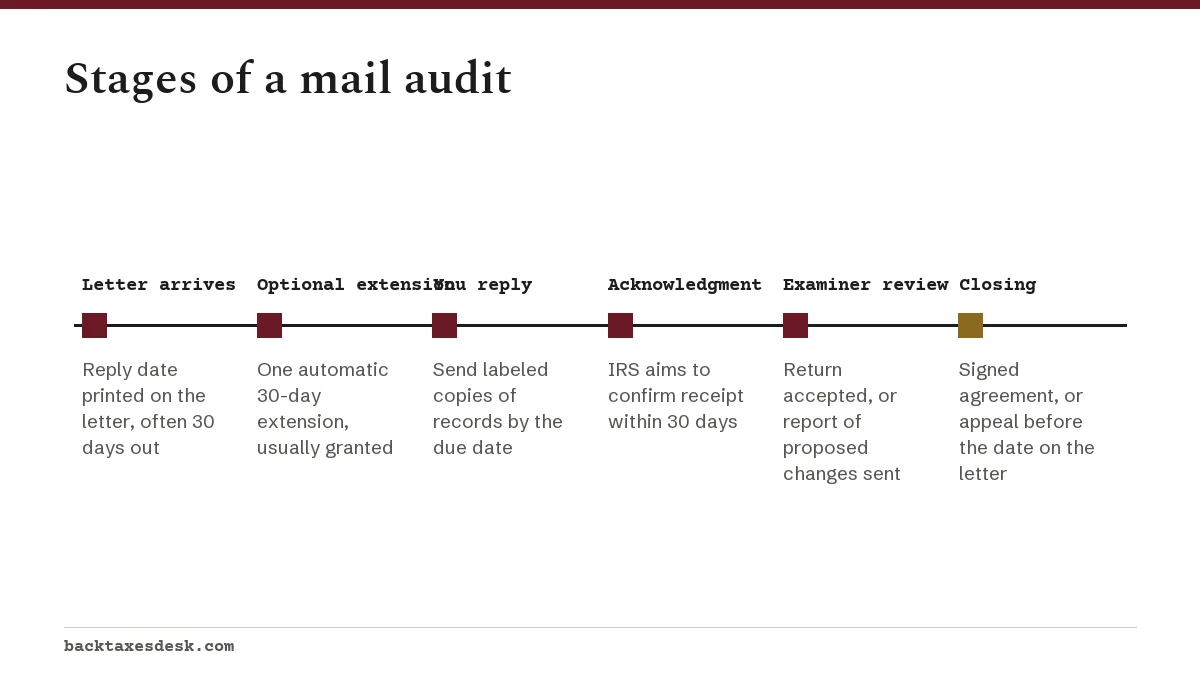
Can you get more time to respond? Yes. For mail audits, the IRS says it can ordinarily grant a one-time automatic 30-day extension. Ask before the due date by calling or faxing the number on the letter. An extension adds a month to the audit, but it is far better than a missed deadline, which leads the IRS to disallow the items it asked about.
In-person audit timing
An office audit or field audit starts with a letter asking you to call and set an appointment, so the first weeks depend on scheduling. After the interview the examiner often issues a written list of further documents, and may need a second meeting. Field audits of businesses can involve reviewing books, bank records and sometimes a tour of the business.
Because in-person audits usually cover more items than mail audits, they take longer. A representative with Form 2848 can attend in your place, which can make scheduling easier. Publication 3498-A notes that if you ask to consult a representative during an interview, the IRS will in most cases stop and reschedule.
How soon after filing does the IRS audit?
There is no set waiting period. The IRS generally audits returns filed within the last three years, so a letter can arrive within months of filing or more than two years later. A refund being issued does not mean the return is closed to selection.
What caps the timing is the legal deadline to assess tax, generally three years from filing, explained on the IRS audit statute of limitations page. If an audit runs close to that date, the IRS may ask you to sign Form 872 to extend it. If you decline, the IRS usually wraps up with the information it has.
How long do the steps after the audit take?
Once the examiner finishes, the time left depends on what you do. If you agree and sign, the case closes and the balance is billed or a refund is issued; Publication 3498-A says a refund due after an audit usually arrives within 6 to 8 weeks. If you disagree, you get a set period to reply, often 30 days, before the IRS moves on.
- Manager conference: must be requested before the date on the letter, and can resolve a dispute without going to Appeals.
- Appeals: the IRS publishes no standard processing time; the case needs more than 365 days left on the assessment deadline to be accepted, per Publication 5.
- Notice of deficiency: 90 days to petition the Tax Court, or 150 days if addressed outside the US.
- Tax Court: the court sets its own schedule, and most cases are offered to Appeals for settlement before trial.
The IRS appeals process page covers those later stages.
What slows an audit down, and how to speed it up
- Answer everything in one package. Go through the letter item by item and send support for each, with a short cover note listing what is enclosed.
- Use the fastest channel offered. Fax or the upload option listed on the letter reaches the examiner faster than regular mail.
- Label each page. Your name and taxpayer number on every page stops documents from being separated from your file.
- Explain rather than go silent. If a receipt is gone, say so and explain how you figured the amount; silence leads to disallowance.
- Keep a log. Record every call, the name of the person, and dates, so repeat requests can be answered with proof of what you already sent.
- Sign promptly if you agree. An agreed report closes the case; waiting only adds interest.
For the whole process in one place, see the IRS audit guide.
Common questions
Can an IRS audit take years?
Yes, some can, especially complex field audits or cases that go to Appeals and Tax Court. The IRS still has to assess tax within the legal deadline unless you agree to extend it, which limits how long an ordinary audit can run.
How do I know when my IRS audit is finished?
You receive a closing letter. If nothing changes, the IRS sends a letter accepting the return as filed. If there are changes you agreed to, you get a bill or refund after the signed report is processed.
What happens if the IRS does not respond after I send audit documents?
Wait for the acknowledgment, which the IRS aims to send within 30 days. If you hear nothing after that, call the number on the audit letter and ask for the status. If the delay is causing a hardship, the Taxpayer Advocate Service may be able to help.
Does an extension on my tax return delay an audit?
It changes when the three-year clock starts, because the clock runs from the date you actually file. It does not make selection more or less likely.
How long does the IRS have to finish an audit?
Generally until three years after the return was filed, six years if more than 25% of gross income was omitted, and with no limit for fraud or unfiled returns. A signed extension on Form 872 can add time.
Sources
- IRS audits irs.gov
- Publication 3498-A, The Examination Process (Audits by Mail) irs.gov
- Publication 5, Your Appeal Rights and How to Prepare a Protest irs.gov
- Publication 556, Examination of Returns, Appeal Rights, and Claims for Refund irs.gov
We check figures against these official pages. Rules change; confirm anything that affects a deadline or payment with the agency before you act.
Tell us what happened
Describe your situation and our editors will use it to improve this guide. If you leave your email, we may reply with a pointer to the right page or official contact. We never share your details.
Related guides
 IRS Audit Guide: Types, Letters, Timelines and Appeals
An IRS audit is a review of a filed tax return to check that income, deductions and credits were reported correctly, and the IRS…
IRS Audit Statute of Limitations: The 3- and 6-Year Rules
The IRS audit statute of limitations is generally three years from the date a return was filed, under Internal Revenue Code secti…
IRS Correspondence Audit: How a Mail Audit Really Works
A correspondence audit is an IRS examination handled entirely by mail, where the IRS asks you to send copies of records supportin…
IRS Office Audit: What to Expect at an In-Person Exam
An IRS office audit is an in-person interview at a local IRS office where an examiner reviews the specific items listed in your a…
IRS Appeals Process: How to Dispute an IRS Decision
The IRS appeals process lets you ask the IRS Independent Office of Appeals, which is separate from the office that audited or bil…