
How the IRS uses AI to select returns for audit
Short answer
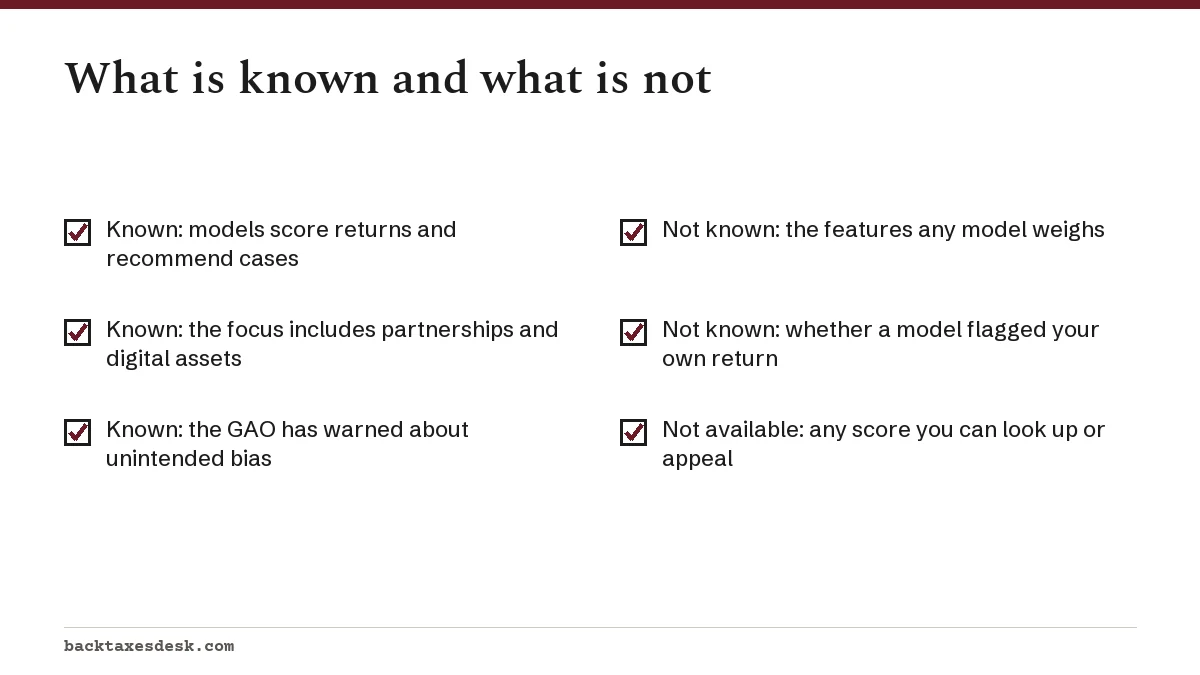
The IRS uses AI-assisted models to score returns for non-compliance risk and recommend cases for examination. The published focus is large partnerships, mid-market corporations, high-wealth individuals and digital-asset users. You are never told whether a model or a person flagged your return, and the Government Accountability Office has warned that these systems can carry unintended bias.
- 01Active IRS AI use cases
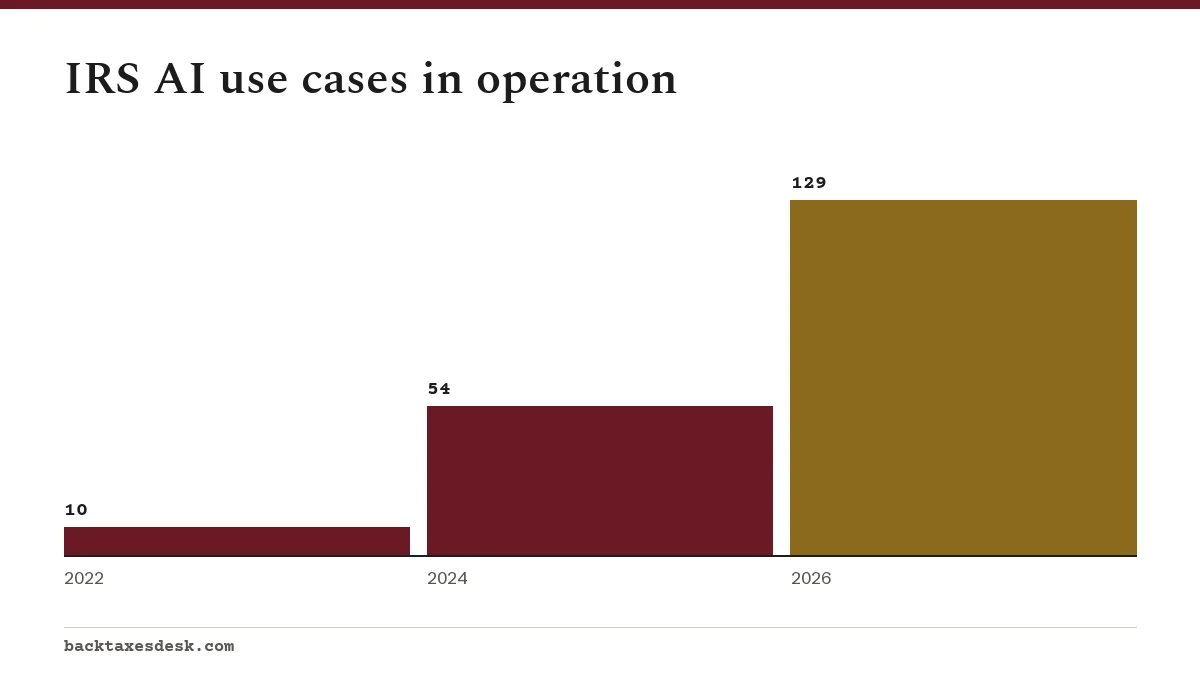
- About 129, up from 54 in 2024
- 02Main published targets
- Large partnerships, mid-market corporates, high-wealth individuals, digital assets
- 03Partnership threshold cited
- $10 million or more in assets
- 04Are you told a model flagged you
- No
Does the IRS use AI to choose audits?
Yes, as one input among several. AI-assisted models analyse returns, score them for non-compliance risk, and recommend cases for audit or investigation. A human still decides whether an examination opens.
The scale has grown quickly. The IRS was reported to have around 129 AI use cases in operation, against 54 in 2024 and only a handful in 2022. Not all of those are audit selection; the IRS applies AI across service and operations too.
Which returns do the models look at?
The published focus is on the returns that are hardest to examine by hand.
| Category | Detail |
|---|---|
| Large partnerships | Broadly those with $10 million or more in assets |
| Mid-market corporations | Replacing legacy systems for roughly $10m to $250m in assets |
| High-wealth individuals | Complex individual returns |
| Digital asset users | Unreported gains on crypto and other digital assets |
| Individual returns generally | Identifying issues within ordinary returns |
Separately, the issues reported as top audit triggers in 2026 are third-party data mismatches, unreported digital-asset gains, Schedule K-1 discrepancies, inflated business losses and omitted foreign income. Those are the patterns a matching model is best placed to find, which is consistent with the technology's strengths.
The broader picture of what draws attention is in IRS audit triggers.
Will you be told an algorithm flagged your return?
No. Audit notices do not say how the return was selected, and taxpayers selected for examination are not told whether a person or a model flagged them.
In practical terms this changes nothing about how you respond. An examination proceeds the same way, asks for the same substantiation and carries the same appeal rights regardless of what put it in the queue. What an IRS audit letter means is the place to start if one has arrived.
What has the GAO said about bias?
The Government Accountability Office has issued more than one report flagging the potential for unintended bias when AI selects returns for examination. That concern sits against independent findings that Black taxpayers have been audited at three to five times the rate of others, with the GAO identifying unintentional algorithmic bias as one possible contributor.
Transparency is the related problem. Taxpayers cannot see the models, cannot see the features they weigh, and are not told when one was involved, which makes the disparity difficult to challenge in any individual case.
Does using AI to prepare your return raise your audit risk?
There is no published indication that the IRS scores returns differently because AI helped prepare them, and no box on the return discloses it. What raises risk is what ends up on the return.
That is where AI preparation genuinely matters. Practitioners reviewing AI-assisted returns during the 2026 season reported repeated errors on Schedule K-1 and Form 1099 entries, state rules applied as if they were federal, and 2025 law changes missed entirely. Those errors are exactly the mismatches automated selection finds most easily.
- A figure that does not match a third-party information return is the most reliably detected error there is.
- A deduction claimed because software suggested it, without the test being met, is a straightforward adjustment on examination.
- Digital-asset reporting is now matched against broker forms, and Form 1099-DA began carrying cost basis with 2026 transactions.
So the honest answer is that AI does not raise your risk directly, and raises it indirectly whenever you file something you have not checked.
What to do about it
- Match every figure on the return against the information return it came from before filing.
- Keep substantiation for anything unusual at the time you claim it, not when a letter arrives.
- Treat any deduction suggested by software as a prompt to check the test, not as confirmation you meet it.
- Reconcile digital-asset activity against your own records, because broker forms do not capture wallet transfers or most DeFi activity.
- If an examination opens, read the letter for what it actually asks and respond to that.
If you need help, the Taxpayer Advocate Service is free and independent within the IRS, and low income taxpayer clinics handle representation for those who qualify.
Common questions
Does the IRS use AI to select audits?
Yes. AI-assisted models score returns for non-compliance risk and recommend cases for examination, with a person making the final decision. The published focus is large partnerships, mid-market corporations, high-wealth individuals and digital-asset users.
How many AI systems does the IRS use?
The IRS has been reported to operate around 129 AI use cases, up from 54 in 2024. Not all relate to audit selection; AI is also used across service and operations.
Will the IRS tell me if AI flagged my return?
No. Audit notices do not explain how a return was selected, and taxpayers are not told whether a model or a person flagged them.
Can I find out my IRS audit risk score?
No. The scores are not published or disclosed, and anyone offering to tell you yours or to remove you from an IRS model is selling something that does not exist.
Does filing with AI software increase my audit risk?
Not by itself, and nothing on the return discloses it. What raises risk is an error on the return, and AI-assisted returns have shown repeated errors on K-1 and 1099 entries, state rules and recent law changes.
Sources
- IRS use of artificial intelligence in tax enforcement (Olshan) olshanlaw.com
- AI at the IRS: transforming tax enforcement (EisnerAmper) eisneramper.com
- IRS use of artificial intelligence and data analytics (Texas Society of CPAs) tx.cpa
- IRS audits (IRS) irs.gov
We check figures against these official pages. Rules change; confirm anything that affects a deadline or payment with the agency before you act.
Tell us what happened
Describe your situation and our editors will use it to improve this guide. If you leave your email, we may reply with a pointer to the right page or official contact. We never share your details.